Have you ever seen the video where you’re asked to count the number of passes between basketball players, then you’re asked a surprise question which shows you don’t see what seems (with hindsight) obvious?
Well, check out this new video. Try it out. I incorporates the original experiment and conducts a new one one you.
Posted in Uncategorized | 2 Comments »
I love how light on water constantly changes. As the clouds move across the face of the sun, or the sun’s rays flicker through the leaves of the trees, flashes of colour and light dance on the surface of the water. If the water is flowing over rocks of different colour, the show is just amazing. Here’s what I saw as I stood upstream and looked down through a little stone bridge.

The water flowing down from the falls, was richly peaty, which added another range of colour entirely.

Posted in from the dark room, photography | 1 Comment »
There’s an interesting piece of research published recently studying the effect of living conditions on cancer. Jonah Lehrer has written about it here. It’s a study conducted on mice, not humans, but the results were pretty dramatic.
In short, the paper demonstrates that mice living in an enriched environments – those spaces filled with toys, running wheels and social interactions – are less likely to get tumors, and better able to fight off the tumors if they appear.
Having injected all the mice with melanoma cells, all the mice raised in the standard cages developed the cancer, but 17% of the ones in the better cages showed no cancer, and those which did had tumours 75% smaller than the other mice. These are hugely different outcomes. The researchers highlight a hormonal pathway in mice which could explain the connection between living conditions and tumour production. Jonah concludes –
It strikes me that we need a new metaphor for the interactions of the brain and body. They aren’t simply connected via some pipes and tubes. They are emulsified together, so hopelessly intertwined that everything that happens in one affects the other. Holism is the rule.
Hear, hear, yet again, Jonah Lehrer!
Posted in from the consulting room, health | Leave a Comment »
I recently read a great piece by Jonah Lehrer where he ponders about the way we pursue science. It’s worth reading the whole article, but here’s the paragraph which really grabbed my attention –
Karl Popper, the great philosopher of science, once divided the world into two categories: clocks and clouds. Clocks are neat, orderly systems that can be solved through reduction; clouds are an epistemic mess, “highly irregular, disorderly, and more or less unpredictable.” The mistake of modern science is to pretend that everything is a clock, which is why we get seduced again and again by the false promises of brain scanners and gene sequencers. We want to believe we will understand nature if we find the exact right tool to cut its joints. But that approach is doomed to failure. We live in a universe not of clocks but of clouds.



I think clouds are beautiful, don’t you? Their variety, their constantly changing shape and colour and size…..their unpredictability. Astonishing. So, yes, I agree with Jonah, (and with Karl Popper), the mechanistic view of the universe has brought certain understandings and certain powers, but the networked, complex view of the universe will bring us a new understanding of reality, with quite a different concept of power. Jonah sums it up this way –
So how do we see the clouds? I think the answer returns us to the vintage approach of the Victorians. Right now, the life sciences follow a very deductive model, in which researchers begin with a testable hypothesis, and then find precisely the right set of tools to test their conjecture. Needless to say, this has been a fantastically successful approach. But I wonder if our most difficult questions will require a more inductive method, in which we first observe and stare and ponder, and only then theorize.
I think it’s about learning to use the whole brain again. Read Ian McGilchrist’s “The Master and his Emissary”. He explains more clearly than anyone else just what these two ways of seeing the world are about and how we might recapture our ability to use both halves of our brain!
Posted in books, from the reading room, neuroscience, science | 4 Comments »
What’s your vision for health care?
I remember once hearing a spokesperson for WHO (the World Health Organisation) being asked that question and he said his dream would be that every child in the world was vaccinated against every known disease at birth. I wondered what planet he was living on.
One vision is based on “mapping the genome”. When I heard the idea that one day we’ll all be given a map of all the diseases we might expect to suffer AND a predicted age of death, I had this image in my head of some 30 year old walking out of the laboratory clutching his gene certificate telling him he would live to 102, so engrossed with the result that he doesn’t notice the bus heading towards him as he steps out into the road……
The main vision for health care currently doesn’t involve much in the way of direct interventions to improve health, but rather, is about “managing” diseases – which means drugs, and more drugs.
One in ten of over 15 year olds in Scotland now take daily antidepressants, and look how the number of prescriptions over all is rising……

Is this the big idea? More drugs?
Posted in from the consulting room, health | 3 Comments »


I found four of the six sculptures on one day’s walk, but I’ll need to go back and try and find the other two.
One thing which really struck me about these figures is how different they are in their individual contexts……not just a bit different, but VERY different.
Posted in art, from the dark room, photography | 1 Comment »
Here’s a scenario to try with any health care professional you know –
Imagine a patient presents with an infection in their bladder (cystitis), with burning pain passing urine, frequent need to pass to urine and some blood in the urine. You send a sample of the urine to the lab and they grow “E Coli” (a commonly implicated bacteria) sensitive to “Trimethoprim” (an antibiotic). You prescribe the recommended “Trimethoprim”. What does it do?
The only correct answer is that it kills the bacteria.
So, how does the inflamed, swollen, bloody bladder wall return to normal?
Only through the body’s natural healing system.
Drugs have effects. Antibiotics in particular can kill bacteria which might otherwise cause us great harm. But prescribing a drug is only part of the job needing done. If we only prescribe a drug and do nothing to support or stimulate self-healing, then we leave healing to chance……as if healing isn’t part of a health care professional’s job.
So, here’s something I wonder about. Why don’t they teach how to heal people at medical school? Why do they only teach how to “manage” diseases, remove diseased tissue, or suppress symptoms?
There’s the BIG gap in biomedical practice – how do we encourage and develop healing?
Shouldn’t we be using approaches which focus on healing as well as those which focus on disease?
Posted in from the consulting room, health | 6 Comments »
The first time I saw Antony Gormley’s “The Field“, I was transfixed. The room filled with those hundreds of small terracotta creatures all gazing at me gazing at them!

It’s an image which has stayed with me ever since and it’s one I think all health care professionals should expose themselves to.
Every patient I see has something in common with some other patients I’ve seen. That’s the basis of “diagnosis” in the way biomedicine considers disease. But every patient I meet is different. No two have the same experience of this disease. No two tell the same story. And here’s another aspect to that…….nobody stays the same, the story constantly evolves and changes. Without attention to the present, without an open-ness to difference, we fail to see what makes every single human being unique and special.
Posted in from the consulting room, health | 1 Comment »
Myth 1
There are two kinds of treatments available – those which work, and those which don’t.
The real world isn’t so simple. There’s not a single treatment on the planet which “works” for every person who receives it. I’m sure the drug companies wish they did have such a product – it would have no competitors. Even treatments which work for most people, don’t work for ALL people.
Myth 2
The placebo effect is distinguishable from a pharmacological effect.
Randomised controlled trials typically have two groups. One group receives the study drug and the other, the placebo. If the improvements in the first group statistically exceed those in the second group, the drug is considered to be effective. However, the placebo effect occurs in both groups. It is impossible to know whether any individual in the first group has gained their improvements from the drug, and not from the placebo effect.
In clinical settings, with any individual patient, it is impossible to know whether the drug has “worked” or whether the improvement is due to placebo.
Myth 3
Giving a placebo is the same as doing nothing

This graph is from Irvin Kirsch’s “Emperor’s New Drugs“. It clearly shows that placebo and doing nothing are not the same.
Myth 4
The NHS only funds “evidence based” treatments.
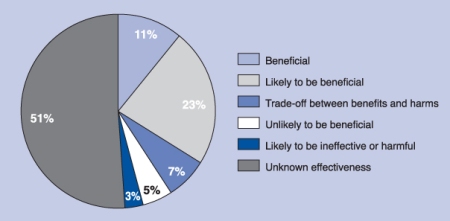
51% of treatments rated by the BMJ group’s “Clinical Evidence” are of “unknown effectiveness”
Myth 5
Objective findings are of value, and subjective reports are value-less
Health is a lived experience. Only a person can report that experience. To dismiss the patient’s narrative is bad medicine.
Posted in from the consulting room, health | Leave a Comment »
Walking around the ochre forest recently, I noticed one of the rocks looked like a face.

Having noticed this face, it then seemed there were faces in the rocks everywhere….


Posted in from the dark room, photography | 4 Comments »
-

This work is licensed under a Creative Commons Attribution-Noncommercial-No Derivative Works 2.5 UK: Scotland License. -
Join 2,047 other subscribers
Top Posts
- Scotland's Chief Medical Officer on the importance of compassion
- The dynamic, flowing, rippling story of YOU
- Life is living you
- Maslow's hierarchy of murder
- Separate and connected, the heart of opposites
- Scheler's hierarchy
- The desire to fly
- Iris
- Homeopathy
- Evidence based medicine....with the human beings stripped out
Categories
- art
- books
- creativity
- education
- from the consulting room
- from the dark room
- from the living room
- from the music room
- from the reading room
- from the viewing room
- health
- humour
- life
- movies
- music
- narrative
- neuroscience
- perception
- personal growth
- philosophy
- photography
- psychology
- science
- Uncategorized
- video
- writing
Pages
Meta
Category cloud
Commenting Policy
Archives
- October 2026
- July 2026
- June 2026
- May 2026
- April 2026
- March 2026
- February 2026
- December 2025
- November 2025
- October 2025
- September 2025
- July 2025
- June 2025
- May 2025
- April 2025
- March 2025
- February 2025
- January 2025
- December 2024
- November 2024
- October 2024
- September 2024
- August 2024
- July 2024
- June 2024
- May 2024
- April 2024
- March 2024
- February 2024
- January 2024
- May 2023
- April 2023
- March 2023
- February 2023
- January 2023
- December 2022
- November 2022
- October 2022
- September 2022
- August 2022
- July 2022
- June 2022
- May 2022
- April 2022
- March 2022
- February 2022
- January 2022
- December 2021
- November 2021
- October 2021
- September 2021
- August 2021
- July 2021
- June 2021
- May 2021
- April 2021
- March 2021
- February 2021
- January 2021
- December 2020
- November 2020
- October 2020
- September 2020
- August 2020
- July 2020
- June 2020
- May 2020
- April 2020
- March 2020
- February 2020
- January 2020
- December 2019
- November 2019
- October 2019
- September 2019
- August 2019
- July 2019
- June 2019
- May 2019
- April 2019
- March 2019
- February 2019
- January 2019
- January 2018
- June 2017
- May 2017
- April 2017
- March 2017
- February 2017
- January 2017
- December 2016
- November 2016
- October 2016
- September 2016
- August 2016
- July 2016
- June 2016
- May 2016
- April 2016
- March 2016
- February 2016
- January 2016
- December 2015
- November 2015
- October 2015
- September 2015
- August 2015
- July 2015
- June 2015
- May 2015
- April 2015
- March 2015
- February 2015
- January 2015
- December 2014
- November 2014
- October 2014
- September 2014
- August 2014
- July 2014
- June 2014
- May 2014
- April 2014
- March 2014
- February 2014
- January 2014
- December 2013
- November 2013
- October 2013
- September 2013
- August 2013
- July 2013
- June 2013
- May 2013
- April 2013
- March 2013
- February 2013
- January 2013
- December 2012
- November 2012
- October 2012
- September 2012
- August 2012
- July 2012
- June 2012
- May 2012
- April 2012
- March 2012
- February 2012
- January 2012
- December 2011
- November 2011
- October 2011
- September 2011
- August 2011
- July 2011
- June 2011
- May 2011
- April 2011
- March 2011
- February 2011
- January 2011
- December 2010
- November 2010
- October 2010
- September 2010
- August 2010
- July 2010
- June 2010
- May 2010
- April 2010
- March 2010
- February 2010
- January 2010
- December 2009
- November 2009
- October 2009
- September 2009
- August 2009
- July 2009
- June 2009
- May 2009
- April 2009
- March 2009
- February 2009
- January 2009
- December 2008
- November 2008
- October 2008
- September 2008
- August 2008
- July 2008
- June 2008
- May 2008
- April 2008
- March 2008
- February 2008
- January 2008
- December 2007
- November 2007
- October 2007
- September 2007
- August 2007
- July 2007
- June 2007
- May 2007
- April 2007
- March 2007

