As the sun set over Tokyo I snapped this photo of the coppery-reddish sunlight illuminating this office block. It looked like a massive silicon chip or computer motherboard and, somehow, I thought that was really apt.

As the sun set over Tokyo I snapped this photo of the coppery-reddish sunlight illuminating this office block. It looked like a massive silicon chip or computer motherboard and, somehow, I thought that was really apt.
Posted in from the dark room, photography | 2 Comments »
I looked out of the window of my 18th floor hotel room in Tokyo and saw these guys cleaning the windows.
I loved the glass, the reflections and the sight of the two men perched up there…..I wonder how long it takes them to clean ALL those windows?

Posted in from the dark room, photography | 2 Comments »
Wow! This could be one of the best talks I’ve ever heard. Randy Pausch is a computer science professor at Carnegie Mellon. They run a lecture series entitled “The Last Lecture” where a professor imagines what he’d say if he only had one lecture left to give before he died. Randy Pausch was diagnosed with terminal pancreatic cancer not long before giving this lecture.
He called the lecture “Really Achieving your Childhood Dreams”. It’s funny, it’s inspiring and it’s deeply moving. Here is the video of the lecture. It runs for just over an hour, so I urge you to sit down, relax and watch it through. The hour will fly past, I promise you. And you’ll be SO glad you took the time to watch it.
If you’ve been as impressed by this as I was, you can find out a lot more here.
Here’s a man who knows what it is to be a hero, not a zombie……..
Posted in from the viewing room, life, personal growth, video | 4 Comments »
There has been an accepted wisdom in the management of diabetes. Diabetes, as you probably know is a disease which presents with abnormally high levels of sugar in the blood. It’s actually a complex disease and involves much more than sugar levels but doctors, dietiticians and other experts have always worked on the premise that if you can “normalise” the patient’s blood sugar level, then you’ll reduce the risks they have of the serious harms that come with this disease. One of the most serious potential harms is death from heart disease. Now a study which has run for four years has come up with a totally surprising result.
Researchers took people who have “Type 2” diabetes (by far the commonest form of diabetes, and not the kind that usually required insulin treatment – that’s the kind that affects younger people mainly) and they randomly assigned them to different groups. The study is looking at management of sugar, cholesterol and blood pressure. The groups studied for sugar control were divided into an “intensive” control group and a “less intense” control group. The former group has had diet and drugs to try to maintain a blood sugar level the same as that found in people who don’t have diabetes. Everyone expected that the less well controlled group would suffer more heart disease but the study has just been stopped because so many more people in the “intensive” control group have died from heart disease than in the less well controlled group. This is totally contrary to expectations, and, so far, nobody has come up with an explanation.
The researchers are at pains to say that diabetics shouldn’t give up their drugs because we don’t yet understand what’s going on here and there is still clear evidence that blood sugar levels which go sky high pose a serious immediate risk to health.
Here’s the statement which really struck me though –
Clearly, people without diabetes are different from people who have diabetes and get their blood sugar low.
I suspect the answer to this puzzle will be found when that conclusion is taken on board. Human beings are just not like machines, and the idea that health can be achieved by managing to control the level of a single particular component of the body within an artificially set of “norms” is misguided. You don’t cure diabetes by assuming the only difference between a diabetic and a person without diabetes is the level of the blood sugar.
This is an excellent example of why we need to understand health and disease from a complexity perspective rather than a simplistic, reductionist one.
Posted in from the consulting room, health | 3 Comments »
I lived in Edinburgh both as a medical student and as a general practitioner for a couple of decades. One of my most favourite places in the world is in Edinburgh – The Royal Botanic Gardens. The gardens are pretty extensive and you can see something different every single time you go. I used to go several times a week when I lived close by. Click here and you’ll see a satellite photo of the gardens to give you an idea of their scale. Whenever I had visitors come to stay for a few days, I’d take them to “the Botanics”.
So one day I took two Dutch doctor friends of mine for a visit to the gardens. Like me, they specialise in homeopathic medicine and as we walked around the gardens they were telling me about a homeopathic medicine prepared from the Diospyros kaki tree which survived the nuclear blast in Nagasaki. They’d had some experience using it in helping patients to recover from severe shocks – specifically patients with either Post Traumatic Stress Disorder, or with cancer.
[NB – this is NOT a cure for cancer! Note my colleagues were saying it was of use in helping a patient to recover particularly from a psychological trauma. Homeopathic treatment is not aimed at pathology, the intention is to stimulate the normal repair and recovery processes of a human being, whatever the actual diagnosis. It can be a useful adjunct to treatments designed to deal with any pathologies, but if there is an improvement in the disease, then that improvement is due to the stimulation of self-healing]
Back to my story……….well, I had never heard before that any tree had withstood the blast in Nagasaki but apparently one did. It was a Japanese Persimmon tree (Diospyros kaki), one of the Ebony family of trees. The particular Nagasaki specimen has had cuttings taken and sent all around the world to be planted and nurtured as a “peace tree”. We chatted as we walked over the bridge and into a copse of trees.

What does this Diospyros kaki tree look like I asked my friend. Well, she said, it looks quite like that tree over there and pointed to the nearest tree to where we were standing.

Let’s go and take a closer look I suggested and used my usual technique for identifying trees in the Botanics – I looked at the label!
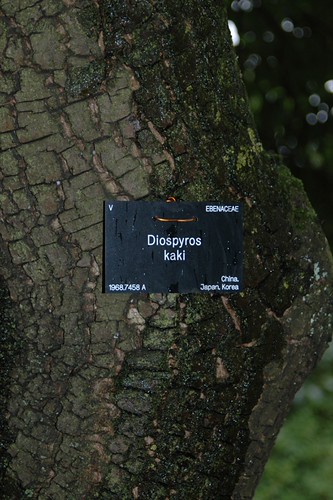
Well! We were stunned! Of all the trees in the Botanics what on earth were the chances that we’d be standing next to the one example in the gardens of the particular tree we were discussing?!
My Dutch friend said, “I don’t know what you believe about how the world works, Bob, but I’m going to send you a sample of the remedy prepared from the kaki tree.
Before I tell you the next part of the story, have a look at the bark of this tree.

You begin to have an idea why this particular species managed to withstand the nuclear blast. Still, for any tree to withstand it was quite amazing. Diospyros kaki means fruit of the gods and this tree is recognised as highly significant in Japan, the kaki fruits being placed in Shinto shrines. Here’s the fruit at an early stage of development –

My colleague was as good as her word and the following week two vials of the homeopathic remedy arrived for me at the dispensary in Glasgow Homeopathic Hospital.
The following day I had a new patient, a young woman whose recurrent breast cancer disease had recently been described by the oncologists as terminal and who had been told she had very few weeks left to live. She was suffering from nightmares and sleeplessness which none of the sedatives she’d been prescribed had helped and she wanted to try a homeopathic medicine. I’m not going to give any more detail than that here but suffice it to say, I gave her the Diospyros kaki remedy and her sleep immediately returned to normal. In fact, more startling than that, she went on to experience an improvement in her energy and well-being and she went on to live for another couple of years. In those two years she stopped her career, trained in another area altogether, and worked successfully in her new field for a few months before the cancer overwhelmed her and she died.
I’ve used this remedy a few times since in similar circumstances. It’s one of the remedies which really makes me think about our basic concepts of health and healing. It does not cure cancers, but in the right circumstances, in my very small experience with this, it can help a patient cope, and, more than that, even to grow in the presence of severe disease.
[Let me just finish this with a short paragraph about the homeopathic method, because this, I think, is an amazing story. However, I want to make very clear that not only is this not a cure for cancer, but it’s not the relevant medicine for just anyone who has cancer. Every homeopathic prescription is individualised on the basis of the patient’s unique personal story, taking into consideration the disease, the person who has the disease, and the contexts of their life. The patients for whom I’ve prescribed this kaki remedy, and who report that they benefited from it, have all been strikingly remarkable people – pragmatically positive, creative and caring individuals – who share a number of characteristic features]
Posted in health | 6 Comments »
Maybe, like me, you have a collection of “significant” books. By that, I mean books which had a big impact on the way you think, or the way you understand life. I’ve written about some of those books here already, but here’s another one which I read a few years ago. Hans-Georg Gadamer‘s “The Enigma of Health: The Art of Healing in a Scientific Age” is a collection of essays by this professor of hermeneutics (I know, I had to look it up in a dictionary too, but, trust me, this man had a brilliant mind!)
Gadamer died in 2002, and while I was visiting Tokyo, a copy of the Japan Times slid under my hotel room door early one morning, included an obituary about him. I’d never heard of him, but it’s amazing what you’ll read in the wee small hours in a foreign country when your body and your head are still half a day away in your home town! I was completely fascinated with what I read and his thinking about health really captured my imagination so I went online and ordered up “The Enigma of Health” from Amazon. By the time I got back home it was waiting for me. Let me share a few quotes with you. I wrote them down in my Moleskine (as I do!)
Although health is naturally the goal of the doctor’s activity, it is not actually ‘made’ by the doctor.
I make this point with every new patient I see. It’s the big unspoken truth about medical practice. Doctors’ treatments might reduce or remove a pathology, might even redress an inner imbalance, but they don’t cure – only the body does that. He says more about here –
Yet the goal of the art of medicine is to heal the patient and it is clear that healing does not lie within the jurisdiction of the doctor but rather of nature. Doctors know that they are only in a position to provide ancillary help to nature.
Franklin put it another way when he said “God heals and the doctor takes the fees”
I often ask medical students to tell me the answer to this – if a patient with a urinary tract infection gives a urine sample which grows bacteria which the lab shows are sensitive to a particular antibiotic and the patient is prescribed that antibiotic, what will the antibiotic do? The ones who don’t think carefully say the antibiotic will cure the infection. It won’t. It’ll kill the bugs. That’s it. The inflamed bladder wall, which might even be bleeding from the effects of the infection will be restored completely by the body’s repair processes. The healing is natural. The antibiotic only removes the offending bug to let the healing system do its job. This might seem like nit-picking, but it isn’t. It involves a profound change in thinking. Doctors aren’t gods. At best they assist healing and all healing is a natural process.
…the doctor’s power of persuasion as well as the trust and the co-operation of the patient constitute essential therapeutic factors which belong to a wholly different dimension than that of the physico-chemical influences of medications upon the organism or of ‘medical intervention’.
There are some who think that health and illness can be understood in purely physical terms and that treatments can be understood to work, or not work, on the basis of their physico-chemical effects. That’s a limited way of thinking. Healing involves more than that, and may not even involve any physico-chemical intervention at all. Those who think medicine can be reduced to a science (as opposed to a science and an art) rely on measurements of phenomena. Gadamer is brilliant about this –
….modern science has come to regard the results of such measuring procedures as the real facts which it must seek to order and collect. But the data provided in this way only reflect conventionally established criteria brought to the phenomena from without. They are always our own criteria which we impose on the thing we wish to measure.
I believe it was Max Planck who said “facts are what can be measured”. Well, reality cannot be reduced to facts. The tendency to reduce understanding to physical measurements is accompanied by a concept of health as some kind of product – an end point or state which can be known and measured. Gadamer argues instead –
…physicians do not simply create a product when they succeed in healing someone. Rather, health depends on many different factors and the final goal is not so much regaining health itself as enabling patients once again to enjoy the role they had previously fulfilled in their everyday lives.
This clear statement suggests to us that health is an experience and it’s an experience which in its detail will be different for every person depending on the characteristics and environments of their lives. Later in his essays Gadamer considers how far from being a measurable product, health is really what is experienced when illness is not present or goes away. This is the “enigma” of health – that we only know it by its absence. Consider the fingers of your right hand. Right now you’re not really aware of them. Trap them in a car door and then you instantly become aware of them. You get the idea?
This post could go on forever! I’ll stop, but suffice it to say this is a deeply thoughtful consideration of our concepts of health, illness and healing.
Posted in books, from the reading room, health, philosophy | 8 Comments »
Sometimes these days, with the dominant biomedical model of health and illness it can seem like people don’t actually matter. The individual stories of patients are dismissed as anecdotes and treatments are divided into one of two categories “proven” or “unproven” on the basis of statistical analyses of clinical trials (experiments on pre-selected groups of volunteers). The implication is that what works in health care is the intervention, be that a drug or a surgical procedure. Who the patient is, and who the doctor is, seems to be of secondary, or, sadly frequently, of no importance at all.
Yet, if you are ever unwell, I bet it matters to you who you consult and how they behave. I think we all want to consult a doctor who, frankly, gives a damn! I know I do. How many of us would seek a health care system based on dispensing machines which dole out drugs after you input your symptoms?
Amazingly, this idea of the importance of the person in medicine is having to be fought for. So, it was with great interest that I read a review of a book in the BMJ this week. The book is “When Doctors become Patients” by Robert Klitzman (ISBN 978 0 19 532767 0). The author is a psychiatrist who became depressed and was so shaken by his experience of becoming a patient that he set about interviewing other doctors who had become patients too.
Time and again Klitzman found that becoming a patient transformed the doctors’ views (and of practice) of medicine.
Non-specific complaints, side effects such as weight gain and fatigue, fear, humiliation, and spirituality acquired new significance. Struggling to adhere to burdensome schedules, they became less draconian about poor adherence to treatment. In presenting medical information, they became aware of the importance of framing the information sensitively.
I guess this is not a surprise. You’d expect experience to change your views. However, you’ll probably find it more than a little shocking that the doctors needed the illness experience to figure this stuff out. We’re clearly missing something in medical education.
The phrase that really hit me between the eyes though was this –
In choosing their own doctor, most interviewees preferred bedside manner over technical skill.
It’s what I’ve always felt personally. I’ve always felt that what’s really important is that you find a person who cares, listens and puts your interests at the heart of the consultation. I take the technical skill bit as kind of a given. ALL doctors should have the technical skills they need to do the job and the processes of continuing education, annual appraisal and the coming revalidation procedures of the General Medical Council are all designed to ensure that. But what about the human bit? What about the importance of the person? We need to make this case more clearly. Too often, the technical skills are attended to, and then we stop.
Finally, the BMJ reviewer concludes –
Klitzman, like Gawande and Groopman, is part of a contemporary group of reflective doctors who, through their writings, contribute to the less palpable but nevertheless crucial moral, social, and experiential dimensions of medicine.
We need more of this. Maybe we are building a body of knowledge and opinion but we’re sadly lacking in the areas of research into the “experiential dimensions of medicine” and in providing medical education which considers this as of equal importance to the knowledge of drugs, trials and the technical skills required to do surgical procedures.
Posted in education, from the consulting room, from the reading room, health | 8 Comments »
Pick the Brain has a great post about teaching and learning. It’s called The Movie Director’s Guide to Effective Teaching. In it, Victor Stachura, the author refers to William Glasser’s theories. Well, this is new to me. I’ve never heard of William Glasser. If you have, what do you think about his ideas and his suggestions? There’s a William Glasser Institute and my little browsing there so far has interested me. I want to find out more. Victor Stachura highlights something he read about learning and teaching from studying William Glasser –
“We Learn . . .
10% of what we read
20% of what we hear
30% of what we see
50% of what we see and hear
70% of what we discuss
80% of what we experience
95% of what we teach others.”
I don’t know about you, but that seems intuitively correct to me. I might take issue with the actual figures used and I also think it doesn’t allow for the processing preferences highlighted from the work of things like the NLP approach which helps us to understand that we are different and some process auditory information better than others, some visual information, and yet others kinesthetic information. However, with that in brackets, the overall thrust of this seems right.
If you are involved in teaching this is an important observation and if you want to learn, it’s equally important. It certainly highlights the importance of what is known as active learning. Sitting attempting to learn passively by just listening or just watching something isn’t easy. But when you have something to read, something to see and to hear, and then you discuss it, you will learn so much more. The challenge beyond that I think is to experience and to teach. I don’t know if you can experience much in a classroom, can you? Don’t you need to get out and actually live what you’re learning? I certainly think that’s true of medical training. Can’t see how you become a good doctor without actually doing it! That last step of teaching so works for me! I find that almost every time I teach, not only in the preparation stage, but also in the delivery, I learn something new myself.
I ran a training day based around characters in Lord of the Rings last week and not only did it convince me that I’ve learned more about my subject than ever, but the feedback from the students was about the best I’ve ever had. The day involved film clips from the Lord of the Rings movies and various small and plenary discussion groups. It was active and interactive all day long.
If you teach, how much do you use movie clips? I use them a lot. I find that not only do they combine the auditory and visual stimulation we need, but they are great for getting discussion going and, fundamentally, they provide the group with an experience – usually something involving both thought and emotion.
To return to the blog post which has seeded this one – the main focus of the piece refers to the “primacy-recency” phenomenon – the finding that we remember the first and last things in a sequence better than the things in the middle. Victor Stachura recommends we deal with this in teaching not just by putting important information at the beginning and the end, but by breaking up the lecture every 15 minutes with some audience exercise, or discussion, to keep attention from waning. He points out that good movie directors know this and change the pace of the movie frequently to achieve a similar effect.
Posted in creativity, education, from the reading room | 4 Comments »
Des Spence highlighted the rather selective way statistics are used to support promotion of drug treatments to prevent disease. In particular, he has focussed on the heavy promotion of statins to control cholesterol levels in the blood. Several doctors have written in to the BMJ in response to this article.
Malcolm Kendrick, who has written The Great Cholesterol Con, says (in referring to the statistic that to prevent one death a year you have to treat 700 people)
let us assume that you do gain one entire extra year of life for every 700 years of taking a statin. Then, clearly, if you treat for 700 years you will create one added life year.
Using this (overoptimistic) figure means that if you treated someone for 30 years you can expect to provide them with 30/700 added years of life. This is 15.64 days, or, a shade over two weeks.
In short, if a 50 year old man asked you how much longer he could expect to live if he took a statin for 30 years you can inform him “just over two weeks—max.”
(it’s also worth watching his exploration of what DOES cause heart disease – here it is……………it’s for a medical audience so is pretty technical!)
Peter Davies asks for inclusion of statistics of relevance to the patient who will actually be taking the medicine –
Any trial generates four summary numbers: relative risk reduction, absolute risk reduction, number needed to treat, and personal probability of benefit.
Each number is useful and gives some information, but no one number gives us the whole truth about the information. Using one figure on its own, particularly the relative risk reduction above all others, is very risky.
Each figure takes a different viewpoint on the evidence. The relative risk reduction is a public health (area wide) prediction.
The absolute risk reduction puts the starting risk back into the frame.
The number needed to treat measures the workload needed to achieve the relative risk reduction. It’s the beginning of health economics.
The personal probability of benefit answers the patient’s question, “What’s in this for me?”
Peter Davies has written an excellent piece in the studentBMJ about this problem with interpreting the value of “evidence”, with this excellent conclusion –
Acknowledging the various perspectives on data will lead us away from simple statements such as “this works” and “the evidence shows” towards more specific statements of what works for whom and when. It leads us away from guidelines and back to intelligent negotiation, to distinguish treatment of an established disease from treatment for reducing the risk of a disease, whether as primary or secondary prevention. The gradual reclassification of risk factors as diseases, “risk factoritis,” has lead to confusion over applying evidence derived from populations to individual patients who may not need or want our help.
The parties involved all need to admit that they know part of the truth, but never the whole truth—whether about the evidence, the patient, or the disease. The next time anyone tells you that “the evidence shows that this treatment works,” ask, “From what perspective does this seem to work?” If they do not understand your question, then they do not fully understand the evidence.
It’s good to see this discussion in a mainstream medical journal. There are some hard questions about the direction of medicine which need to be asked. The reliance on medication for a “healthier” life is one of them.
Posted in health | 10 Comments »
The people who come to see us bring us their stories. They hope they tell them well enough so that we understand the truth of their lives. They hope we know how to interpret their stories correctly. We have to remember that what we hear is their story.
Robert Coles in “The Call of Stories”.
Stories have always fascinated me. I love them. Every day when I sit in my consulting room patients tell me the most amazing, fascinating and unique stories. As a medical student I was taught how to “take a history” – I hate that phrase actually – who’s doing the “taking” and what exactly are they “taking” and from whom? Doesn’t seem right to me at all. Instead I prefer teaching medical students how to listen to patients’ stories. However, the point is that this is the beginning of all diagnosis. To a certain extent listening to the patient’s story is a diminished art. There’s an over-reliance on technology and a lot of doctors just don’t seem to be able to make a diagnosis without a test these days. Diagnosis is a form of understanding. It’s a process of trying to make sense of somebody’s experience.
If stories are so important in clinical practice, then how can I learn to handle them better I wondered? There is a developing area of medicine known as “narrative-based practice”, with associated “narrative-based research” methodologies, but materially-orientated, reductionist scientists look down on narrative. They prefer data. So, when I started to study narrative (which, technically is the story AND the way that story is told), I couldn’t find much work from a scientific perspective. I had to turn to the humanities.
One of the books which I really love in this area of study is “On Stories” by Richard Kearney (ISBN 9-780415-247986). Not only is it a fabulous exploration of the place of story in human life, but it’s written completely beautifully. Richard Kearney is a philosopher but he’s also a magnificent writer. This one book taught me more about the importance of story than any other.
Telling stories is as basic to human beings as eating. More so, in fact, for while food makes us live, stories are what make our lives worth living.
This sets stories at the heart of human existence – not optional, but essential.
Aristotle says in “Poetics” that storytelling is what gives us a shareable world.
The key word there is “shareable”. It’s through the use of story that we communicate our subjective experience and its through the sharing of subjective experience that we connect, and identify with others.
Without this transition from nature to narrative, from time suffered to time enacted and enunciated, it is debatable whether a merely biological life could ever be considered a truly human one.
Beautifully expressed. Sets narrative at the heart of what it means to be human and stands it against those who would take a materialistic view of life which they claim can be reduced to data sets and DNA.
Every life is in search of a narrative. We all seek, willy-nilly, to introduce some kind of concord into the everyday discord.
This is one of my favourite lines in the whole book. This is exactly the power of story – it enables us to “get a handle on” life, to bring some kind of order out of chaos.
What does Richard Kearney mean by story then? Well, I’ll finish this post with two more quotes from his book which make it very clear and very simple.
When someone asks you who you are, you tell your story. That is, you recount your present condition in the light of past memories and future anticipations.
This shows that story collapses time, bringing the past and the future into the present. Story telling requires memory, imagination and expression.
Every story requires –
a teller, a tale, something told about, and a recipient of the tale.
Nice and simple, but what profundity lies in there. For every story, there is a unique human being doing the telling, there is the story itself and its subject matter, and, very importantly there’s the recipient – the listener or the reader. Story is, as Aristotle said, a way of creating a shareable world. That’s the greatest potential of blogs, I reckon. By sharing our stories we create a shared world. Yes, sure, stories can divide as well as connect, but without stories, there is no potential for connection, no potential for compassion and no potential for the creation of a meaning-full, and better world.
Posted in books, creativity, from the reading room, life, narrative, philosophy | 39 Comments »


