Feeds:
Posts
Comments

Creativity and art

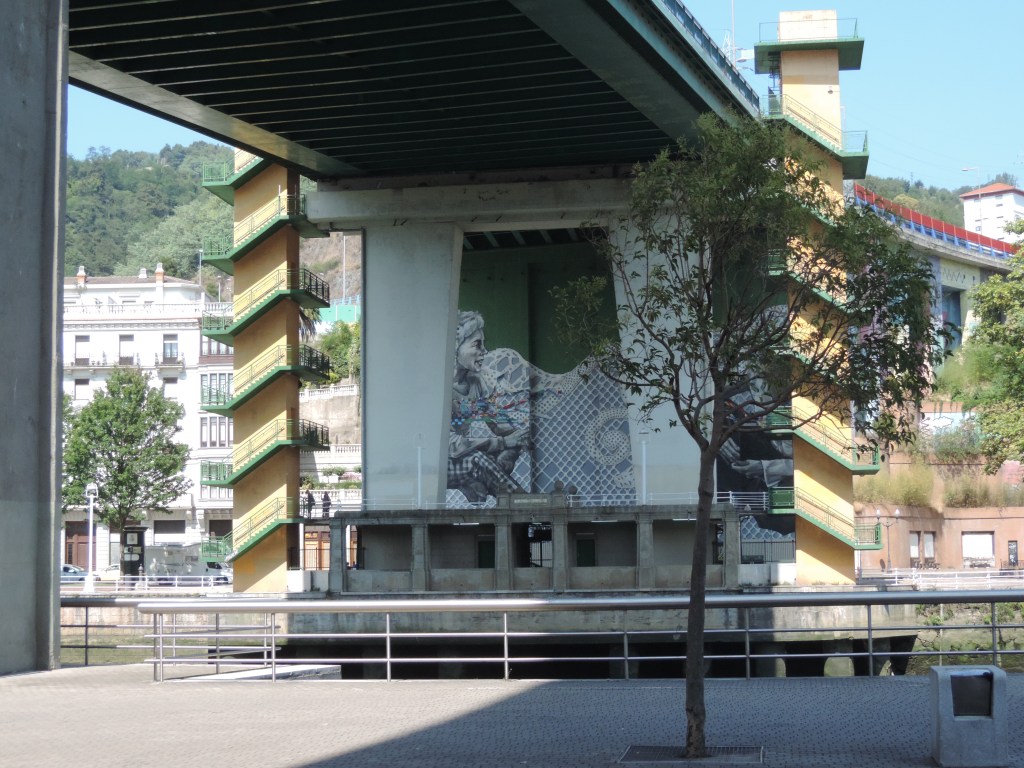
The dominant mind set for a long time has been a materialist rationalist one. In this way of thinking roads, flyovers and bridges are built right through the middle of cities “to enable vehicles to cross the city quickly and easily”. Whilst this might make sense logically and functionally it often dehumanises living spaces, creating ugly “redundant” areas which degrade the lived environment.

Here’s a photo of some beautiful wall art painted under an urban roadway in the city of Bilbao. I suppose a materialist functionalist urban planner would say “what’s the point?” But I think art like this is beautiful and is a great example of that human characteristic of creativity and artistic expression.

I’m greatly saddened to hear that universities are closing down Humanities departments and that one Tory leadership candidate has said he’ll close any university course which doesn’t lead to graduates making a significant income within six months of leaving university.

These developments seem barbaric to me. They deny what it is to be fully human. If we reduce education to training for jobs with salaries of a certain size, and if we make our decisions about the lived environment on the basis of short term materialist goals then we will experience more and more dehumanisation of society.

Can’t we have a richer, more beautiful, more compassionate view of what it is to be human? I think we need to shift our emphasis away from this narrow, limited agenda if we’re going to create a better world which will enable more people to do more than survive – to enable them to grow and to flourish.

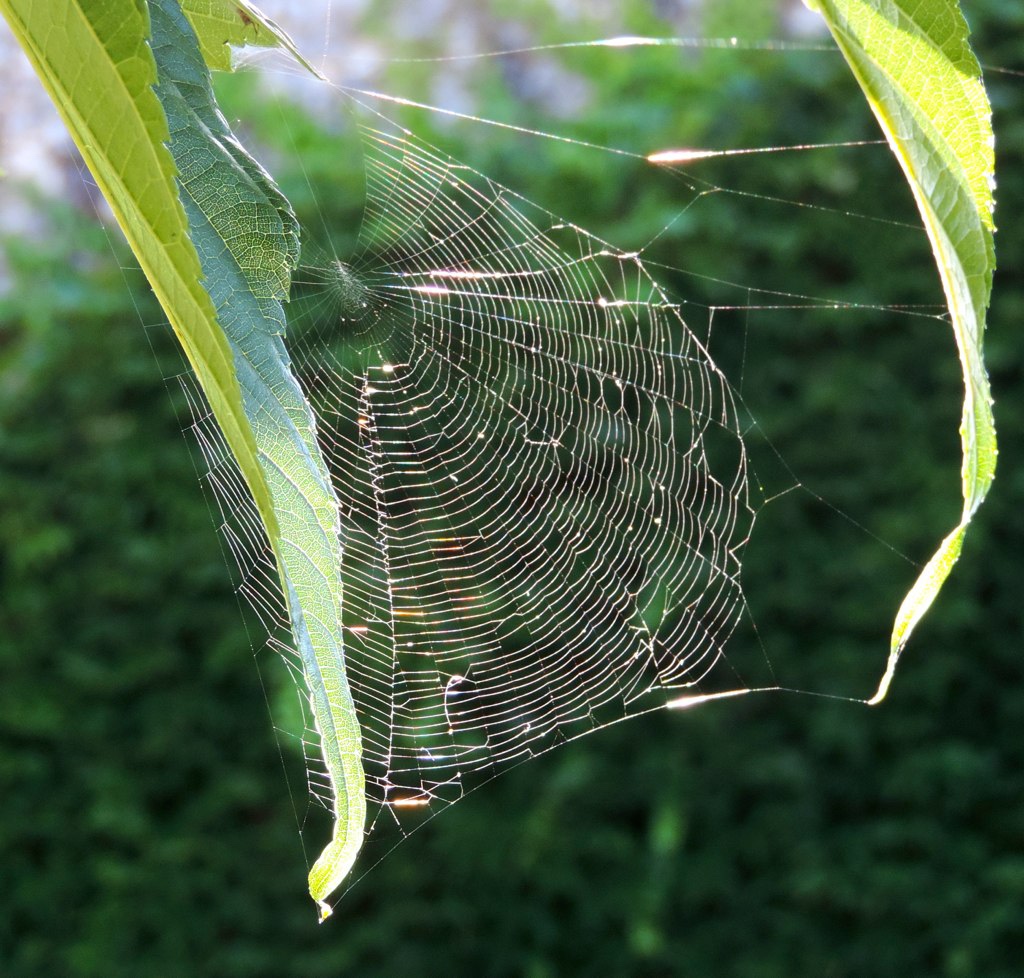
I find webs fascinating. It astonishes me that a single spider can spin such a creation with her own skill and with material produced by her own body. I’m especially drawn to the webs which are bejewelled with water droplets. But this one is quite different from all of those.

You might have to look more carefully, or to zoom in, but you can see rainbows of colour in this web. It’s acting as a kind of prism or crystal and revealing the colour spectrum which makes up the light of our world.

It’s a colour catcher. Or a colour revealer. Or a light catcher and revealer.

Light is such a fundamental part of life but for much of the time we’re not that aware of it. Perhaps we are most aware of it when it’s not there…when we are in the dark. Or most aware of it when a small amount of it appears in the dark, the way we can spot a lit window or a car’s headlights from far, far away, at night.

Or perhaps we become aware of it when it’s intense….when we have to shade or close our eyes, put on dark glasses, or pull down a visor.

But mostly I think we become aware of light when it changes, when a cloud moves in front of, or away from, the Sun. We are instinctively drawn to sunsets and sunrises where the changing light is most dramatic and often most colourful.

There are other times we are aware of the light, times associated with particular places. How many artists have sought out places such as towns on the coast in the South of France “because of the quality of the light”?

When are you most aware of the light? When and where?

And why not consciously notice the light somewhere today? Where did it catch your attention? Where did your attention catch the light?

Resilience

We are in the midst of historically high temperatures here in South West France. The ground is parched and cracked, the grass has turned brown and crispy, the water in the “source” is so low it’s no longer flowing over into the Roman aqueduct.

This week we have several days where the temperature reaches 38 degrees centigrade and there are restrictions on water usage. As you might imagine it’s hard, often impossible to keep plants in the garden alive in such circumstances.

Yet as I crossed the crackling grass yesterday I noticed a splash of purple and green. I stopped, knelt down, and took this photo.

As a Scot, it made me a little proud to recognise this hardy wee plant was a thistle. And I was delighted to see it not just grow but flourish in such adversity.

Seeing this one plant reminded me of the astonishing powers of resilience and adaptation which are so characteristic of Life. It’s like when you see a flowering weed growing in a tiny crack in the pavement. You stop and wonder at its opportunism, at how it can turn so little in such adverse circumstances into something beautiful.

It also reminded me how this world is complex and diverse. We should always be wary of sweeping generalisations which exclude the individual experiences. Different plants respond to similar conditions differently.

It’s the same for human beings. Even in the same time and place we all respond differently. Every one of us is unique.

Morning dew

Look at these beautiful sparkling drops of water adorning this flower like jewels. This is morning dew and it fascinates me.

Where do these water droplets come from? They just appear “out of thin air”. Isn’t that a strange phrase? What’s “thin” about air? Anyway, the point is, all the water which is sparkling now was invisible in the air until it appeared on the plant. In other words, it was already present in the air. It was just invisible.

It’s quite magical isn’t it? It enchants me, delights me and sparks my natural reaction of wonder. It gets me wondering about how the everyday phenomena of life come into being, exist for a short while, then disappear again. Because within a short period of time all these droplets will evaporate. The water will become invisible again.

It fascinates me that modern physics has moved on from the atomistic model of material being made up of indivisible solid pieces – atoms which join together to make molecules which join together to create unconnected solid objects – to a concept of energy fields which vibrate. Every atom is an interaction of energy fields flickering in and out of existence.

As Physicist, Carlo Rovelli, puts it, in his “Reality is Not What it Seems”…..

“It is only in interactions that nature draws the world.”

“The world of quantum mechanics is not a world of objects: it is a world of events.”

Isn’t that beautiful?

As I stumble across this sparkling plant I’m privileged to be participating in an event, not standing “outside” gazing at an “object”.

Celtic knots

I was born in Scotland and lived there for the first sixty years of my life. So these Celtic designs are very, very familiar to me. They aren’t quite a symbol in the way a Christian crucifix or the Asian yin yang symbol, but they have the power of a symbol for me. They are more than just a design or a pattern.

For me they convey two fundamental characteristics of reality – interconnectedness and flow.

You can’t see a start or a finish in any of these typical Celtic motifs – whether you look at a small one, such as the three loop structure on the horizontal arms of this cross, or at the larger ones which cover the uprights. You can start anywhere, follow with your eyes, or trace with a finger, and you’ll eventually end up back where you started.

This demonstrates a third feature of reality. The constant flow along a completely interconnected system produces a rhythm of cycles, or of seasons. It inspires me to think of both dynamic complexity and non-linearity, both of which are key to understanding living creatures.

The smaller designs on this cross are three interwoven loops, and this motif of a triad is very, very common in Celtic art. In fact they have a special name – a triskele. Google that word and see how many variations there are.

I’m particularly fond of the triskele – it speaks to me of wholistic perspectives, of body, mind and spirit, something which is at the heart of my understanding of human beings and human health.

Be more natural

One of the most amazing, wonderful sights in the world is where you see the perfect co-evolution of two entirely different species – a particular bird and a particular flower. The perfectly shaped beak to get nectar out of a perfectly shaped flower.

This is one of Nature’s most important lessons – integration – the formation of mutually beneficial bonds. Both parties in the relationship benefit. They aren’t competing with each other.

Doctors often say their best teachers are there patients and I’d agree with that but before I encountered patients I was taught about the human body – the anatomy, physiology, biochemistry of the body – and there’s where I return to find my teacher – the human body.

The essence of a healthy body is integration – the well differentiated parts…..cells, organs and tissues, working in perfect harmony with each other through the creation of mutually beneficial bonds.

So here’s my question – why don’t we create our societies in the same way? The more we create mutually beneficial bonds with each other, the healthier we will all be.

Attractors

We are complex adaptive systems. So are all living organisms. So is every ecosystem. So is our planet. So is our universe.

One of the characteristic features of a complex adaptive system is an attractor. An attractor organises the flows which surround it, whether they be flows of energy or molecules.

Three kinds of attractors have been described. Point attractors, which look a bit like what you see in this photo. They are a single point of attraction, pulling everything around towards it, creating the impression of a drain, a hole, a dent, or a single magnetic pole. Loop attractors have two points, often polar opposites and whatever comes within their sphere of influence develops dual or oscillating states. The third kind is called a Strange or Chaos attractor. These have multiple interacting points of attraction creating immensely complex, even chaotic patterns within their domains.

Ok, this is an over simplification. You can probably read whole textbooks on complex systems and their attractors. However I’ve often found this to be a useful model for understanding some of the phenomena of Life, of health and of illness.

There’s no doubt that we, or parts of us, can get trapped going round and round the same circuit of habit again and again. Or we can experience swings back and forth from one pole to another, from highs to lows, from hyper to hypo, and back again. And from time to time we feel lost, trapped in chaos, unable to make sense of our experience or to escape it.

Understanding these patterns and, if possible, uncovering the events, experiences or traumas which created the attractors, helps us to break free, to move on, or to create our own more liberating, more joyful, more creative attractors to organise our lives around.

This photo reminds me that what I can see lying ahead of me is framed by my present position.

The future is full of potential. That potential is a multiplicity of possibilities. Which one will I choose to move towards? Which one will i realise?

However even though that future which I can glimpse contains a seeming infinity of possibilities, they are only a small portion of the whole.

What if I change my position? What becomes more obvious as I move forward? And what disappears out of sight?

We can’t change a future which doesn’t exist yet but we can change our perspective. We can change how, in this present moment, we frame what potential lies ahead.

I think we often get stuck in a certain frame, and that frame both colour and constrain our view of the future. So as we look ahead maybe fearing what might lie ahead, changing our present position, looking through a different frame can change that future completely.

I think we are at one of those times and places. We need to change our frame, need to see the world differently, if we are going to create a better future for us all. The competitive, consumerist, disconnected frame isn’t serving us well.

It’s time to shift from a left brain view of the world to a whole brain one.

Adapting

I read an interesting article yesterday on a French website. They discussed the lifestyle of the Spanish on the other side of the Pyrenees from Toulouse, posing the question, how might the French adapt their lifestyle in the light of climate change which is producing the record high temperatures we are experiencing in France just now.

They explored three areas I thought worth sharing – town/city design, work patterns and food.

In medieval towns streets were narrow and buildings were tall which means you can walk around those old towns in shade at any time of day. In wider streets, the Spanish often stretch colourful sheets of material from buildings on one side of the street to the other. That design produces shade and creates a celebratory feel to the city centre. This idea reminded me of visits to Kyoto where there are permanent shades fixed above the pavements and to Bologna with its long arched cloister style design of structure over some of the pavements.

I’ve also seen several articles recently which describe how tree lined streets in cities maintain much lower, more comfortable temperatures in the heat of summer.

The second area explored was lifestyle – particularly work patterns. In Spain shops close in the middle of the day then open again much later in the afternoon, remaining open much later in the evening. Spanish people are also much more likely to take a siesta in the heat of the day. I wonder how often we adjust our to do and task lists throughout the day to take the weather into account? Which leads to the next point….employment law which supports switching to more flexible work hours when the temperature is over 30 degrees.

Finally, the third area was food. Refreshing cold tomato soup (gazpacho) is very popular in the hot summer months, but Spain is also famous for tapas – those delicious mini-dishes which are ideal for hot weather – eat little and often is the advice.

Maybe you don’t live in a part of the world which is facing more, hotter days, but wherever you are I’m sure climate change is going to challenge us all to adapt, to make changes to our lifestyles and our lived, built environments.

The water of life

I have quite a few photos like this. They all show well worn, moss covered rocks with exactly this colour of water pouring over them.

I look at a photo like this and I see Life. I see flow. I see how the river is never the same twice yet remains the same river over hundreds of years. I see the co-existence Nature’s kingdoms. I see the co-creation of this present moment, overflowing with all we call the past….the experiences, events and memories which flow into the here and now from upstream. I see the river surging forward filled with potential, making its way towards an ocean, to dissolve into the salt waters, to be whipped up into waves and foam by the winds and lifted high into the sky by the Sun to form clouds. Clouds which will turn to rain again over the mountains and run fast back down paths just like this one.

I see Scotland. Because that’s where I took this photo and that’s where I have seen all the golden peaty water in the world. I know there must be other places to see water like this but I haven’t been to those other places.

But more than anything when I look at this photo I see the Life Force which surges through our bodies, yours and mine. The energy, the vibe, the living, beating web of existence which connects us, you and me. And every living organism on this glistening little planet.

Without this water of life, none of us would exist.