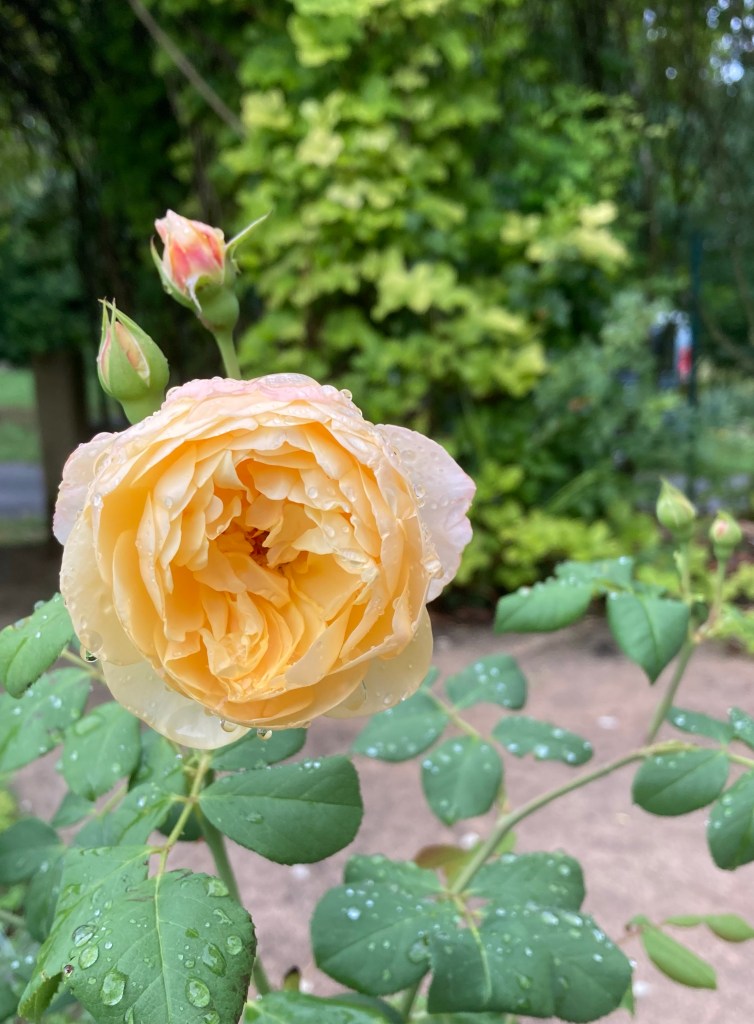
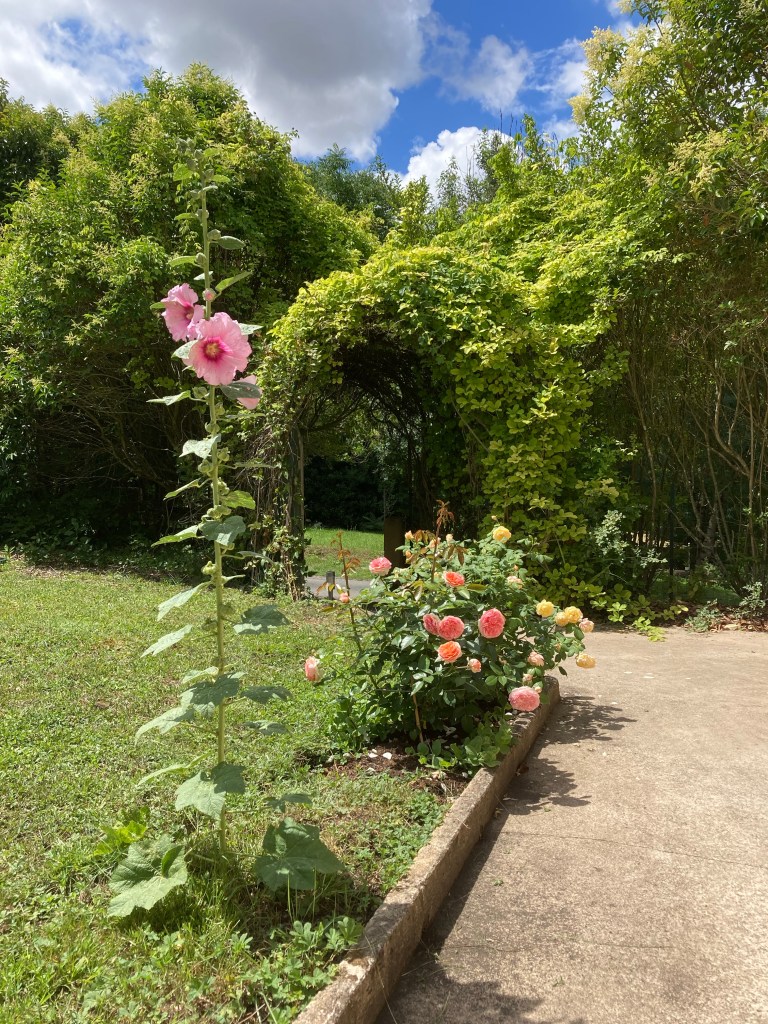
Maybe you’re familiar with The Little Prince and how he cares for his rose. Well this is my rose. I had to dig out a strip of grass and weeds along the border of the path, and here in the Charente Maritime the ground is very, very stony. My neighbour says his main garden tool for planting is a pick! We bought two roses, one each, and planted them next to each other just inside the entrance way.
That tall flower is a hollyhock, known as a Rose Trémière around here. I think they are astonishing and beautiful plants and mostly they grow where the seeds land. You see them everywhere in this part of the world. They go nicely with the roses don’t you think?
My experience of looking after a plant is very consistent with that of The Little Prince. It is based on the creation of an ongoing relationship. This rose is not the same as all the other roses in the garden centre. I don’t care for them the way I care for my rose.
Looking after plants is about nurturing. I can prepare the soil, feed the rose, water her, look out for for pests, but I don’t control her life, her growth or her flourishing. That reminds me of how I saw the practice of Medicine. As a doctor, I attended to patients, established a relationship of care and supported their recovery and growth. Medicine isn’t about control, it’s about care and nurture.
Every plant is unique. Every human is unique. And every relationship between a human and a plant is unique. It’s special.
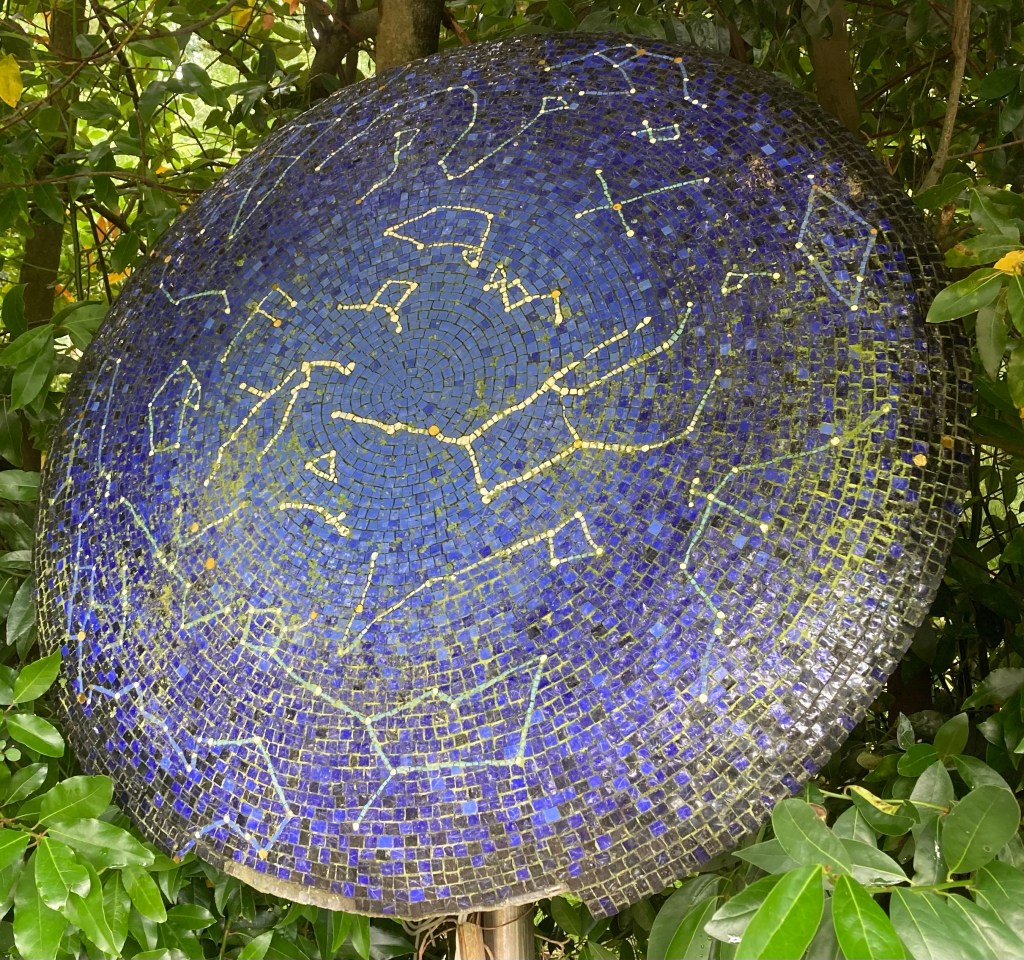
I stumbled across this beautiful mosaic in the gardens of the chateau at Dampierre-sur-Boutonne. Isn’t it glorious? What a work of art!
When I look at this I’m reminded of John Berger who wrote…
Those who first invented and then named the constellations were storytellers. Tracing an imaginary line between a cluster of stars gave them an image and an identity. The stars threaded on that line were like events threaded on a narrative. Imagining the constellations did not of course change the stars, nor did it change the black emptiness that surrounds them. What it changed was the way people read the night sky.
What Berger weaves together in this passage is how human beings use imagination to see patterns, tell stories about those patterns, then use those creative products of imagination to change the way we see and understand the universe.
I often think we underestimate the importance of imagination. It’s a real super power. Without it we wouldn’t have creativity, art, music, storytelling. We wouldn’t be able to solve problems, or to invent anything. We wouldn’t be able to understand other human beings because imagination is at the basis of empathy and compassion…the ability to put ourselves in someone else’s shoes.
This special use of imagination to weave together patterns and stories into maps changes how we perceive, and consequently, how we live, in this universe.
Of course, “the map is not the territory”, as Korzybski, the creator of “General Semantics” pointed out. But maps are lenses, filters, symbolic ways of presenting the world to us. And maps, clearly, are works of imagination.
That doesn’t make them “unreal”. I think that’s a common mistake we make….that what we imagine is unreal. Some of what we imagine is unreal, but we can’t access reality without imagination. Life, every day living, is a constantly creative act.
Here’s what I think is most important about all this. We are able, if we choose, to do two things….to become aware of the maps we use to live our daily lives (and to become aware of where those maps, those patterns and stories come from), and to create our own maps.
We can discover new patterns. We can make new patterns. We can listen to new stories. We can tell new stories.
We can become conscious co-creators of our universe.
We need to do that now. The old, dominant, world view isn’t working. We need a new one. Do you agree? Do you have an idea of what better patterns, stories and maps we could share?
Virginia Woolf’s favourite Montaigne quote came from his last essay…..
Life should be an aim unto itself, a purpose unto itself.
We are meaning seeking, and meaning creating organisms, we humans. We strive to make sense of our experiences and our life. We keep coming back to the idea of purpose…..what’s the purpose of my life? Why am I here? We will all find our own paths to the answers to those questions, but for Montaigne his path was not through religion or politics. It was through fully engaging with everyday life. This is consistent with my favourite French phrase – “L’émerveillement du quotidien” – which works as a touchstone in my own daily life. Roughly translated it means “the wonder of the every day”.
It continues to astonish me that the universe has created me and you, that we are the children of the stars, our whole beings emerging within this vast, interconnected web of subjects. Each one of us created only once, to live a unique and unrepeatable life. Only I, only you, can experience what we experience. Only you, only I, can express those experiences in our own, particular, personal and unique ways.
Sarah Bakewell concludes by saying the modern world could gain a lot from Montaigne’s sense of life.
It could use his sense of moderation, his love of sociability and courtesy, his suspension of judgement, and his subtle understanding of the psychological mechanisms involved in confrontation and conflict.
That’s a powerful conclusion. We could certainly do with a bit of moderation. Sometimes it seems to me the whole economic system we have created is based on greed and selfishness. The constant drive to consume more, to “grow” by ripping more out of the planet and destroying our natural homes strikes me as a kind of madness. Shouldn’t we be aiming at sustainability instead of increasing consumption? What’s the point of billionaires? They can’t even spend all the wealth they’ve grabbed. How sustainable is climate change? Yep, it’s way past time we needed a bit of moderation.
Sociability is such a key characteristic of healthy human life. We are social creatures. We don’t live in separate bubbles. We need each other. Ubuntu – I am because you are.
Courtesy – oh my goodness how much do we need more courtesy in our social and political discourse? Sometimes it feels as if social media is drowning in disrespect and hatred. How much more nourishing, more healthy, would exchanges and conversations be if they were based on courtesy and respect for difference?
There’s such a rush to judgement in our media and society, yet I find the only way to get to know another person and to understand them is by not judging them. Suspending judgement creates a space for compassion and tolerance, two qualities we need to have healthy relationships.
Montaigne lived through a time of great conflict and violence, thriving despite that by concentrating on the here and now, remaining open and welcoming to everyone, delighting in individual differences and staying full of curiosity and wonder every day. His humility and unceasing desire to understand himself and others underpins his writing and that delights me.
I don’t think of Montaigne as a hero but I find his essays an enormous inspiration. We shouldn’t try to be the same as Montaigne, we are, each of us, unique and different after all, but we’d have a better world if we all tried harder to understand ourselves and chose to live more consciously, with more wonder and more compassion.
I’ve enjoyed re-reading Sarah Bakewell’s “How to live”, and I hope you’ve enjoyed these last twenty posts where I’ve reflected on her twenty possible answers to that most fundamental of questions, which reminds me of the fabulous Mary Oliver poem, The Summer Day, which ends with the following lines….
Tell me, what is it you plan to do
with your one wild and precious life?
Montaigne suffered from kidney stones which made him seriously ill many times. There were no treatments for stones in those days. He had to bear with the pain until the stone passed. Remarkably he came to believe these repeated experiences improved his life. They were often followed by such profound relief that recovery was almost a “high” for him, but more than that the attacks taught him that we are all vulnerable and imperfect. They reminded him of his mortality.
All if this made him appreciate life all the more and developed his ability to accept whatever today might bring. Along with this acceptance came a profound belief in the ability of nature to cure us.
“Nature does everything for you, and there’s no need to trouble your head about anything.”
And
It is better to be moderate, modest, and a little vague. Nature will take care of the rest.
These are pretty challenging beliefs for we moderns. I’ve long held the view that the self-repairing, self-regulating and self-healing powers of the body are responsible for our recoveries and for our health. As a doctor it was my job to assist those natural processes. Sadly, pharmacological medicine rarely works directly with these systems. We seem to have developed a set of “anti” tools instead which act against whatever is happening in the body.
However, in my work, I didn’t just stand back and wait for Nature to do her work. Rather, I sought to understand the person and their illness, to acknowledge and support them, and to find ways to support or even enhance the processes of healing.
Some manage to take this thinking a step further and can find a benefit, find new strengths even, in their illnesses. A bit like the hero’s journey, the challenges brought by the disease are like obstacles which, when overcome, provide the “boons” which provoke development and flourishing. They ultimately increase and deepen self understanding. Montaigne was one who thought that way.
Learning to live, in the end, is learning to live with imperfection….and even embrace it.
There can be no really ambitious writing without an acceptance that other people will do what they like with your work, and change it almost beyond recognition.
Montaigne’s essays were edited and published in several different forms over the years, each publisher applying their own take on the text to present him and his writings in ways which were consistent with their own values and the particular fashions of the time. But he also had individuals, in particular Marie de Gournay, who championed him and published him as fully as possible.
The truth is all writing is read and each reader brings themselves to the text. The author really has no control over that.
I took a decision many years ago to use this blog format to publish some of my own photos and words. I’ve very little idea who will see the images, who will read the sentences, and whether or not they’ll be touched or moved by them. Over the years I’ve become familiar with some of you and I’ve received some really fabulous feedback. Thank you to all of you. I’m very grateful.
I do think that the moment I hit the “publish” button I let go and I hope that anyone who encounters the posts will be inspired, delighted or moved by some of them……but once they’re out there, they are really out of my control. And I’m totally fine with that.
Montaigne knew that some of the things he had done in the past no longer made sense to him, but he was content to presume that he must have been a different person at that time, and leave it at that. His past selves were as diverse as a group of people at a party.
I think it’s great that Montaigne didn’t regret things. I’m sure we all have things we’d rather have said or done differently in the past, but that judgement so often comes after the event. If instead of beating himself up with regret, he reflected on his past behaviour and learned from it, then he gave himself the opportunity to grow and develop. “Another bloody learning opportunity”, as one of my friends would put it.
I understand that, and it’s not a new insight. I’m also familiar with the idea that each of us is a “community of selves”, (search for that phrase in my blog for more details), each self coming forward in particular circumstances or contexts. But, for some reason, I’ve never applied that to the past.
It’s a good idea of Montaigne’s though, don’t you think? How often do we look back to previous life stages and think “I was a different person then”? Even looking at old photographs we can find ourselves thinking “was that really me? Was that what I was like back then?”
Seeing that phase, that stage, in life as a different “self” (as long as we don’t split apart all those selves and disintegrate) can be really healthy. It allows us to find the same compassion towards ourselves as we do towards others and that let’s us understand ourselves better.
Another way of thinking the “community of selves” idea is by seeing ourselves as multidimensional. Montaigne said “We are all patchwork, and so shapeless and diverse in composition that each bit, each moment, plays its own game”. This is a pretty good description of how we are all a constantly changing interplay of flows, each stream, or dimension, or part, or self, interacting with the others and coming to the fore in specific and particular times and places.
You have to be gentle with yourself (your selves) if you’re going to get to know yourself better.
….and Montaigne engage constantly with a world which always generates more things to write about – so why stop? This makes them both accidental philosophers: naturalists on a field trip into the human soul, without maps or plans, and having no idea where they will end up, or what they will do when they get there.
I love that concluding paragraph to this chapter which is about how Montaigne’s style of writing became popular in England. He just couldn’t stop writing once he’d started. He added to his essays over many, many years, re-reading, revising and adding more. He didn’t remove what he’d written but he did add to a lot of it. If he’d lived longer he would have written even more.
He understood that he would never completely understand himself, that he would never be done discovering new things, and changing his opinions and views, but he didn’t erase those past insights because they were appropriate at the the time of writing. This gives an uncommonly holistic view of his psyche. Not only was he prepared to reflect on absolutely any aspect of his experience, but he was prepared to show the threads and themes as they developed over his lifetime.
And yet, it’s important to see that he didn’t spend his life thinking all the time. He was most heavily invested in the experiences of life. His “accidental philosophising” emerged through his writing. That might seem a small point, but I reckon it’s an important one. There is, of course, a constant feedback loop connecting thought and behaviour, but I’m pretty clear that what Montaigne showed us was how daily experience can teach us how to think, and that by writing down what we think and experience we can enrich and expand our lives.
This chapter confused me at first. What is this idea of doing a good job, but not too good? Shouldn’t we always try to do our absolute best? Aren’t we constantly encouraged to find not just a “personal best”, but to be “world beating”? It turns out this is another area of Montaigne’s life where he applies his principle of moderation. He was elected mayor of Bordeaux, not a position he desired, but he was given no choice. He had to follow the king’s orders. So he did his duty and did such a good job as mayor that he was elected for a second time, something pretty much unheard of in those times. But he often wrote that he did what was expected of him but no more. He didn’t see it as an opportunity to further some political ambition, or to be the best mayor of Bordeaux. He always held something back and was criticised for that.
As I reflected on this chapter I realised it reminded me of two things. Firstly, the poison of perfectionism. How much harm does that do? How many people beat themselves up every day because they believe they are not perfect? Yet there is no such thing as perfection. The Japanese concept of wabi sabi embraces the “imperfection” of human creation and of Nature, highlighting and celebrating the evidence of dynamic change, of incompleteness and of the traces of human hands.
Secondly it reminded me of the counselling advice to be “good enough”. To be compassionate and understanding and to know that everything is contingent. That every day we can engage and commit and live in ways which are absolutely “good enough”, and that we continue to learn, to grow and mature. It’s a counsel of self acceptance and of reality.
I come back to this many times. I’m not going to beat myself up for what I would now do differently, but I can continue to strive to develop, and grow, and, I hope, to live well.
Yet again Montaigne demonstrates a way of life where he commits to whatever is in the here and now, knowing that nothing remains the same forever, and applying certain limits to moderate his efforts and actions so that he doesn’t “over do” anything. That’s a pretty unusual path these days, and I’m sure a lot of readers would find it challenging but it certainly provokes some self reflection, don’t you think?
Of the 20 possible answers to the question How to Live in Sarah Bakewell’s book, this is one of my most favourite ones. Every time I’ve visited another country I feel my life has been enriched. Montaigne’s main reason for travelling was the opportunity it brought to meet new people, people with different habits, different beliefs and different ways of seeing the world. This is exactly my experience.
Can you imagine lifestyles, culture and habits any more different than Japan, India, South Africa, Morocco, France, Italy, Spain, USA, Russia…..and these are just some of the countries I’ve visited.
Everywhere I’ve gone I’ve been fortunate to meet friendly, helpful, well meaning people. Of course, as we’re all human, we’ve found many things in common, but it’s the differences which are the most interesting thing. As Montaigne found, these encounters introduce us to different ways of thinking and different habits…..they expand our range of choices and ways of living. And they do that other thing he wrote about…..they challenge our habits. In more modern terms they make us more aware of our unconscious ways of living, giving us the opportunity to reflect and reassess our daily behaviours.
For many years I planned to emigrate once I retired and I followed through on that plan almost eight years ago now. It wasn’t a matter of preferring one country to another. It’s not that I think France is a better place than Scotland. It’s that they are very different. Different language, different culture, different climate, and consequently plenty of opportunities to discover new ways of thinking and to learn different ways to live. My move here has absolutely met my expectations. I continue to learn the language, continue to discover new ways of living my daily life. And I still travel – well, apart from the Covid times of restrictions over the last couple of years.
We move, we humans.
We travel, we humans.
We migrate, we humans.
Because in so doing we have the opportunity to enhance our lives and those of others, we can build new relationships, make new connections and increase the depth and understanding of life together.
Montaigne created a new genre of writing. Many people had written memoirs or autobiographies but nobody had published this self reflection. His essays are not about “I did this” and “I did that”, they are about what he encounters and the thoughts and feelings these encounters provoked. Maybe that doesn’t seem so ground breaking now but it was in the sixteenth century.
Many creative people find a new way to express themselves. Each of the art movements, whether impressionists, cubists, or whatever, had their pioneering artists who created paintings which were different from those ever created before.
You can say the same of musicians and composers who created distinctive and different expressions of their own unique voices. Once you become familiar with Beethoven, Mozart, Paul Simon, The Beatles, Jimi Hendrix, or whoever, you can recognise them instantly.
I remember the first time I read Jack Kerouac. His writing style was like nothing I’d ever read before. In fact, he gave it a name – Spontaneous Bop Prose.
I think this is the phenomenon referred to here. Every one of us is unique and every one of us can create and express in brand new ways. We each have our own voice, our own experiences and our own perspectives which we weave together to bring into existence something which has never existed before.
I welcome constructive criticism and suggestions. I will not, however, tolerate abuse, rudeness or negativity, whether it is directed at me or other people. It has no place here. ANYONE making nasty comments will be banned.