Feeds:
Posts
Comments

Time and presence

There’s an Etruscan word, saeculum, that describes the span of time lived by the oldest person present, sometimes calculated to be about a hundred years. In a looser sense, the word means the expanse of time during which something is in living memory. Every event has its saeculum, and then its sunset when the last person who fought in the Spanish Civil War or the last person who saw the last passenger pigeon is gone.

Orwell’s Roses. Rebecca Solnit

From time to time I muse about what it is to be a person, and whether or not that uniqueness of an individual is bound to the presence of their physical body. It seems clear to me that it’s not. Great artists continue to have an impact on others and on the world through their art, long after they are gone. Great musicians and composers too. Great writers, thinkers, inventors, also. But even within a family, a loved one has never completely gone…..maybe not ever, but at least not until there are no more stories told about them, no more memories lodged in the minds of the living, no more of their creative works still in existence, whether that be a poem, a song, a garden, or a something made by their own hands.

I’m sure that what it is to be a person, a unique, individual, is not bound to the presence of a physical body, nor is it limited to the short span of life that any of us are likely to experience.

I read this recently –

Residents of Jersey have been recommended bloodletting to reduce high concentrations of “forever chemicals” in their blood after tests showed some islanders have levels that can lead to health problems.

I thought, “What? Bloodletting? Good job we didn’t get rid of all the leeches!” Then I read a bit more and discovered the leeches involved in this story aren’t the kind that suck your blood.

Private drinking water supplies in Jersey were polluted by the use of firefighting foams containing PFAS at the island’s airport, which were manufactured by the US multinational 3M.

So, the proposed solution from the Jersey government was to offer repeated blood letting to reduce the levels in residents’ bodies. It’s going to cost several thousand pounds a year to do this. Will the company responsible for the pollution pay? Well, it turns out that back in 2005, 3M secured an agreement with the States Assembly (after a behind-closed-doors debate), resulting in 3M giving the government of the day £2.6m, which went towards cleaning up the contaminated training ground and building a new rig on the site. In exchange for the money, the government agreed to “forever release, acquit, discharge, and covenant not to sue 3M or any 3M entity in relation to any and all Airport claims.”

What?

The details of the agreement are pretty shocking, the government agreed to –

“not take any action or other steps […] to procure, permit, promote, suggest, support or induce any company or other persons to make any claim or bring any proceedings against 3M or any 3M entities in relation to the supply to Jersey Airport and/or Jersey Airport’s Fire Service of any Firefighting Foam, the environmental, health, or safety effects of any Firefighting Foam or any substances in Firefighting Foam, or the presence or possible presence of any Firefighting Foam or any substances in Firefighting Foam in surface water, groundwater, or public water supply at or in the vicinity of Jersey Airport or Jersey Airport Fireground. They and all or any of their Government Committees shall use their reasonable best endeavours to provide information to 3M or any 3M Entity that might assist them in defending claims made or proceedings brought by any third party or parties in Jersey relating to the supply to Jersey Airport and/or Jersey Airport’s Fire Service of any Firefighting, the environmental, health, or safety effects of any Firefighting Foam in surface water, groundwater, or public water supply at or in the vicinity of Jersey Airport or Jersey Airport Fireground save that upon providing Information to 3M or any 3M Entity the States of Jersey and all or any of their Government Committees can at their entire discretion provide the same information to the other party or parties to the claim or proceeding. For the avoidance of doubt, this obligation to use reasonable best endeavours to provide information also means ensuring that the personnel and agents of the States of Jersey and their Government Committees with information in their possession make themselves available to 3M or 3M Entity, save that in the case of individuals in their possession who are not employees of the States of Jersey, the States of Jersey may discharge this obligation by using their reasonable best endeavours to encourage such individuals to make themselves available.”

This seems an example of how wealthy individuals and corporations can use their wealth as power – to secure protection against criminal or civic suits, and to never have to pay for the pollution and/or harms they cause.

Hardly a day goes by without my seeing some story or other which involves a “Non disclosure agreement”, or some other such procedure which involves money paid to avoid Public scrutiny and responsibility, and, in many cases, to avoid being held to account for harmful or careless behaviour. Corporations and wealthy individuals are able to buy themselves a variety of “justice” which is never available to ordinary citizens.

It’s time to reform corporate, and contract, law to stop these individuals from escaping their responsibilities, and to hold them to account in the exact same way that a non-wealthy citizen would be held to account. How is it just or fair to allow the rich, whether individuals, companies or institutions, to buy themselves a different variety of justice?
Screenshot

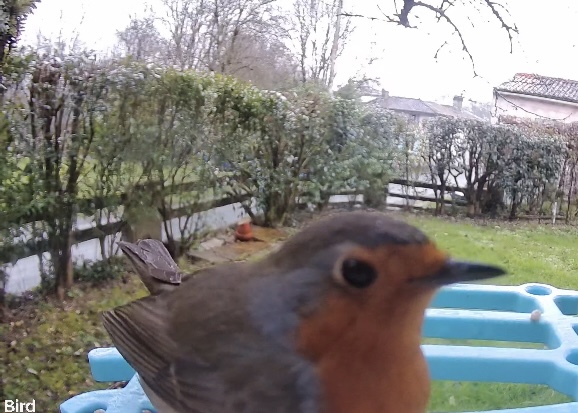
I got a Christmas present of a bird feeder with integrated solar powered camera. It was a bit fiddly to get going, but I persevered and am glad I did. It connects to an app on your phone where you can either watch live what the camera can see, or you can scroll back through the events where motion triggered a short video and capture some stills from there.

So far the blue tits and robins are the commonest visitors, and I’ve been able too see many short clips of them.

I really enjoy my encounters with the birds in my garden. Yesterday I mentioned how another app I have on my phone recognises birdsongs and told me that there were seven different species all singing at the same time.

So, these are two technologies I never knew existed, and probably, actually didn’t exist until pretty recently, which are enhancing my daily life.

How about you? Have you been discovering any technologies which make an every day a better day?

What I love about discovery and exploration is that you can do it right on your own doorstep. Our garden here in the Charente Maritime was largely abandoned for a few years before we bought the house. We’ve been working on a bit at a time over the last three years. There’s an area where we had giant brambles, overgrown nettles and fallen trees cleared away and seeded grass where it had until then been impenetrable but we left all the healthy trees which surrounded that area. I made a few paths amongst the trees and it feels like a little forest walk.

One of the things I love about this garden is that so many plants grow here after having found their own way here. I think there’s very little which has been deliberately planted (until we arrived!). So, the other day, the sun lit these lovely yellow flowers and I thought, what on earth are these? These days it’s dead easy to find out. I took a photo with my phone, pressed the “info” button and it told me this is Calendula arvensis. I only knew Calendula officinalis, so I then searched online and found a research article on PubMed Central about traditional uses of this particular plant. Wow, was I amazed! The researchers say it has “anti-inflammatory, antiviral, antimutagenic, antimicrobial, insecticidal, antioxidant, and immunomodulatory activities” – well, that sounds a lot! They list about 45 different areas of the world where there are recorded traditional uses of this plant, describing in each instance what parts of the plant are used and what they are used for.

I find all that absolutely fascinating, and it reminds me how much we limit our knowledge and therapeutic skills when we ignore how populations around the world have used particular plants over millennia. Surely we shouldn’t dismiss all this information just because we haven’t studied them the same we study our manufactured, artificial drugs?

While I was admiring this little flower I was aware of how much bird song I could hear, so I fired up another app on my phone, “Merlin”, which is a kind of Shazam for birdsong, and it found and identified seven different species of birds all singing like mad. I don’t think I’ve ever lived somewhere where there were so many birds around every single day.

I like how modern technology helps be to recognise plants and birds and how easy it is now to discover so much about them. It makes me aware of how little I know and how I’ll never stop discovering and exploring.

Hope buds

I got a lemon tree for my birthday last June and it took a while, but, in the autumn I enjoyed two lovely, large, juicy lemons which it produced. Like so much in the garden the lemon tree has been pretty dormant throughout the winter. I’ve lifted inside for a day or two during the days where the frost has been most severe (although I don’t think we’ve had less than minus four centigrade), but brought it back outside again to get maximum sunlight as soon as possible.

Today I see there is a little bud. Do you see it? In fact, there are two, close to each other. I know I had some kind of fantasy of a lemon tree laden with lemons all year round, but, hey, sometimes scarcity and having to wait just adds to the sense that you’re having something special, when, eventually the fruit matures.

This little bud gives me hope. I’m never very sure about a lot of the plants in the garden over winter. The fig tree and the walnut tree I planted are reduced to little sticks for the season, but, last year, once Spring came, they produced green leaves and started to grow again.

It might not seem like much, but, psychologically, in the midst of a lot of global news which can be rather dispiriting and demoralising, I find it really helps to be able to stumble across something like this and feel the sensation of hope and brighter future starting to stir in my heart.

As a river flows

“I would love to live like a river flows,
carried by the surprise of its own unfolding.” – John O’Donohue

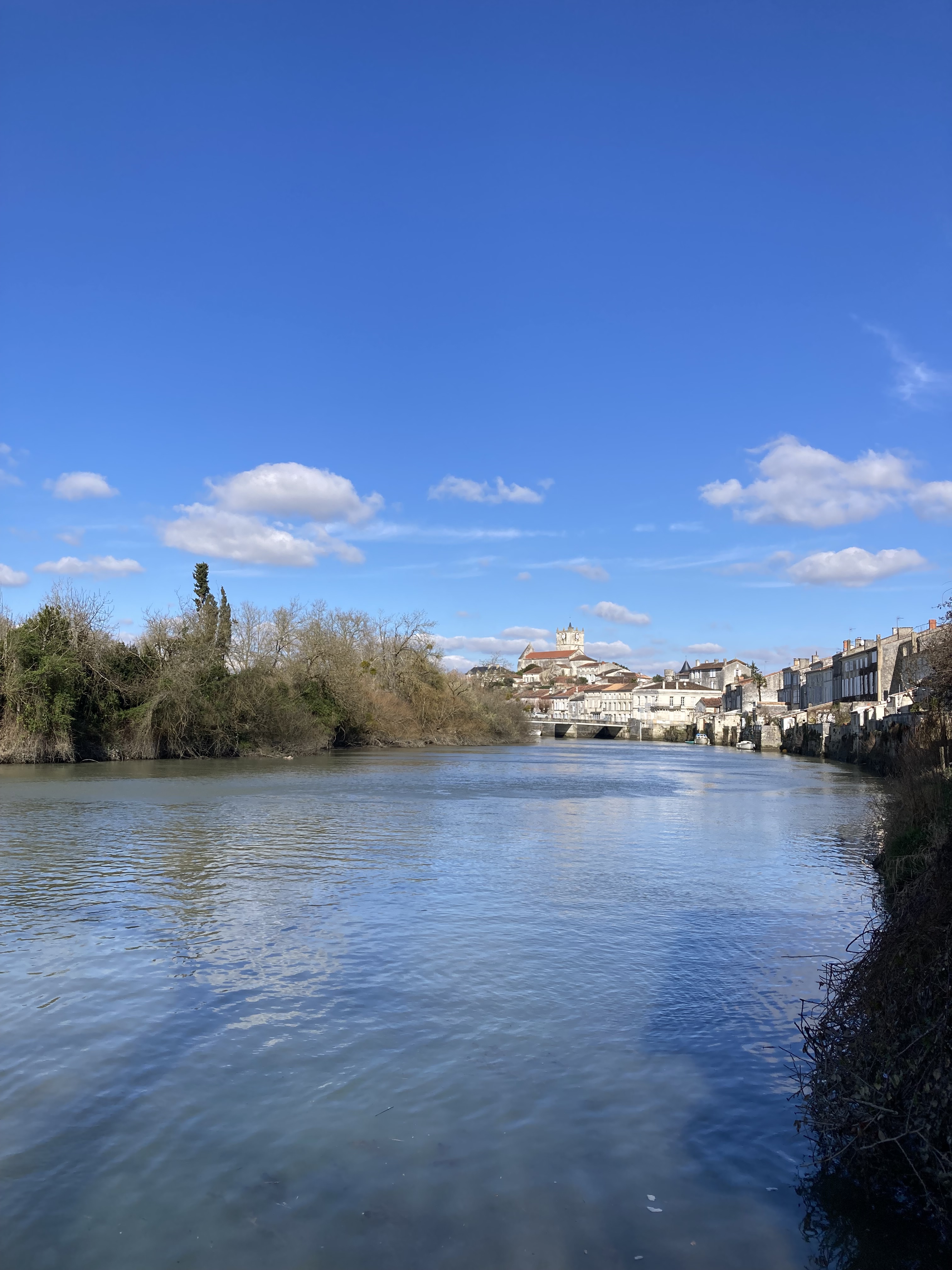
I live in the Charente Maritime, in South West France. I took this photo in Saint Savinien which is a small town just a few kilometres from where I live. The River Charente runs through the town, as it also runs through Cognac, near where I lived when I first moved to France a decade ago. It winds and twists its way through both the Charente and Charente Maritime departments and as you travel around you come across it again and again.

The primary characteristic of the River Charente is that it pretty much always looks the way it does in this photo. It flows incredibly smoothly. Maybe there is somewhere along its way where it breaks into white river rapids, but I’ve never seen that. It just never seems choppy, no matter whether it is flowing fast or slow. In fact, the impression you get is that it is at ease. It’s a river which flows calmly and almost effortlessly. So much so that people around here will tell you it is responsible for the rather laid back, “zen”, “take it easy” attitude so typical of this area.

Flow is a fundamental characteristic of all life. You could argue that it is the key characteristic, distinguishing the animate from the inanimate…..except that even the inanimate also flows, just over a much longer duration than the animate. You have to take a longer view to be able to see the flows of glaciers, continents and mountains.

I think flow is a marker of a good day. I feel I’ve had a good day when my activities, my thoughts, and my feelings have all been flowing like the Charente…..strongly, smoothly and incessantly…..with an ease, a freedom and purpose.

I know the old saying is “Red sky in the morning, shepherd’s warning”, but when I look out my window when I get up and see a sky like this I am delighted. I’m delighted because it’s beautiful. Don’t you agree?

And every encounter we have with beauty contributes to making today a good day. I notice beauty everywhere in nature. It’s easy to experience just by walking round the garden and noticing. There is so much beauty in the plant world. But while I’m in the garden I notice something else beautiful….birdsong. I’ve never lived anywhere else where I hear so much birdsong every day. I’m surrounded by it. Probably because my garden is surrounded by trees on every side. Looking up to the sky is another way to encounter beauty, whether it’s in the gorgeous reds of a sunrise, or sunset, or the amazing blues of a clear day, or the astonishing shapes of clouds as they drift by, or the sparkling night sky with the parade of planets.

A lot of the beauty I encounter is visual. You’ll know from browsing this blog that I’m a keen photographer. I photograph whatever catches my attention. I photograph what I find beautiful and what stirs my sense of wonder. But a lot of the beauty I encounter is also auditory. I love music and listen to music for a good part of every day. And a lot of the beauty I encounter is in other human beings. I am repeatedly struck by the kindness of others, by the shining delight in a happy face, by the strength and resilience of those coping with adversity, with the radiance of those who love.

Where will you encounter beauty today? Take a moment to notice, and a moment to reflect at the end of the day. It’ll make your day a better day.

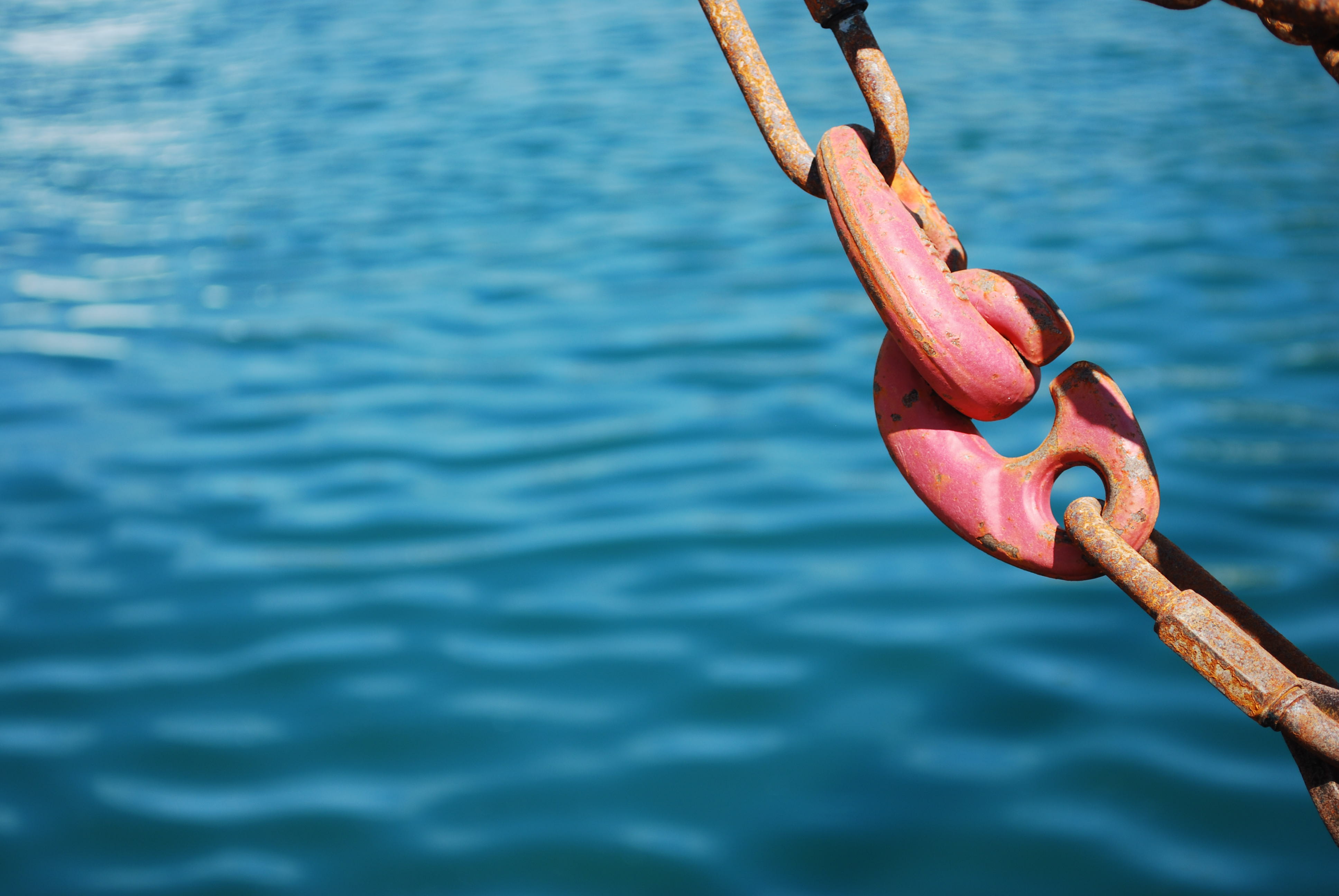
Bonds and links

Making mutually beneficial bonds – that’s the key to forming integrative relationships. What’s an integrative relationship? It’s one where both parts contribute towards the health and wellbeing of the other. When that happens both can achieve more than they could alone.

When I think about this concept, I think of the human body. Every single organ in the body forms, and is formed by, integrative relationships with the others. What kind of body could exist if all the organs were fighting each other, trying to secure resources at the expense of the others? What kind of body could exist if all the organs were trying to put themselves first? Same thing applies to all the cells which constitute our being…they are not fighting each other, competing each other, trying to outdo each other in some kind of dystopian “survival of the fittest”. Their super-power is the ability to collaborate, the ability to form mutually beneficial bonds.

I’m not saying that competition doesn’t exist. Of course it does. It’s one of the drivers of evolution as best we understand it. But we took a wrong turn when we honed in on that and made it the fundamental principle of the societies we created. Our current global economic and political system is built on these foundations.

It’s beyond time that we shifted our focus and started to build the kind of world we want to live in by drawing, instead, on our natural super-powers – co-operation, collaboration, integration. We build mutually beneficial relationships by using our powers of imagination to foster empathy and understanding.

We can build a better world by recognising that the best way to thrive is to build integrative relationships….with other humans, with other animals, with other forms of life on this one, small, finite, shared planet.

Courtyards and cloisters

I am really a fan of courtyards and cloisters. I love the churches or monasteries which have a garden in the middle. Sometimes I’ve wandered around a church or cathedral and found it quite oppressive, then I’ve noticed the sunlight shining through an open door and I step out into the courtyard with its arches and covered walkways. It feels delightful and appealing.

I do enjoy the Japanese aesthetic of asymmetry but I find the symmetry of these arches around courtyards like these especially engaging.

Riads in Morocco also have this design of an inner courtyard and I like them just as much.

Is it that they are comfortable in the heat of the sun? Or is it that they somehow compel you to wander along the passageways viewing the garden, which often contains a central fountain, from every angle?

They feel safe. They feel secret. And they feel sacred.

I’m sure that was the intention of the builders.

Symbolism and utility

The “cardabelle” dried out and attached to the exterior of a house is a common sight in Saint Guilhem le Desert, in the far South of France. It’s a great example of one those uniquely human phenomena that I love to find.

First, its local purpose was to predict the weather. When it’s becoming more humid, a storm might be on the way, and the shepherds would notice that the flower had closed up. It keeps this ability long after it’s been removed from the fields and pinned to a doorway. So, shepherds would pay attention to it, and make sure that both they, and their flocks stayed safe. This primary use is very utilitarian.

But we humans don’t stop there. We love beauty. And so people would collect these plants and put them in, or on, their houses, simply because they found them beautiful. There’s beauty everywhere in nature, and it’s often used as a method of attraction – flowers to attract pollinators, birds to attract mates etc. But we humans have definitely taken it to new heights. We love to be surrounded by beauty and we can find it everywhere – in landscapes, in gardens, in the people we meet, the objects we create, the music we listen to, the art we make. Setting off today with an intention to notice beauty can be a good way to make today a good day.

But we do something else, something I don’t think any other creatures do at all. We have the capacity to symbolise. We can make anything we want into a symbol of something else. I don’t think any other creature does this. It enriches our lives, helps us to have a daily sense of purpose and to discern meaning in our existence. There’s a magical quality to symbols. We use them to focus our attention, to create a frame of reference through which we engage with, and co-create, the world. These “Cardabelles” are pinned outside houses for good luck. They are one of many, many items, we, in our different cultures use, to either bring good fortune, or to ward off evil, or misfortune.

I don’t think we should dismiss the value of symbols in life and reduce everything to utility. Symbols are powerful ways for us to get in touch with, and share, our values. They can act as anchor points, or, in complexity science terms, as “attractors”, organising our local reality around us.

What symbols are most important to you?