Feeds:
Posts
Comments

Who are we?

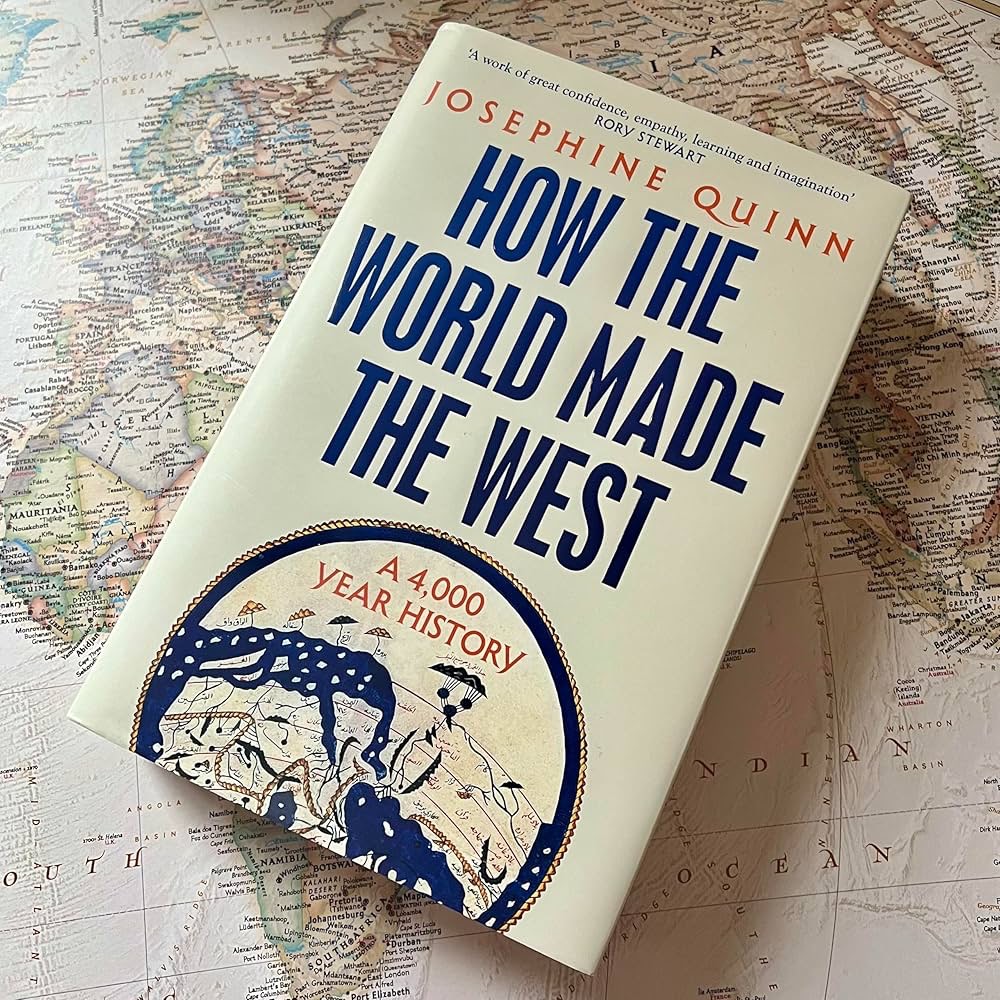
I’m reading “How the World made the West” by Josephine Quinn, a fascinating and mind expanding history of how the concept of “The West” arose. This paragraph really got me thinking –

“The study of antiquity gives the lie to the idea that everyone is born with a natural, fixed ethnic identity, tied to specific other people by ancestry or ancestral territory. The concept is fundamentally incoherent anyway: at some level all humans share the same ancestry and territory, and decisions about where to draw lines across that shared heritage in time and space can only ever be arbitrary. But ethnic identification is also for the most part a relatively modern phenomenon, associated with modern levels of literacy, communication and mobility. Without these, communal identities tend to form on smaller scales. And despite their physical proximity to one another, links between the ‘Phoenician’ ports were relatively weak.”

This reminds me of my experience working as a GP in the Irvine Valley back in the early 1980s. There were three small towns in the valley, Galston, Newmilns and Darvel. Although they seemed pretty similar in size, and even appearance, to the locals, especially the elderly locals they each had distinct characteristics. For example, one elderly woman told me a traditional saying was “Darvel for swanks, Newmilns for banks, Galston for guts” and another told me she was born in Galston but when she married she moved to Newmilns (two miles away), “But I couldnae staun it and had to come hame” – she couldn’t stand living in Newmilns and had to move back to Galston. Yet another, this time from Newmilns, told me the old piece of marriage advice she remembered was “If you can’t get a man, go to Galston and get a miner”. As Josephine Quinn writes, “communal identities tend to form on smaller scales”. 

By the time I was working there, each of the towns had changed considerably, with mining and textile industries disappearing, and an increasing number of people moving to the valley and commuting for work. However, when I left in 1986 to take up a post in Edinburgh, a twenty something year old female patient asked me what Edinburgh was like. She had never been. I asked her if she usually went to Glasgow (there’s actually still quite a cultural divide between Scotland’s two largest cities), but she said no, she’d never been there either. I asked where she had been, and she told me she’d visited Ayr once. She definitely identified with place, not an ethnic group. 

Anyone who has done even a small amount of genealogical research into their own family, pretty quickly finds that their ancestors come from a wide range of towns, or even countries, and those who use on the DNA testing genealogy services, find that they have percentages of their DNA which can be traced to several countries around the world. 

Josephine Quinn makes the point that DNA discoveries have undermined the concept of separate, distinct, or “pure” races, and that her research in ancient history (her book focuses on the period from 1500 BC to 1500 AD) undermines the concept of competing “civilisations”. As she describes each period, time and time again, she shows that trade and migration play a key role in the spread of ideas, technologies and innovations, whilst strengthening local cultures of belief and tradition. 

Nothing we are familiar with today would be possible without a long, long history of migration, communication and trade.

Yesterday I heard The Beach Boys song, Good Vibrations, on the radio and it took me right back to my youth. It came out in 1966….that’ll be 60 years next year! I’d only be 12 when I bought the single. I’ve always loved it. It was innovative and it’s aged especially well. I enjoy it now as much as I ever did.

But, here’s the thing. This time it evoked a certain sadness in me. Something it hasn’t done before. It wasn’t the sadness of getting old. Sure I can feel sad that my mortality is more obvious to me than it was when I was young, but surely that’s just normal, and it’s not something that colours my everyday. Maybe it was a bit of nostalgia – for the years, on the brink of becoming a teenager, enjoying my life with my large group of friends who all shared an enthusiasm for music. There are so many songs from that decade which delight me still….and I read a study recently which suggested the most powerful music for us (neurologically) is the music we listened to between the ages of 15 and 25. Well, those figures are not fixed, for sure, and I’ve read many other studies about the power of music to increase quality of life and slow down cognitive decline, especially the music of our teens and twenties.

But, no, this wasn’t a nostalgia for my teenage years with my friends. It was a nostalgia for America.

OK, I know that every Age is a complex mix of experiences and events, but I grew up through the years where music like the Beach Boys, Simon and Garfunkel, Joni Mitchell, Crosby, Stills and Nash, and so on, created very positive, delightful, moods for me. To be honest, I started with the Beatles, moving on to bands like The Kinks, The Who, Genesis, Yes, Jethro Tull, and so on. I used to listen to the pirate radio station, Radio Caroline, and the constantly fading out and in signal of Luxembourg, 208. My vinyl collection (yes, I still have those records I bought, mainly through those years), is heavily British, but there are a significant number of American artists in there.

I suppose the kind of feeling I had for America was coloured by that music, by Woodstock, and Peace and Love. And, frankly, those feel like kinder days.

Those feel like lost days.

In 2025, the stories from America are about hatred. Hatred of “immigrants”, and “others”. Stories of turning allies into enemies. Stories of suppression, of arrests and deportations. The UK and several EU countries have changed their travel advice to citizens seeking to go to America – and the message is, even a visa won’t guarantee you entry. I don’t know anyone who is thinking of traveling to America this year. It feels a place of hostility and fear.

So, the sadness I felt when I listened to Good Vibrations, came, I think, from feeling that the vibrations from America now are anything but good.

I’m sure you’ll have a different experience from me. We all have our own experiences. But I thought I’d just take a few moments to share what happened to me. And to hope…..to hope that, one day, maybe in my lifetime, I’ll associate America with Good Vibrations again.

I came across a term recently, “suicidal empathy”. Musk talked about it in an interview with Joe Rogan, and it seems to have originated from a man called Gaad Saad. As best I can tell he suggests that a big problem in society these days is an excess of empathy. In fact, in some pieces this concept is put forward as a big “threat to Western civilisation”.

I was pretty shocked when I read this, and explored a bit further to try and understand exactly what they were claiming. They seem to be saying that if we have “too much” empathy for certain people then we risk damaging the lives and values of the great majority. Who are these certain people? The usual suspects I’m afraid, immigrants, minority ethnic groups, trans people and, well, it seems to me, pretty much anyone they don’t actually like.

I don’t buy this. Not at all. Empathy doesn’t determine your actions. But it can, and, I believe, should, influence them. My point is that empathy does not lead inevitably to any particular strategies or policies at a societal level, and whatever an excess of it is, do we seriously believe that having empathy for a minority group actually harms the lives of the majority?

We only have individuals in life. We only have individuals in relationships. There is no “the people”, or “the majority” which has a single view of anything. The claim that there is such a thing is the path to despotism or populist fascism.

I spent an entire career over four decades where the core of my everyday was a sequence of one to one relationships with individual patients. I had empathy for every single one of them. I believe that was the only way to understand them, to really get to know them, and, so to help them. I believe that without empathy for every single person I worked with, I wouldn’t have been as good at my job as a doctor. Can you imagine a doctor who reserves their empathy for select groups of individuals? Well, actually we can imagine that, but it’s not something I’d like to support.

No, it’s not an excess of empathy, or a “misdirected” empathy, which is the biggest threat to our way of life. It’s a deficiency. We don’t care enough.

When immigrants are vilified, treated as less than human, when children are bombed, blown to pieces and killed in pursuit of “terrorists” or in an attempt by one country to grab some of the land occupied by others, then we have an empathy deficiency.

Back when 9/11 happened, the novelist, Iain McEwan, said the greatest failing of the terrorists was a lack of empathy….or did he say a lack of imagination? I’m not sure at the moment, I’ll look it up. Ah, it was both…..

If the hijackers had been able to imagine themselves into the thoughts and feelings of the passengers, they would have been unable to proceed. It is hard to be cruel once you permit yourself to enter the mind of your victim. Imagining what it is like to be someone other than yourself is at the core of our humanity. It is the essence of compassion, and it is the beginning of morality.

We need MORE empathy. Not less.

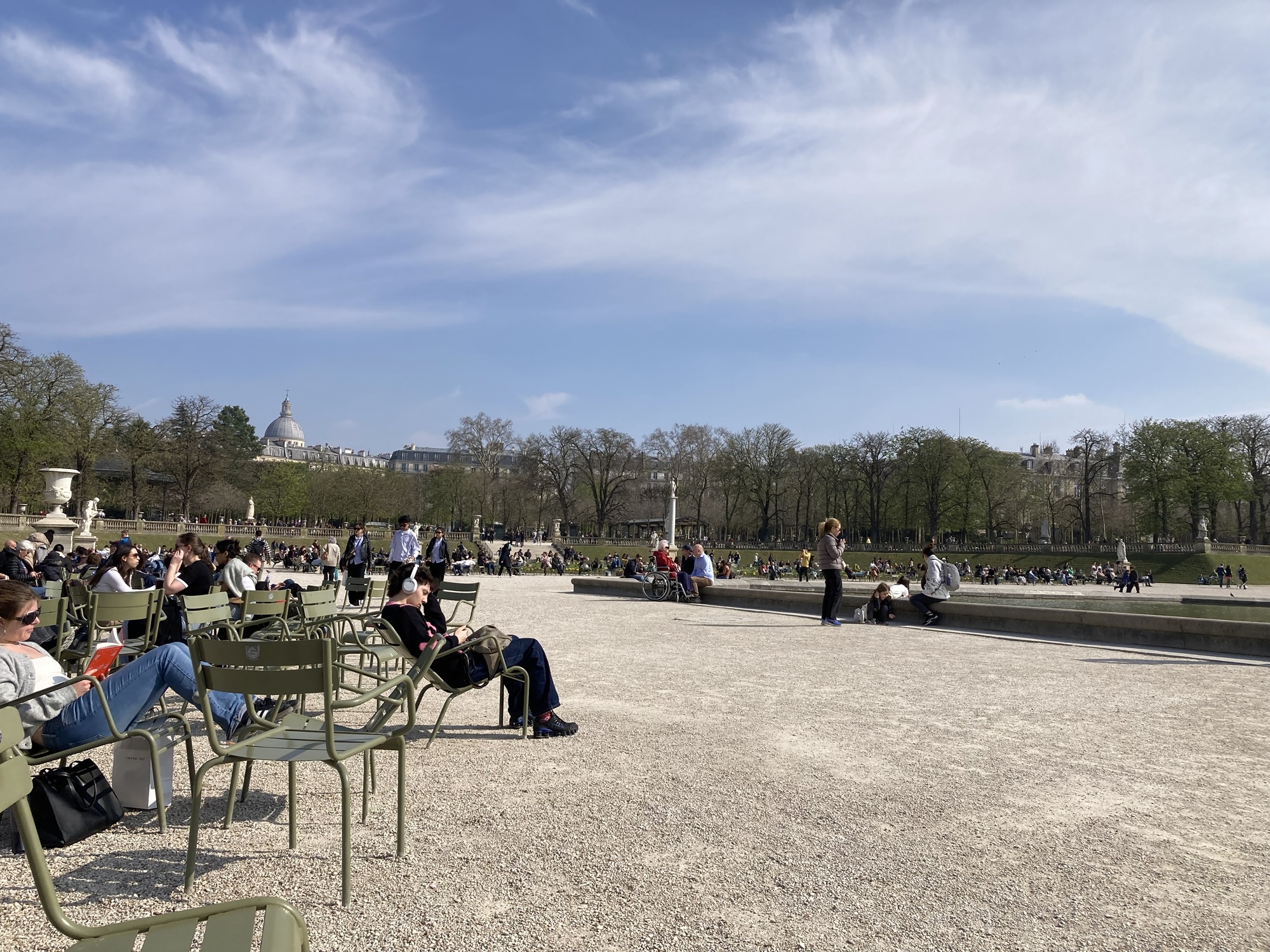
“Cities are built around plazas where friends, family and co-workers sit, eat, drink and talk. That turns out to be good for you even if you sip vermouth and eat crisps at noon. Reams of research show that social contact is critical for physical and psychological well-being.”

economist.com

I took this photo in the Luxembourg Gardens in Paris last Tuesday afternoon. There are lots of spaces in Paris which encourage people to walk, sit, stroll, relax, chat, take a pause.

This second photo was taken in the centre of Beziers. At one end of a long, wide, tree lined promenade sprinkled with benches, is the “Plateau des Poètes”, a beautiful garden, with several busts of French poets. Not only does this encourage people to spend time together, but it celebrates poetry. What a delight!

We need social spaces, places to connect, to exchange, to chill, or to pause. We need poetry, and stories, and art. We need beauty and plants and trees. Because we are human.

In the obsessively micro-managed world we live in now it’s more important than ever for us to take a pause. We are being bombarded with talk of crises, of doom, of having to everything faster, consume ever more, do everything so-called more efficiently.

But we humans are not machines. And we shouldn’t lead our lives, or construct our workplaces according to industrial machine-like principles.

Time and time again you can find creatives….artists, writers, composers, musicians, sculptors and so on tell you they need to have some breaks, some times where they just sit, or they sit and daydream. We need times to just step off the treadmill. We need to pause to gather our thoughts, to become more aware of the present moment, and to restore our depleted reserves of energy.

What length should a pause be?

There is no fixed amount. It can be a short as taking three deep breaths. It can be a few minutes, or a few hours. We need bigger breaks than that too, which is why it’s important to take all your annual leave from work. For some people it’s a sabbatical that they need. But the kind of pause I’m thinking about here, is the kind we all need, every single day.

I’m impressed by how in France there is a habit of stopping for a proper lunch…not grabbing a factory produced sandwich and a can of coke on the way to work and wolfing them down at the desk. They take time to go to a restaurant or cafe, to sit down, have a meal and share some time with workmates or friends. Then back to get on with the rest of the day. There’s still a widespread tradition of working five days a week, not seven here, so that everyone can have some family time, some home time, to do with as they want.

How about you? What pauses do you build into your everyday? What pauses would you like to build in, and why not start today?

Before he became famous for his predictions, Nostradamus was an acclaimed doctor, who during a plague treated patients successfully. What kinds of treatments did he use which were successful back in the early 16th century?

Well, primarily, he gave good advice about how to live healthily….recommending that people went outdoors to get fresh air as much as possible, teaching them about hygiene in the home, getting them to rid themselves of rats and excreta in the house, changing and washing the bedsheets, and eating a healthier diet (low fat, I read, but I’m not sure of the details).

On top of that he prescribed a herbal remedy based on rose hips which contained high levels of vitamin C.

So about 500 years ago the most successful ways of dealing with infections and epidemics was already known – it came down to good hygiene and healthy living conditions, combined with a decent diet rich in vitamins. When it came to our most recent pandemic, Covid, the same proved to be the case. The highest rates of infection, serious illness and death were in those who were already suffering from chronic diseases and/or who were living in poverty, in overcrowded housing, and with inadequate diets. Great claims have been made for vaccines, but, at the end of the day, the best way to maintain the health of populations is the same as it’s always been – a good healthy living environment.

That’s why I think we should take good care of our commons – the air, the water, the soil – reducing pollution, and investing in healthy environments. It’s also why I think we should radically change our industrialised farming and food production to produce healthy, vitamin rich food, which should be the basis of everybody’s good diet. It’s also why I think we should invest in good housing, well insulated, easily maintained, and accessible to everyone.

In addition, I think Universal Basic Income and taxing the rich to reduce inequality and poverty are worthwhile policies to pursue (even if our current governments don’t seem to be doing that)

Finally, comes better health care. We do need to improve our health services, and our health care methodologies, but the way to healthy, resilient populations, has a lot less to do with health care than it has to the provision of healthy living conditions.

Tomorrow and today

I was in Saint Remy de Provence recently and spotted these two windows. Nostradamus was born there in 1503, and that window on the right depicts him with his scientific instruments gazing out at the world. He remains famous for his predictions, and, science is in the business of making predictions. The scientific method has evolved over the years and is now focused on making measurements, carrying out experiments and seeing what can be predicted from “reliable” measurements.

The window on the left is a real window, with glass in it. In this photo you can see what the world was like in the moment when I took the picture. Blue sky, early trees without leaves or blossom yet. A beautiful, early Spring day.

When I look at this image again I’m struck by how the window on the right is a work of art, the produce of a creative imagination. Back in the day when Nostradamus was alive, art and science were not as divided as they are today. Both disciplines require a good imagination and skilful observation. The focus of the window on the right is the future….what’s coming next?

The window on the left, you could say, is more utilitarian. It’s part of the architecture of the building. It’s designed to let light in and to allow the inhabitants to see out into the street below. Its focus is on the present, but from my perspective as the photographer, it’s showing me a reflection, not what can be seen directly by looking through the glass.

Both windows are a re-presentation – one through reflection, the other through painting.

They make a nice pair, don’t you think?

Everyday creativity

It’s easy to think that creativity is what professional artists, musicians, poets and inventors have. But actually creativity is a fundamental human characteristic. We all have the gift of imagination. We are all born with the ability to play and experiment.

We are adaptable problem solvers, and we are great storytellers, telling ourselves and others the stories which make sense of our lives and allow us to connect with others.

We have the ability to express our feelings and share our experiences through art. This is how we connect subject to subject.

Creativity doesn’t need to be serious. It begins in childhood with curiosity and play.

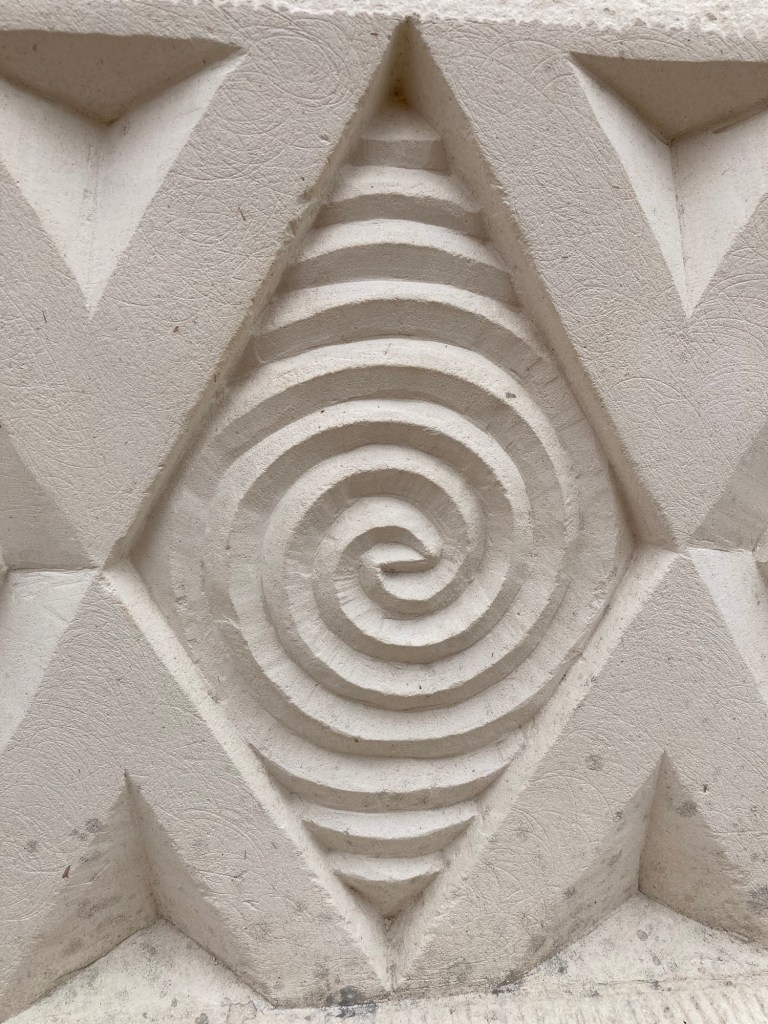
Have you had any fun creating something recently? This photo, by the way, is of an external wall of a shop in Saint Remy de Provence.

Re-presentation

Here’s how our brain works…..all the signals from our environment, and from within our own body, flow up from our sensory organs, through a vast network of nerve fibres to the right cerebral hemisphere which then hands off the information to the left hemisphere. The job of the left is to abstract, to focus on parts, to label and categorise. In short, to re-cognise, in order to help us grasp, both physically and mentally, the world, so we can manipulate it. The left hemisphere, having done its job hands back its work to the right which contextualises it all….puts it all back into the vast web of connections which the left extracted it from….so we can see the whole, so we can see the connections and relationships.

The left hemisphere fundamentally creates a re-presentation of reality. It’s a map, a model, an abstracted layer. It’s not actual reality. The right deals with reality as a whole.

OK, that’s all a vast over-simplification of the process, but it gives you a basic understanding of why we need both halves of the brain – it’s not a matter of one side good, the other bad. They do different jobs and we need them to work together.

But there’s just one more nuance to lay out here – they are not equal. The right hemisphere should be in charge. Iain McGilchrist’s thesis in the Master and His Emissary, is that we have developed cultures and ways of thinking where we give greatest credence to the left hemisphere….even to the extent of dismissing what the right can tell us. This separates us. It’s separates us from each other and from the rest of the world. It’s not real.

Influence

Whether I consider the physical changes I make by living on this planet…the oxygen I breathe in, the water and nutrients I ingest and digest, the molecules I excrete, the radiation of heat from my body…..or whether I consider the impact of my words, my creations and expressions….the intense interconnectedness of being a live human being means that every day I change the world a little, just as the world changes me.

So, I’m reminded of a much taught piece of advice – if I have a choice I should choose kindness. Whatever I pay attention to, I should pay a loving attention to. Whenever I can, I should care.

We make this world a better world by building and nurturing integrative relationships – mutually beneficial bonds between well differentiated parts.