Feeds:
Posts
Comments

Posts Tagged ‘art’

“Nothing begins with us.”

“The more we pay attention, the more we begin to realise that all the work we ever do is a collaboration. It’s a collaboration with the art that’s come before you and the art which will come after. It’s also a collaboration with the world you’re living in. With the experiences you’ve had. With the tools you use. With the audience. And with who you are today.”

Rick Rubin, in his “The Creative Act”. 

This really resonates with me. Over the last few decades we humans seem to have privileged competition over collaboration. Many people even call competition, “Darwinism”, because Darwin showed the role of competition in evolution. But Darwin also showed the role of collaboration in evolution. Why don’t we give that aspect, equal, or even greater, attention. 

It strikes me that even in my lifetime here on this little planet, over these last just over seventy years, I’ve witnessed a growth of alienation and isolation. The cult of the Self, of the Ego, of the so called “self-made man” (a total delusion, by the way), contributes to this isolationism. 

We are isolating ourselves from each other, because we are blind to how connected we are….to each other, to the past, to our ancestors, to our children, and their, as yet unborn children….to the myriad of other forms of Life on Earth. 

We even think of “Nature” as something that is separate from us. We are never separate from “Nature”. We emerge within it, within this vast, complex web of relationships and billions of other organisms with whom we are in constant collaboration. The very cells of our bodies come into being from the flows of materials, energies and information which gather and co-exist for a short while to create what I experience as “me”, which create what you experience as “you”. 

If we are going to heal ourselves, heal our communities, our societies, our world, we are going to have to become more aware of our connectedness, and to build creative, collaborative, “integrative” relationships (mutually beneficial ones). 

Because “nothing begins with us”……and nothing ends with us, either. 
Read Full Post »

There’s been a shift in social media channels. Not long ago many people presented themselves as “Influencers”, but now, not so much. Increasingly I’m seeing the term “Content creator” instead. Or, sometimes, “Digital content creator”. I must say, the first time I noticed this shift I wondered mainly about the word “content” – I don’t find it appealing, but I understand it will cover anything from text, images and videos, to the spoken word or music (and maybe more, I’m not sure!). I do think of myself as a photographer and a writer. I do both of those things frequently…..pretty much every day. But, I guess none of that is “content” unless I publish it (or upload it) somewhere, like here on my blog, or on a social media platform like Bluesky (or Facebook, Threads, Mastodon, Substack, or whatever). However, having wondered for a while about what constitutes “content” I shifted my attention to the second word….”creator”.

A few years ago when thinking about health, and how did I know a patient was becoming more healthy, I hit on a three word acronym – ACE – for Adapation, Creativity and Engagement. Briefly, for me, the healthier someone became the better I saw their ability to cope, to deal with whatever they had to deal with, to adapt and change. In addition, I’d notice they were becoming more creative, more able to solve problems, to come up with new ideas and ways of living, to be better able at expressing themselves. And, finally, I’d see they were becoming more engaged, building connections and relationships, deepening connections and relationships, paying better attention to the here and now.

It struck me then, and it continues to strike me, that we humans are naturally creative creatures. Maybe you learned from a religious teacher that God created us in His likeness? I always thought that meant He created us as creative creatures. (We are more than simply creative creatures, and there are several other factors we can consider which contribute to our “human-ness”, but I’ll explore that another time.

Rick Rubin’s “The Creative Act: A Way of Being”, begins with a chapter entitled “Everyone is a Creator”. He writes –

To create is to bring something into existence that wasn’t there before. It could be a conversation, the solution to a problem, a note to a friend, the rearrangement of furniture in a room, a new route home to avoid a traffic jam.

He goes on to explore how through our senses and our brain/body processes, we create experiences for ourselves, we create our internal reality, from the undifferentiated external reality. In other words, just being alive is a creative act.

Finally, he writes –

To live as an artist is a way of being in the world. A way of perceiving. A practice of paying attention……your entire life is a form of self-expression. You exist as a creative being in a creative universe. A singular work of art.

I couldn’t agree more.

It’s not just “content creators” who are creative, it’s you and it’s me and it’s everyone you know. How does it change your perception of someone once you start to explore their creativity? What do you notice when you start to ask yourself, “in what ways is this person creative?”

Read Full Post »

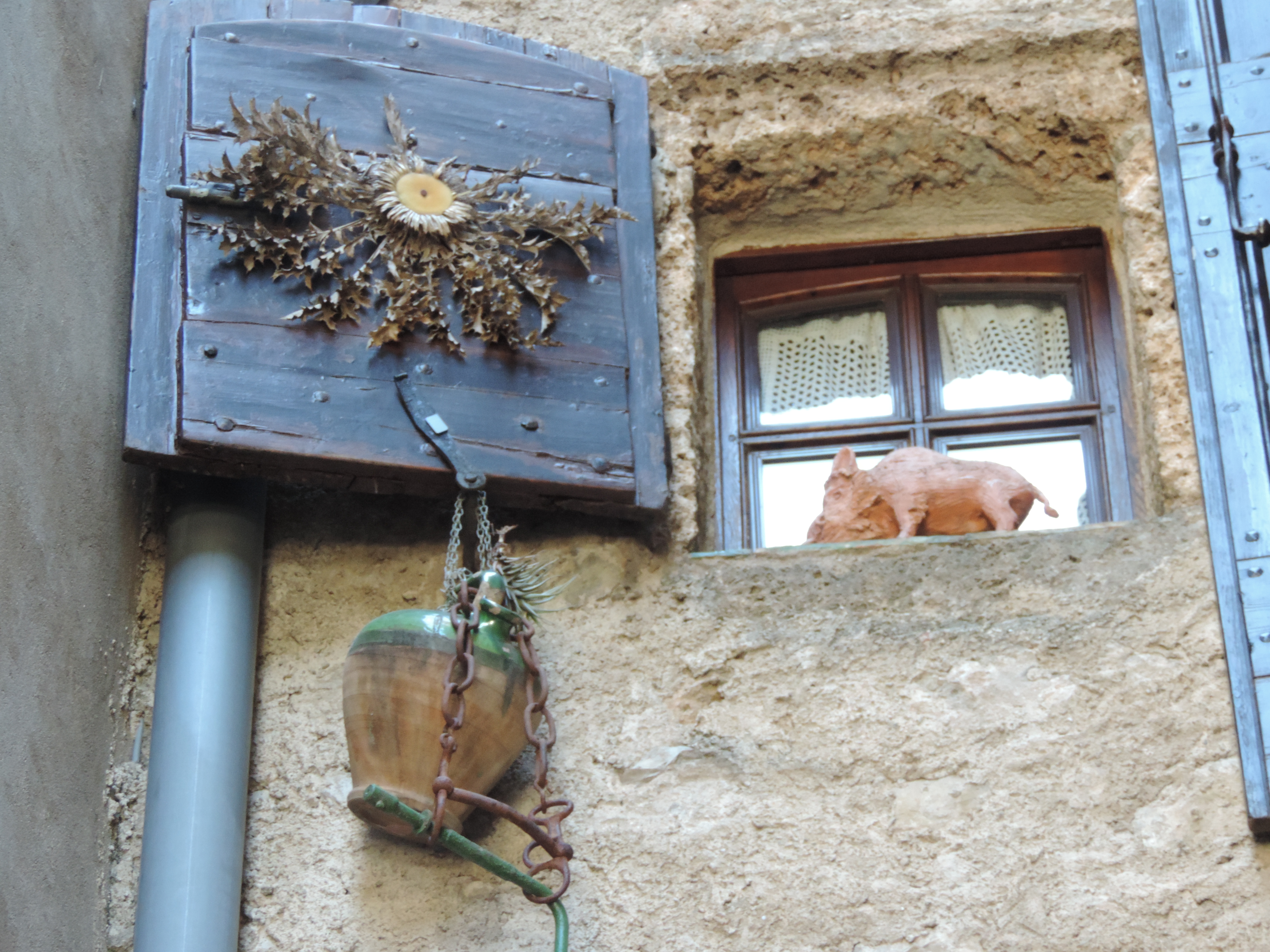
The “cardabelle” dried out and attached to the exterior of a house is a common sight in Saint Guilhem le Desert, in the far South of France. It’s a great example of one those uniquely human phenomena that I love to find.

First, its local purpose was to predict the weather. When it’s becoming more humid, a storm might be on the way, and the shepherds would notice that the flower had closed up. It keeps this ability long after it’s been removed from the fields and pinned to a doorway. So, shepherds would pay attention to it, and make sure that both they, and their flocks stayed safe. This primary use is very utilitarian.

But we humans don’t stop there. We love beauty. And so people would collect these plants and put them in, or on, their houses, simply because they found them beautiful. There’s beauty everywhere in nature, and it’s often used as a method of attraction – flowers to attract pollinators, birds to attract mates etc. But we humans have definitely taken it to new heights. We love to be surrounded by beauty and we can find it everywhere – in landscapes, in gardens, in the people we meet, the objects we create, the music we listen to, the art we make. Setting off today with an intention to notice beauty can be a good way to make today a good day.

But we do something else, something I don’t think any other creatures do at all. We have the capacity to symbolise. We can make anything we want into a symbol of something else. I don’t think any other creature does this. It enriches our lives, helps us to have a daily sense of purpose and to discern meaning in our existence. There’s a magical quality to symbols. We use them to focus our attention, to create a frame of reference through which we engage with, and co-create, the world. These “Cardabelles” are pinned outside houses for good luck. They are one of many, many items, we, in our different cultures use, to either bring good fortune, or to ward off evil, or misfortune.

I don’t think we should dismiss the value of symbols in life and reduce everything to utility. Symbols are powerful ways for us to get in touch with, and share, our values. They can act as anchor points, or, in complexity science terms, as “attractors”, organising our local reality around us.

What symbols are most important to you?

Read Full Post »

There’s what some people call a spiritual practice taught by the Classical Greek philosophers. It’s called “The view from on high”. I thought of that when I looked, again, at this photo which I took from the train crossing the Alps last year.

The idea of the view from on high, is about taking an overview. It’s about seeing the context of something, seeing the “bigger picture”. We can be too close to something, so close in fact that we can’t “see the wood for the trees”. The answer is to go higher for a more comprehensive perspective.

Although the Greeks didn’t know it, this is advice to access your right hemisphere. The left hemisphere of the brain has a very narrow focus. It enables us to zoom in, separate out elements, and grasp what we are looking at. But the right hemisphere takes in the context, sees the connections, enables a more holistic understanding.

Of course, it’s best when we use our whole brain, not just half, but, sadly, we’ve developed the habit in our cultures of thinking the left hemisphere knows best. It doesn’t. It only helps us when we take its “re-presentation” of reality back into the right hemisphere, to situate it in the whole.

Reality is not made up of pieces which are assembled. Reality is a whole, in constant flow and change. Stepping up a level and taking “the view from on high”, can help us to appreciate that.

Read Full Post »

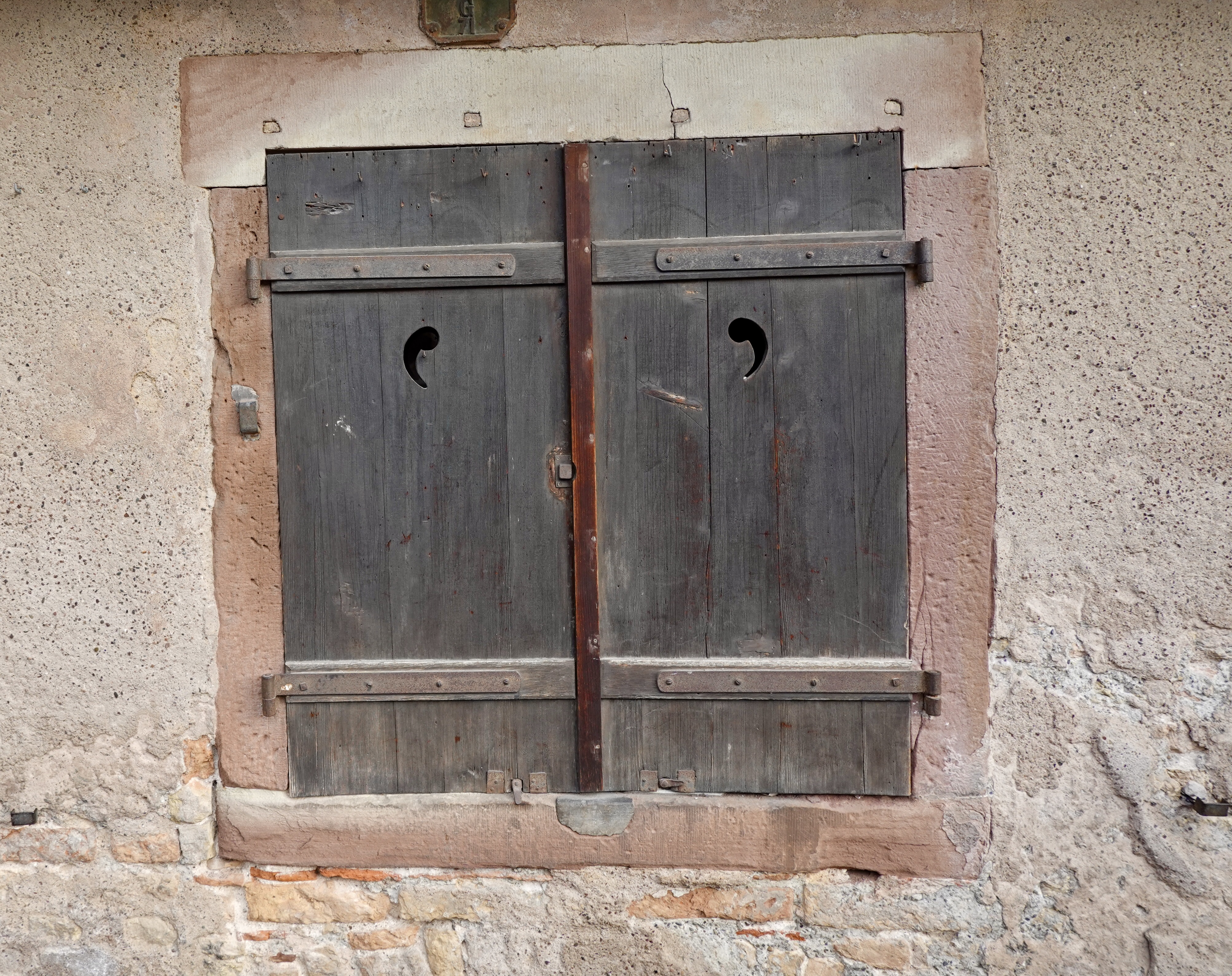
You could argue that these little “commas” cut out of the shutters covering this window are to let some light in. But if you wanted to let light into the room, you’d open the shutters, wouldn’t you? But maybe you just want some light in, not much. So why cut the holes into these carefully crafted shapes? Or maybe we need to think of this from the other side. Maybe these are holes to look out through….viewing points to see a bit of the world outside. But there again, why make them this shape? You know what? Maybe they aren’t carved for a utilitarian function. Maybe they are neither for letting in light, nor for facilitating observations of the street outside.

Maybe the creator just wanted to make something beautiful. Because they are beautiful, aren’t they? And without them, the shutters would look pretty, well, uninteresting. It’s the comma-shaped holes which have caught my attention, made me pause, take a photo, and return to it again to wonder……what are these all about? Who made them? Questions to which I’ll never find the answers. But, this much is sure…..they bring me a moment of delight and wonder…..”l’emerveillement du quotidien“.

I’ve looked at these shutters several times now, spent some time with them, reflecting, and wondering. But this morning, something else comes up – don’t they suggest a word? If you look at them, there is one on the left, a space, then another on the right, and if you saw them on a page like that, you’d assume that in that space there should be a word. Wouldn’t you? A word. Or a quotation.

So, here’s something to play with today…….what word, or what words, would write in this particular space?

Read Full Post »

I read an article in the Guardian today entitled “Consuming arts and culture is good for health and wellbeing, research finds” It caught my eye – first because I thought consuming arts and culture ??!! I hate that. I don’t consume arts, I experience/enjoy/participate in…..not consume…. and what is culture anyway? Well, let’s leave that issue for another day. The next thought I had was “I don’t enjoy arts in order to improve my health or wellbeing, and this headline leads me to think these folk are about to try and justify arts on the basis of their utility. But, in fact, the article is even worse than the headline suggests. Here’s how it begins –

Most people are familiar with the buzz that attending a memorable play, film, concert or art exhibition can trigger. But now it is official: consuming culture is good for your health and wellbeing – and generates £8bn a year worth of improvements in people’s quality of life and higher productivity.

Seriously? I might have felt a “buzz” but, “now it is official” – “it generates £8bn a year of improvements in people’s quality of life and higher productivity”. Oh, thank goodness they’ve quantified that. Otherwise I’d have been stuck with my personal delusion that I was just enjoying something, or that it was adding meaning to my life!

Look, I understand what these people are doing, and, at one level, I commend them for it. They are trying to make an economic case for what isn’t measurable. We can’t measure paintings, poems or music. We can’t even really measure “health and wellbeing” (instead we invent questionnaires, the answers to which we allocate scores, then we say we are measuring the invisible – ok, another controversial view I can return to another day) They are claiming that, for example, going to a weekly drawing class at a museum is worth £1310 to each person from “going to see their GP less and feeling better about their lives”. Really? £1310? Not £1315? These apparently definite figures remind me of the old joke that 86.57% of statistics are made up……but, good on them for trying to make the case for arts funding to governments and policy makers who seem to understand only sums and measurements.

But, fundamentally, this makes me hugely uncomfortable. Can’t we make a case for the place of arts “and culture” in our lives without reducing them to arbitrary financial “values”, or so-called “measurements”. I don’t need any of those justifications to play music every day, to write, to read novels, to visit galleries and delight in their works, to feel the connections to their creators……

However, I read, just the other day, that more and more universities in the UK are closing down their Humanities courses, claiming that students don’t want them because they don’t see how they can lead to remunerative employment. Oh goodness, what has happened to our idea of education? What have we reduced that to? Is education only valuable if it lets you get a job managing a McDonalds outlet, or selling people “stuff”?

I hope reports like this one do stimulate debate about the Humanities. I hope they stimulate debate about what makes our lives valuable and meaningful. Meanwhile…..I’m going to continue taking photos, writing, sharing my creativity. I’m going to continue listening to music, reading novels, visiting museums and galleries – because those are some of the activities that bring me joy, that amaze me, that make me think, that help create meaning in my life. If all that contributes positively to my “health and wellbeing”, then so be it. But that’s not the reason I’ll keep filling my daily life with “arts and culture”.

Read Full Post »

The English philosopher, Mary Midgley, in her response to those who said the Self was an illusion, said “If the Self is an illusion, who is it who is having this illusion?”

Philosophers, psychologists, psychiatrists and neuroscientists, continue to debate exactly what the Self is. I’m taking a pragmatic, maybe simplistic approach. For me, the Self is what does the experiencing. Me, myself and I, as the song goes…….All the sensations I experience, are experienced by my Self. Yes, I know there are complex sensory cells and networks throughout the body which enable me to pick and process various signals, energies and waves which flow around and through my body. But, ultimately, the experiencing of the light, of colour, of sound, touch, temperature, taste….that’s all done by my Self. Similarly, it’s my Self which experiences my thoughts and feelings. Again, maybe thoughts and feelings involve a huge network of cells and chemicals in my body, but it’s my Self which experiences them.

I know that not everyone will agree with that conception of the Self, and I’m neither a philosopher, nor a neuroscientist, but I just want to describe, as clearly as possible, how I envisage the Self.

From that standpoint, I explore the world in which I find myself alive. I turn to Science to help me grasp and understand what is external to my Self. Primarily, that picks out elements from within the flux of reality, and considers them as objects…objects which can be measured and manipulated. I even turn to Science to discover elements which exist within my body, but which, I argue, are “external” to my “Self”. So developments in anatomy, physiology, pathology and so on, help me to comprehend the tissues, organs, cells and chemicals within my body, and, as a doctor, to understand them within the bodies of others. That helps me to make diagnoses and to suggest treatments when people fall ill.

Secondly, I turn to Art, to understand what is “internal” to my Self, to express what is “internal” to my Self, and to communicate with the “selves” of others. It’s through music, poetry, painting, sculpture, storytelling, novels, dance, and so on, that I attempt to show others what I feel, what I experience, what I think, from this unique perspective on the universe which I call my Self. Through Art I channel, and stimulate my creativity, my imagination and my empathy.

Thirdly, I turn to Spirituality to explore the connections between my Self, and the rest of the Universe. Through experiences of awe and wonder, I dissolve the boundaries of my individuality, and step into the Oneness of Reality.

I know these terms, external, internal, and beyond, are simplifications in their own right, but I reckon if I am to know a person, to really get to know and understand another person, then my best chance will emerge by taking a blend of these three approaches – science, art and spirituality. And, I’ll see more clearly that no single one of them can give me a comprehensive understanding.

Does this make sense to you? I’d love to hear your take on all this.

Read Full Post »

The concept of “and not or” is very important to me. “And” creates and explores connections. I broadens and deepens our experience. Whereas “Or” divides. It splits reality into pieces and asks us to choose. Iain McGilchrist’s superb explanations of how the left and right hemispheres of the brain enable to focus on the world in very different ways has taught me to try to use my whole brain, not just half of it (we, as a civilisation, and, as individuals, have privileged the left hemisphere approach at the expense of a whole brain one, for far too long now)

But there’s another way in which I apply the “and not or” approach, and that’s through the triad of ways in which we humans view and try to understand the world – science, art and spirituality.

Science provides us with ways of discovering what exists objectively. A core feature of science is measurement. The scientific approach allows us to separate out objects from the ongoing flux of reality, measure them, subject them to experiments and, from there, to make predictions which enable us to exert greater control.

Art, on the other hand, provides us with ways of expressing our inner experience, and of sharing those experiences with others. It’s a range of ways of connecting subject to subject. We use art to express and communicate love, beauty, joy, and unique, individual experience of life. We use music, dance, storytelling, visual arts, poetry etc to develop our creativity and to engage with each other subject to subject. These subjective experiences are not measurable.

Thomas Berry says that the universe is not a collection of objects, it’s a community of subjects.

Thirdly, spirituality, is, for me, that sense of being connected to what is greater than me. I experience it through moments of awe. I experience it everyday through what the French call “l’emerveillement du quotidien” – through wonder, amazement and awe.

I need all of these ways of engaging with the world to lead a deep, whole and meaningful life. Science isn’t enough by itself. It can’t help us to connect, subject to subject. Art isn’t enough by itself, it lacks science’s ability to isolate elements in the objective world to better understand and manipulate them. Spirituality isn’t enough in itself but it stokes our humility and our sense of connection with others and with the rest of the planet, even, the universe.

How about you? Do you enjoy all three? Science, Art and Spirituality?

Read Full Post »