Feeds:
Posts
Comments

Posts Tagged ‘complexity’

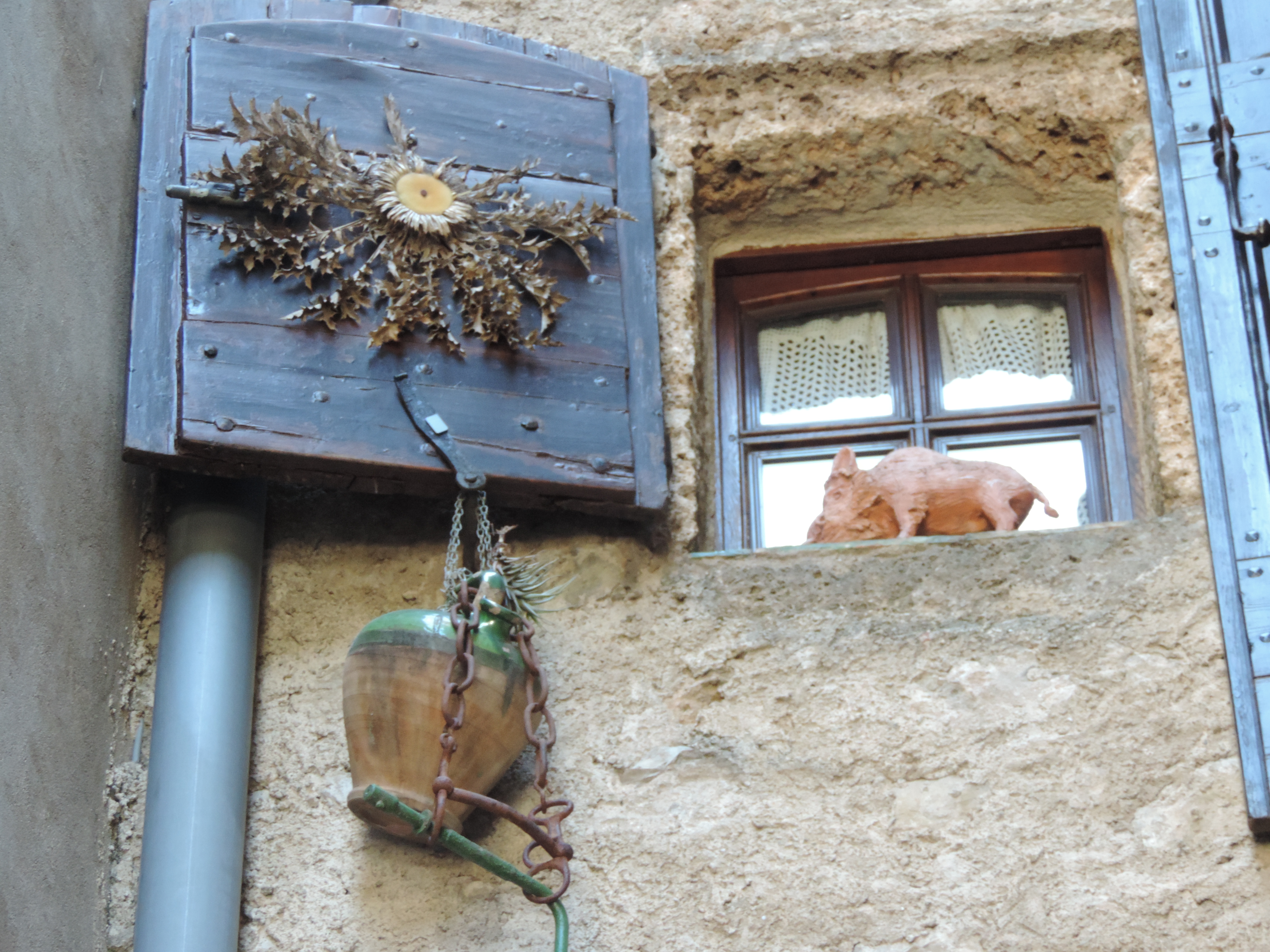
The “cardabelle” dried out and attached to the exterior of a house is a common sight in Saint Guilhem le Desert, in the far South of France. It’s a great example of one those uniquely human phenomena that I love to find.

First, its local purpose was to predict the weather. When it’s becoming more humid, a storm might be on the way, and the shepherds would notice that the flower had closed up. It keeps this ability long after it’s been removed from the fields and pinned to a doorway. So, shepherds would pay attention to it, and make sure that both they, and their flocks stayed safe. This primary use is very utilitarian.

But we humans don’t stop there. We love beauty. And so people would collect these plants and put them in, or on, their houses, simply because they found them beautiful. There’s beauty everywhere in nature, and it’s often used as a method of attraction – flowers to attract pollinators, birds to attract mates etc. But we humans have definitely taken it to new heights. We love to be surrounded by beauty and we can find it everywhere – in landscapes, in gardens, in the people we meet, the objects we create, the music we listen to, the art we make. Setting off today with an intention to notice beauty can be a good way to make today a good day.

But we do something else, something I don’t think any other creatures do at all. We have the capacity to symbolise. We can make anything we want into a symbol of something else. I don’t think any other creature does this. It enriches our lives, helps us to have a daily sense of purpose and to discern meaning in our existence. There’s a magical quality to symbols. We use them to focus our attention, to create a frame of reference through which we engage with, and co-create, the world. These “Cardabelles” are pinned outside houses for good luck. They are one of many, many items, we, in our different cultures use, to either bring good fortune, or to ward off evil, or misfortune.

I don’t think we should dismiss the value of symbols in life and reduce everything to utility. Symbols are powerful ways for us to get in touch with, and share, our values. They can act as anchor points, or, in complexity science terms, as “attractors”, organising our local reality around us.

What symbols are most important to you?

Read Full Post »

Finding a future

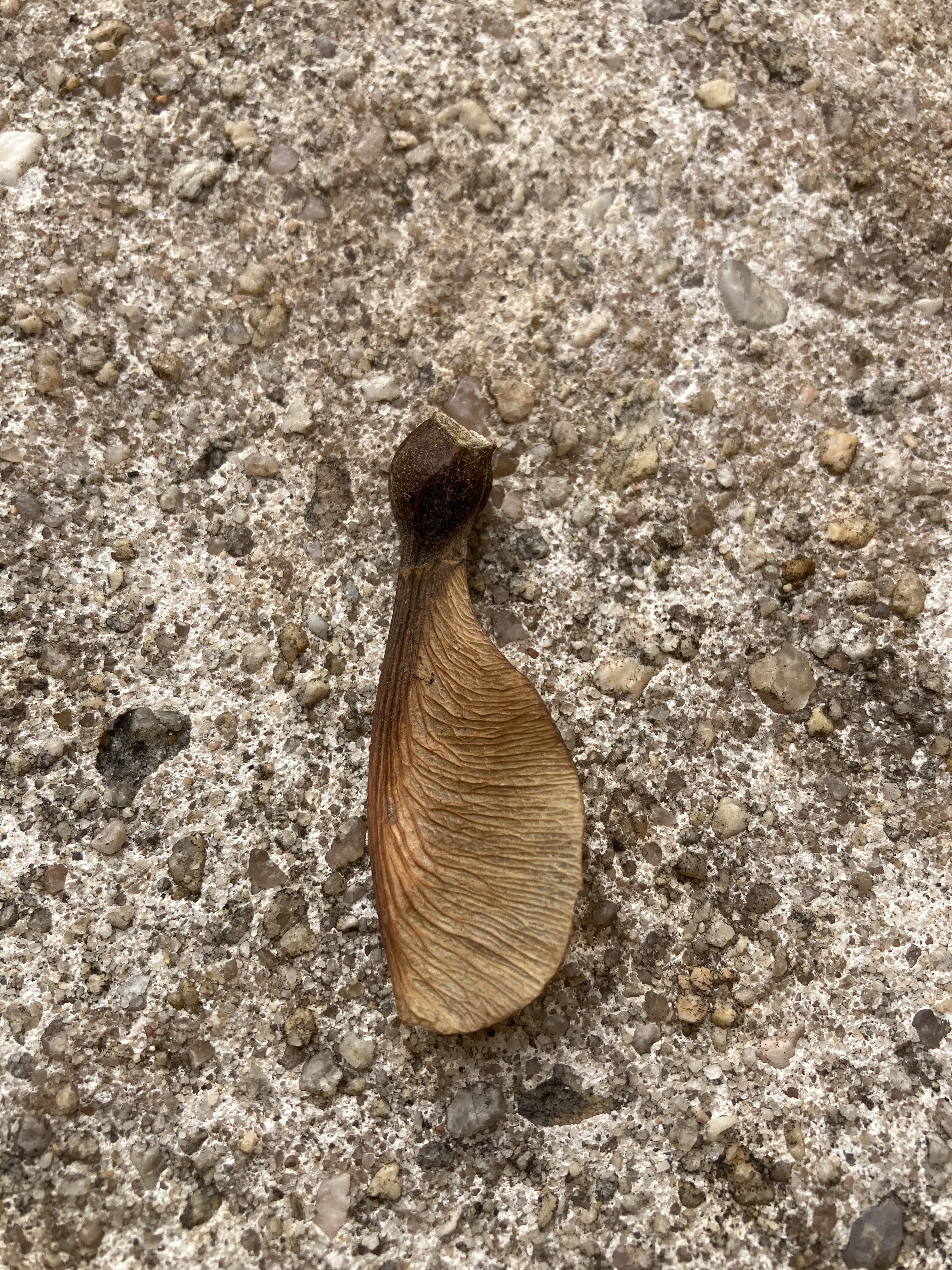
This single seed isn’t uncommon, is it? You’ll all be very familiar with this kind of seed distribution….where a plant creates an appendage which allow it to be carried far and wide by the wind. Well, first of all, this is pretty astonishing, isn’t it? I mean how amazing to be able to create a structure like this all by yourself? Trees, of course, don’t use any machinery or tools to manufacture a structure like this. And how even more amazing that a structure and strategy like this seems to have evolved on our planet. Isn’t nothing short of miraculous. You don’t have to look outside of Nature to be amazed, to find what seems utterly magical and enchanting. Truly amazing.

But there are a couple of other things I think about when I contemplate this single seed. The first is that even with our advanced scientific methods, nobody can tell you whether or not this particular seed is alive. And nobody can predict exactly where, when, or even if, it will grow into a tree. Nature, and Life, are fundamentally unpredictable. There’s a body of thought which argues that if we have enough “data” we can know “everything”….we will be able to predict the future with accuracy once we have enough data and the means to analyse it. I reckon that’s wrong headed. Nature, and Life, just aren’t like that. No amount of data will enable you to make accurate predictions about individuals….whether they be winged seeds, or human beings.

The second is that abundance is at the heart of Nature. Seeds like these are produced in enormous numbers. You could argue that they are “inefficient” in terms of modern management theory, because they are produced in numbers which far, far exceed the number of new plants which will grow from them. But these are key features to natural systems – abundance and “redundancy” (this latter term refers to having multiple systems which mostly aren’t used, but are there to provide flexibility and adaptability). Our industrialised capitalist system creates false scarcity – how many times do you come across an advert which tells you that if you don’t buy this now, then it’ll be too late, it’ll all be gone? If we created an economic and social model based on Nature, it would be based on the reality of abundance. We could house the world’s population in decent housing. We could feed the world’s population. We just don’t choose to, preferring to create an elite of billionaires instead……

Management theories based on pushing for ever more “products” or “services” from the least possible resources (human, material, social and financial) are not healthy, and they aren’t natural. Look how well they responded to Covid for example. From “Just in time” delivery systems, to the closing of hospital beds and failing to stock equipment needed to deal with crises…..it goes on and on. We need management systems better attuned to the reality of Life on Earth – and that doesn’t involve cut after cut after cut, or reducing human being to cogs in multinational corporate machines.

Thirdly, this seed lying on a stony path reminds me of the parable of seeds, as I was taught it at Sunday School. I don’t know if that parable is still taught, but amongst other things, surely it teaches the importance of the environment. If your seed doesn’t fall on fertile ground it’s unlikely to thrive. We need healthy water, air, and soil, and none of us can provide that by ourselves. Our human super power is co-operation and our ability to work together to create healthy conditions for individuals to thrive.

Any other thoughts come to you when you look at this little seed?

Read Full Post »

From above

I haven’t been on a plane for a long time. However, here’s a photo I took a few years back. I looked out of the window just before dawn and what struck me was how solid the clouds looked. They look like a landscape on the surface of the The Earth. There even seems to be a deep ravine as if there is a river flowing far below, down in the dark depths of that gap.

Of course, I know that these clouds are simply water and that if I were to try to step on them I’d fall straight through. And I know that the surface of the Earth is not like that. I know that when I stand in my garden, for instance, I am standing on solid ground.

But this last year of extreme weather events in a wide variety of places in the world has shown us that this sense of solidity is based on somewhat shaky foundations. We are witnessing the Earth reshaping itself….glaciers shrinking, ice mountains falling into the ocean, volcanoes covering the land with lava, overflowing rivers sweeping away hillsides, roads and houses in a few minutes, fires razing forests and whole townships to the ground.

Then along comes a pandemic and the entire world is faced with the certainty that nothing is certain. Day after day “experts” make predictions about what’s going to happen next, then something else transpires instead. We’ve even become a bit obsessed with the future….juggling fears, anxieties, plans and “what ifs”.

Maybe we are being forced to learn to live outside of our shared delusions – the delusion that human beings can control Nature, the delusion that Nature is something outside of us, something apart from us, the delusion that we exploit and consume without limits, (add your own favourite delusions here).

Maybe we are going to have to learn new skills, learn that we live in a complex inter-connected world, learn to emphasise adaptation over control, learn to rate relationships more highly than consumable goods, learn to co-operate and collaborate more than we compete.

Maybe if we do respond to these challenges by seeing the world anew, by taking the view “from above” as the old philosophers taught, then a new, bright, dawn lies just over the horizon.

I hope so.

Read Full Post »

One of the greatest skills we have as human beings is the ability to spot patterns. My eye was drawn to this fungus growing on a tree stump, but later, once I’d uploaded the photo onto my mac, I was amazed to see the echoes, similarities, even symmetries between the patterns in the fungus, the cut slice of the tree, the bark around the tree, and even the shell lying on the ground.

Beautiful. Amazing.

self-symmetry

Read Full Post »

That reductionism is limited, however, does not mean it is not powerful, amazingly productive, and tremendously useful scientifically. We simply need to understand its place, and recognise that we live in a very different universe from that painted by reductionism alone.

So writes Stuart Kauffman in “Reinventing the Sacred” (ISBN 978-0-465-00300-6). I agree with that. As a medical doctor who practices in a field of medicine which values an understanding of patients from a holistic perspective, seeking to know, not just the diseases they might have, but to know the individuals who have those diseases, I find reductionist approaches both useful and insufficient. As Mary Midgley says in “Wisdom, Information and Wonder”,

One cannot claim to know somebody merely because one has collected a pile of printed information about them.

The key point Kauffman seeks to make in his book (he is a complexity scientist) is how our relatively new exploration of complex systems in non-reductionist ways has revealed characteristics which fundamentally change the way we understand reality. The central characteristic is, he feels, “emergence”.

…while life, agency, value, and doing presumably have physical explanations in any specific organism, the evolutionary emergence of these cannot be derived from or reduced to physics alone. Thus, life, agency, value and doing are real in the universe. This stance is called emergence……….Emergence is therefore a major part of the new scientific worldview. Emergence says that, while no laws of physics are violated, life in the biosphere, the evolution of the biosphere, the fullness of our human historicity, and our practical everyday worlds are also real, not reducible to physics nor explicable from it, and are central to our lives. Emergence, already both contentious and transformative, is but one part of the new scientific worldview I shall discuss.

The other major characteristic he describes is how Nature does not conform to “natural laws”, and so the world is not nearly as predictable nor controllable as we have believed (well you only need to read about this year’s economic crises to see that’s true, don’t you!)

Kauffman explains how emergence is a quality of unceasing creativity, and he explains how unpredictability challenges the supremacy of reason as a guide to life. When you first encounter them, these are radical ideas for a scientist, but the more you learn about complexity as a way of understanding reality, the more you realise how reductionism does not equal science. Science is a greater way of thinking than that, and its the modern concepts and methodologies which are expanding science beyond its limited and reductionist constraints. He shows how “ceaseless creativity in the evolution of the biosphere” undermines the Newtonian concept of “natural laws”.

We will soon find its analogues in economic and cultural evolution, which, like the biosphere, are self-consistently self-constructing but evolving wholes whose constituents are partially lawless.

(This book was published in January 2008, and therefore written well before the economic crises of the last year)

This is a radically different scientific worldview than we have known. I believe this new scientific worldview breaks the Galilean spell of the sufficiency of natural law. In its place is a freedom we do not yet understand, but ceaseless creativity in the universe, biosphere, and human life are its talismans. I believe this creativity suffices to allow us to reinvent the sacred as the stunning reality we live in. But even more is at stake……We must come to see reason as part of a still mysterious entirety of our lives, when we often radically cannot know what will occur but must act anyway. We do, in fact, live forward into mystery.

I do resonate with these ideas. Emergence is a fascinating concept. To connect it to the concept of ceaseless creativity and beyond that to the notion of God as Creator is an interesting step. Somehow, though, it doesn’t quite work. I am with him in the awe-inspiring inspiration of ceaseless creativity. I think human beings, other creatures, Nature itself are endlessly fascinating and can, in fact, never be wholly known. But to use “God” symbolically to represent this phenomenon doesn’t work for me. I do like how contemplation of emergence, however, can help us to put reductionism in its place. In fact, reductionism can be more, not less, useful, if instead of trying to understand absolutely everything from that single standpoint, we use it in appropriate contexts and never consider that it gives us the whole “Truth”.

I also resonate with the idea that the acceptance of the inevitabilty of uncertainty makes us aware of the ineffable. In so doing, it makes both the mysterious more real, and reality more mysterious.

I wanted to like this book. I wanted it to be a great book. But that’s not where I’ve ended up. I’m grateful to Stuart Kauffman for this work though, and coming from the perspective of a scientist gives his ideas a particular and a unique value. But in terms of “reinventing the sacred”, I think poetry, art, photography, music, and stories do all that so much better. Take a look at the photos of the frozen Scottish countryside I posted earlier, read “Anam Cara” by John O’Donohue, or “The Little Prince” by Saint Exupery, get in touch with what the French call “emerviellement” in your daily life (in the “quotidien“) and tell me if you agree. Yes, the new science of complexity can make us a bit more humble again, has a good chance of firing up our sense of awe, but I think it takes both Art and Philosophy to really put us in touch with the sacred again.

Read Full Post »