Feeds:
Posts
Comments

Posts Tagged ‘life’

I know the old saying is “Red sky in the morning, shepherd’s warning”, but when I look out my window when I get up and see a sky like this I am delighted. I’m delighted because it’s beautiful. Don’t you agree?

And every encounter we have with beauty contributes to making today a good day. I notice beauty everywhere in nature. It’s easy to experience just by walking round the garden and noticing. There is so much beauty in the plant world. But while I’m in the garden I notice something else beautiful….birdsong. I’ve never lived anywhere else where I hear so much birdsong every day. I’m surrounded by it. Probably because my garden is surrounded by trees on every side. Looking up to the sky is another way to encounter beauty, whether it’s in the gorgeous reds of a sunrise, or sunset, or the amazing blues of a clear day, or the astonishing shapes of clouds as they drift by, or the sparkling night sky with the parade of planets.

A lot of the beauty I encounter is visual. You’ll know from browsing this blog that I’m a keen photographer. I photograph whatever catches my attention. I photograph what I find beautiful and what stirs my sense of wonder. But a lot of the beauty I encounter is also auditory. I love music and listen to music for a good part of every day. And a lot of the beauty I encounter is in other human beings. I am repeatedly struck by the kindness of others, by the shining delight in a happy face, by the strength and resilience of those coping with adversity, with the radiance of those who love.

Where will you encounter beauty today? Take a moment to notice, and a moment to reflect at the end of the day. It’ll make your day a better day.

Read Full Post »

Making mutually beneficial bonds – that’s the key to forming integrative relationships. What’s an integrative relationship? It’s one where both parts contribute towards the health and wellbeing of the other. When that happens both can achieve more than they could alone.

When I think about this concept, I think of the human body. Every single organ in the body forms, and is formed by, integrative relationships with the others. What kind of body could exist if all the organs were fighting each other, trying to secure resources at the expense of the others? What kind of body could exist if all the organs were trying to put themselves first? Same thing applies to all the cells which constitute our being…they are not fighting each other, competing each other, trying to outdo each other in some kind of dystopian “survival of the fittest”. Their super-power is the ability to collaborate, the ability to form mutually beneficial bonds.

I’m not saying that competition doesn’t exist. Of course it does. It’s one of the drivers of evolution as best we understand it. But we took a wrong turn when we honed in on that and made it the fundamental principle of the societies we created. Our current global economic and political system is built on these foundations.

It’s beyond time that we shifted our focus and started to build the kind of world we want to live in by drawing, instead, on our natural super-powers – co-operation, collaboration, integration. We build mutually beneficial relationships by using our powers of imagination to foster empathy and understanding.

We can build a better world by recognising that the best way to thrive is to build integrative relationships….with other humans, with other animals, with other forms of life on this one, small, finite, shared planet.

Read Full Post »

Finding a future

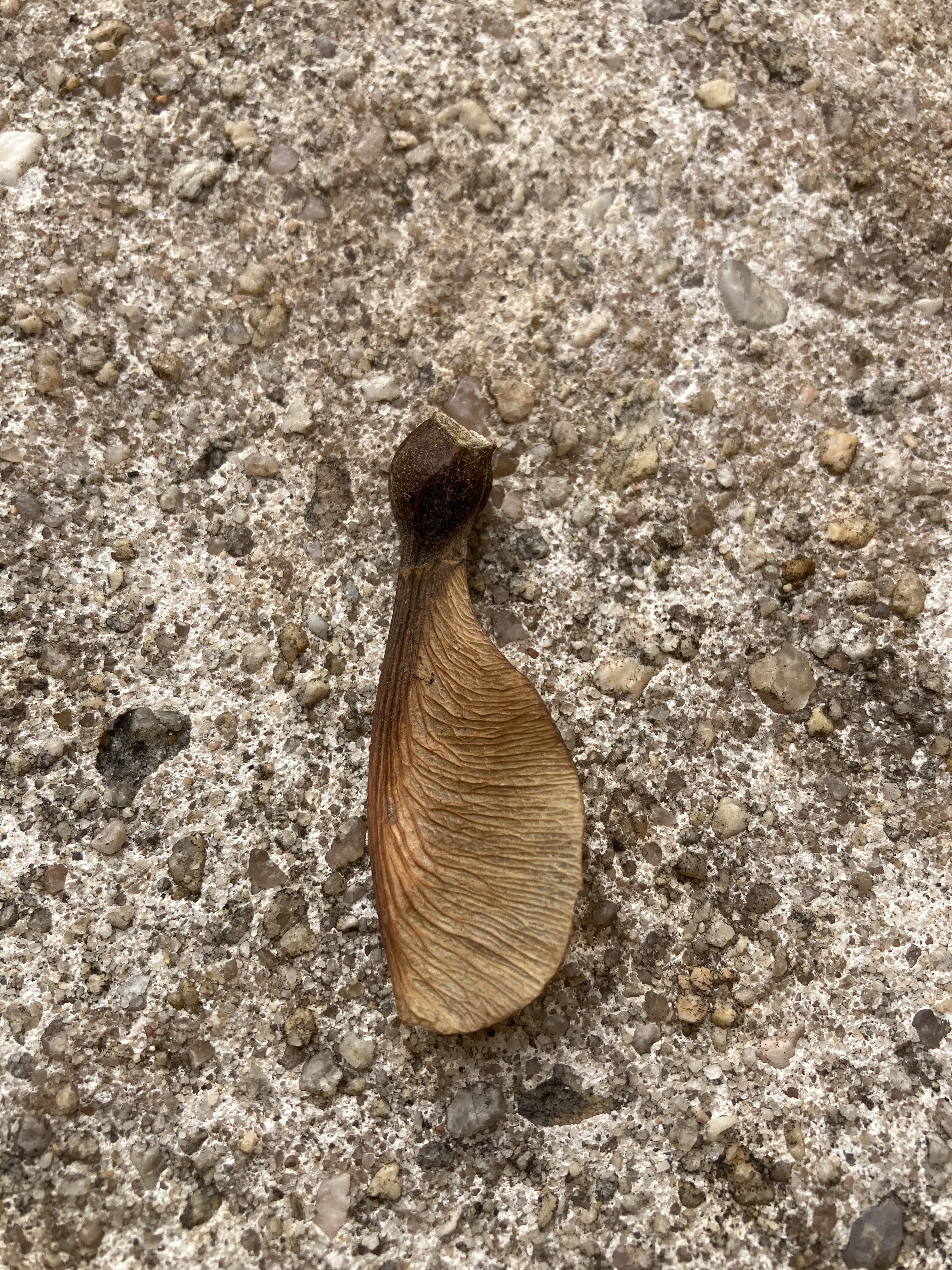
This single seed isn’t uncommon, is it? You’ll all be very familiar with this kind of seed distribution….where a plant creates an appendage which allow it to be carried far and wide by the wind. Well, first of all, this is pretty astonishing, isn’t it? I mean how amazing to be able to create a structure like this all by yourself? Trees, of course, don’t use any machinery or tools to manufacture a structure like this. And how even more amazing that a structure and strategy like this seems to have evolved on our planet. Isn’t nothing short of miraculous. You don’t have to look outside of Nature to be amazed, to find what seems utterly magical and enchanting. Truly amazing.

But there are a couple of other things I think about when I contemplate this single seed. The first is that even with our advanced scientific methods, nobody can tell you whether or not this particular seed is alive. And nobody can predict exactly where, when, or even if, it will grow into a tree. Nature, and Life, are fundamentally unpredictable. There’s a body of thought which argues that if we have enough “data” we can know “everything”….we will be able to predict the future with accuracy once we have enough data and the means to analyse it. I reckon that’s wrong headed. Nature, and Life, just aren’t like that. No amount of data will enable you to make accurate predictions about individuals….whether they be winged seeds, or human beings.

The second is that abundance is at the heart of Nature. Seeds like these are produced in enormous numbers. You could argue that they are “inefficient” in terms of modern management theory, because they are produced in numbers which far, far exceed the number of new plants which will grow from them. But these are key features to natural systems – abundance and “redundancy” (this latter term refers to having multiple systems which mostly aren’t used, but are there to provide flexibility and adaptability). Our industrialised capitalist system creates false scarcity – how many times do you come across an advert which tells you that if you don’t buy this now, then it’ll be too late, it’ll all be gone? If we created an economic and social model based on Nature, it would be based on the reality of abundance. We could house the world’s population in decent housing. We could feed the world’s population. We just don’t choose to, preferring to create an elite of billionaires instead……

Management theories based on pushing for ever more “products” or “services” from the least possible resources (human, material, social and financial) are not healthy, and they aren’t natural. Look how well they responded to Covid for example. From “Just in time” delivery systems, to the closing of hospital beds and failing to stock equipment needed to deal with crises…..it goes on and on. We need management systems better attuned to the reality of Life on Earth – and that doesn’t involve cut after cut after cut, or reducing human being to cogs in multinational corporate machines.

Thirdly, this seed lying on a stony path reminds me of the parable of seeds, as I was taught it at Sunday School. I don’t know if that parable is still taught, but amongst other things, surely it teaches the importance of the environment. If your seed doesn’t fall on fertile ground it’s unlikely to thrive. We need healthy water, air, and soil, and none of us can provide that by ourselves. Our human super power is co-operation and our ability to work together to create healthy conditions for individuals to thrive.

Any other thoughts come to you when you look at this little seed?

Read Full Post »

This photo inspires two opposite thoughts in my mind – one about longevity and one about brevity. This tree stump reveals about a hundred rings. I haven’t actually counted them all, but I think there are around a hundred of them, and that’s not unusual for a tree. In fact, many trees have a far greater longevity than human beings do. Some of them have lived several hundred years. Methuselah, a tree in Eastern California, is reckoned to be the world’s oldest tree, and seems to have been alive for over four and half thousand years. We humans average around eighty years, and can reach just over a hundred in a minority of cases. What enables any living organism to live for many years? One feature is persistence. The thing is nothing stays the same. Objects are not as fixed as we believe them to be. A tree, like any other living creature, is constantly metabolising nutrients, turning some into energy and others into structures such as fibres and cells. It’s actually more true to say that all living things are systems of constant flow and change…..but they look stable and fairly fixed over time. We can identify them, one from the other, not least because of this capacity to retain an internal integrity – a persistence over time.

On the surface of this tree stump is the shadow of a couple of flowers. From the shape of the shadows I’d say they are some kind of allium. If you look carefully you’ll see a few scattered purple petals. The shadows won’t last long at all. A cloud might pass over the sun at any moment and they’d disappear. Or over a few minutes the Earth will turn and the Sun won’t cast the shadows of the flowers in this direction any more. The petals which have fallen from the flower remind us how brief is the life of a flower. They really don’t appear for very long at all….certainly not nearly as long as a tree. Both the shadow and the flower make me think of the polar opposite of persistence – transience. Transience is the other fundamental characteristic of all life. Nothing lives for ever. Even a tree thousands of years old will die. We humans, all within a much shorter period than that. In Japanese culture transience is greatly valued and you can see that most clearly during the season of the cherry blossom, where the national newspapers chart the spread of the blossom from the south to the north of the country, and when thousands upon thousands of people go out to admire the trees, take photos, have picnics, and enjoy the colours.

Persistence and transience.

We need both. And it’s not a matter of balancing them so that one cancels the other out. Reality is a constant flow of change…..but it’s not formless chaos. Very distinct, very knowable, very recognisable individuals appear, live a life, then fade away back into the whole from which they emerged. Isn’t it amazing how we have evolved the ability to be aware of, even to relish, or celebrate, these polar opposites? Persistence and transience.

Read Full Post »

Not simple

Living organisms are not simple (no, not even the simplest of them!). Look at this tree. How could you begin to trace its beginning and its end? Where do its roots begin and end? Where does the trunk begin and end? What makes the branches emerge exactly where they do, and what determines the direction they will grow and distance they will stretch?

And, to think, this tree began as a single seed. How absolutely impossible to predict the exact shape and size of this tree from an examination of that seed.

We like to chop reality into pieces, calling this a part, and that, another part, as if there are clear divisions between what we are calling “parts”. But that’s just what our brains do. Specifically, that’s how we engage with the world from the perspective of our left cerebral hemisphere. That hemisphere was never intended to function alone, and all its hyper-focus, all its re-presentation, all its re-cognising, labelling and categorising, was always meant to be passed back to the right hemisphere for re-contextualisation, for re-absorption into the whole, so we could see the connections, the relationships, the ever changing, developing flow of the world.

I’m convinced that the world is a more satisfying place, that life is better, when I open my mind to awe, to wonder. I’m convinced that the world becomes meaner and more shallow when I reduce it to “things”, “objects” and utility.

How amazing it is to really stand and see a tree, a single tree, to gaze, and to wonder at its origins, its history, its connections and its here and now reality. How amazing.

Read Full Post »

I’m a fan of the idea of “going with the flow”, and I’ve written about it often, but when I was in South Africa last January I saw this person in the sea….not so much going with the flow, as “riding the wave”. This latter phrase isn’t one I use so much, but these feel like turbulent times, and it feels as if the flow is also turbulent….there are great waves, one after another. Waves of significant change, eye catching, attention grabbing waves. It would be easy to feel submerged by waves like these. It would be easy to feel that they are going to wash us all away. So maybe this is a time to learn how to “ride the waves”, to “rise above” them. To tap into their energy and use that to go my own way.

I think it comes down to the attitude we strike – if we approach these waves with fear, then, surely, we’ll drown, or, at best, be driven this way and that, against our will. But if we approach them with confidence, with a sense of wonder and curiosity….then we can play with them, create what we want to create, drawing on the energy and power within the wave, without blindly following its direction.

This does feel a time of great change, but, that can be exciting when we begin to see a potential evolution, a possible phase change, allowing us, as individuals, as communities, and even as a species, to move on to very different world, a very different way of living.

Read Full Post »

Living on the edge

I imagine that the first thing you notice when you look at this image is the sea. In fact, it was the sea which caught my attention, and triggered my camera release. But when I review it now, my eye is drawn from the water, to the rocks, and then to the houses perched on the top of the cliff. Strangely, I didn’t notice them when I was taking the photo.

How would you like to live there? Right on the edge?

You’d certainly have a fabulous view of the sea every day, for as long as you wanted to. As best I know house prices on the coast, with a sea view, are pretty much higher than house prices inland, so, perhaps most people are keen to live on the edge.

Others find it a bit scary. They’re not so secure perched on the top of a cliff, and open to the winds and storms which sweep in from the sea from time to time.

We’re all different.

The philosopher, Gilles Deleuze, writes about the “far from equilibrium” zone. It’s where change occurs. It’s the closest area to chaos, to phase changes, to producing emergent phenomena which we couldn’t predict. He says that when we follow a “line of flight” towards the edge, things can become clearer. In the middle, in a balanced, and relatively static place, the mix of streams of information and energies can make it hard to distinguish characteristics and themes, but as you stretch out towards the edge, it’s a bit like unravelling a ball of threads, each colour becomes easier to see.

But there’s something else about living on the edge which occurs to me. I’ve noticed the word “extreme” is used a lot these days, especially in politics, and always with an intention of shutting people down. Some views are described as “extreme right”, others “extreme left” (sometimes the word “extreme” is replaced with the word “hard”) but what does it tell us about the person to whom we are attaching this label? It’s a judgement, not an observation. The label is applied differently in different contexts of course. As I understand it, something like “universal health care” is described as an “extreme” view by some (much more so in the USA than in Europe). Here in France, that’s definitely not labelled “extreme”.

I’m wary of labels at all times, but I’m especially wary of this “extreme” label. It doesn’t tell me anything. I want to hear what the person has to say. I want to understand their world view and their beliefs. I want to explore their values. Labelling them doesn’t let me do that.

By the way, understanding a point a view, doesn’t mean you have to adopt it. It can, however, open up some points of common ground, and shift the discourse away from the harmful polarised quality which seems dominant at this time.

Read Full Post »

When I look at a mountain, my first thought, my first impression, is how unchanging it is. You can’t imagine a mountain changing. Can you? I used to look out across to Ben Ledi in Central Scotland, and what I saw every day was different. It was different because the light and the weather were different. So sometimes it would glow red with a setting sun, sometimes seem painted white with snow, other times hidden by low clouds and mists, but the mountain, itself, looked the same size and the same shape every single day. I couldn’t imagine a time when it wasn’t there, or when it was just created.

But look at this mountain beside Lake Annecy. It looks pleated. It has so many folds that it looks as if it is draped in a giant cloth. And when I look at that I can easily imagine that this mountain emerged…that it was created by massive forces, stronger than I’ve ever seen.

I can imagine a time when this mountain didn’t exist, and so I can imagine a time when it might disappear.

And I know, that if I was a scientist studying mountains, I’d be aware of just how the mountain changes, little by little, every single day.

Nothing is fixed in this universe. There are no fundamental, unchanging particles, the “building blocks” of all that exists.

The Universe is flow. Reality is always in the process of creation. Every changing.

Read Full Post »

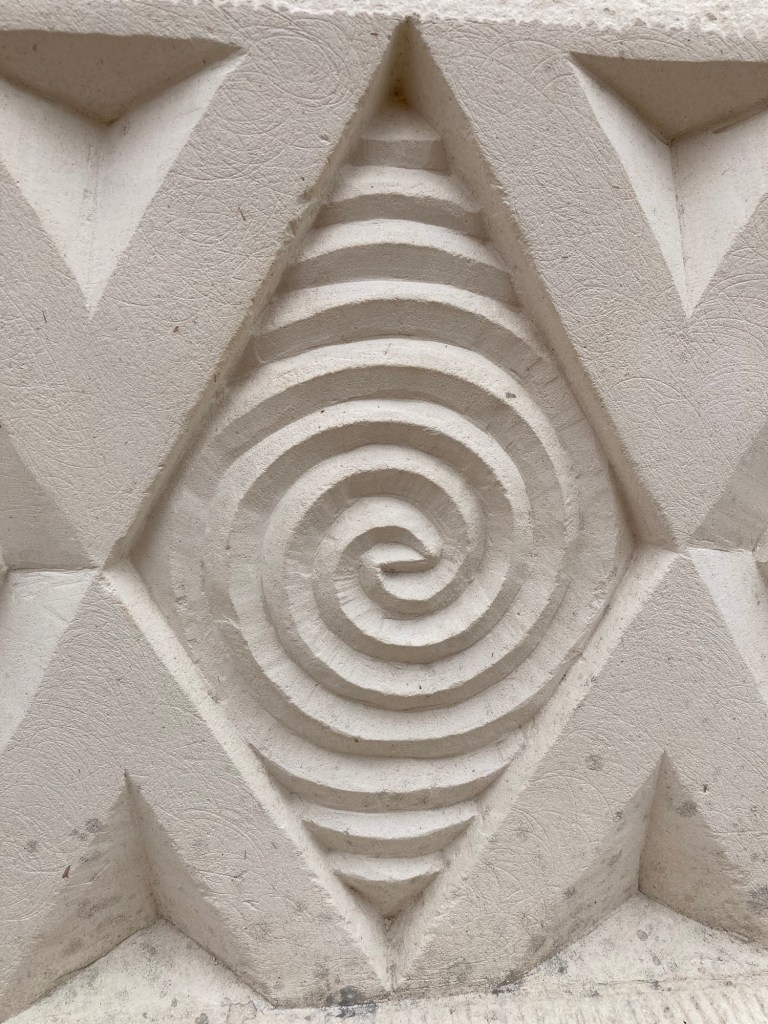
One of the commonest forms you’ll see in the plant world is the spiral. Pretty much any plant which sends out creepers to latch onto something so the plant can grow higher towards the sunlight, uses this form. It doesn’t go for a straight line….what we were taught is the shortest distance between two parts. Why not? There just aren’t that many really straight lines in Nature. It seems there’s a great preference for meandering, changing direction, spiralling around…..not what a machine would do.

Machines, and the industrialised types of management which dominate our lives now, are said to be best when they are most “efficient”. But Nature has a different idea. “Efficiency” seems, these days, to be about expending the least possible amount of effort and money to achieve a standardised outcome. It’s not natural, and it squeezing out beauty and life.

Complex, natural, living forms are not like machines. A plant doesn’t produce the least number of seeds required to produce a second plant. It produces thousands and thousands of them, using a huge number of different methods to have those seeds carried far and wide, relying on the weather and other creatures to do the scattering. Have you ever watched a bee or a butterfly collect pollen? They don’t start top left and work their way “methodically” flower by flower until they’ve harvested the most possible. There’s an inherent, apparent randomness to their flight. You just can’t predict which flower they are going to explore next.

The spiral is a favourite form of exploration in many plants. It’s a way of discovering.

It’s also extremely beautiful. One that artists replicate again and again. Here’s an example from the sculpture park near where I live……

Beautiful, dynamic, attractive, pleasing, and even in a stone carving, bursting with “life”.

I reckon we’ve taken a life destroying path through industrialisation, and I’d love to see us grow whatever we find life enhancing instead. We can do that by paying attention to, and learning from, plants and other creatures. We can privilege beauty, joy and Life instead of consumption, “efficiency” and “profit”. That would lead us to a very different kind of “growth”, and a very different society.

Read Full Post »

On reflection

One of the things I enjoy most about photography is taking the time to really look at the photos I’ve taken. I see things on review that I swear I didn’t see when I was actually there taking the photo. Or I see better something I had noticed, but didn’t take the time to look more closely while I was actually there. When either of those things happen it reminds me to slow down and pay attention in everyday life. I know some people feel that taking photos separates you from the moment, and maybe, in some ways, it does, but actually I find taking some photos, AND taking time to pay attention in the moment, AND reviewing the photos at home, (repeatedly), enhances the joy and pleasure I get out of life, and allows me to make more sense of the everyday.

Here’s an example. I was in Strasbourg and noticed the beautiful reflections of the old buildings. Probably thousands of people have taken a photo like this, standing at the exact same spot as I was standing on this bridge. You can see that happening more and more as particular views and locations become “instagrammable”. However, just as in life, every photo is unique. I framed this particular shot, not just to capture the buildings and their reflections in the water but to include the couple sitting on the steps (bottom left of the image) – because I thought that made a more appealing composition.

Having noticed them in the viewfinder, and taken the shot, I zoomed in to take a second photo, where the couple and their reflection in the water became the main subject. Here’s that second photo –

I think, at the time, my thought was, what a nice image of “reflection” this would be…..a reflection in the water, and a couple of people, well, reflecting (taking a moment).

But now that I’m revisiting these photos I’ve just seen something else. These people aren’t looking at the water, or the reflections. They are looking at something off screen to the left (there was a beautiful and very ancient tree growing at the end of the bridge. I think that’s maybe what they were looking at). Then I noticed something else. At first, I thought, oh, they’re sharing a pair of white gloves. Because it looks like they both have one gloved hand, and one ungloved hand. Now, sharing a pair of gloves is an interesting thing to do. I think I might have done that while we walked on a cold wintry day, with one hand gloved, and the other thrust deep into a jacket pocket….but, looking closer, I see that for each of them, the gloved hand is the left one. They are both wearing a left hand glove. Well, I’ve never seen anyone do that before. That sure makes me curious and stimulates my wonder and my imagination. What’s that about?

I do love it when a photo I’ve taken leads me off down very different paths of wonder the more closely I look at them.

I am convinced that taking photos, and reviewing them repeatedly, encourages me to reflect more….on the world, on other people, on my life, and on my every day experiences.

Read Full Post »

« Newer Posts - Older Posts »