Feeds:
Posts
Comments

Posts Tagged ‘mental-health’

Rebecca Solnit, in her “No straight road takes you there”, quotes the environmental writer, Chip Ward, as referring to “the tyranny of the quantifiable”.

There’s an obsession with numbers in our world. From measurements to statistics, there is a determination to quantify every aspect of life. Yet, Life, itself, is not quantifiable. Neither is Love, Beauty, Goodness, Happiness, Self esteem or self worth, despite the attempts by psychologists to attribute numbers and scales to any invisible phenomena.

This is an issue I had to deal with every day of my working life, because neither “health”, nor the most troublesome of symptoms such as pain, nausea, dizziness, fatigue, itch or breathlessness, can be observed objectively and be measured. Many people used proxies to measure the invisible – scales, such as “from 0 to 10, where 0 is the least troublesome and 10 the most, what number would apply to your “X” today”?

I remember the story of a dentist who ran a facial pain clinic. He insisted that every patient begin the consultation by telling him a figure from 0 to 10 related to how much pain they were experiencing. If they started to describe their symptoms, he’d interrupt, and insist “The next thing to come out of your mouth should be a number”. His successor in the clinic was baffled when the first patients would sit down and rather than say “hello” or start to describe their symptoms, they would say “7”, or “5”, or whatever. The old chief had trained them so well! “The tyranny of the quantifiable” indeed!

But let me return to health, because we all seek that, and doctors, surely, would hope to improve the health of their patients. But health, as Gadamer describes so vividly, in his “Enigma of Health” essays, is not visible, and not quantifiable. Rather, it’s pathology which makes an appearance….in the form of a rash, a swelling, an irregular heart beat, or a restriction of function. When the pathology recedes, health reappears….the painful hand becomes unnoticeable again.

The experiences which make every day seem worthwhile are equally, not quantifiable. Wonder, awe, joy, love, happiness, a sense of connection, of being understood, a feeling of belonging. We can’t measure those with a smart watch, a smart phone, or a fancy scanner.

That’s why our individual stories are so important. Only you can describe what you are experiencing, and only your story helps you make sense of your life. The counter-balance to the tyranny of the quantifiable is appreciation of, and the telling of, our encounters with wonder, joy, love and connection with others.

Your story is unique, and, together, we create a world worth living in by sharing our stories and co-creating the ones which we value the most.

Read Full Post »

In his “A Sand County Almanac”, Aldo Leopold writes…..

The last word in ignorance is the man who says of an animal or plant: “What good is it?” If the land mechanism as a whole is good, then every part is good, whether we understand it or not. If the biota, in the course of aeons, has built something we like but do not understand, then who but a fool would discard seemingly useless parts? To keep every cog and wheel is the first precaution of intelligent tinkering.

Now, this language, from the late 1940s is too mechanical for my liking, but, actually it’s still not uncommon today. We humans are not machines. Plants are not machines. No living organism on the planet is “machine-like”. As a result of the dominance of left hemisphere thinking, reductionism, for all its results and benefits, has blinded us to reality.

A human being cannot be reduced, cannot be broken into separate, isolated parts, without, at best, ignoring the consequences of changes in the whole body which come about from changes in a part, and, at worst, without killing the individual human being. Reductionism can only ever be a stage on a journey towards an understanding. The reductionist work of the left hemisphere needs to be integrated back into the holistic perspective of the right in order to understand the connections and consequences.

The same can be said of any living form. There isn’t a plant, an animal, or any other living creature which can be fully understood except by exploring their relationships and connections with the world in which they live.

One of the most unfortunate consequences of reductionism (I don’t know if it results from it, or simply accompanies it), is a focus on utility. What use is this? What use is this plant? What use is this creature? What use is this person? Utility can, or should, only be considered as one aspect, one perspective. We know this instinctively, don’t we? We wouldn’t reduce a loved one to an assessment of their “usefulness”, unless we were suffering from some kind of psychopathy. So why do we allow that to happen when we create businesses and factories? Industrial capitalism has a tendency to reduce human beings to “human capital”, or “Human Resources”, to be weighed, assessed, and judged, only on the criteria of utility. If they aren’t useful towards to the goal of increasing profits, then they are “useless”. A sad, miserable way to view the world.

What’s the utility of music? What’s the utility of art? Of gardens, of beauty, of poetry, of stories? What’s the utility of love, compassion and care? What’s the utility of joy, of wonder, awe and happiness?

Do people think that way?

Actually, it’s not uncommon to find that they do. Have you read anything that tells you about how gardening is “therapeutic”, of how music can improve “your mental health”, of how sharing a meal with a loved one can be “good for your health”?

The thing is, a good life, a life worth living, is full of activities and experiences which we pursue, not for their utility but for joy, for love, and because they touch our souls. Don’t wait for “science” to “prove” that music is beneficial to your neurones, to your immune system, or your hormones. Don’t wait for “science” to “prove” that a walk in the forest modulates your immune system, or stimulates your vagus nerve. Live for the everyday moments of wonder, joy, love and delight. One day, “science” will catch up, and tell you what you already know…..music, nature, poetry, caring relationships, love, wonder and joy are all “good for you”.

Read Full Post »

The dominant narrative in our current industrialised society is competition. It’s held up as the key success factor in capitalism, in business, and even, often citing Darwin, in evolution. It’s presented as the main way in which we humans have improved ourselves, succeeding over other species, beating each other to the top. It’s presented as the way to power and wealth. The key to success and happiness.

There is no denying that competition exists, and that its greatest worth is how it pushes people to improve. Sport is all about competition. It’s exciting and it drives human performance constantly to do better than has ever been achieved before.

Clearly, competition has its place.

But putting front and centre of the whole of life seems seriously misguided to me. Throughout history it has brought war, violence, exploitation, abuse and corruption. Because it all depends what you are competing for. If it’s more power and wealth, it too often results in division, xenophobia, racism, selfishness and cruelty. If you’re competing to improve, to achieve your best self, to create the best, fairest, healthiest society, maybe it’ll help.

I worked all my life as a doctor, so my area of knowledge and skill is what makes human beings thrive. If you consider the human body you can see that it contains billions of cells. Billions. Many of those cells grow together to form body organs, like the heart, the lungs, the liver and kidneys. Many grow together to form tissues, like bone, ligaments, skin. Other grow together to form systems of chemicals and cells, like the immune system and the endocrine system. Are all these cells, all these organs, all these tissues in competition with each other to be the best they can be? No, they are not. If our heart was in a continual war with our kidneys, we would be sick. If our immune system was in a continuous race against our endocrine system, we would be sick.

A healthy body is based on collaboration. It’s based on relationships, especially “integrative” relationships. Integrative relationships are defined as “mutually beneficial relationships between two well differentiated parts”. In other words, health, and, life itself, emerges from a vast, interconnected web of collaboration. When it works, we have harmony. We have flow. We have ease. We have growth and maturation. When it doesn’t work we have sickness and death.

I often think of that when I read about society, politics or economics. Why base those systems on something more likely to drive violence and a world of “winners and losers”? The body doesn’t do that.

Not only that, stop for a moment and reflect. Which human being could thrive entirely by themselves? In isolation, with only their themselves to deal with everything? None. There’s not a single baby born who would have made it to adulthood without the care and support of others. There’s not a single human being on this planet who has made it to adulthood without a vast web of “integrative” relationships – between themselves and others, between themselves and other living creatures, between themselves and the rest of Nature.

What would society be like, what would politics be like, what would economics be like, if we based it on the natural reality of life on Earth………not excluding all competition, but putting collaboration, care and sharing at the heart of everything we do?

Read Full Post »

I came across a term recently, “suicidal empathy”. Musk talked about it in an interview with Joe Rogan, and it seems to have originated from a man called Gaad Saad. As best I can tell he suggests that a big problem in society these days is an excess of empathy. In fact, in some pieces this concept is put forward as a big “threat to Western civilisation”.

I was pretty shocked when I read this, and explored a bit further to try and understand exactly what they were claiming. They seem to be saying that if we have “too much” empathy for certain people then we risk damaging the lives and values of the great majority. Who are these certain people? The usual suspects I’m afraid, immigrants, minority ethnic groups, trans people and, well, it seems to me, pretty much anyone they don’t actually like.

I don’t buy this. Not at all. Empathy doesn’t determine your actions. But it can, and, I believe, should, influence them. My point is that empathy does not lead inevitably to any particular strategies or policies at a societal level, and whatever an excess of it is, do we seriously believe that having empathy for a minority group actually harms the lives of the majority?

We only have individuals in life. We only have individuals in relationships. There is no “the people”, or “the majority” which has a single view of anything. The claim that there is such a thing is the path to despotism or populist fascism.

I spent an entire career over four decades where the core of my everyday was a sequence of one to one relationships with individual patients. I had empathy for every single one of them. I believe that was the only way to understand them, to really get to know them, and, so to help them. I believe that without empathy for every single person I worked with, I wouldn’t have been as good at my job as a doctor. Can you imagine a doctor who reserves their empathy for select groups of individuals? Well, actually we can imagine that, but it’s not something I’d like to support.

No, it’s not an excess of empathy, or a “misdirected” empathy, which is the biggest threat to our way of life. It’s a deficiency. We don’t care enough.

When immigrants are vilified, treated as less than human, when children are bombed, blown to pieces and killed in pursuit of “terrorists” or in an attempt by one country to grab some of the land occupied by others, then we have an empathy deficiency.

Back when 9/11 happened, the novelist, Iain McEwan, said the greatest failing of the terrorists was a lack of empathy….or did he say a lack of imagination? I’m not sure at the moment, I’ll look it up. Ah, it was both…..

If the hijackers had been able to imagine themselves into the thoughts and feelings of the passengers, they would have been unable to proceed. It is hard to be cruel once you permit yourself to enter the mind of your victim. Imagining what it is like to be someone other than yourself is at the core of our humanity. It is the essence of compassion, and it is the beginning of morality.

We need MORE empathy. Not less.

Read Full Post »

In the obsessively micro-managed world we live in now it’s more important than ever for us to take a pause. We are being bombarded with talk of crises, of doom, of having to everything faster, consume ever more, do everything so-called more efficiently.

But we humans are not machines. And we shouldn’t lead our lives, or construct our workplaces according to industrial machine-like principles.

Time and time again you can find creatives….artists, writers, composers, musicians, sculptors and so on tell you they need to have some breaks, some times where they just sit, or they sit and daydream. We need times to just step off the treadmill. We need to pause to gather our thoughts, to become more aware of the present moment, and to restore our depleted reserves of energy.

What length should a pause be?

There is no fixed amount. It can be a short as taking three deep breaths. It can be a few minutes, or a few hours. We need bigger breaks than that too, which is why it’s important to take all your annual leave from work. For some people it’s a sabbatical that they need. But the kind of pause I’m thinking about here, is the kind we all need, every single day.

I’m impressed by how in France there is a habit of stopping for a proper lunch…not grabbing a factory produced sandwich and a can of coke on the way to work and wolfing them down at the desk. They take time to go to a restaurant or cafe, to sit down, have a meal and share some time with workmates or friends. Then back to get on with the rest of the day. There’s still a widespread tradition of working five days a week, not seven here, so that everyone can have some family time, some home time, to do with as they want.

How about you? What pauses do you build into your everyday? What pauses would you like to build in, and why not start today?

Read Full Post »

The nature of any system cannot be discovered by dividing it into its component parts and studying each part by itself, since such a method often implies the loss of important properties of the system. We must keep our attention fixed on the whole and on the interconnection between the parts

Planck 1936

The Physicist Max Planck wrote this almost a hundred years ago, and he wasn’t the first to make such an observation. Despite that breaking things down into parts and studying them separately is still the predominant approach in the world.

When I studied Medicine at the University of Edinburgh in the 1970s we were taught “Medical Sciences” for the first three years of the six year course. We dissected bodies in the Anatomy class, studied pathological change in tissues and organs in Pathology, learned chemical pathways in Biochemistry and so on. In fact, the first time I saw “cirrhosis” was a diseased liver stored in formalin in a plastic box marked “cirrhosis”. It wasn’t until year 4 that I met an actual patient who had “cirrhosis of the liver”. Maybe all that has changed. But we still practice Medicine by focusing on parts. I often hear from relatives that on a visit to their GP, they are told they can only discuss one problem per visit….so, their asthma today, but come back to talk about their joint pain.

It seems the modern management techniques applied to health care chop the system and the patient’s experience into pieces, sending them to one person for a diagnosis, another for a blood test, another for a prescription, another for advice…..it’s horrendously disjointed. When my dad was in his last month of life in hospital, every single doctor I asked about his progress started their reply with “I’m not your father’s doctor, but I’ll look up his records….” I never found the person who seemed to actually know him.

Yet, we know from research that continuity of care increases both outcomes and satisfaction ratings of patients and practitioners.

In this age where so many people experience multiple “co-morbidities” we need to keep our focus on the whole even more than ever. If we only focus on the parts we begin to believe we know exactly what each drug will do when we prescribe it, yet, not only are the effects different for different people, but in reality, many people are taking multiple medications at the same time (for a multiplicity of disorders)

We need to focus on the whole, and that means giving priority to human beings, their uniqueness and their relationships. It involves trusting doctors and nurses to practice professionally focused on their patients, not on their protocols and clinical guidelines. And we need a lot more whole of life research, which will help us to understand the complexity of the effects of any drug, and the course of any disease in a real person over their lifetime.

It was never a good idea to ignore, or to relegate holistic knowledge. Learning about the parts should include learning about the limitations of learning about the parts.

Read Full Post »

We have two focus modes in our brains, with each of our cerebral hemispheres using one or the other. The left hemisphere engages with the world through a narrow focus. It pays attention to re-cognising what we already know. It tries to help us identify objects, literally grasp them, or understand and manipulate them. The right hemisphere engages with the world through a broad focus, paying attention to the bigger picture. It seeks out patterns, connections and relationships. When the left hemisphere identifies something it should pass that info to the right for it to be contextualised. Sadly, we’ve developed habits of not bothering to do that, sticking with our generalisations and abstractions.

What we pay attention to becomes magnified. It is the means by which we engage with the world. It creates our experience of the world. If we prioritise the left hemisphere focus we engage with a world of objects, of tools and “things”. We engage with a desire to manipulate and control. But if we prioritise the right hemisphere we engage with a world of relationships, of contexts and patterns, with a world of subjects. We engage with a desire to belong, to make connections, and to see the whole picture.

We live in what has been termed “the attention economy” where the big digital companies make their money through advertising, and advertising only works by grabbing your attention. Politicians have become adept at this too, casting out statements designed to shock, enrage or stoke fear….because shock, anger and fear are primary responses to threat.

But as you’re “doomscrolling” or reading social media headlines and posts, which of them command your attention? Are they the ones that make you feel enraged, afraid, insecure, inadequate? If so, those are the feelings which are going to get magnified. Those are the feelings that are going to shape your perception of reality. Or are they the ones which delight you, which stir feels of wonder, curiosity or joy? Do they put you in touch with the three classic values of beauty, truth and goodness? Do they increase your feelings of dignity, decency and compassion? If so, that’s how you are going to perceive reality.

What we focus on, and what’s important here is to be aware of what we are focused on, shapes our world and our day to day experience of life.

Our attention is our super power. We should use it wisely.

Read Full Post »

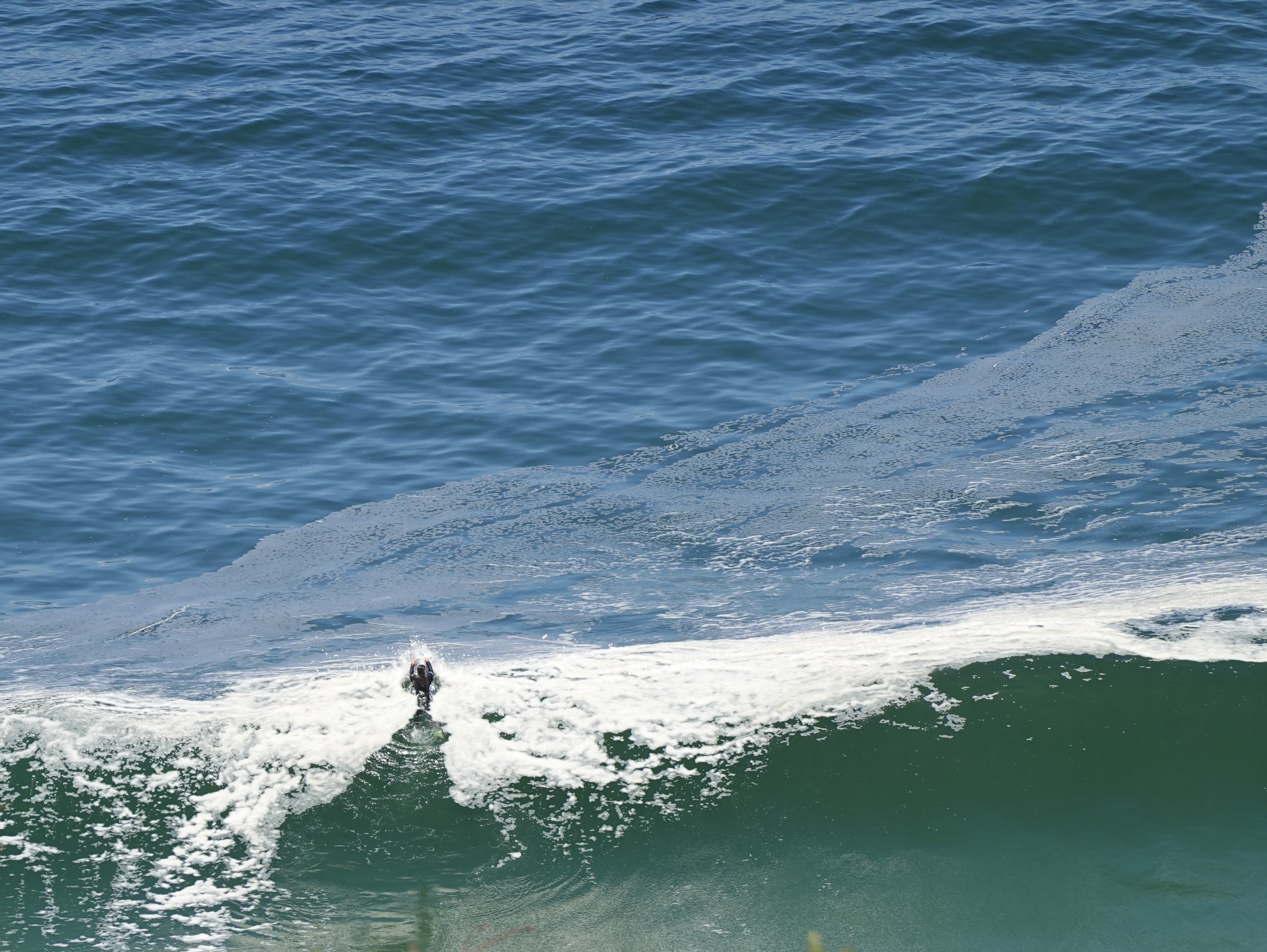
I’m a fan of the idea of “going with the flow”, and I’ve written about it often, but when I was in South Africa last January I saw this person in the sea….not so much going with the flow, as “riding the wave”. This latter phrase isn’t one I use so much, but these feel like turbulent times, and it feels as if the flow is also turbulent….there are great waves, one after another. Waves of significant change, eye catching, attention grabbing waves. It would be easy to feel submerged by waves like these. It would be easy to feel that they are going to wash us all away. So maybe this is a time to learn how to “ride the waves”, to “rise above” them. To tap into their energy and use that to go my own way.

I think it comes down to the attitude we strike – if we approach these waves with fear, then, surely, we’ll drown, or, at best, be driven this way and that, against our will. But if we approach them with confidence, with a sense of wonder and curiosity….then we can play with them, create what we want to create, drawing on the energy and power within the wave, without blindly following its direction.

This does feel a time of great change, but, that can be exciting when we begin to see a potential evolution, a possible phase change, allowing us, as individuals, as communities, and even as a species, to move on to very different world, a very different way of living.

Read Full Post »

How do we improve the quality of our everyday lives?

One way is to do whatever brings us joy, and makes us wonder. And we can do that, either by pursuing an activity which we know brings us joy, for example, listening to our favourite music. Or, and this adds in the element of wonder and discovery, pay attention to the hear and now.

As I wandered through my garden one day, just looking to see what I might notice, I spotted this tiny plant. First of all, I’d never seen a plant like this before, so I didn’t know what it was called. Secondly, I kneeled down, got up close, and just looked. Isn’t it beautiful? Isn’t it amazing? What an incredible structure, and what beautiful colours. I love those tips of purple emerging from the green. Then I got my phone out and took a close up photo….this photo.

I like to take a photo for two reasons. First of all, I can then go back and look more closely over and over again. I can enrich an already rich experience. Second, because my curiosity has been stimulated, I can touch the little “(i)” button on the phone screen when I’m looking at the photo, and it magically tells me the name of the plant.

Apparently, it’s a “self-heal”. Oh, like all plants, it has many other names too, but the name “self-heal” immediately appeals to me. After all, in all my years working as a doctor, that’s exactly what I was trying to do – to stimulate and support a patient’s self healing. I know we live with a kind of medical myth that doctors heal us with their operations and their drugs. But they don’t. Nobody repairs a single wound without the body’s capacity to self heal. Nobody recovers from a virus without the body’s defence and repair system doing its job. Nobody heals without the body’s complex system of self healing doing what it is designed to do. Doctors should remember that. They don’t heal patients. Patients heal patients and the doctor, when working at their best, support, stimulate and work with, the capacity if the patient to self heal.

Once I had spotted this plant, identified it, explored more about it online later, then I suddenly saw it appearing everywhere in the garden. Well, not everywhere, but over a very wide area. Now there’s something else amazing about gardens. I didn’t plant this beautiful plant. I didn’t “propagate” it. But there it is, and it’s thriving. I find that wonder-full!

Read Full Post »

I read an article in the Guardian today entitled “Consuming arts and culture is good for health and wellbeing, research finds” It caught my eye – first because I thought consuming arts and culture ??!! I hate that. I don’t consume arts, I experience/enjoy/participate in…..not consume…. and what is culture anyway? Well, let’s leave that issue for another day. The next thought I had was “I don’t enjoy arts in order to improve my health or wellbeing, and this headline leads me to think these folk are about to try and justify arts on the basis of their utility. But, in fact, the article is even worse than the headline suggests. Here’s how it begins –

Most people are familiar with the buzz that attending a memorable play, film, concert or art exhibition can trigger. But now it is official: consuming culture is good for your health and wellbeing – and generates £8bn a year worth of improvements in people’s quality of life and higher productivity.

Seriously? I might have felt a “buzz” but, “now it is official” – “it generates £8bn a year of improvements in people’s quality of life and higher productivity”. Oh, thank goodness they’ve quantified that. Otherwise I’d have been stuck with my personal delusion that I was just enjoying something, or that it was adding meaning to my life!

Look, I understand what these people are doing, and, at one level, I commend them for it. They are trying to make an economic case for what isn’t measurable. We can’t measure paintings, poems or music. We can’t even really measure “health and wellbeing” (instead we invent questionnaires, the answers to which we allocate scores, then we say we are measuring the invisible – ok, another controversial view I can return to another day) They are claiming that, for example, going to a weekly drawing class at a museum is worth £1310 to each person from “going to see their GP less and feeling better about their lives”. Really? £1310? Not £1315? These apparently definite figures remind me of the old joke that 86.57% of statistics are made up……but, good on them for trying to make the case for arts funding to governments and policy makers who seem to understand only sums and measurements.

But, fundamentally, this makes me hugely uncomfortable. Can’t we make a case for the place of arts “and culture” in our lives without reducing them to arbitrary financial “values”, or so-called “measurements”. I don’t need any of those justifications to play music every day, to write, to read novels, to visit galleries and delight in their works, to feel the connections to their creators……

However, I read, just the other day, that more and more universities in the UK are closing down their Humanities courses, claiming that students don’t want them because they don’t see how they can lead to remunerative employment. Oh goodness, what has happened to our idea of education? What have we reduced that to? Is education only valuable if it lets you get a job managing a McDonalds outlet, or selling people “stuff”?

I hope reports like this one do stimulate debate about the Humanities. I hope they stimulate debate about what makes our lives valuable and meaningful. Meanwhile…..I’m going to continue taking photos, writing, sharing my creativity. I’m going to continue listening to music, reading novels, visiting museums and galleries – because those are some of the activities that bring me joy, that amaze me, that make me think, that help create meaning in my life. If all that contributes positively to my “health and wellbeing”, then so be it. But that’s not the reason I’ll keep filling my daily life with “arts and culture”.

Read Full Post »

« Newer Posts - Older Posts »