Feeds:
Posts
Comments

Posts Tagged ‘nature’

What I love about discovery and exploration is that you can do it right on your own doorstep. Our garden here in the Charente Maritime was largely abandoned for a few years before we bought the house. We’ve been working on a bit at a time over the last three years. There’s an area where we had giant brambles, overgrown nettles and fallen trees cleared away and seeded grass where it had until then been impenetrable but we left all the healthy trees which surrounded that area. I made a few paths amongst the trees and it feels like a little forest walk.

One of the things I love about this garden is that so many plants grow here after having found their own way here. I think there’s very little which has been deliberately planted (until we arrived!). So, the other day, the sun lit these lovely yellow flowers and I thought, what on earth are these? These days it’s dead easy to find out. I took a photo with my phone, pressed the “info” button and it told me this is Calendula arvensis. I only knew Calendula officinalis, so I then searched online and found a research article on PubMed Central about traditional uses of this particular plant. Wow, was I amazed! The researchers say it has “anti-inflammatory, antiviral, antimutagenic, antimicrobial, insecticidal, antioxidant, and immunomodulatory activities” – well, that sounds a lot! They list about 45 different areas of the world where there are recorded traditional uses of this plant, describing in each instance what parts of the plant are used and what they are used for.

I find all that absolutely fascinating, and it reminds me how much we limit our knowledge and therapeutic skills when we ignore how populations around the world have used particular plants over millennia. Surely we shouldn’t dismiss all this information just because we haven’t studied them the same we study our manufactured, artificial drugs?

While I was admiring this little flower I was aware of how much bird song I could hear, so I fired up another app on my phone, “Merlin”, which is a kind of Shazam for birdsong, and it found and identified seven different species of birds all singing like mad. I don’t think I’ve ever lived somewhere where there were so many birds around every single day.

I like how modern technology helps be to recognise plants and birds and how easy it is now to discover so much about them. It makes me aware of how little I know and how I’ll never stop discovering and exploring.

Read Full Post »

“I would love to live like a river flows,
carried by the surprise of its own unfolding.” – John O’Donohue

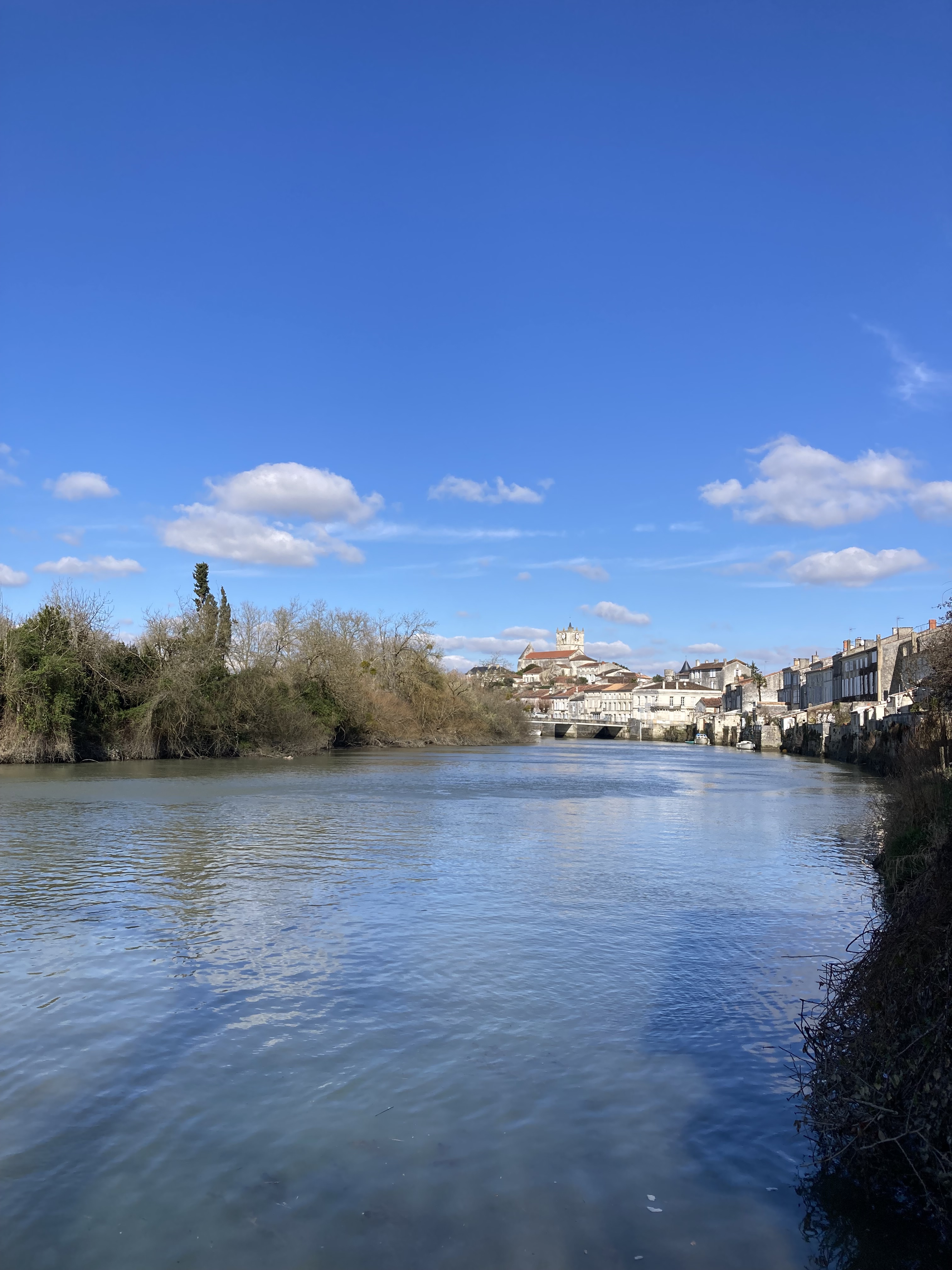
I live in the Charente Maritime, in South West France. I took this photo in Saint Savinien which is a small town just a few kilometres from where I live. The River Charente runs through the town, as it also runs through Cognac, near where I lived when I first moved to France a decade ago. It winds and twists its way through both the Charente and Charente Maritime departments and as you travel around you come across it again and again.

The primary characteristic of the River Charente is that it pretty much always looks the way it does in this photo. It flows incredibly smoothly. Maybe there is somewhere along its way where it breaks into white river rapids, but I’ve never seen that. It just never seems choppy, no matter whether it is flowing fast or slow. In fact, the impression you get is that it is at ease. It’s a river which flows calmly and almost effortlessly. So much so that people around here will tell you it is responsible for the rather laid back, “zen”, “take it easy” attitude so typical of this area.

Flow is a fundamental characteristic of all life. You could argue that it is the key characteristic, distinguishing the animate from the inanimate…..except that even the inanimate also flows, just over a much longer duration than the animate. You have to take a longer view to be able to see the flows of glaciers, continents and mountains.

I think flow is a marker of a good day. I feel I’ve had a good day when my activities, my thoughts, and my feelings have all been flowing like the Charente…..strongly, smoothly and incessantly…..with an ease, a freedom and purpose.

Read Full Post »

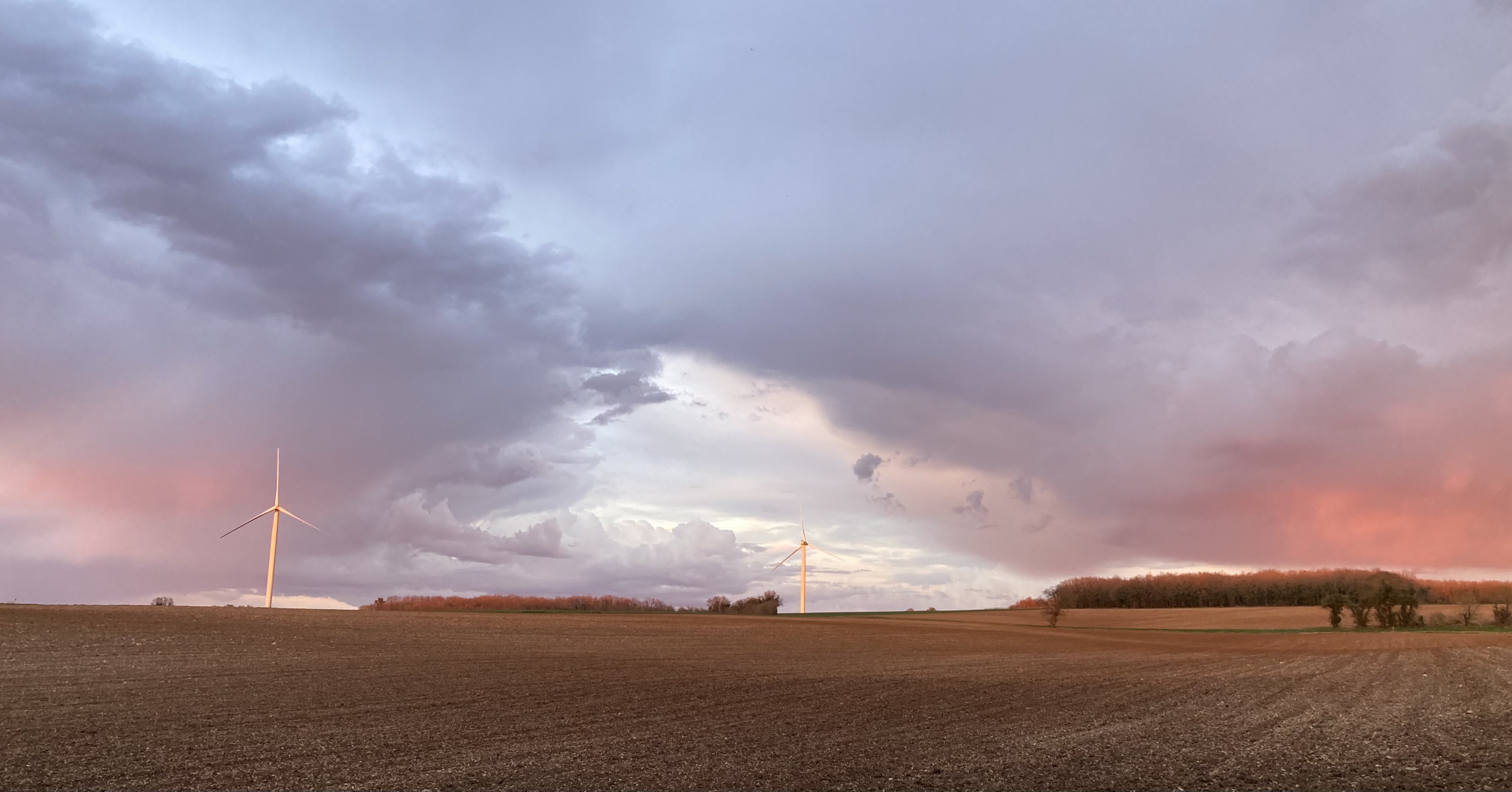
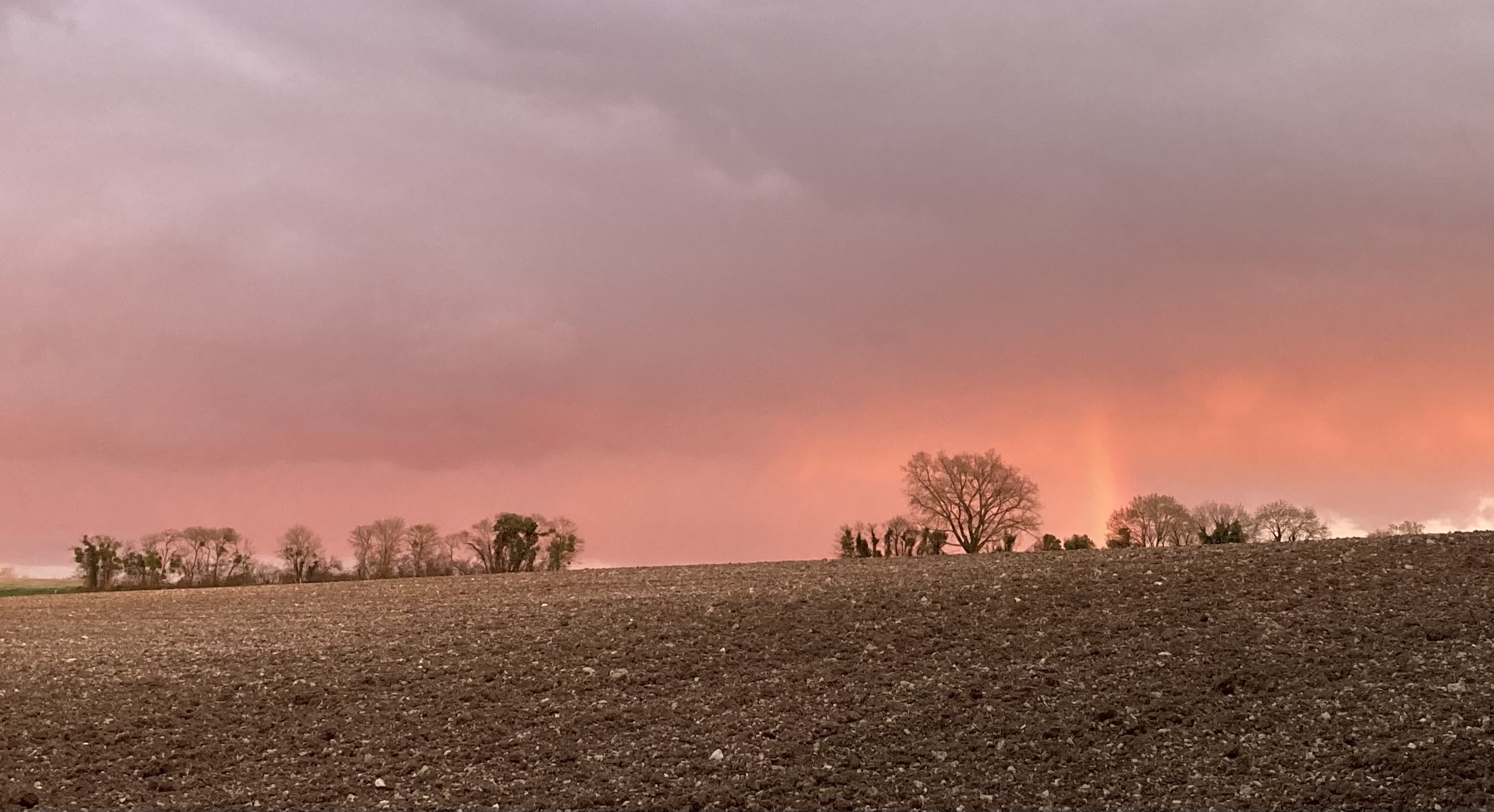
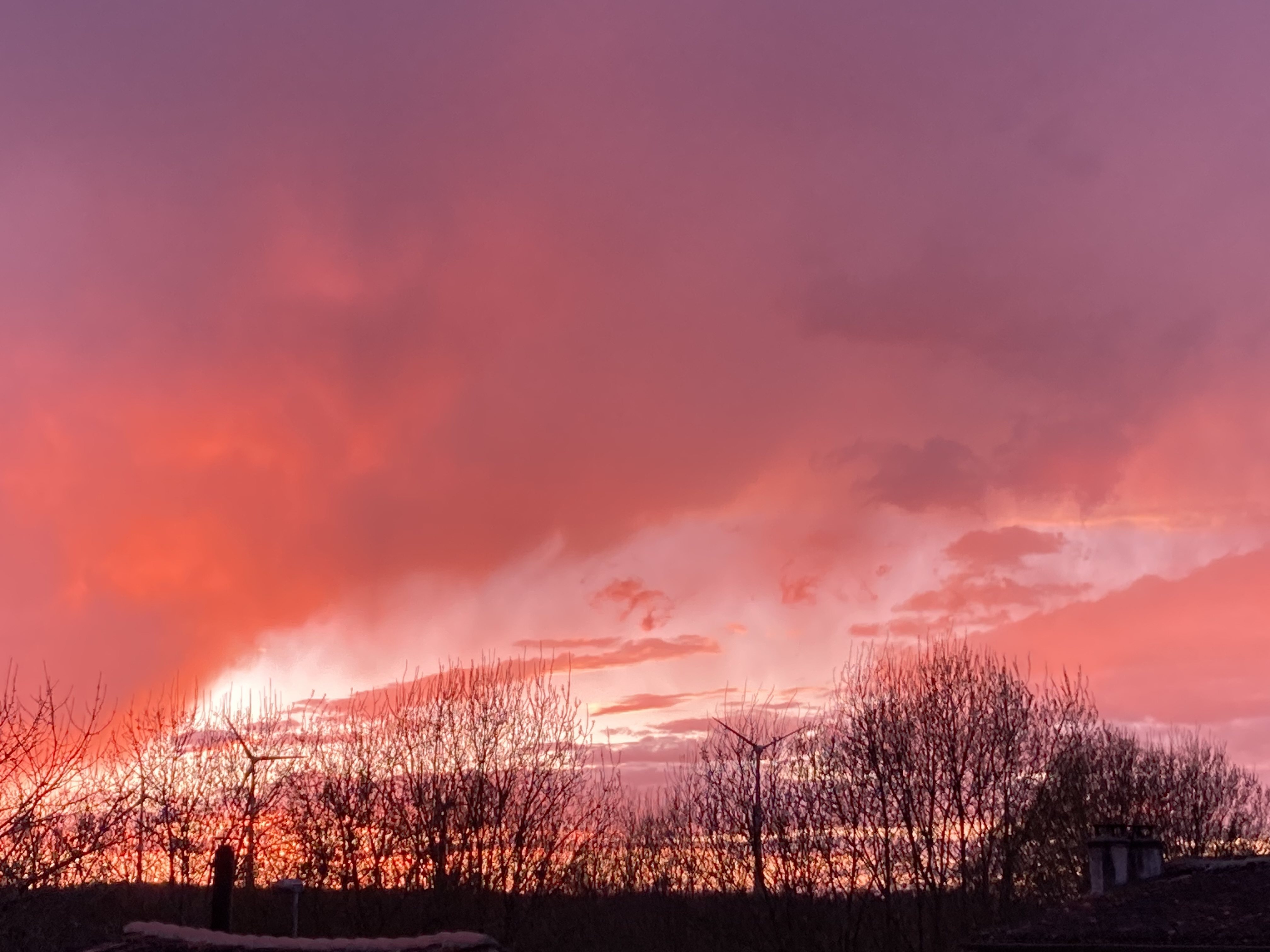
I know the old saying is “Red sky in the morning, shepherd’s warning”, but when I look out my window when I get up and see a sky like this I am delighted. I’m delighted because it’s beautiful. Don’t you agree?

And every encounter we have with beauty contributes to making today a good day. I notice beauty everywhere in nature. It’s easy to experience just by walking round the garden and noticing. There is so much beauty in the plant world. But while I’m in the garden I notice something else beautiful….birdsong. I’ve never lived anywhere else where I hear so much birdsong every day. I’m surrounded by it. Probably because my garden is surrounded by trees on every side. Looking up to the sky is another way to encounter beauty, whether it’s in the gorgeous reds of a sunrise, or sunset, or the amazing blues of a clear day, or the astonishing shapes of clouds as they drift by, or the sparkling night sky with the parade of planets.

A lot of the beauty I encounter is visual. You’ll know from browsing this blog that I’m a keen photographer. I photograph whatever catches my attention. I photograph what I find beautiful and what stirs my sense of wonder. But a lot of the beauty I encounter is also auditory. I love music and listen to music for a good part of every day. And a lot of the beauty I encounter is in other human beings. I am repeatedly struck by the kindness of others, by the shining delight in a happy face, by the strength and resilience of those coping with adversity, with the radiance of those who love.

Where will you encounter beauty today? Take a moment to notice, and a moment to reflect at the end of the day. It’ll make your day a better day.

Read Full Post »

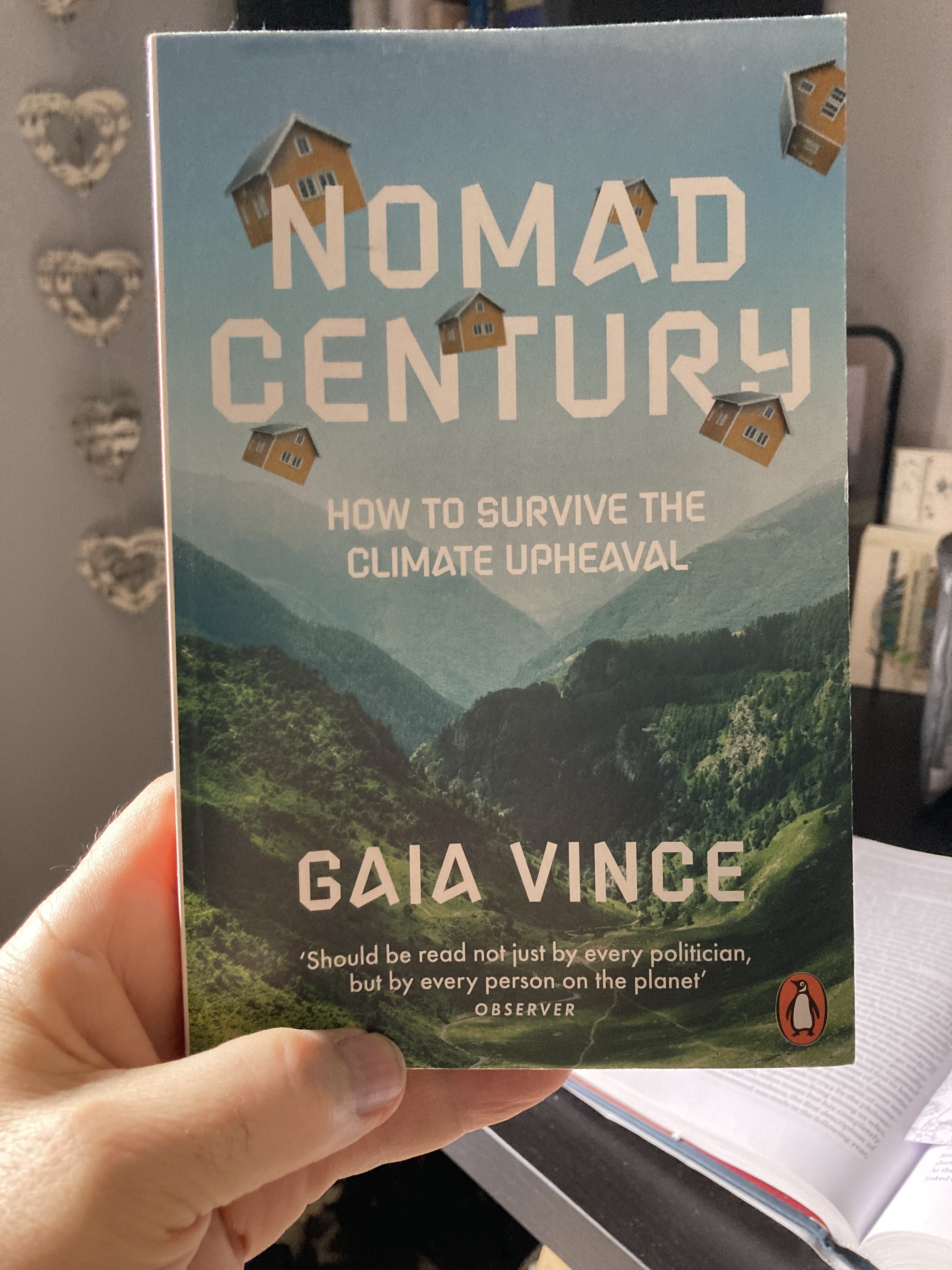
Here’s a book I’d recommend to anyone.

There are loads of books about climate change but science writer, Gaia Vince’s, book is probably the one I’ve enjoyed most. It is beautifully written, and easy read, and isn’t brimming over with despair about our changing climate. She doesn’t play down the significance, or magnitude, of the changes, but, in this book, she takes a focus on an aspect which I haven’t seen others do (or, at least, not so well) – migration.

“Migration is a survival strategy used widely in nature”

There’s a statement which resonates strongly with me. Whenever I try to explain reality, to demonstrate what “integration” actually means, and to highlight how important “cooperation” is, I focus on the human body. In the body are various organs…..heart, liver, kidneys, brain etc…..and in order for us to be healthy all of these organs have to relate to each other. They have to work with each other. They are not part of a competitive market fighting each other for nutrition and resources. Rather, they form “mutually beneficial bonds” – in other words, they create relationships which work both ways in the best interests of each part. This is integration – “the creation of mutually beneficial bonds between well differentiated parts”. Having explained that in relation to body organs, I go on to show how the same rule applies to all the cells and tissues of the human body, all of the billions and billions of cells which each of us has. And from there, it’s easy to see how the same principle applies throughout nature, across the globe, with complex webs of relationships forming between people, animals, plants, and the rest of the environment. Gaia Vance doesn’t use the word “integration” but what she focuses on is migration and cooperation.

For humans, migration is deeply interwoven with cooperation – it is only through our extensive collaboration that we are able to migrate, and it’s our migrations that forged today’s collaborative global society.

and

Studies across nature show that global dispersal is the most effective strategy for any species to prevent extinction.

and

…human brains are highly adaptive and we are hypersocial, able to cooperate with large numbers of unrelated people, supporting each other and sharing resources, ideas and knowledge

What she does so well in this book is to show just how natural it is to migrate. She describes the history of migration, in humans as well as in other species, and the history of borders and nation states (a surprisingly recent development in human civilisation). This reminds me of the writing of Rutger Bregman who challenges the whole issue of nation states and borders in his excellent “Utopia for Realists”.

This is a hopeful book which highlights how we need to think about migration differently – to move away from the toxic, xenophobic and racist narrative which seems to dominate in the world today.

We live in an inextricably interconnected interdependent world. None of us can live by ourselves. Our human super power is collaboration, and combing that with migration, learning how to plan for it, and manage it well, to ensure good integration, is our best hope in the face of a rapidly changing world.

Buy this book. Read it. Talk about it. Share it with your friends.

Read Full Post »

Finding a future

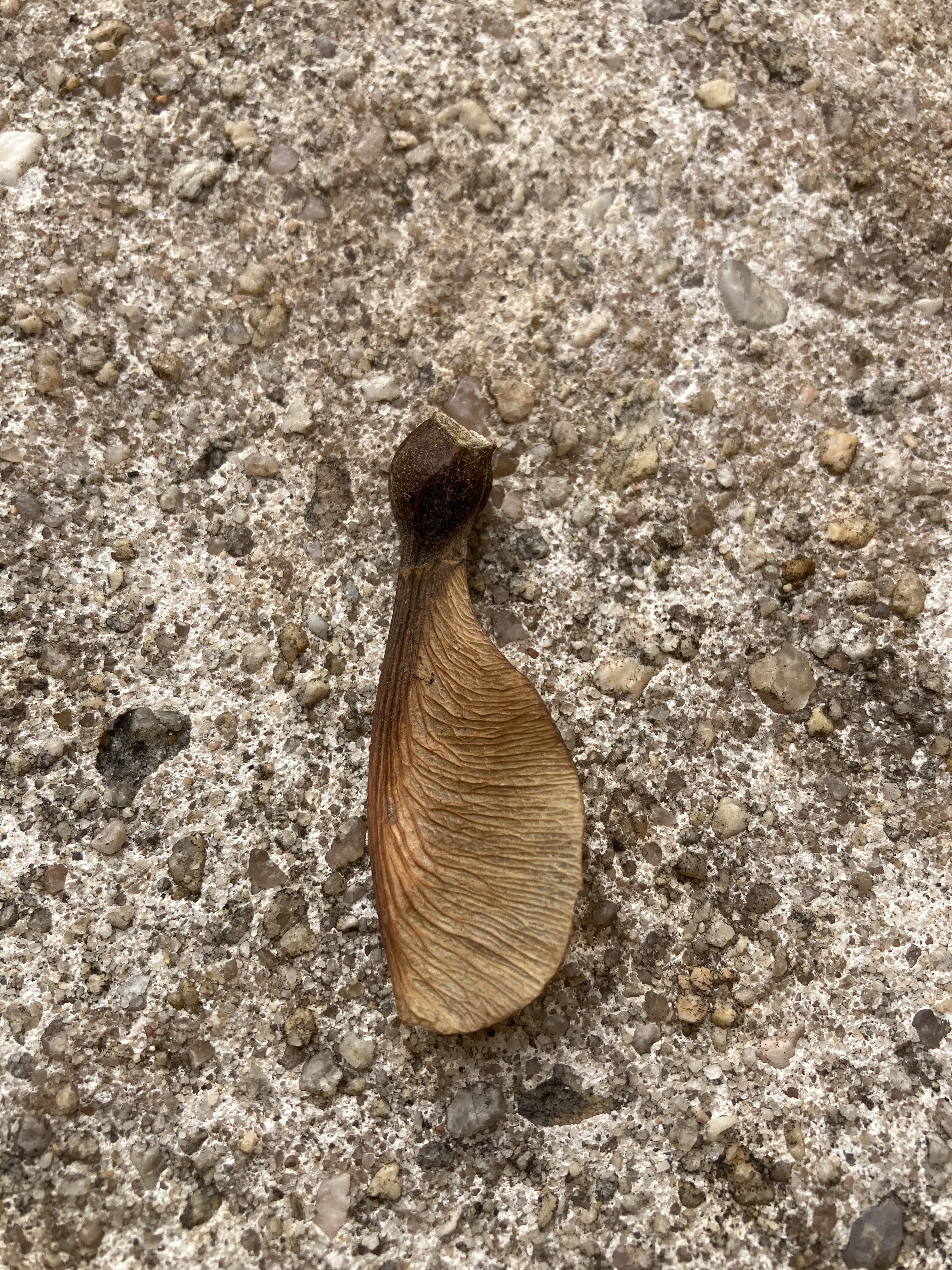
This single seed isn’t uncommon, is it? You’ll all be very familiar with this kind of seed distribution….where a plant creates an appendage which allow it to be carried far and wide by the wind. Well, first of all, this is pretty astonishing, isn’t it? I mean how amazing to be able to create a structure like this all by yourself? Trees, of course, don’t use any machinery or tools to manufacture a structure like this. And how even more amazing that a structure and strategy like this seems to have evolved on our planet. Isn’t nothing short of miraculous. You don’t have to look outside of Nature to be amazed, to find what seems utterly magical and enchanting. Truly amazing.

But there are a couple of other things I think about when I contemplate this single seed. The first is that even with our advanced scientific methods, nobody can tell you whether or not this particular seed is alive. And nobody can predict exactly where, when, or even if, it will grow into a tree. Nature, and Life, are fundamentally unpredictable. There’s a body of thought which argues that if we have enough “data” we can know “everything”….we will be able to predict the future with accuracy once we have enough data and the means to analyse it. I reckon that’s wrong headed. Nature, and Life, just aren’t like that. No amount of data will enable you to make accurate predictions about individuals….whether they be winged seeds, or human beings.

The second is that abundance is at the heart of Nature. Seeds like these are produced in enormous numbers. You could argue that they are “inefficient” in terms of modern management theory, because they are produced in numbers which far, far exceed the number of new plants which will grow from them. But these are key features to natural systems – abundance and “redundancy” (this latter term refers to having multiple systems which mostly aren’t used, but are there to provide flexibility and adaptability). Our industrialised capitalist system creates false scarcity – how many times do you come across an advert which tells you that if you don’t buy this now, then it’ll be too late, it’ll all be gone? If we created an economic and social model based on Nature, it would be based on the reality of abundance. We could house the world’s population in decent housing. We could feed the world’s population. We just don’t choose to, preferring to create an elite of billionaires instead……

Management theories based on pushing for ever more “products” or “services” from the least possible resources (human, material, social and financial) are not healthy, and they aren’t natural. Look how well they responded to Covid for example. From “Just in time” delivery systems, to the closing of hospital beds and failing to stock equipment needed to deal with crises…..it goes on and on. We need management systems better attuned to the reality of Life on Earth – and that doesn’t involve cut after cut after cut, or reducing human being to cogs in multinational corporate machines.

Thirdly, this seed lying on a stony path reminds me of the parable of seeds, as I was taught it at Sunday School. I don’t know if that parable is still taught, but amongst other things, surely it teaches the importance of the environment. If your seed doesn’t fall on fertile ground it’s unlikely to thrive. We need healthy water, air, and soil, and none of us can provide that by ourselves. Our human super power is co-operation and our ability to work together to create healthy conditions for individuals to thrive.

Any other thoughts come to you when you look at this little seed?

Read Full Post »

Power of uniqueness

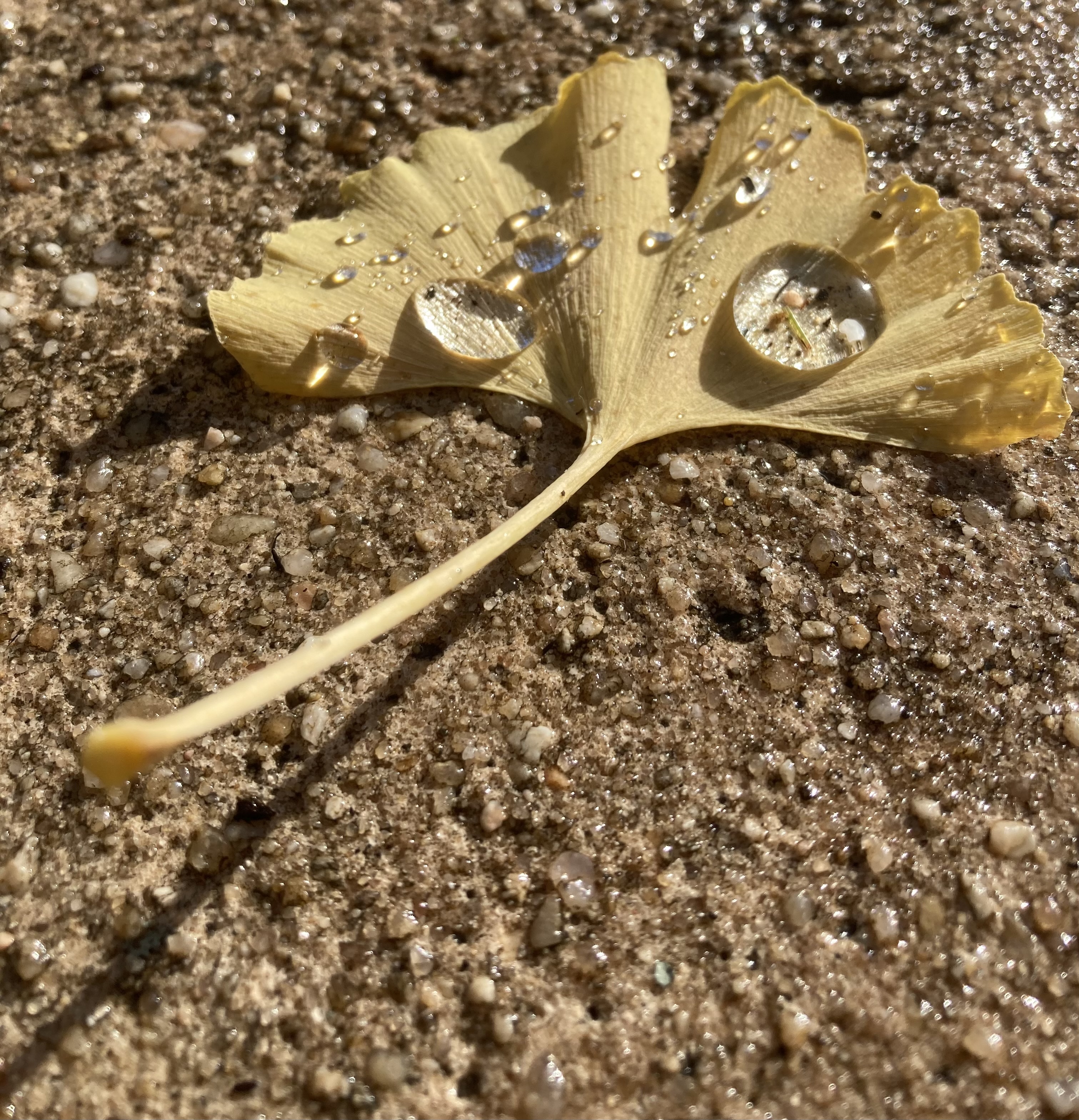
I find many trees beautiful. Some have especially lovely leaves which are so distinct in shape and colour that it’s easy to spot and recognise them. But what I find more powerful than just noticing and naming a tree, is to focus in on an individual leaf and take the time to really see it. There are no two leaves which are completely identical. Their uniqueness emerges as we consider their exact location at a particular time on a specific tree, or even, when we see a single leaf lying on the ground after a shower of rain.

The uniqueness of the leaf doesn’t lie in its “essence”, or even its particular shape, size and colour, but in its contexts and its relationships…….the tree on which it grew, the place where that tree grew, the season, the day and the time we noticed it, and took a moment to photograph it, the place the seed from which the tree grew came from, the person, or creature which carried the seed to this specific place, planted it, nurtured it, looked after it……and so on……

It’s the same for each of us. Every single one of us is unique. Over four decades of work as a doctor engaging with patient after patient individually, I never encountered two identical patients with two identical stories. Everyone had a special, un-repeatable, un-copiable (is that a real word??), presence. There was, and there remains, something incredibly special, even magical about uniqueness….perhaps not least because it can never be completely known.

There’s great beauty in uniqueness. There’s something “enchanting” about it. Not least because it’s the gateway through which we pass to encounter the “real”……all generalisations blind us to reality. They reduce complex individuality to features, characteristics or measurements. Labelling, judging and categorising extinguishes uniqueness and turns the beauty and wonder of diversity into something bland, soulless, and inhuman.

My life experience is that an awareness of uniqueness, and a desire to explore it and understand it, leads to a richer, deeper, more satisfying life.

Read Full Post »

I like this kind of fountain where the water pools in a bowl, or on a table, and flows gently, but constantly over the edge. It’s common to see this type of structure in Japan, but I’ve seen them in many other countries too.

One of the things I like about this particular photo is how the water in the bowl is blue, green, purple and black, but as it flows over the edge it appears golden, silver and clear. I know that has a lot to do with the colour and structure of the container but that’s the thing with water….it adapts, morphs, according to where it finds itself.

Water is such a strong metaphor for change. It loves to flow. It hates to be stagnant. It loves to change from liquid to gas, sending up into the air both millions of invisible water molecules, and visible mists. It loves to firm up in the deep cold of winter, to become hard and to create spectacular structures from icicles, to snow crystals, to icebergs. Those hard, solid looking structures don’t appear to be flowing, but they don’t remain in any one particular form for long. They too give off molecules into the air, at the same time as they turn to liquid on their surfaces.

Without water there would be no life on Earth. We only have the one water cycle on this planet. We might artificially divide up areas of the world’s oceans and seas and give them names. We might try to claim ownership or rights over patches of water, or the seabed below them. But water knows no boundaries, and water continuously cycles into the air, onto the soil, and runs back down into the oceans again. You can’t keep any of the water separate from all the rest.

We try to keep the water out of our houses, but water goes where it wants to go, and no amount of concrete or sandbags can contain it for long. Are there more floods these last few years? It seems so. At least, here in France, it does. Do we understand that? Do we understand how the water cycle works and why rainfall is increasing? Do we understand how rivers are formed and how they flow? Because if we don’t understand these phenomena well enough, how are we going to live with them?

Coastlines don’t stay the same forever. River banks don’t stay the same for ever. We need to adapt to the changes. King Canute didn’t have the right idea.

Read Full Post »

This photo inspires two opposite thoughts in my mind – one about longevity and one about brevity. This tree stump reveals about a hundred rings. I haven’t actually counted them all, but I think there are around a hundred of them, and that’s not unusual for a tree. In fact, many trees have a far greater longevity than human beings do. Some of them have lived several hundred years. Methuselah, a tree in Eastern California, is reckoned to be the world’s oldest tree, and seems to have been alive for over four and half thousand years. We humans average around eighty years, and can reach just over a hundred in a minority of cases. What enables any living organism to live for many years? One feature is persistence. The thing is nothing stays the same. Objects are not as fixed as we believe them to be. A tree, like any other living creature, is constantly metabolising nutrients, turning some into energy and others into structures such as fibres and cells. It’s actually more true to say that all living things are systems of constant flow and change…..but they look stable and fairly fixed over time. We can identify them, one from the other, not least because of this capacity to retain an internal integrity – a persistence over time.

On the surface of this tree stump is the shadow of a couple of flowers. From the shape of the shadows I’d say they are some kind of allium. If you look carefully you’ll see a few scattered purple petals. The shadows won’t last long at all. A cloud might pass over the sun at any moment and they’d disappear. Or over a few minutes the Earth will turn and the Sun won’t cast the shadows of the flowers in this direction any more. The petals which have fallen from the flower remind us how brief is the life of a flower. They really don’t appear for very long at all….certainly not nearly as long as a tree. Both the shadow and the flower make me think of the polar opposite of persistence – transience. Transience is the other fundamental characteristic of all life. Nothing lives for ever. Even a tree thousands of years old will die. We humans, all within a much shorter period than that. In Japanese culture transience is greatly valued and you can see that most clearly during the season of the cherry blossom, where the national newspapers chart the spread of the blossom from the south to the north of the country, and when thousands upon thousands of people go out to admire the trees, take photos, have picnics, and enjoy the colours.

Persistence and transience.

We need both. And it’s not a matter of balancing them so that one cancels the other out. Reality is a constant flow of change…..but it’s not formless chaos. Very distinct, very knowable, very recognisable individuals appear, live a life, then fade away back into the whole from which they emerged. Isn’t it amazing how we have evolved the ability to be aware of, even to relish, or celebrate, these polar opposites? Persistence and transience.

Read Full Post »

There’s an ancient spring opposite my house. It was there in the times of the Celts and the Gauls, then the Romans came and built a small viaduct and channel to harness it. The pool at the spring’s origin flows over a small wall into a narrow channel, and out into a stream which runs for kilometres through the countryside. Several of the villages near me have the word “moulin” in their name. It means a “mill”. The water flowing along this stream powered the millstones which ground the wheat. There’s little left of actual mills, but there are some with remnants of great stone wheels in their gardens, or at the sides of a house. The road follows the route of the stream. It follows it so closely you’d think they had both been created at the same time, but I think the water probably found its own way, and the people followed.

From time to time, I’ll spend a while across at the spring, gazing at the water flowing past the ancient Roman walls, and listening to it gurgling its way to the stream. It’s such a delightful experience. A few moments under the trees, standing on the grassy slope, paying attention to the flowing water.

There are many aspects of Nature which enhance our lives. The Japanese practice “forest bathing”, benefiting from time spent amongst trees, an experience I highly recommend. Researchers have discovered benefits to hospital patients in terms of speed of healing and reduction in pain and complications if they have a view of nature through the window from their beds.

Experiences of flowing water, for me, is one of these many circumstances which enhance an ordinary day. Fountains can have a similar effect. We don’t have any near us, but many French towns have a number of fountains in their central squares, and they always draw me to them.

Do you have anywhere nearby where you can spend a few moments next to flowing water? A stream, a fountain, a waterfall? If so, all you need to do is to pay a little attention to it. Focusing on some flowing water for a few minutes often seems to make a day a better day.

Read Full Post »

Look at this nest hanging from a tree in a garden at the foot of the mountain. Some nests are pretty amazing. This one is a sphere with a small entrance on one side. Why has the bird has chosen this exact spot to create it? We don’t know, but I’d imagine it’s got something to do with safety. After all, isn’t that one of the most basic needs of all forms of life? Shelter. But why hang it way out on the branch like this, where, surely, it’ll be buffeted by wind and rain more than it would be if it were closer to the tree trunk, or in a more dense area of branches and twigs. Again, I expect it’s about security. I expect it’s harder for predators of all kinds to reach it way out there.

But the other thing I thought about when looking at this photo, is the location of the nest in the surrounding landscape. A phrase from one of TS Eliot’s plays came to mind, where a character asks if people huddle together in cities in such large numbers because they like to be close to each other. I saw a graphic the other day showing the growth of cities over the last fifty years. Tokyo is the most densely populated city in the world by far, with something like a quarter of the whole population of Japan living there. I live in a hamlet of about 20 houses, just at the edge of a small village, surrounded by fields and trees. There are so many little villages and towns in rural France where you can pass through without seeing a single soul. All you see is shops and businesses which have long gone, and many abandoned old houses in various stages of disrepair. There’s a common issue in small to medium towns in France where they have developed shopping malls and zones around the edges of the town, and now, the middle of the town is almost dead. When we used to live near Cognac, we could walk down the main streets hardly seeing another soul, but as we passed the shopping outlets on the edge of the town we could see the parking lots were full to overflowing.

Why do we choose to live where we live? Of course, that’s a very complex question, related to where you were born, where your relatives live, where you can find gainful employment, where there are the necessary services providing education, health and social care. And a host of other factors too. But there’s also the issue of personal preference between city dwelling and country dwelling. There’s no doubt some people really prefer city life to that of a small town, or a village, and there are others who have the exact opposite preferences.

What would be your ideal place to live? If you could choose freely, what size and type of community and environment would you like to live in? And, do you know why?

Read Full Post »

« Newer Posts - Older Posts »