Feeds:
Posts
Comments

Posts Tagged ‘wildlife’

Little Owl

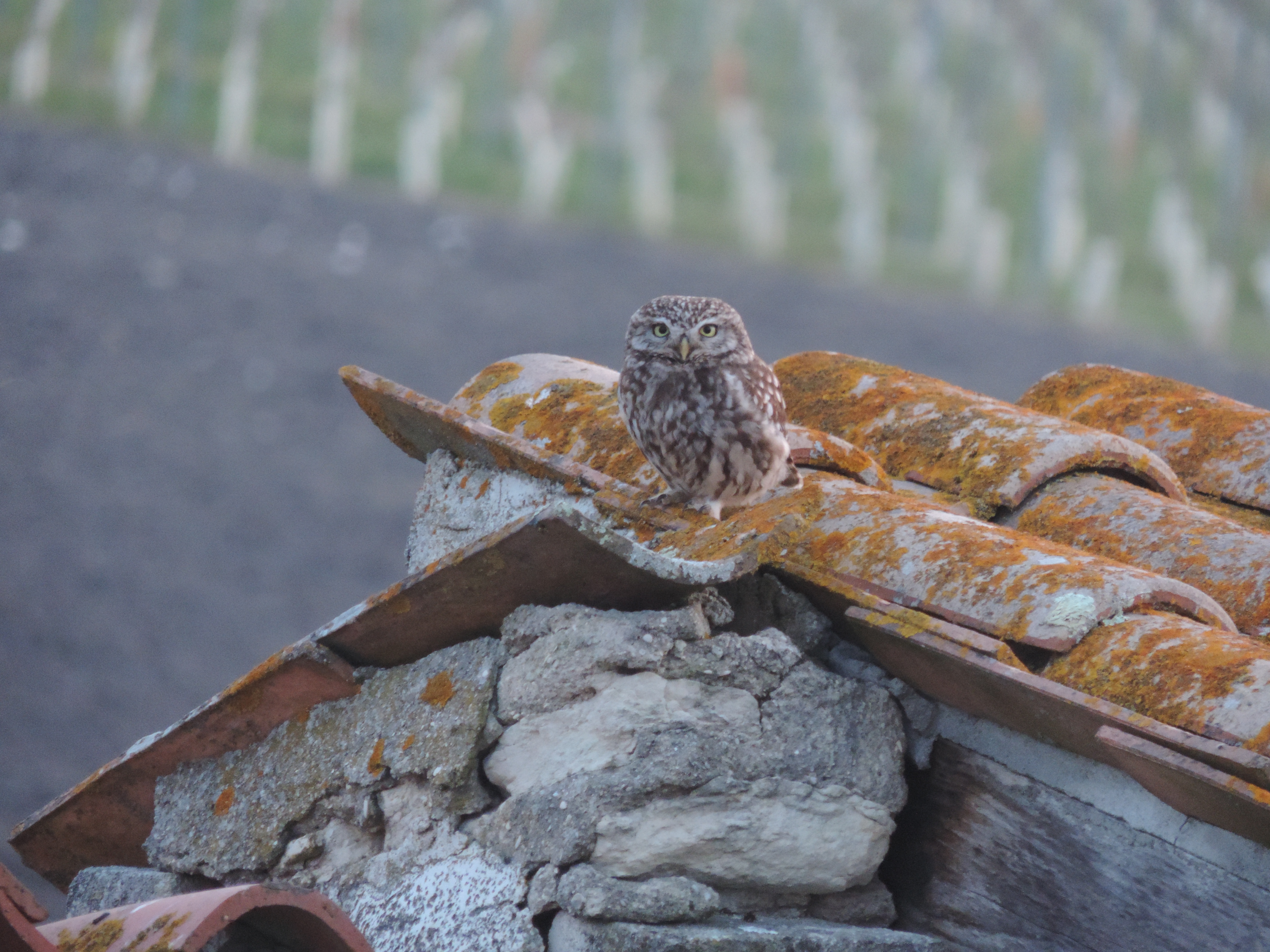
When I lived in Genté I had a studio upstairs looking out over old, abandoned barns to a hillside covered with vines. One day I had that sensation of being watched and when I looked out of the window I saw this bird. It’s a “Little Owl”. Yep, that’s what it’s called. There were several Barn Owls living both in one of the old barns, and in a dovecot cut into the wall of the house, just above our front door. I’d become quite familiar with them, but I hadn’t seen a Little Owl before. I reached for my camera and took this photo. No wonder I had the sensation of being watched! Look at that gaze!

We moved to the Charente Maritime, from the Charente, four years ago. I haven’t seen any Barn Owls since. But over the last few days I’ve heard a really loud bird call at night, and, then, more often, in the daytime too. I use an app on my phone to identify birdcalls. It tells me this is the call of a Little Owl. I haven’t managed to see him yet, but I’m hearing him loud and clear. I think he’s taken up residence in the forest area at the top of the garden.

But to return to this gaze……how do we sense that we are being looked at?

It can happen in a cafe, or restaurant. It can happen in the street. Somehow, we are attuned to the gaze of others (not just other people, but other creatures too). I’m convinced it’s not about scanning the environment and just noticing who, or what, is looking our way. It happens too often that I’ll look up from a book (yeah, I do a LOT of reading) and turn in the exact direction to meet the gaze of another. I don’t know how that works.

But, we all have a need to be seen, to be acknowledged, to be taken into account. Solitary confinement, “sending to Coventry”, and exile are powerful punishments. Intolerable, even. We are social creatures, and we can’t survive entirely without others. Yet, on the other hand, we can receive too much attention. We can wish for times where we aren’t noticed. We are living in a disturbing time of mass surveillance, where corporations and governments are watching, keeping an eye on us, and it’s not comfortable, or welcome.

Like so much else in Life, we have to find some kind of balance, some kind of harmony of two polar opposites. We need connections, we don’t want to be ignored or excluded. But we need privacy too, we don’t want others watching over us, following what we do, whether that’s to feed us advertisements, or policies, or to exert a control over us. And like the other balances we seek to achieve, there isn’t an end point, a place where we get to and then that’s it, we can move on. It’s a way of life.

There’s another question I have when I look at this photo. Why?

Why is this Little Owl looking at me? Why is he sitting out there on the roof, looking through the window into my studio, looking directly at me?

Fear? He’s keeping an eye on me, as a potential threat? I’m definitely no expert in bird expressions, but he doesn’t look afraid.

Because he wants to connect? Not, like have a chat, or start a beautiful friendship, but just to connect. Sometimes making a connection is enough.
Read Full Post »

I’m reading “A Sand County Almanac”, by Aldo Leopold, published back in 1949. It’s a delightful series of small essays on Nature, conservation and life on a farm in Wisconsin. It’s a breath of fresh air compared to the proclamations of today’s politicians, and a wholly different set of values, and seem to see the natural world as something to be plundered.

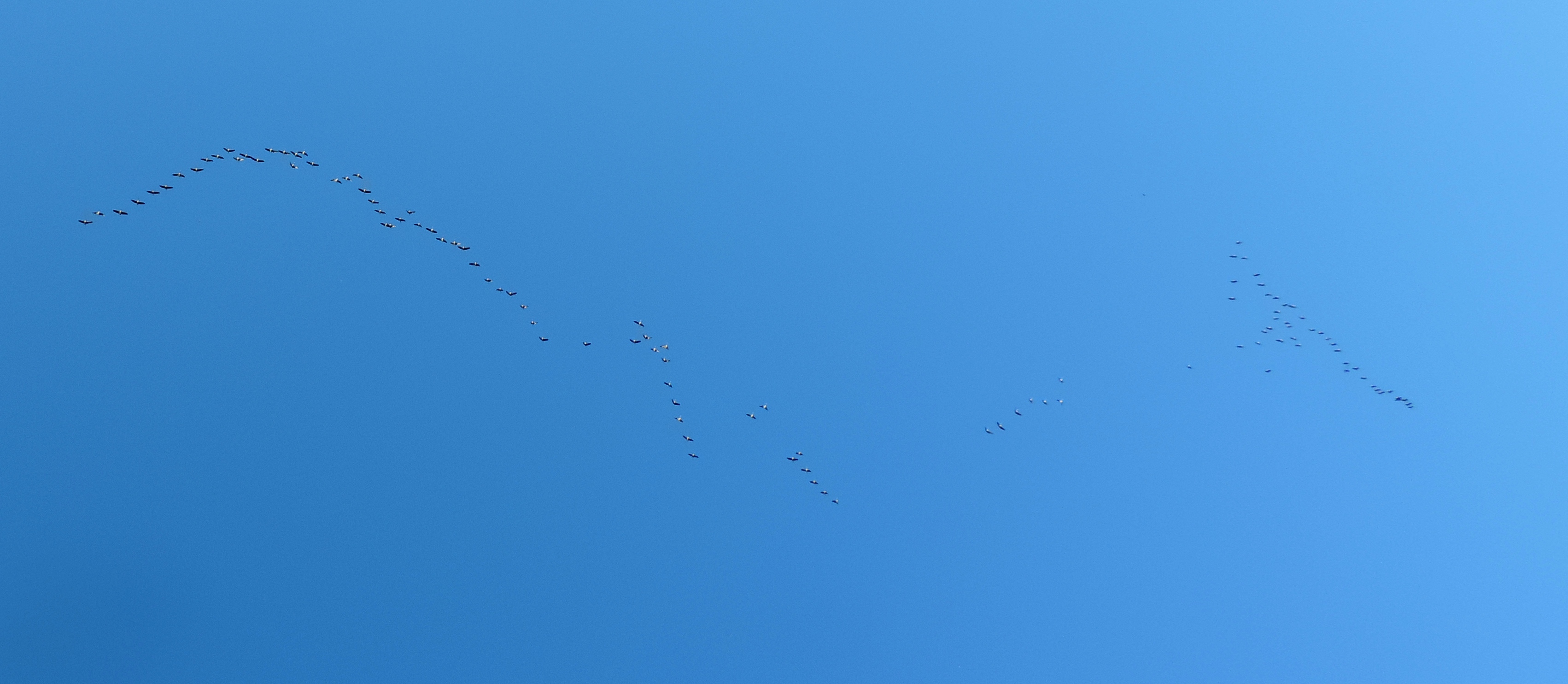
Early in the book, Leopold muses about the return of the geese from their winter migration. And he says this – “It is an irony of history that the great powers should have discovered the unity of nations at Cairo in 1943. The geese of the world have had that notion for a longer time, and each March they stake their lives on its essential truth”

Isn’t it amazing that the “essential truth” is we all share this one small planet, and that borders are totally artificial phenomena created by human beings to either try to grab a part of geography, or to exert power over others, creating a basic feeling of “us and them”. There are those who are included within a border, and there are those who are not – “aliens”, “foreigners”, “migrants” – any title other than fellow human beings.

Life moves around planet Earth.

We see it clearly in migrating creatures, not least the birds who spend part of the year in one hemisphere and part in another. But we only have to look back over a pretty short period of human history to see that we humans too, migrate. There have been great waves of migration in the past (not least to America from Europe in the 19th and early 20th centuries) and constant flows in between. Yet the powers that be seem to promote the us and them idea and think people should be judged and treated differently according to where they happened to have been born, or where their parents happened to have been born.

I think this is a kind of madness. It’s a delusion to think we can divide the human species up into all these separate, invented categories, and cruel to treat others according to where they, or their parents, happened to have been born. Who chooses where they want to be born?

I’ve long thought the problems of our modern societies are not caused by migration, but by greed, selfishness and inequality. Until we reverse the current trend of the rich getting richer while life becomes harder and less secure for the rest, politicians will seek “others” to blame – and, to often, those “others” are those who “were not born here”. Targeting those “aliens” or “foreigners” is a convenient way for keeping the Public attention away from those who are really causing the problems – the elites who grab and hoard more and more wealth, and are in the process of passing it on to their children through inheritance, enabling the next generations of the rich to become even richer, without having to do a single thing to do so.

This current system isn’t working. It’s not good for families. It’s not good for society. It’s not good for Nature. It’s not good for the planet. So who is it good for? Well, I think we know. But the trouble this, those profiting from it are a tiny minority of the human beings sharing this one little planet.

Read Full Post »