Feeds:
Posts
Comments

Archive for October, 2025

Rick Rubin writes –

Turning something from an idea
into a reality
can make it seem smaller.

This immediately stimulated my memories of reading the philosophy of Gilles Deleuze. It’s a few years since I did that, and I’m no philosopher, so I can only share with you, what I, personally, got out of reading some of his work. One concept he described, the one which came to me when I read these lines by Rick Rubin, was that of the “virtual”. I think his idea of the virtual was pretty complex and nuanced, but as I read it, the virtual contained what he called “a multiplicity of singularities”.

A “singularity” is a specific. I think of it this way. Today, as I wake up, stretching before me are a pretty much infinite number of possibilities. The day lies there full of potential conversations, encounters and experiences. There are sights and sounds and smells and tastes and textures which I could pick up on and enjoy. As the day unrolls, I make certain decisions, choices. I have certain encounters, certain experiences. Moment by moment they are the specifics of my day. All the other possibilities that were there at the start disappear. It’s a bit like the collapse of the wave. Like how Schrodinger’s cat can be both alive and dead until we open the box, then it’s the one or the other.

It’s even more complex than that, of course, because, moment by moment new “multiplicities of singularities” emerge….ones which only come into existence because of the actual moments which have led to this particular moment.

OK, that’s spiralling a bit out of control, and I’m sure some professional philosopher will be able to point out how much I’ve got wrong about the idea, but my point is, as inspired by Rick’s words, the actual, the specific, the singular, feels like a reduction. It’s the same with every choice we make. Once we make a choice, we choose one thing, one action, and in doing so, don’t choose the others. That’s why making decisions can be difficult. We can’t help imagining all the other possibilities we are about to turn away from. We feel, perhaps, that we are making the world smaller.

But there’s no alternative here. It’s not possible to live without singularities, without specifics, without actuals. If we don’t engage, if we aren’t aware, if we don’t reflect and consider, then the choices are made for us. Because this moment does actually exist. And the other moments which could have been disappear, or morph into some potential future set of possibilities.

So, I don’t fear this phenomenon of making anything “smaller”. Instead, I choose to be aware, to be engaged, and to co-create this actual moment of my unique existence in this vast universe.

Awareness and engagement open up the universe to us. They open the doors to co-creation of this moment, at this time, in this place. Embracing that is a joy, a celebration, which stirs wonder, awe and gratitude.

What not to like?
Read Full Post »

Rick Rubin refers to “the Source” when discussing the origin of ideas and inspirations. He writes that our creative ideas, the seeds of our acts of art, don’t come from inside us, which is what we unthinkingly believe, but, rather are “precious wisps [arising] from the unconscious like vapour, to condense and form a thought.”

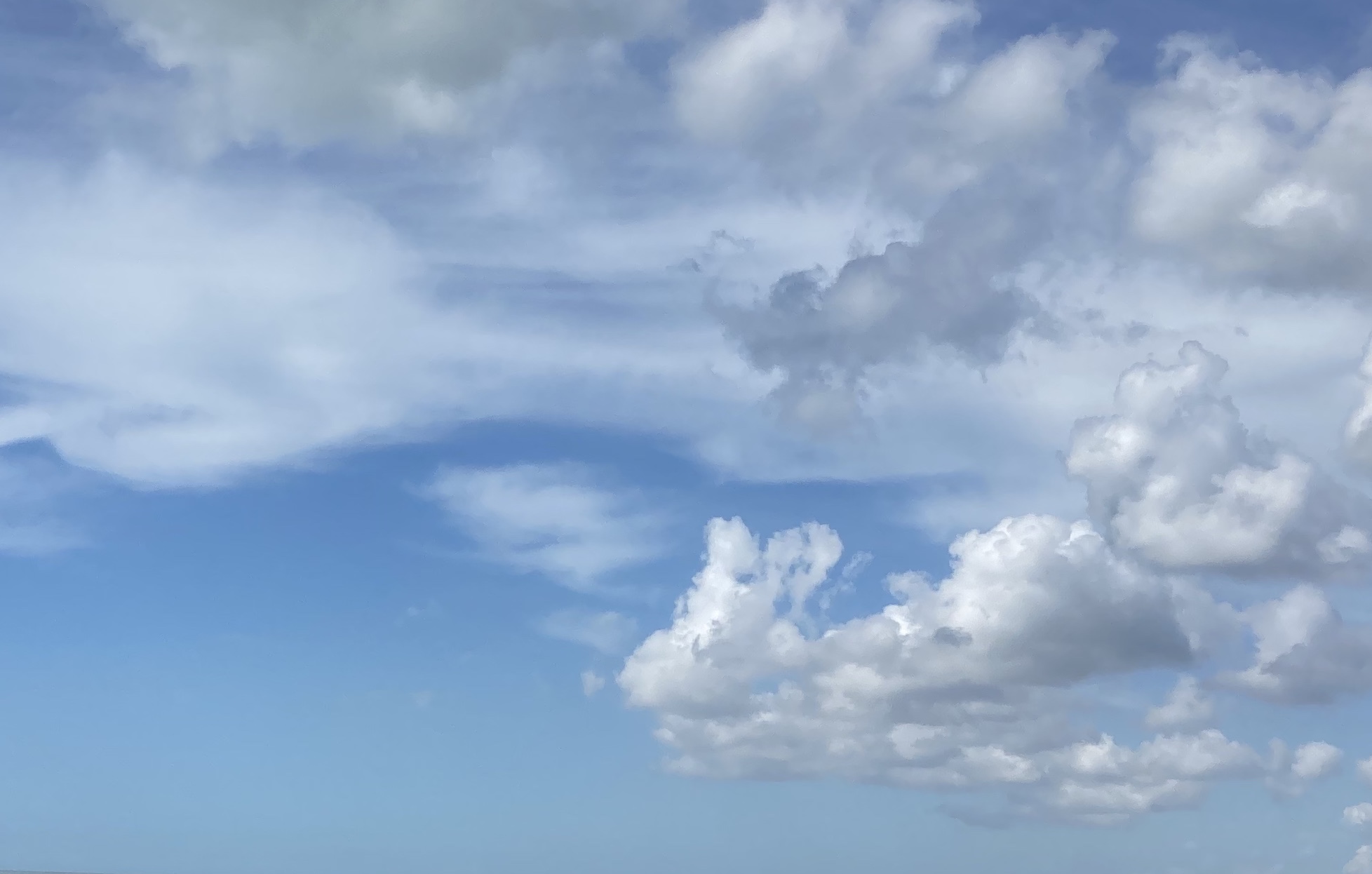
He uses the analogy of clouds.

“Clouds never truly disappear. They change form. They turn into rain and become part of the ocean, and then evaporate to return to being clouds. The same is true of art. Art is a circulation of energetic ideas. What makes them appear new is that they’re combining differently each time they come back. No two clouds are the same.

This whole concept has a foundation on the belief that the universe is benign, which reminds me of the much quoted idea about a friendly universe (attributed to Einstein)

If we decide that the Universe is an unfriendly place, then we will use our technology, our scientific discoveries and our natural resources to achieve safety and power by creating bigger walls to keep out the unfriendliness and bigger weapons to destroy all that is unfriendly and I believe that we are getting to a place where technology is powerful enough that we may either completely isolate or destroy ourselves as well in this process. If we decide that the Universe is neither friendly nor unfriendly and that God is essentially ‘playing dice with the universe’, then we are simply victims to the random toss of the dice and our lives have no real purpose or meaning.

“But if we decide that the Universe is a friendly place, then we will use our technology, our scientific discoveries and our natural resources to create tools and models for understanding the Universe. Because power and safety will come through understanding its workings and its motives.”

Using a slightly different form of language, Thomas Berry, in the final chapter of “The Great Work”, writes about “Moments of Grace” and tells the story of the evolution of the universe from this perspective, with each major “development” described as a “moment of grace” – the “Big Bang”, the formation of the fist stars, the creation of the planet Earth, the first forms of Life on the planet, the emergence of Human Beings, the first use of fire, the first gardens, the creation of writing and alphabets, and so on. Referring to each of these emergent steps in the history of we humans, situates us in a much “friendlier” universe.

Years and years ago I read a short article in Wired magazine which listed new words and their definitions. One of them was “pronoia” – defined as the delusion that others are conspiring behind our backs to help us out. That word popped up again recently when I was scrolling social media, defined now as a belief that the universe was “on our side”, helping us out.

The final writer who came to my mind as I read this idea of positive contributions from the universe, was Matthew Fox, who teaches “Creation Spirituality”. He claims the Catholic emphasis on “Original Sin” is all wrong, and makes a good case for replacing it with the idea of “Original Blessing”, pointing out that the creation story in Genesis is a very positive one, and that “original sin” isn’t described in the Bible at all (I don’t know if that’s true, my Bible knowledge isn’t that great, but he was a Catholic monk, so he should know!) I like his reframing though, and his “blessings” are very similar to Thomas Berry’s “moments of grace”.

It isn’t hard to find thinkers and authors who can help us to see the universe, not as meaningless, not as threatening and uncaring, but as vast phenomenon, which acts to support us in our survival and our creation.

Read Full Post »

“There’s a time for certain ideas to arrive,
and they find a way
to express themselves through us.”

There’s a theory about where ideas come from, and where memories reside. I’ve read this theory, or some version of it, in several places over the years. Most recently I read it in Rick Rubin’s “The Creative Act”. He suggests that sometimes great ideas come to us but we don’t act on them, then some time later we see them expressed by someone else. It isn’t that other people have stolen our ideas, it’s that the idea’s time has come, and if we don’t act on it, then someone else may.

I read a very similar view a few years ago in Elizabeth Gilbert’s excellent, “Big Magic”, where she said if we don’t write when inspiration comes our way, then, maybe somebody else will. Maybe the idea or inspiration will flow on to someone else because it needs to be expressed. Maybe we will miss our opportunity.

Iain McGilchrist, in “The Matter with Things”, explores memory and consciousness, and dismisses the idea that they lie encased in our skulls. Rather, he argues, our brains act as “receivers” which filter out some of the signals being received to present us with our experiences of consciousness and memory.

Others have argued something very similar……from Jung’s “collective unconscious”, to Sheldrake’s “morphic fields’.

So, it’s not a new idea that we have the ability to “tune in” to whatever is flowing through the universe, nor that that includes ideas, inspirations, memories, and so on. This tuning in is a bit like turning on a radio, the old fashioned, analogue kind, turning the dial, and listening as voices and music begin to appear in the white noise, first of all quiet and fuzzy, till we tune in better and it comes through loud and clear. Aren’t you still amazed that you can sit in a room somewhere, hearing only silence, but, in fact you are surrounded by, you are bathing in, a whole world of songs, stories and speech? You just need to switch on the radio, and tune it in for it all to be revealed.

That still amazes me.

But the idea that the universe is full of stories, words, ideas, images, and music, and that all we need to do is to create the space for it to appear, all we need to do is tune in, and listen….then be inspired…… then we can choose to act on these inspirations, these dreams, these ideas…..express them. Well, that amazes me too.

Read Full Post »

There’s been a shift in social media channels. Not long ago many people presented themselves as “Influencers”, but now, not so much. Increasingly I’m seeing the term “Content creator” instead. Or, sometimes, “Digital content creator”. I must say, the first time I noticed this shift I wondered mainly about the word “content” – I don’t find it appealing, but I understand it will cover anything from text, images and videos, to the spoken word or music (and maybe more, I’m not sure!). I do think of myself as a photographer and a writer. I do both of those things frequently…..pretty much every day. But, I guess none of that is “content” unless I publish it (or upload it) somewhere, like here on my blog, or on a social media platform like Bluesky (or Facebook, Threads, Mastodon, Substack, or whatever). However, having wondered for a while about what constitutes “content” I shifted my attention to the second word….”creator”.

A few years ago when thinking about health, and how did I know a patient was becoming more healthy, I hit on a three word acronym – ACE – for Adapation, Creativity and Engagement. Briefly, for me, the healthier someone became the better I saw their ability to cope, to deal with whatever they had to deal with, to adapt and change. In addition, I’d notice they were becoming more creative, more able to solve problems, to come up with new ideas and ways of living, to be better able at expressing themselves. And, finally, I’d see they were becoming more engaged, building connections and relationships, deepening connections and relationships, paying better attention to the here and now.

It struck me then, and it continues to strike me, that we humans are naturally creative creatures. Maybe you learned from a religious teacher that God created us in His likeness? I always thought that meant He created us as creative creatures. (We are more than simply creative creatures, and there are several other factors we can consider which contribute to our “human-ness”, but I’ll explore that another time.

Rick Rubin’s “The Creative Act: A Way of Being”, begins with a chapter entitled “Everyone is a Creator”. He writes –

To create is to bring something into existence that wasn’t there before. It could be a conversation, the solution to a problem, a note to a friend, the rearrangement of furniture in a room, a new route home to avoid a traffic jam.

He goes on to explore how through our senses and our brain/body processes, we create experiences for ourselves, we create our internal reality, from the undifferentiated external reality. In other words, just being alive is a creative act.

Finally, he writes –

To live as an artist is a way of being in the world. A way of perceiving. A practice of paying attention……your entire life is a form of self-expression. You exist as a creative being in a creative universe. A singular work of art.

I couldn’t agree more.

It’s not just “content creators” who are creative, it’s you and it’s me and it’s everyone you know. How does it change your perception of someone once you start to explore their creativity? What do you notice when you start to ask yourself, “in what ways is this person creative?”

Read Full Post »

I read an article recently about Cognitive Behavioural Therapy and its “evidence base”. The term “Evidence Based” is thrown around these days as a kind of label of approval. You might think it means “proven” or that scientists have examined the therapy and found that it works – well, when they say it works they mean they found it to be statistically superior to the control group. What they don’t say is whether or not the patients actually get well. And here’s the problem with CBT – a recent review found that 75% of people with depression treated with “CBT” did not become well, even though the statistical findings applied by the researchers led them to conclude it was “effective”. Can it be called effective if it doesn’t make people well?

CBT researcher Alan Kazdin put it bluntly in the flagship journal of the American Psychological Association:

“Researchers often do not know if clients receiving an evidence-based treatment have improved in everyday life or changed in a way that makes a difference. It is possible that evidence-based treatments with effects demonstrated on arbitrary metrics do not actually help people, that is, reduce their symptoms and improve their functioning.”

It’s strange really. The second half of my career was spent working at Glasgow Homeopathic Hospital, which developed into the NHS Centre for Integrative Care. We worked exclusively with patients with long term conditions, and, for the most part, with those who had failed to find relief through the orthodox approaches of drugs and surgery….or at least, who had failed to become well again.

We used an in-house assessment tool to measure the patients’ progress. It was a simple scale, 0 to 4, where 0 represented no change, 1 a change which had not made an impact on daily living, 2 a change which had made an impact on daily living, 3 a change which had made a major impact on daily living and 4 for completely well (there was a corresponding scale 0 to negative 4 for people who got worse). The person who assessed the change was the patient. The important point about this simple measure was that it was focused on the question…..has this therapy been of value to the patient in their daily living. That’s quite a different question from what percentage of the patients had a change in their blood lipid levels, their blood pressure, or whatever.

Time and time again our reviews showed that around two thirds of the patients rated a 2, 3 or 4 – in other words, two thirds of the patients experienced a change with had impacted on their daily living.

Yet, our approach, our tools and our therapies were rated as “not evidence based”, and year, after year, the Service was cut back and cut back, whilst at the same time online cognitive therapy programmes expanded on the back of their being “evidence based” (even though most patients didn’t become well again)

It’s a great idea to look at evidence, relevant evidence, but the pioneers of EBM said the clinician should take into account the research evidence, their clinical expertise and the preferences and values of their patients. How often does that happen?

It’s long past the time we should stop rubber stamping an approval on treatments which haven’t been shown to make a difference in most patients’ lives.

Read Full Post »

Rebecca Solnit wrote, “Categories too often become where thought goes to die. That is, there’s a widespread tendency to act as if once something has been categorised, no further consideration is required. But, often, it is.”

When I read this I thought of some of the writings of the General Semanticists, especially the phrase, “Judgement stops thought”.

We humans have a tendency to privilege the work of our left cerebral hemisphere which is our powerhouse for stripping out details, generalising what it encounters and applying labels, before setting its work into categories…..neat, separate, distinct, categories.

The trouble is, once we’ve done that, and once we start putting whatever we encounter into one of those categories, we stop seeing the uniqueness of “here and now”. We stop seeing the uniqueness of this particular person. We stop seeing a person at all.

There was a strong element of this in my training at Medical School, where they taught us pathologies before they taught us about people. Teachers and students would say things like “Have you seen the hepatomegaly in Ward 2”, or “Have you listened to the heart murmur in bed 14?” I first encountered cirrhosis of the liver in pathology class. It was in a perspex box filled with formalin so the diseased liver inside wouldn’t deteriorate any further. It was a good three years later before I encountered a human being suffering from cirrhosis of the liver (in Ward 2). This kind of thinking is still pretty dominant in Clinical Medicine. When I was a visiting a relative in hospital I overheard a nurse in the corridor say to a colleague “Have you taken blood from bed six yet?” (and I thought, good luck with that, getting blood out of a bed!)

I recently read an interview with a Paris-based oncologist, who was describing how he was using “Integrative Medicine”. He said he realised that all his chemotherapy, his radiotherapy and his surgical procedures were directed at pathology, but nothing he was doing was specifically directed towards patients. So, he began to explore, learn about, and use, a variety of interventions which engaged with the individual, unique patients, to hear their stories, to understand what they were experiencing in their lives, and to support their recovery and healing. This isn’t a new idea, but it still gets reported as if it is new.

The tendency to label and categorise seems to be on the rise. “Asylum seekers” become “illegal immigrants” become “immigrants” who should be denied the rights and privileges of those whose ancestors arrived in the country before them. In the apparently increasingly divided USA, billionaires, politicians, and evangelicals, talk about “Good vs Evil”. The President frequently applies the label “hard Left” to anyone who disagrees with his policies. Derogatory labels like “libtard” are thrown around. People are accused of being “woke”, although it seems nigh impossible to get anyone who uses that term to describe exactly what it means…..and so on. All of these terms, all of this way of thinking, tends to dehumanise….and that makes it easier to hate, easier to be cruel, easier to make life difficult for whoever is being targeted.

What’s the way out of this?

I suspect it will involve using our whole brain instead of only half of it.

The right hemisphere helps us to appreciate the whole, helps us to see connections and contexts. Looking for connections and contexts is a great way to punch holes in the labelled boxes. It’s a great way to make impermeable categories, leaky and permeable.

The reality is we are not all separate, living in entirely different boxes. We are unique, and that uniqueness arises from our individual complex web of connections and relationships. When we start to look for connections, we see the ways out of the separated boxes. We start to see humans again.

But it isn’t just uniqueness which emerges from these connections and relationships, it’s a discovery of what we have in common, of what we share. It’s a realisation that our similarities matter just as much as our differences, and, luckily, our brains have evolved to be able to handle such paradoxes magnificently…if only we would resort to using our whole brains and not stopping thought at labels and categories.

Read Full Post »

Awe and reverence

“Wonder is not simply curiosity. Curiosity is wonder without awe and reverence. It has lost the wider context.” according to the philosopher, Mary Midgley.

I love the French phrase, “L’émerveillement du quotidien” which translates as “the wonder of the everyday. “emerveillement” isn’t limited to “wonder”, though, it includes awe and amazement. Midgley knew that wonder included these elements of awe and reverence. Like Mary Oliver, she knew that when we pay loving attention we gain a both deeper and wider experience of what we are paying attention to than when we are merely curious.

There’s a view that “objectivity” involves “detachment”, keeping yourself somehow at a distance from whatever you are paying attention to. That might have its place but it’s not how I want to live my life, and it’s not how I related to the patients who consulted me.

I want to be engaged, involved, to pay empathetic attention, and, so to do more than understand…rather to wonder – with awe, with reverence, with love for this beautiful planet and the abundant Life which thrives here in it’s infinitely diverse forms.

There’s a key to this in the last sentence of that quotation “It has lost the wider context”. As wonder replaces curiosity we see this “wider context”, we experience both what we are paying attention to and the connections which inextricably embed this uniqueness in the greater whole.

When I wonder with the curious Robin who pops down beside me to see what I’m having for lunch, who comes to see what I’m digging for, who flies down behind me to see what’s in the boot of my car when I return home from the market, then I am aware, not only of this one particular Robin, but of birds, their relationship to we humans, of the amazing expressions of Life on this planet, and even of how this tiny world is spinning in an enormous galaxy in a vast universe.

The wonder takes me from the particulars of here and now out towards the virtually unimaginable infinity and eternity of the universe. All without detaching, but, rather, by engaging, and in bringing the contexts to mind, I go deeper.

I’m not just curious about other human beings, I frequently wonder about them….with awe and reverence, with “emerveillement”.

Read Full Post »

The poet, Mary Oliver, wrote “Real attention needs empathy; attention without feeling is just a report.”

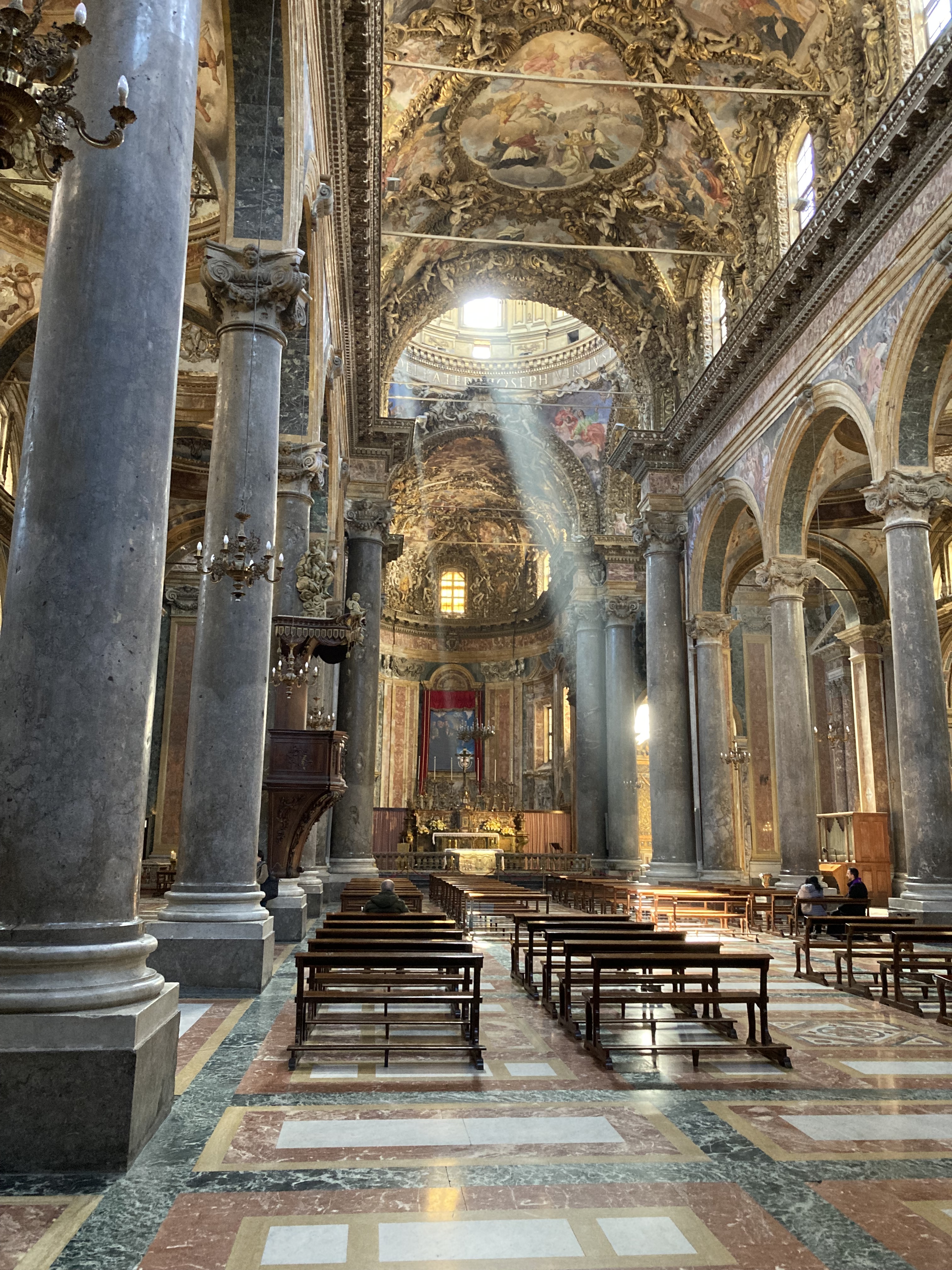
When I walked into this church in Palermo, I quickly experienced one of those moments of awe. Churches can leave me cold, and some, with their images of saints being tortured to death cruelly, I find quite off-putting. Maybe that’s just me, or maybe it’s because I brought up in the Church of Scotland, which stripped its churches pretty bare of most art.

However, the thing that really caught my attention in this particular church was that shaft of light, pouring down through the upper window, a bright sunbeam illuminating some of the space inside the church, before finally resting on some of the pews. Of course, my attention didn’t stay long on the pews, because the shaft of light pulled my gaze upwards towards the ceiling. What a ceiling, covered with art.

I was stirred by this sight, and moved, feeling a sense of being connected to something greater than me, but also feeling a sense of connection to the thousands of others who must have spent time in this church, gazing, praying, listening to sermons, singing hymns, deepening their sense of connection with each other, and with God.

So, for me, my attention, this time, was grabbed by the sunbeam, then, over the next few seconds, that light set fire to my sense of awe, and to deep feelings of empathy…..for fellow human beings, for the other creatures, as dependent as me for the sunlight in order to live, and for this entire, beautiful, astonishing little planet.

I pray we learn to treat her better, this Mother Earth. I pray we learn to treat our fellow, incredibly different species of Life, with whom we share this planet. I pray we learn to treat each other with more kindness, compassion and love.

Read Full Post »

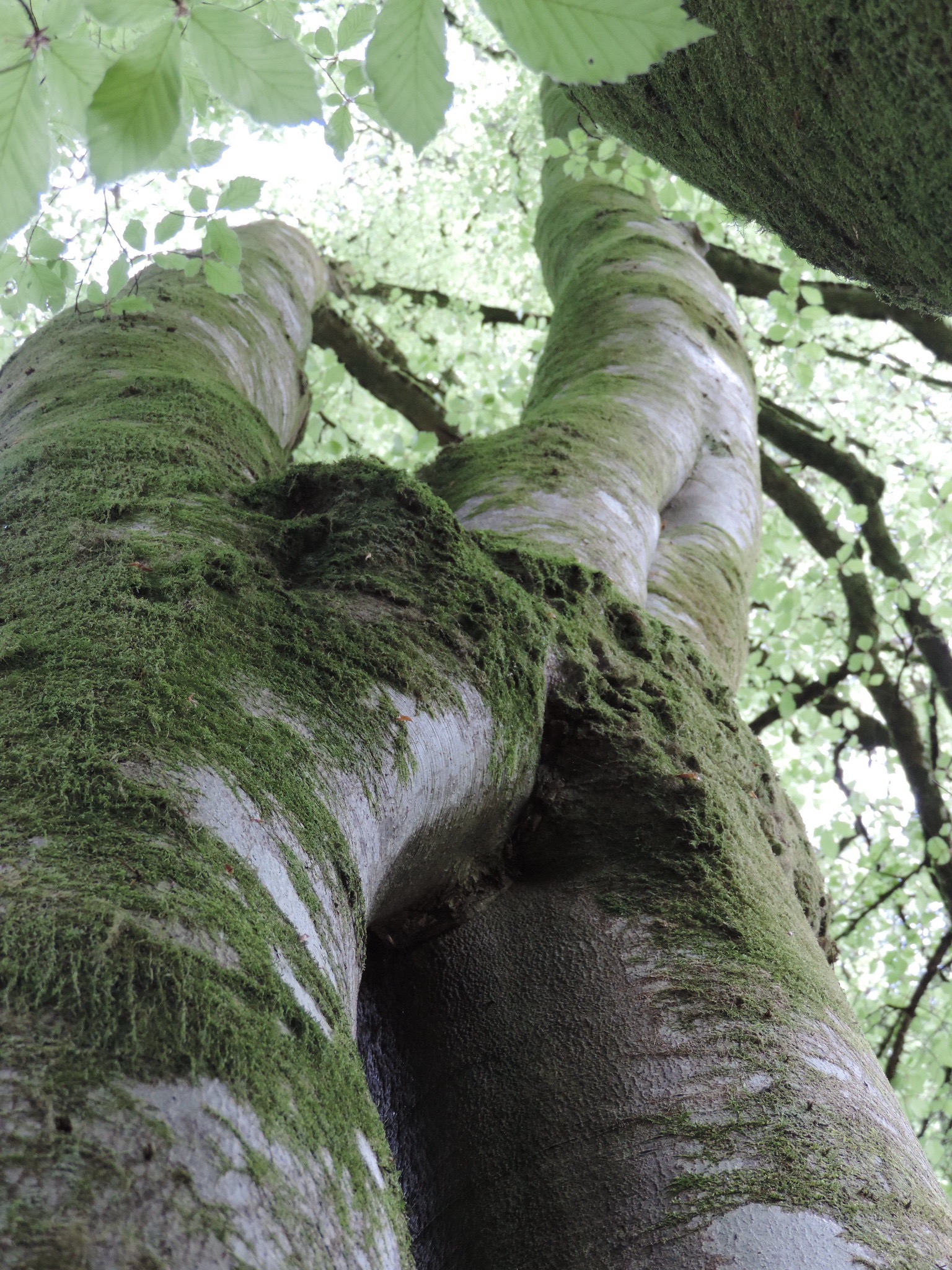
This is one of the most extraordinary trees I’ve encountered. The one on the left seems to have reached out to the one on the right, then the two trees have merged to continue upwards together as one trunk. I don’t know how they did this. It’s like grafting but as best I can tell this wasn’t a forest where there was active grafting happening. I’m pretty sure they’ve managed this all by themselves.

This image is one of my favourites and it always makes me think about the importance of connections. There really isn’t any species of life where each organism exists all by itself, disconnected, as it were, from its fellows, from other creatures, and from its environment. We can only imagine that an organism could exist completely separately if we think of it as a fixed, bounded object. But, in reality, there are no fixed, bounded objects.

As we zoom in and in to look deeper and deeper into any organism, or so-called “object”, we get down to the atoms we all learned about at school. But twentieth century physics has enabled us to look inside those, previously imagined, “fixed” objects, and we’ve discovered that there is no final, fixed material in there. Rather, even atoms are interactions between flows of energy and information, sparkling briefly in and out of existence. They aren’t fixed. They aren’t separate.

Human beings have evolved to have the longest period of dependency for their young. It takes years and years for babies to learn enough to be able to survive….I was going to say, “by themselves”, but, actually we never live “by ourselves”……..independently. So we have evolved superbly social capabilities. It has been argued that we are, in fact, THE most social of all animals.

Yet we swallow the myth of the “Self made man”, of the “hero”, or “genius”, who has somehow come to be all by themselves, without the help and support over their years, of others. It’s a nonsense. The narcissistic, massively egotistical politicians we see today are totally deluded. They only have what they have because of others, because of their connections. Same goes for the tech billionaires. They didn’t create money from nowhere, they grabbed it from others. They didn’t invent and build the technologies they own all by themselves, they profited from the skills and work of many others.

Maybe we need to follow connections a bit more carefully in order to realise just how co-dependent everyone really is.

Finally, let me zoom out a bit and consider nation states. These are inventions. They didn’t drop down onto Earth from the sky, fully formed. Some human beings, some time in the past, staked out the borders and said everything inside these lines is “mine” or “ours”, then fought off any attempts by their neighbours to live on any of that land. Those borders around the nation states are way more permeable than the politicians would like you to believe. The entire planet has one water cycle. You can’t keep separate what flows into one ocean from another. You can’t keep what flows into an ocean separate from the sky, the rivers and the lakes. Same with air. We have one atmosphere around the entire planet. You can’t stop radiation from a disaster like Chernobyl or Three Mile Island spreading freely across “borders”. Same goes for most species in the world – for bacteria, viruses (remember Covid??), insects, birds, plants and many mammals. As each species is lost through loss of habitats, connections are broken, and we are all diminished. We humans are one species. It doesn’t matter which part of the map someone has drawn is where we were born, or where we live now. Our fellow humans aren’t only those in our village, our city, or even our nation state. We are inextricably connected to them all. We are inextricably connected to the entire planet.

Read Full Post »

When we bought our house here in the Charente Maritime about four years ago the garden had been pretty much neglected for a long, long time. The house had previously been someone’s holiday house and, as if often the case, when you come on your holiday you don’t want to spend the time doing house and garden maintenance.

One result of that is that pretty much everything growing in the garden had arrived here by itself.

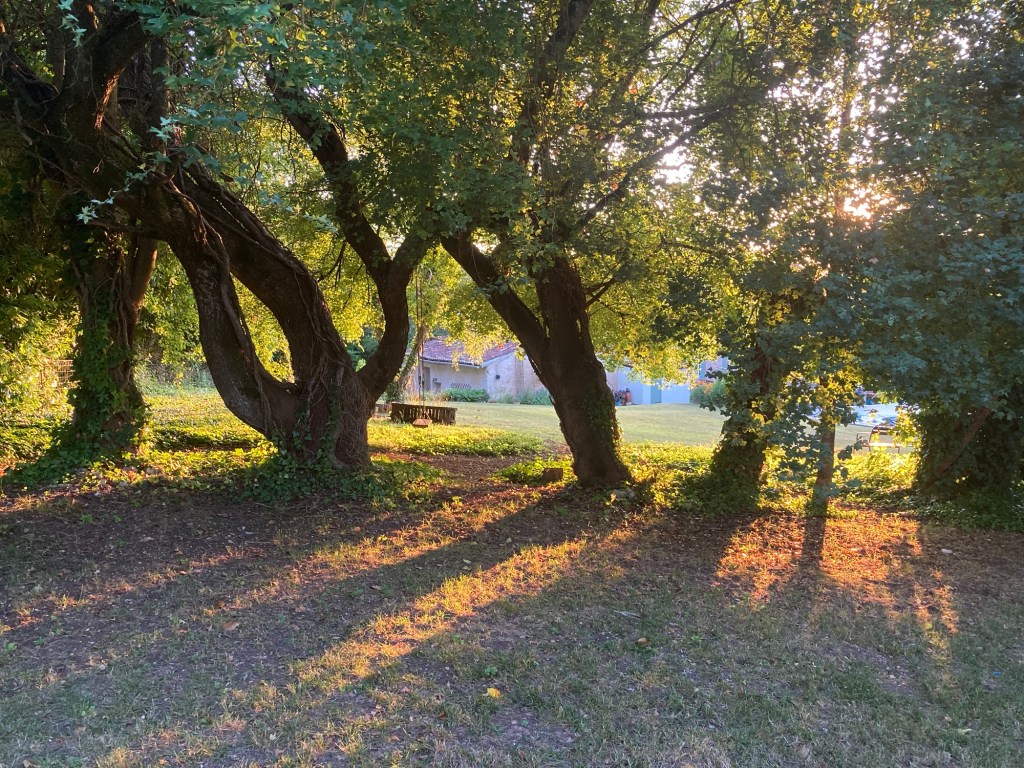
We spend a lot of time in the garden and have reclaimed the impenetrable area we call our forest (honestly, it’s way too small to be a forest but it has the feel of one)

I love the discoveries we make. We’ve found many plants and trees which have been thriving here for years, but it’s still an actively serendipitous garden. New plants appear every year. Here are a couple of the more recent ones…

This is Russian Sage (thank goodness for smartphone abilities to recognise plants), which has popped up in a gravel area.

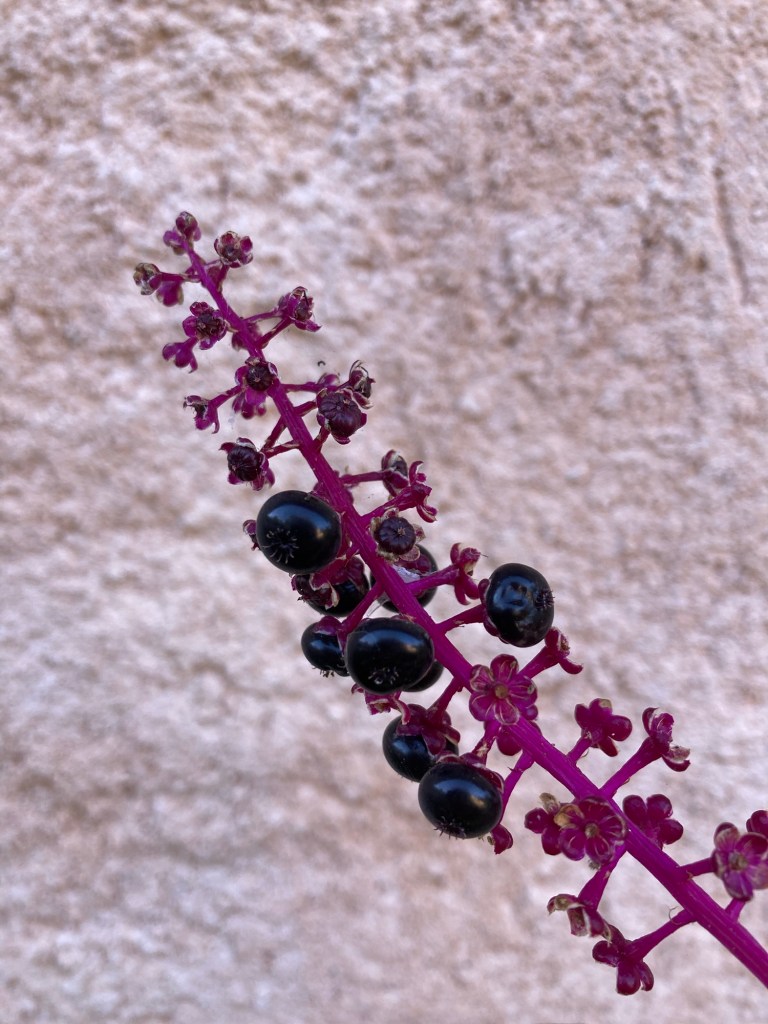
And this Pokeweed, a plant I know from homeopathy, but which I’d never seen in real life until it started growing in front of the wall. It grows really tall and has spectacular leaves, flowers, stems and berries!

Read Full Post »

« Newer Posts