Feeds:
Posts
Comments

Archive for the ‘life’ Category

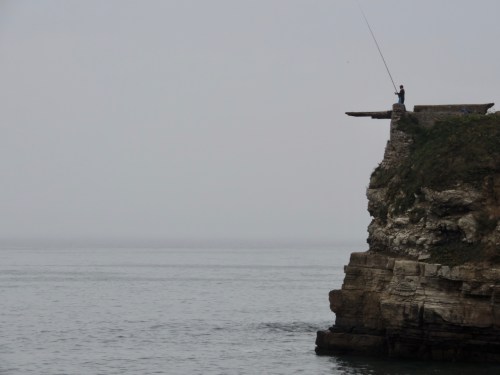
I took this photo in Gijon, Spain a while back. I’ve returned to look at it many, many times.

There’s something hear which captures my attention and provokes my thoughts.

I’ve always been struck by two things in this image. The first is the solitary nature of the fisherman. It reminds me how we humans are constantly addressing two apparent opposites. We are highly social creatures. We need relationships. We need to connect. We want to share. On the other hand, every one of us is unique. Every one of us experiences this universe from the position of the subjective self. There’s no alternative to that. We need to know that we exist, that we are seen and heard, that we can exert our will and make a difference in the world. We all need some time alone. Alone with our thoughts, our memories, our sensations and experiences. And, yes, it’s also great to share.

The other thing is the distance between this fisherman and the water (and therefore the fish!). It looks a LONG way down. I can’t see his fishing line but I can see that the rod he is using seems huge. There does seem to be a man-made ledge at the top of this cliff so I’m guessing it’s a good place to fish. And as I’ve never fished in my life, I know nothing about fishing, but I’m going to guess that a good place to fish is where you catch fish. There would be little point in standing there dangling a line into the sea far below if you never caught a fish, would there? (Or maybe there would. Sometimes I wonder if the main pleasure from fishing comes from the solitude, not from catching anything. But maybe some of you do go fishing and you can tell me)

As I look at this image again today, well into our third week of lockdown in the midst of this pandemic, I see a third thing – hope.

Hope?

Yep, hope.

Here is a man, a solitary man, standing far above the source of what he hopes for (fish?), but with sufficient hope to actually stand there.

I think that’s one of the things we need at this point – hope.

I hope for an end to this pandemic and its deaths and confinements.

I hope for a re-evaluation of the world we live in.

I hope we carry forward our new-found admiration and respect for all the people in under-valued jobs who keep our societies going – the health workers, the carers, the cleaners, the food producers, the transporters, the cashiers, the shelf-stackers, the teachers, the people who keep the water flowing, the lights on, the heating working, the researchers and innovators……has this list got an end? I’m sure you are already thinking of other workers whose importance to us all is suddenly coming to the fore.

I hope we shift our focus and our energy away from competition and control towards co-operation and helping.

I hope we learn from this experience.

I hope that what we learn leads us to make different choices.

I hope we take forward this valuing of human beings and relationships and build it into our new societies.

What do you hope for?

Let’s begin to imagine what kind of world we want to build together in the light of what we know now.

(My list of hopes is by no means complete. I only hope I can inspire you to start to make your own list)
Read Full Post »

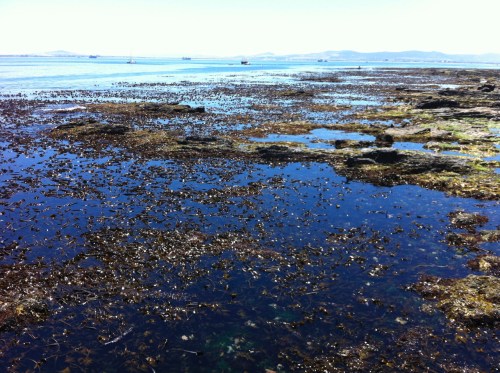
I love the places where one element meets another. The places where constant change is right in front of my eyes.

These are borderline places, zones of transition and transformation. There’s a word for spaces and regions like these – liminal spaces.

This first photo today is of one such area. You can see its coastal and that the tide is out revealing rocks, plants, seaweed, and rock pools. I love the colours in this photo and how you just know that, despite this being a single, still, image, it is already changing and won’t look exactly like this in a few moments time. I see some ships in the distance too and wonder about the people onboard, making a journey, transitioning from one place to another, from one life perhaps to another.

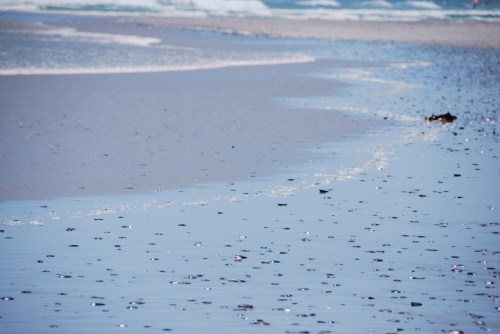
Here’s my second photo

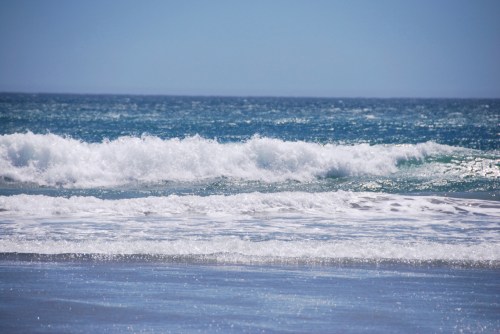
Staying at the coast for this one….an image which is almost entirely composed of shades of blue. You just know that this apparently blue sand is wet, and that as it dries it will turn golden. There are no hard edges in this photo. Just gentle curving lines where the sea turns to surf, and the water bubbles up with escaping air. This is a calming image to me. I see it and I can hear the rhythm of the waves breaking on the shore. I can smell the fresh, invigorating sea air (and hope it won’t be TOO long before I’m allowed out to experience it again).

Number three…

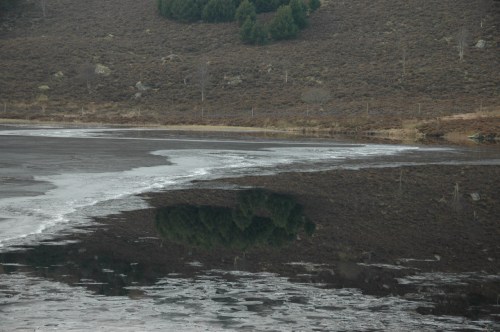
Take in Scotland one winter this one shows either the spreading ice on top of the loch, or maybe it was receding….who knows? I can’t remember. But again you can almost see this changing before your eyes. There are edges here which are highly reminiscent of the ones in the second image….of the sea breaking on the shore. Although this time it is ice breaking on the water, or water eroding ice. The bonus in this image is the reflection. You can see the trees on the slope of the hill, but they are much darker on the surface of the water, which seems kind of dream like to me. A glimpse into the Earth’s unconscious.

Finally…..

The low morning mists at the foot of Ben Led seem to mimic the shape of the hills above them. The mist rises and falls the way the land rises and falls. There is clear ground between me and the misty zone, and clear ground rising above it, creating a very special kind of mysterious liminal space I think. Beautiful.

Here we all are. In the midst of this pandemic. Nothing is the same. Everything has changed and, often frighteningly, continues to change so quickly we can’t even see what’s coming. But this pandemic will end. And what then? What kind of world will we live in together after this? Sure, there will be forces which try to get right back on exactly the same track as we were on before, but something else seems to be emerging in this liminal space….a re-evaluation of what’s important in life, of relationships, of the kind of work different people do, of how we are so inter-dependent, so connected. Of how we share this one single planet on which Life exists without borders.

Let’s use this space, this region, this zone, to reflect and to think. After all, many of us the time to do so now. Let’s use this time to imagine how we humans might better live on planet Earth. Together.

What do you hope will be different afterwards?

What do you imagine the post-pandemic world might look like?

How might health care change? How might work change? How might education change? How might economics and politics change? [add your own question here…..because everything might change]

Read Full Post »

What a combination! Sunlight and flowers!

I’ve a number of photos of this type. I like to get down on the ground with the sun above and in front of me, and photograph the petals of a flower as the sunlight makes them glow.

It looks like LIFE to me.

And it reminds me of how Richard Feynman once said that trees are made from air, which, of course, shocks you when you hear him say that. We think surely trees are made from the soil? But no, not so much. They capture carbon dioxide from the air, capture the sun’s rays and then they use them to break the carbon dioxide down to get that building block of organic life – carbon, and in the process push out the oxygen they’ve released into the atmosphere. He was asked…but what about water? They need water and that comes up from the soil through their roots. Aha, he said, well, yes, but where does the water come from? The air.

Of course he was exaggerating to make a point because trees are made of a lot more than carbon and water. But did you know that the roots of trees are covered in micro-organisms, little fungi which reach into the tree roots and outwards into the soil. These tiny creatures gather up and transfer into the tree nitrogen, phosphorus, potassium, zinc, magnesium and other micro-elements which the tree needs to survive and to grow. They also help the roots gather up water and form part of a kind of immune defence against pathogens for the tree. In return the tree transfers up to 60% of the sugars it makes to feed these little fungi.

Amazing, huh?

A real lesson in co-operation, collaboration, and symbiosis. In fact a principle we’d do well to learn from. How can we live better on this Earth? In more symbiotic ways, which turn out to be more creative than our consumption and destruction methods which produce “waste” (something which doesn’t exist in Nature)

Did you know that researchers tried treating some flowers with antibiotics and found that their lovely scent disappeared? Turns out than in many cases the scent of a flower is actually produced by the population of bacteria which lives in it symbiotically.

Huh! Turns out this symbiosis thing can be pretty damn beautiful!

Read Full Post »

We’re all trying to peer into the distance.

In the next few days…..what measures will my government introduce? When am I going to run out of food, and when do I need to brave the outside world to go and buy some more? What challenges am I going to face this week?

In the next few weeks……..How many people are going to catch COVID-19? How long will the pandemic last? How long will the lockdowns and shutdowns last? How are we going to get out of these current restrictions?

In the next few years…..what kind of world are my grandchildren going to grow up in? How will society change? How will the economic and political structures change? How will countries and people become more resilient?

We’ve always done that, we humans. We are blessed and cursed with the power of imagination. We can imagine all kinds of wonderful futures, invent, create, plan, innovate. And we can imagine all kinds of terrible futures, paralyse ourselves with fear and anxiety and the interminable….but what if? and what if?

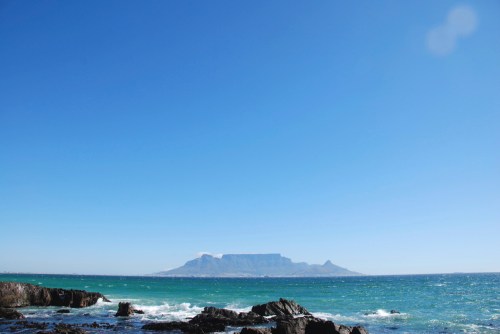
I was thinking of all that as I looked at this old photo I took of Table Mountain (who knows when, or even if, I’ll get to stand at that point on the Earth again?).

I was admiring the beauty of the scene, of the waves breaking on the rocks in the foreground, the rich palette of colours of the water in the mid-ground and the glorious Table Mountain in the distance.

Funny how that got me thinking about the futures we imagine and which seem to inhabit our everyday more and more just now, because, actually, there is no future in this scene. It is all present, all at once. The rocks, the sea, the mountain. I’m not standing there imagining what any of them might look like one day. I’m standing there basking in the beauty of the present reality.

Well, that brought me back to right here, right now.

Nobody can reliably describe a future which doesn’t exist yet.

I know, I know, there are philosophers and physicists who will argue that time isn’t linear and that matter doesn’t really exist, and I understand all that, but even so, it seems to me that we live in an emergent world, one which unfolds moment by moment, inventing itself, constantly creating novelty.

I know we can discern patterns and we use those patterns to predict the future. I know our scientific method has developed along those lines….describe, measure, predict, control…..though I’m not sure that’s been the best way to go. I’ve still got a preference for émerveillement….for wonder, awe, curiosity and amazement over data and controls. But we are complex adaptive systems, we humans, we life forms, we Earth-creatures, and complex adaptive systems constantly develop, adapt and evolve, sometimes in small steps, and sometimes in giant leaps. We change. Everything changes. The future surprises us all the time because it is novel.

So, I find myself coming back to what I used to explore with patients. What if our human super-power of imagination is trained on fears and anxieties? In what way does that help us? What if our human super-power of imagination is trained on creativity and compassion? In what way does that help us?

Because, you know what? I don’t think it helps to be judgemental. Fears, anxieties, creativity and compassion all exist for a reason. We can make choices. We can decide what to focus on, which “hungry wolf to feed” (do you know that teaching?)

They are seeds inside us, aren’t they? They include fear, anxiety, creativity and compassion.

Which seeds will you nurture today?

Read Full Post »

What colour is the sea?

Blue?

Like the sky?

Green?

Like grass?

White?

Like clouds?

What colour is the sand?

Yellow?

Like lemons?

Grey?

Like stone?

Blue?

Like the sky?

Here’s one thing I’ve found….the more I pay attention to the particular, the more I see (or hear, or smell, or taste, or feel)

We use our left cerebral hemispheres to focus on parts or aspects, label them, categorise them….which is all useful of course, but if we leave it at that we stop seeing reality as it really is.

We need to reintegrate that information into the right cerebral hemisphere to see its contexts, its connections and relationships to everything else. Only then do we experience the particular, the uniqueness of all that is real.

I found that in my work with patients. It was never enough to apply the diagnostic label and think of the patient as just an example of that – whether that be a “diabetic”, an “asthmatic”, or whatever. I had to pay attention to the specifics, to this particular patient’s unique story. Only then could I experience the reality of who they were and understand what they were experiencing.

So, here’s something to try today. Slow down and take your time to pay attention. Explore, as much as possible without labelling. Or, actually, it’s pretty tough not to label, so once you apply the label, just say to yourself, ok, this is an apple (or whatever it is you are exploring), but then, what colours do I see, what textures do I feel, what scents do I smell, what sounds do I hear as I interact with it (turning it over in your hand, running your fingertips over its surface, biting into it…..only if you are exploring something edible of course!)

You get the idea?

Pick anything you like. An object, a song, a view, a flavour, a scent, a sensation. Slow down, pay attention, notice the labels which pop into your head, then continue to explore.

Allow yourself to experience the diversity of the unique.

Read Full Post »

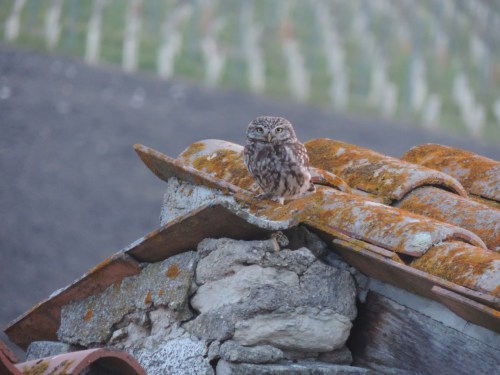
This year a new bird has taken up residence in a neighbour’s barn. He’s a “Little Owl”, and, yes, that’s his common name. His scientific name is “Athene noctua”. The “Athene” part goes right back to the belief that this owl had a special connection with Athena, and the “noctua” part comes from the Latin for “Minerva”, who was the Roman equivalent of Athena. As such, this little creature has long been held to represent wisdom and knowledge…..pretty much just what we need more of in our world.

I’ve watched him come and go and the other day there noticed he wasn’t alone. Seems he and his mate have a nest up high behind the roof beams at the back of the barn. He’s a pretty wary creature though so it’s been hard to get a decent photo. However, yesterday, looking out of the window of my study, I could see him sitting on a nearby roof. I slowly raised my camera to my eye, taking care not to make any sudden movements which might attract his attention, even though I was inside my house, and he was outside on the roof. I zoomed in, focused, and pressed the button. I can’t say I really clearly saw what I was getting a picture of, but when I uploaded it to my computer I realised he had totally clocked me.

He is looking directly at me!

How does one living creature possess that knowledge? How do we know that we are being looked at? I bet you’ve had an experience where you are sitting reading a book or having a coffee and, suddenly, you become aware that someone is looking your way. You look up, catch their eyes, and they either hold their gaze, or, more commonly, quickly look away.  I’ve often wondered how that works. What are we picking up? It’s not about casting our eyes around the world and just noticing someone else’s direction of gaze. We seem to be able to detect something, and it also seems this is a talent which is not exclusive to human beings.

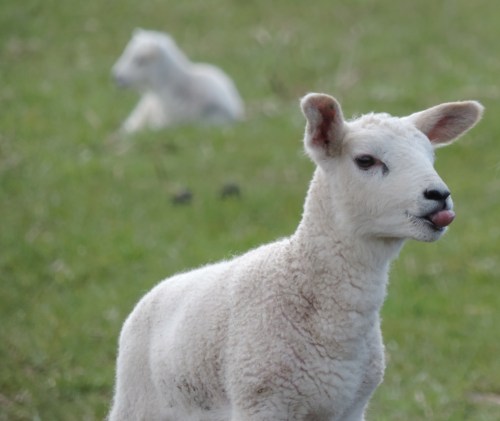
This isn’t the first time I’ve had this experience with an animal. Here’s a photo I took one Spring day when the first lambs were in the fields.

Tell me this little one hadn’t clocked me!


Read Full Post »

Quite a lot of people, me included, are saying this pandemic is throwing a light on certain things – how fragile our systems of health care and social care, how poor the safety nets are, how interconnected the world is, how the instincts to collaborate and connect are so strong in human beings, how much we humans move around the Earth……[add you own here]

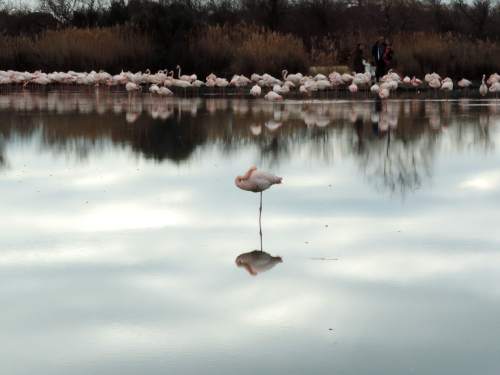
But today I stumbled across some old photos of reflections and I realised that the reflections are a different sort of light.

A direct light brightens and maybe even makes more clear the object it is shining on. That’s useful. Though it immediately brings to my mind that question I have about Scandi-noir crime drama – why does the (usually female) detective always go down into the basement or the abandoned warehouse at night, all alone, with just a torch to light up little bits of the room? Well, I suspect I know the answer to that one already.

Reflections are different.

They turn things upside down.

They give us an unusual and different take on reality, which lets us see beyond what the light is illuminating.

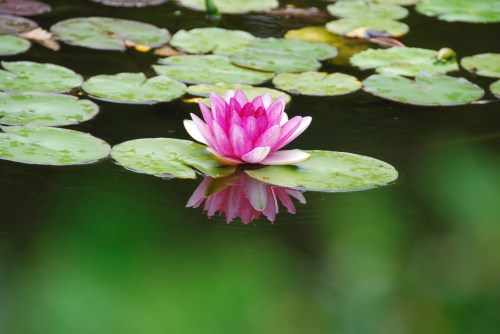
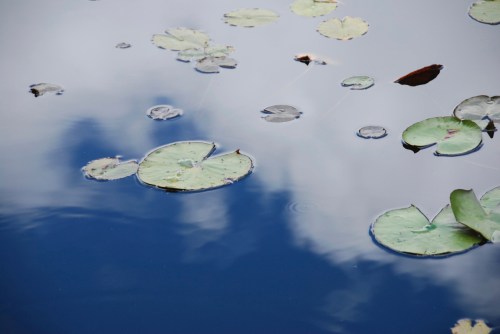
Look at this one, for example –

lily leaves on a still pond which is reflecting the blue sky and some clouds.

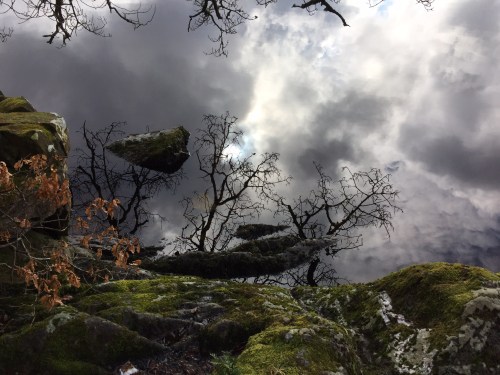
Or this one –

the edge of a Scottish loch where the still water is reflecting the clouds

Or, this one –

the solitary flamingo doubled by the water’s surface

In all these cases the reflection does something special I think.

It literally turns something upside down which immediately makes us look more carefully.

It changes our perspective whilst keeping our default one. In other words, it increases our perception and understanding by doubling our perspectives.

It shows us connections we were happy to ignore as long as we focused solely on the central subject. It connects the sky to the water, the water in the clouds to the water in the loch, for example, reminding us of these cycles and links and interconnections which are the most fundamental characteristic of Nature.

It increases our experience of beauty. Each of these photos could have been beautiful without the reflections, but I think that including the reflections make them exponentially more beautiful.

All of which brings me to my main thought today – shining a light on something helps us to understand it, promotes analysis and clarifies what has been obscure or forgotten. Reflecting adds in something completely different – it promotes our perception and understanding by changing our perspective, highlighting the connections, and increasing our senses of wonder and delight.

“And not or” is my moto – analyse and reflect. Actually, as I write that sentence I’m reminded of Iain McGilchrist’s Divided Brain thesis and how the left cerebral hemisphere is great for zooming in, analysing and cataloguing, while the right seeks out the connections, the specific and the unique.


Read Full Post »

Markings.

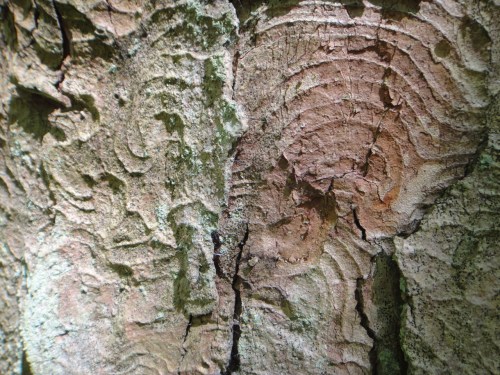
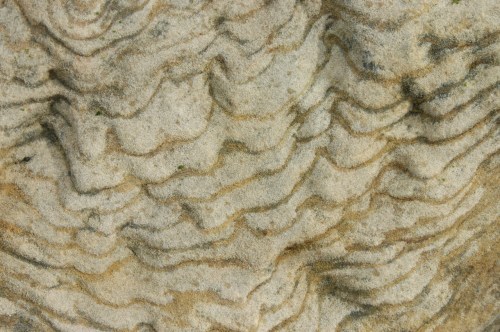
I find patterns utterly fascinating….wherever they are. Look at this blend of textures and colours on the surface of a tree. Isn’t it beautiful? It’s as if some artist has been doodling or a sculptor has been running his or her fingers through wet clay.

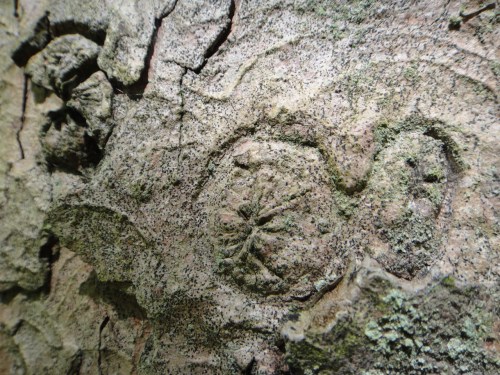
Here’s another one.

This one looks like an infinity loop to me.

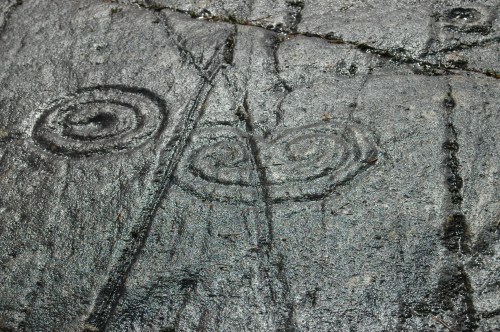
It reminds me of some of the cup and ring markings on the rocks in the Kilmartin Valley in Scotland. Here’s a photo I took of one of them.

The cup and ring markings in Kilmartin are really impressive and challenging. As best I know absolutely no-one has managed to explain them. Are they maps? Are the signatures? Are they messages from one person or tribe to another? Are they symbols, and if so, of what? Or are they doodles?

We humans have a particular kind of creativity. We imagine, we play and we make marks. I love all of that. But then I look around me and I see that making marks is embedded in all kinds of natural phenomena. It’s as if the whole Universe just loves to make marks.

We live an a creative universe.

Creativity runs through us the way our blood runs through us, the way our breath runs through us, the way we are infused by the streams of materials, energies and information which run through us, the way our spirit runs through us.

We react and we act. We engage and we respond. Catabolism and anabolism (biological terms related to our metabolism….how we break down materials which we consume and fashion them into the things we need to live) are at the core of our being.

Just by living, we create, but isn’t it such a thrill when we create consciously?

Isn’t it such a delight when we stumble across the works of creation?


Read Full Post »

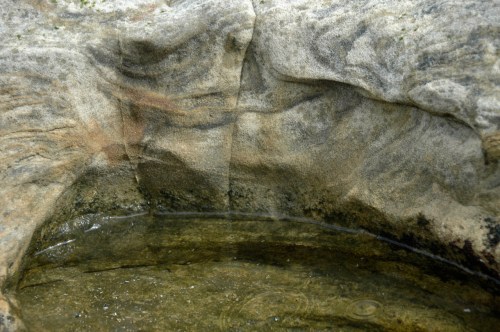
When I look at this the first thing I think is “how beautiful”. It’s like a work of art, isn’t it?

Look at the sweeping lines, the layers, the smooth surfaces and the ripples in both the water and the stone.

The next thing I think is how similar AND different the water and the stone are…..those colours, surfaces and lines, but the stone which changes over millennia while the water changes over seconds.

The third thing I think is how the universe began, fourteen billion years ago or so, first with only a couple of different atoms, then a few more as the creative and destructive furnaces of the stars kicked into action, and how every single element we’ve found on this planet was created, atom by atom, in those vast clouds of stars millions of light years away. Then over millions of years how the Earth was fashioned into the incredible substances, structures, materials.

It astonishes me.

The fourth think I think when I contemplate this image is how all the water, all the rocks, all the air which moves around as winds across the face of the Earth and the Sea, all the heat of the Sun which beats down upon us, makes this one, precious place for us all to live.

One of my favourite books of all time is Thomas Berry’s “The Great Work”.

Read Full Post »

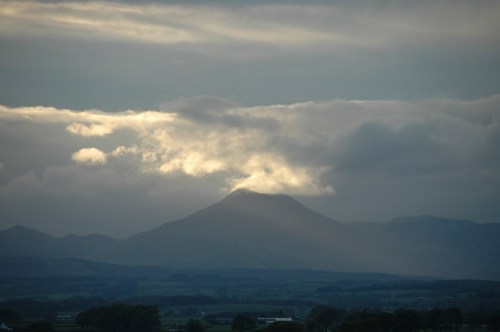
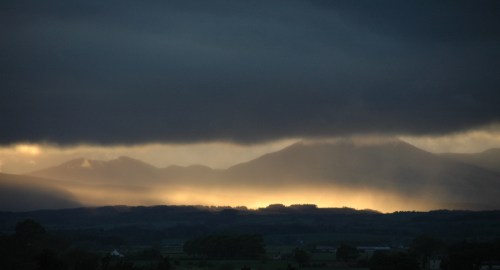
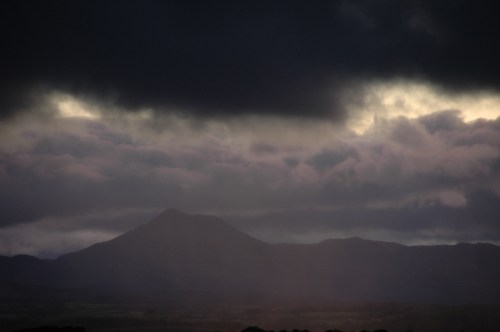
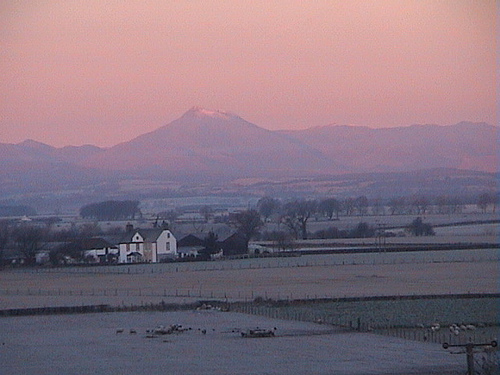
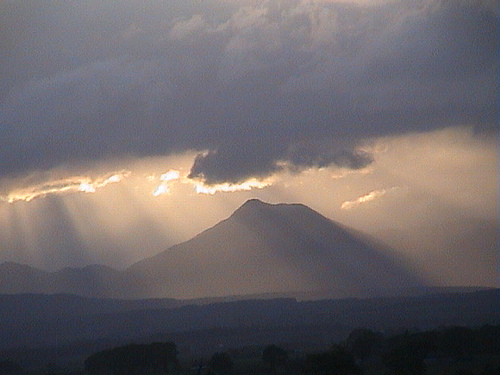
When I lived in Cambusbarron in Scotland I looked out of the window each day and saw Ben Ledi. I quickly realised that this mountain looked different every day, so I started taking photos of it. I took a LOT of photos.

I was constantly amazed how my usual experience was not of looking at the same scene every day, but seeing a different scene.

I know, maybe you are thinking, but it’s the same mountain. It’s just the clouds and the light which is changing….

But the mountain doesn’t exist by itself. It exists in a place and a time. I can’t see the mountain disconnected from the world in which it exists. That wouldn’t be real, would it?

I think the world is like this.

Absolutely everything is connected. Absolutely everything exists in webs of contexts and environments.

It changes moment by moment. Everything we see, hear, smell, touch and taste changes constantly as the streams of molecules, energies and information flow through, influencing, creating, disrupting.

So, today is always new.

This moment is always new.

We humans are good at doing something called “abstracting”. We isolate a part of what we are experiencing and consider it as if it is separate, disconnected, un-attached. We call these abstractions “things” or “objects”. Or we call them “outcomes” or “results”.

But we have to return our abstractions to reality eventually and then we seem them as less isolated, less fixed, less separate than we thought.

I never felt I could understand a patient by isolating their disease from their life. I never felt I could understand someone’s illness if I considered only the changes in certain cells, organs or tissues.

When we tell our stories, part of what we are doing is describing some connections…..some sequences, some consequences. We describe events, experiences and emotions, and together they combine to make every day, every moment, every place and every relationship, unique.

What did you notice today?

Was there something familiar which you experienced differently today?

Read Full Post »

« Newer Posts - Older Posts »