Feeds:
Posts
Comments

Archive for the ‘personal growth’ Category

two words

PRESENT

CREATIVITY

These two words, or concepts related to them, keep coming up for me. I read a LOT, and I have one of those minds that seems to be good at seeing connections, patterns, echoes, themes, and in all those ways these two words keep coming to mind. Whether I’m thinking about flourishing, about happiness, about health, about living a good life, about understanding what it is to be uniquely human, and most especially when I think how to be a hero not a zombie!

If you don’t want to be a zombie, you have to wake up and smell the coffee. Different thinkers and authors refer to this in different terms. Some talk about waking up from the sleeping state, others about living consciously, and yet others about living mindfully. What it amounts to is being present. Really being present. Not just being somewhere in your body while your head is in the past, worrying about the future or drifted off somewhere into the clouds. So it’s a deliberate act to be present.

I am very attracted to the ideas of the “slow movement“. If we take our time to fully savour the here and now we enrich our experience of living. Fast food, quickly prepared and gulped down with hardly time to even taste it is one kind of experience. Picking up fresh food in the local market, walking home with it, preparing it, cooking it, sitting down to savour it (whilst not doing anything else!) is quite another kind of experience.

Mindfulness is a very popular term currently (other traditions over many years have taught the same concept) The famous mindfulness meditation exercise of the single raisin is one simple way to understand experientially what it means to be present.

I often find myself sharing with patients the simple understanding that your mind can only be in one place at a time. If you are giving attention and focus to the past (remembering, ruminating, ruing?), or giving it to the future (planning, worrying, fearing?), then you aren’t giving it to the present (sensing, savouring, being?). So, if you are troubled with too much of the past or the future in your head, deliberately turning attention and focus to the present can change your inner experience instantly.

I find that having a sense of wonder, of seeking the extraordinary in the ordinary, drives my attention to the present.

What about creativity? Life, it seems to me, is constantly evolving, adapting, growing, developing. It’s a dynamic phenomenon which moves as a whole in the direction of ever greater complexity, diversity and uniqueness. In fact, that’s how I see the universe story – one of continuous and ongoing creation.

Creativity is also about expression. I believe every one of us has our unique and special contribution to make to the universe through living this life. We engage with and understand the world uniquely and we react and interact with it uniquely. Those interactions are creative. In biological terms we use the word “emergent” to describe phenomena and behaviours not seen before. That’s what we do. We are complex adaptive organisms in a process of continuous development, emerging, evolving (potentially) to higher consciousness.

Whether you create through art, through music, through building, through problem solving, through being with and sharing with others…..every day, you have countless opportunities to create, to make the world anew.

What does it mean to you to be present? And how can you be more present today?

What does it mean to you to be creative? And what will you create today?
 

Read Full Post »

There are many ways in which writing can help us to understand ourselves better, heal wounds and gain a deeper insight into our lives. Here are three ways you might like to explore.

A. Regular continuous writing

Julia Cameron, in The Artists Way, describes an exercise she calls “Morning pages”. Essentially it involves writing every morning until you’ve filled three pages of an A4 notebook. With one additional, and crucial, rule – you can’t stop. Not for a moment. Your pen or pencil shouldn’t leave the paper, and your hand should never pause. This is not a thinking exercise. You aren’t to work out what you are going to write, and if you find yourself writing “I don’t know what I’m writing and I can’t stop moving the pencil so I’d better keep going and…..” – well, that’s OK. It’s a stream of consciousness thing.

People do different things with this kind of exercise. Some swear it only works if you do it as the very first thing you do on waking, others just in the mornings, some at other times of day. See what works best for you. What I have found is that the greatest benefit comes from it if you don’t read what you’ve written. At least not for a pre-fixed period of time – a week, 30 days, a month, three months. Again, see what works best for you.

Try it. I’m pretty sure it’ll surprise you

B. Gratitude journal

There are many traditions which recommend creating and regularly using a gratitude journal. Quite simply, it involves having a special notebook and every night, before you go to bed, taking a few moments to reflect on the day and recall something, just one thing, for which you are grateful. It might relate to something you saw or heard, something you ate, a conversation you had, a moment of being held…..it’s up to you. Then just note it down. You can write it in as much detail as you like. I find this has at least two benefits. It gives you an opportunity to re-experience a positive emotion (and that’s good for your heart, and good for your health). And it means you head off to bed with your most recent experience being a positive one.

C. The story you live by

In the inspiring “the stories we live by”, by Dan P McAdams, he describes a template to help you write out the story of your life, in a way which will enable you to clarify your own main themes and influences. I like this approach. I like the idea of the story of the self, especially as stories take us from the past, into the present and forward to the possible futures. Here’s a very brief synopsis of Dan’s template. It starts with writing down your chapter headings for the story of your life, then moves down through the seven further points of focus and reflection. You might want to try the whole thing, or you might like to pick and mix. As ever, see what works for you……

1. Chapters – titles and brief contents

2. Eight key events –

  1. Peak experience
  2. Nadir experience
  3. Turning point – significant change in understanding of yourself
  4. Earliest memory
  5. An important childhood memory
  6. An important adolescent memory
  7. An important adult memory
  8. Other important memory

3. Four significant people

4. Any heroes

5. Future script

6. Two areas of life where you are experiencing stress, conflict or challenge

7. Personal ideology

8. Life theme

Read Full Post »

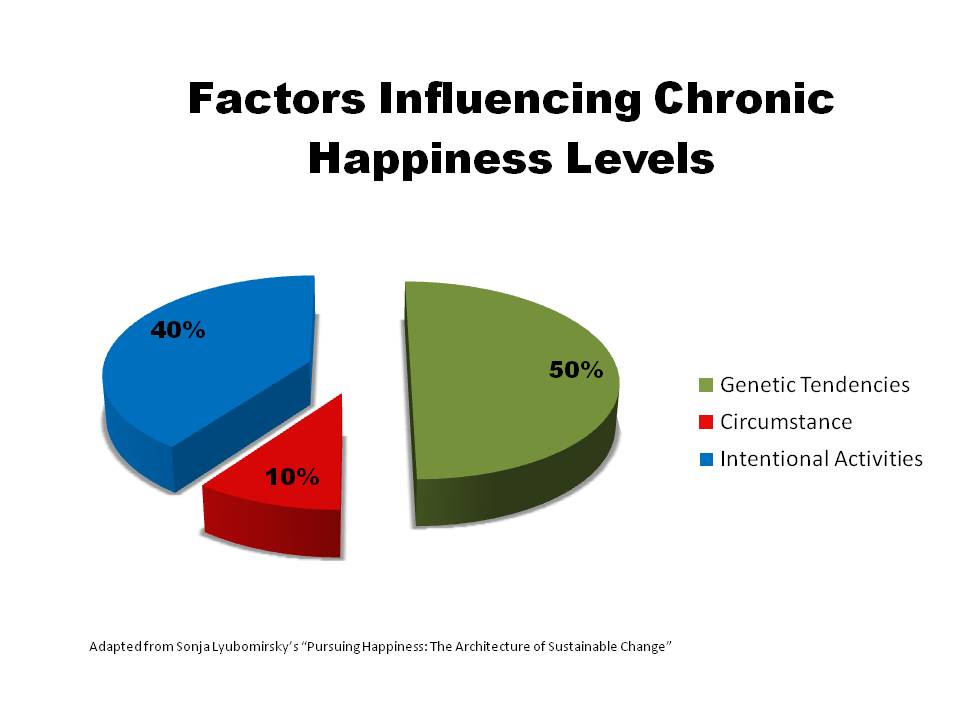
I came across some interesting research into the factors affecting long term happiness. Positive psychology researcher, Sonja Lyubomirsky found that your long term happiness is partly determined by your genes, partly by external circumstances and partly from your disposition/choices. It breaks down something like this –

IMG_0446

Whatever you think about the proportions, this got me thinking more widely about not just happiness, but health.

It strikes me there are three contributing influences – the given, the random and the chosen.

The given includes not only genetic factors, not just the DNA inside you, but also the circumstances of your birth. A child born in a Mumbai slum doesn’t just have different genetic influences from one born my home town of Stirling, Scotland. There are the physical, economic, cultural, familial environments into which they are born. Let’s assume the child neither chooses their genes, nor the circumstances of their birth. (I know not everyone sees the world that way) This is the given.

The random is whatever happens by chance. If a drunk driver loses control of his car and knocks you down as you walk along the pavement, that’s bad luck. If you happen to be on a train which derails, to be where a tornado hits, get caught in a tsunami…….unpredictable events – the random.

The chosen – we are always able to choose how we respond, to choose what to say or do in any given circumstance. As Viktor Frankl found, what matters is what stand we take in the face of events. See William Glasser’s “choice theory” for more on this.

I don’t know if the proportions are always the same, 50/10/40, but that’s not really the point. The thing is choices are what we can do something about. In fact, it’s not as separate as this description seems so far. We now know that we aren’t just our genes using us to replicate themselves. Epigenetics shows that genes can be switched on or off by external factors. We can influence whether or not certain genes are expressed. Similarly we can influence our luck. Watch the movie, “The Cooler”, with William H Macy for a really entertaining exploration of that!

Then I thought, it’s a bit like a game of cards. You have the hand you are dealt (the given), luck (what other cards other players are dealt and how they play them), and then you choose what to play when – something you can do well, or badly, depending on your skill level.

And that brought back to mind the phrase, “its the hand you are dealt” – which is usually a statement of something pretty limiting. People tend to say that when they think that whatever has happened is completely outwith the person’s control, when it’s all down to Fate, or to genes or whatever….but I think we can reframe this card game analogy much more positively.

We take the hand we are dealt, use our skills to play the game well, and make our best choices in the face of lucky (or unlucky) breaks!

We have the given; stuff happens; and we can usually make choices, develop strengths and skills.

What choices are you making today? What strengths do you have which you can develop?

Read Full Post »

seeds


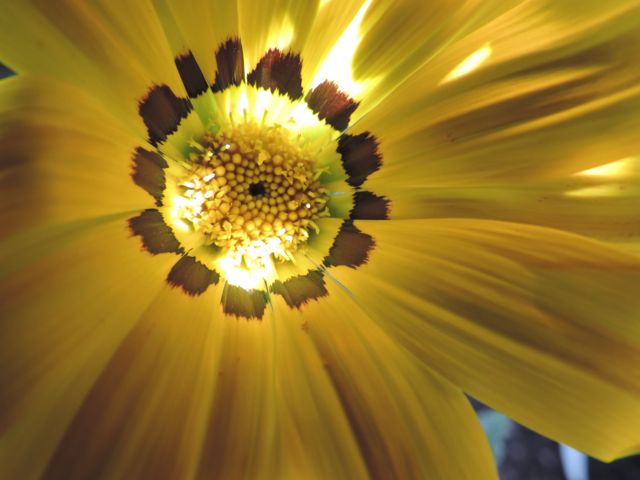
Look at this wonderful cluster of seeds with the sun shining through…..simply bursting with potential…..this is me, today. This is you, today…..

simply bursting with potential

Which seeds will you water?

Reminds me of Thich Nhat Hahn’s teaching on watering the seeds…..

If you live in a couple, if you live in a family, if you live with another person or several persons, you may ask them to be careful. You may ask them to be aware of the seeds you have in your store consciousness. “Darling, I know that I have these negative seeds in me. And every time these seeds manifest, I make myself suffer and I make you suffer, also. So, please, if you love me, if you care for me, be careful not to water these seeds in me.” Among lovers, there should be such an agreement. That is the practice. “Darling, if you really love me, water the positive seeds in me, because I do have the seeds of understanding, of compassion, of forgiveness, of joy in me. Even if they are still small, if you know how to touch them in me every day, I become a much happier person and when I am happy, you don’t have to suffer as much.”


Read Full Post »

The Heartmath technique involves recreating a positive emotion – not just remembering a positive event, but actually feeling the feeling again.

When I found this project from “soul pancake” it struck me that they were making little “heart math” moments in the street. Watch the video. It’s delightful, and I’m pretty sure it will make you smile……

……and remember, to flourish, you should try to have a 5:1 ratio of positive to negative feelings/experiences each day.

Read Full Post »

Isn’t it amazing how being human involves unrelenting, constant change? My body feels like my body. It’s always felt like my body. But there isn’t a single cell in this body today which was here when I was a child. In fact all of the cells which make up this body are continuously being renewed. Some die off, others are born. So what is this “me”? And, at this point, I just mean my physical being. Goodness knows how you pin down the subjective “self” that is me! I create that every moment of every day.

With all this constant change, how come I retain a consistent identity?

I certainly don’t feel I am a “thing”……I’m not even sure what a “thing” is! What I mean is I am not an object. I cannot be reduced to my “substance”, my cells, my molecules, my DNA even. The totality of me is more than that, and the totality of me, right here, right now, had never existed before, and won’t exist exactly like this by the time you read this.

I think I’m a wave.

What I mean is I am more like a wave, than an object.

Have you ever stopped to think about what a wave is? You can spot a wave far out from the shore and follow it as it heads towards the rocks or the sand, but that wave is not an “it”. The water particles which make up the wave stay pretty much where they are. As the wave passes through the water, the particles just move up and down in a circular motion. They don’t actually head together towards the shore.

As you follow a wave, you are watching an energy complex consistently recruit particles into a distinctive pattern or forwards but it doesn’t bind those particles into an entity. It picks them up and drops them, moving its shape through the water……

Here’s a couple of quotes from other authors about waves.

The truth is that life is not material and that the life stream is not a substance.

Luther Burbank

You are a wave. Every minute you say goodbye to more than a billion combinations of post synaptic receptors in your brain and replace them with new ones. You do the same with the cells that line your digestive tract and make up your skin. And you constantly shift your mind from one obsession to another. Yet you retain an identity. Something more puzzling than mere substance continues to impose the shifting flicker of a you…..Your identity is a pattern holding sway over a hundred trillion cells that change constantly…….Your self is a dance that uses matter to whisk from the invisible and the impossible into the gasses, dusts, and jellies of reality.

Howard Bloom


Wave

Read Full Post »

pine


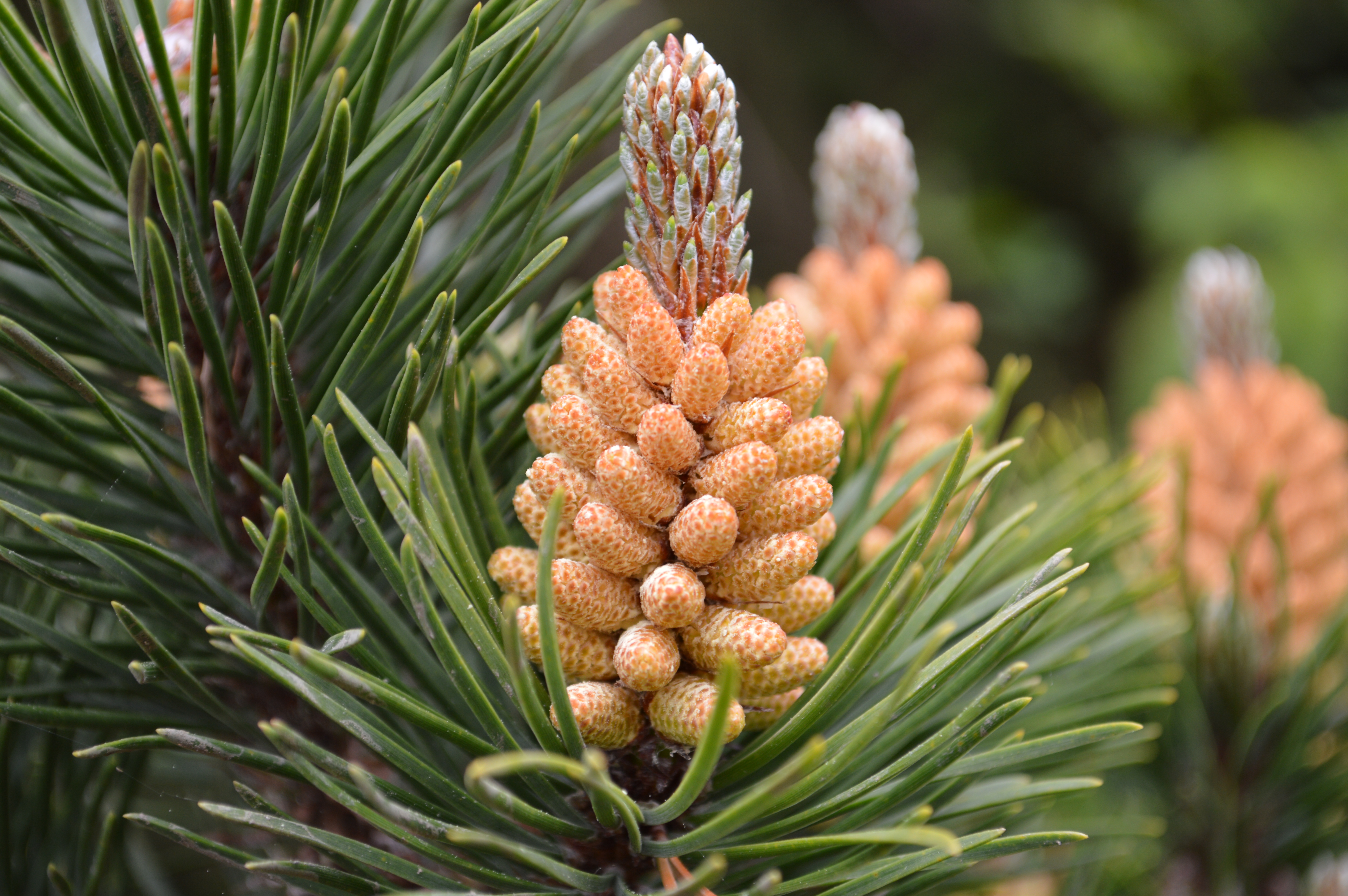
This tree is just bursting with potential. Every little seed could grow to become a whole tree. Could you tell what the tree will look like, just by looking at one of these seeds? Only if you have seen one of these seeds before and you recognise it, or if you see it in the context of the parent tree (as you can see in this photo). But even then, you can’t predict which seed will become a full tree, and which won’t. Nor can you tell EXACTLY what the particular grown tree will look like.

But what we do know, is that here is potential and possibility.

Life is like that. YOU are like that.

Bursting full of potential.

What are you becoming…..?

Read Full Post »

I read Montaigne’s essay yesterday about “Liars” and it made me laugh out loud. I really enjoy Montaigne’s humility. It seems to me that he frequently wrote with a twinkle in his eye. In this essay he refers to his claim that he as a terrible memory. He says that others consider that an affliction of sorts, but he thinks it has advantages.

Firstly, he says that having a poor memory has saved him from being an ambitious person – “the defect being intolerable in those who take upon them public affairs”.

Secondly, he says it has saved him from deafening all his friends with his “babble”

I have observed in several of my intimate friends, who as their memories supply them with an entire and full view of things, begin their narrative so far back, and crowd it with so many impertinent circumstances, that though the story be good in itself, they make a shift to spoil it…for whilst they are seeking out a handsome period to conclude with, they go on at random, struggling about upon impertinent trivialities, as men staggering on weak legs.

…..old men who retain the memory of things past, and forget how often they have told them, are dangerous company; and I have known stories from the mouth of a man of very great quality, otherwise very pleasant in themselves, become very wearisome by being repeated a hundred times over and over again to the same people.

Thirdly, he says he is less likely to remember the injuries he has received (and therefore doesn’t hold grudges)

Fourthly….

the places which I revisit, and the books I read over again, still smile upon me with fresh novelty.

And, finally, (getting to the title of the essay) he says that it has saved him from being a liar, because liars always forget the details of their lies and trip themselves up. Knowing he has a bad memory means he doesn’t trust himself to lie!


Read Full Post »

Feather


A little white feather, caught in grass which has pushed up through the Tarmac.

i’m sure you’ve seen LOTS like this before, but, wait a minute. Don’t rush. Take a look at it. It’s  beautiful. It’s delicate. It’s strong. And it’s complex. What an amazing structure.

The way my mind works I look at this and I think about becoming……..how does a bird make this structure? How can one cell, fertilised by one other cell, double and double in numbers, then differentiate so that some cells become eyes, some become brain cells, some become legs and some produce feathers. And all in just the right places. I was entranced by my embryology lessons at university and this incredible process still fills me with wonder and awe.

And I think about how the first feathers appeared on the Earth. Were there many stages of almost-feather which eventually become feathers? Did they appear suddenly? One day there were no feathers on Earth, then the next day, there they were?

And then I come back to this particular feather. Where is the bird which grew this feather? Is it a swan? A seagull? Does it live around here?

And. Then I remember that Paulo Coelho, the author, says he starts to write a new book only after he finds a white feather, and I wonder which bird, therefore, created The Alchemist!?

Read Full Post »

Oh when should we start?

Start living differently, if we reckon we’re not living the way we want to live? Eat differently, if we reckon we want to change our diet?

Start a project? Pursue a dream? Make a different choice?

I’m sure most advice is to start today. But then today passes and becomes yesterday and we haven’t started yet, so now what? The advice remains the same – start today.

I understand the wisdom of that advice…..I just have difficulties following it! If you do too, maybe this little excerpt will bring a smile to your face, the way it did to mine yesterday –

…Luigi Cornaro (1467-1566), a Venetian nobleman, published four editions of a work on “The Temperate Life.” He had been subject to digestive disturbances and gout for fifteen years, when at forty he took to dieting and hygienic living. Until within a few years of his death at ninety-eight he was able to write for seven or eight hours a day, conversed with his friends, attended concerts, etc. His first book was written when he was eighty-three, the others when he was eighty-six, ninety-one and ninety-five. The later ones contain apologies for the juvenile crudities of the earlier compositions!

A couple of interesting things about that story, huh? He had his illnesses for 15 years before he decided to live a healthier life. Having decided, aged 40, he went on to live another 58 years. We aren’t told whether or not his diseases went away, but we are told that for most of that time he was able to be creative, to be socially active and to enjoy music and attend events. That’s the important part isn’t it? What kind of life did he live? A fully engaged, creative life.

He published four books between the ages of 83 and 99, and his FIRST book was when he was 83, but how long had he been writing for 7 or 8 hours a day? Since he was 40?

Finally, don’t you love the humility of this man, and his understanding of the developmental nature of knowledge? In his final books, he apologies for the “juvenile crudities” of his earlier writing (the book he wrote when he was a mere 83!)

I guess one of the main lessons I take from this is that there is no “right time” to start, but the important thing is to start!


Read Full Post »

« Newer Posts - Older Posts »