Feeds:
Posts
Comments

Archive for the ‘Uncategorized’ Category

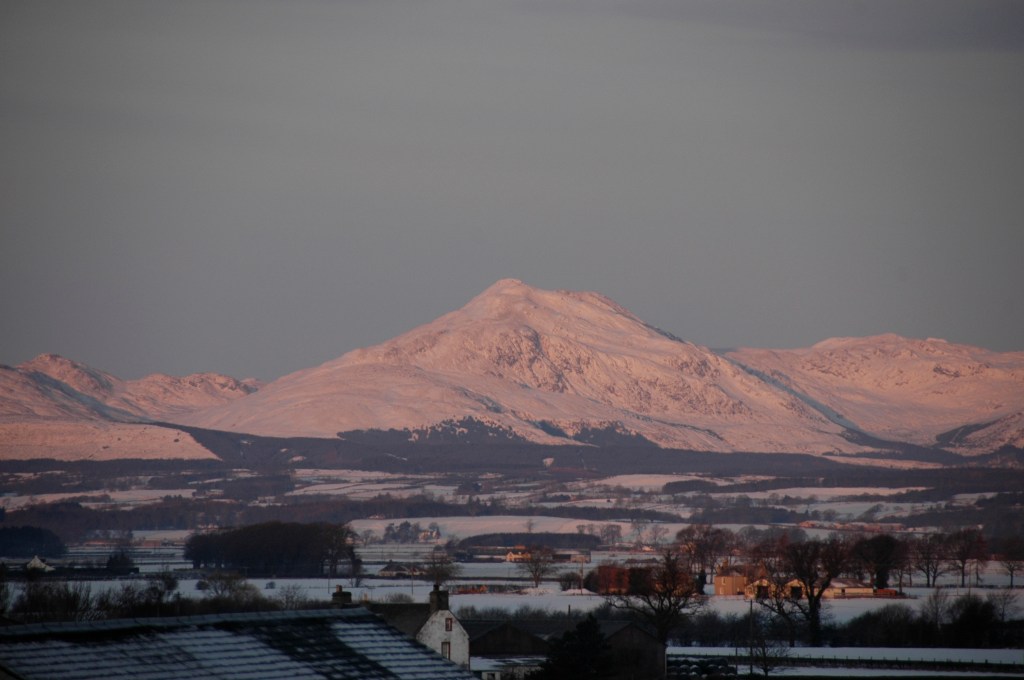
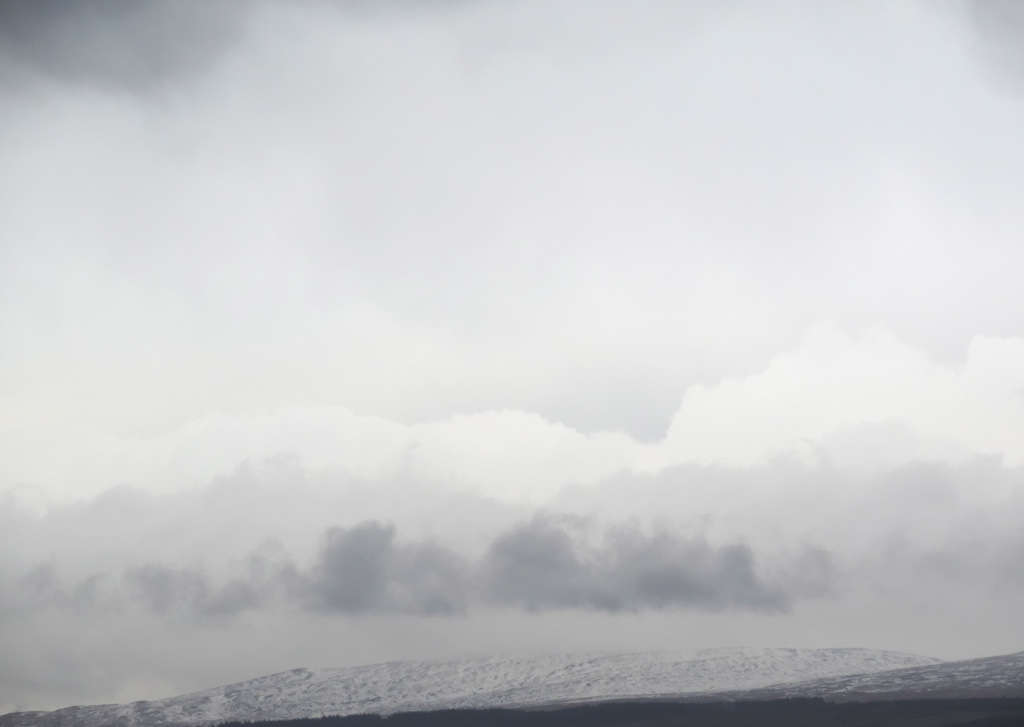
Yesterday I shared a January view from my old apartment. It was very foggy that day, which made the image very atmospheric but hid the mountains. Here’s another view from the same window. This time without fog, and with the sun turning the snow pink.

My views from a top floor window across to Ben Ledi always reminded me of one of the teachings of classical philosophy – the view from on high.

This teaching is sometimes described in terms of climbing a hill and looking down over the whole valley below, or by imagining a flight into space and looking back at the Earth.

It’s the perspective which lets you see a bigger picture. It enables you to be more aware of the contexts and environments.

It’s also the way to see a moment in time within the flow of a longer period (perhaps leading to that other classic teaching – “this too shall pass”)

This is, actually, our natural, first perspective. We begin with an awareness of the whole, and only after that abstract elements, or narrow our focus to reduce the amount of information we want to consider.

Think about that. Reductionism, looking at parts, is not our primary view and doesn’t reveal reality. Reality is whole. It exists invariably intertwined with layers and layers of connections, contexts and environments.

Holistic understanding is our natural default but our culture promotes disconnected views of reality – short term and partial. Maybe that’s why it keeps failing.

I believe our future will be secured by reclaiming our ability to see connections, to take a longer time perspective and by taking the view from on high.

Read Full Post »

Winter distancing

We’ve had one of the coldest Januarys I can remember here in South West France. In the seven years I’ve been here I can only remember the odd frosty morning but this year it’s been minus a couple of degrees centigrade every morning for pretty much the whole of January.

Along with the frosty mornings sometimes we have a freezing fog which just lolls over the countryside all day long. It was like that yesterday and, so far, it’s the same today.

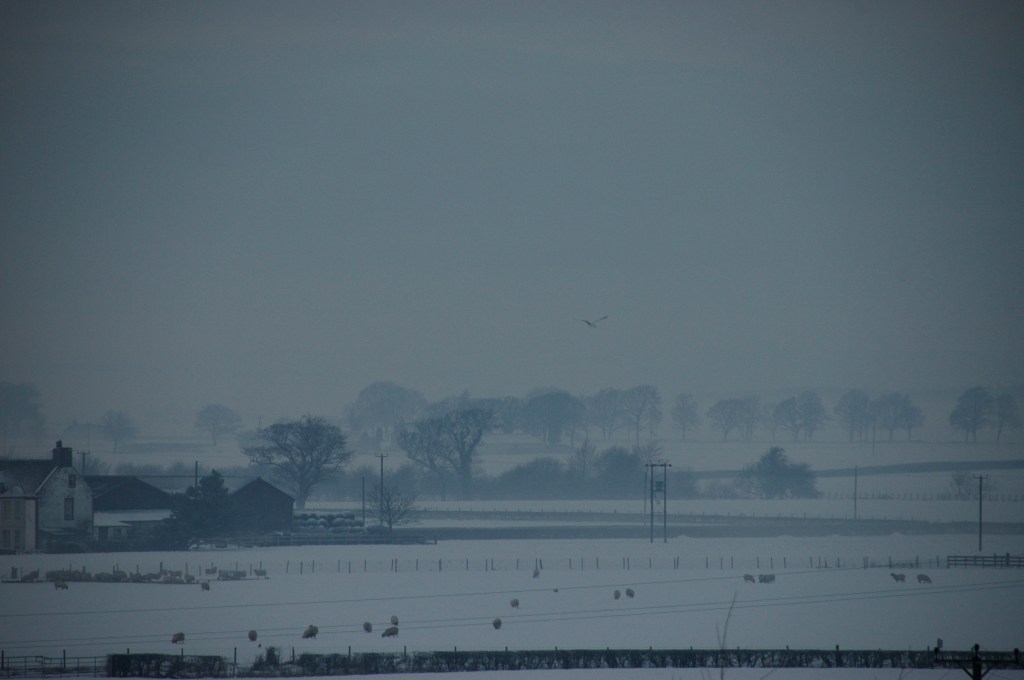
So it seems appropriate that as I browse photos from Januarys gone by, I come across this one. This is a photo I took from the window of the place where I lived for many years before emigrating. We lived on the top floor of a nineteenth century converted carpet mill. The flat had big arched windows and we looked out across the Carse of Stirling towards Ben Ledi and the mountains to the north. It was a view which changed every day.

This particular winter the snow fell and stayed on the ground for many weeks. There’s a real beauty in a snowscape and I think the mist adds to the atmosphere, to the feel, of this image.

This is the kind of scene I associate with winter. But the reality is most days winter is not like this, not in southern France, and not even in Central Scotland.

Our minds work this way though, don’t they? A particularly impressive scene becomes the marker, or representative of, a larger period or area. It’s only when we stand back, or apart, that we see the “bigger picture”, allowing us to be more aware of the uniqueness of whatever is right in front of us, here and now.

That’s our super power – our ability to put a little distance between ourselves and our experience so we can see both the particular and the whole.

Read Full Post »

Poetry

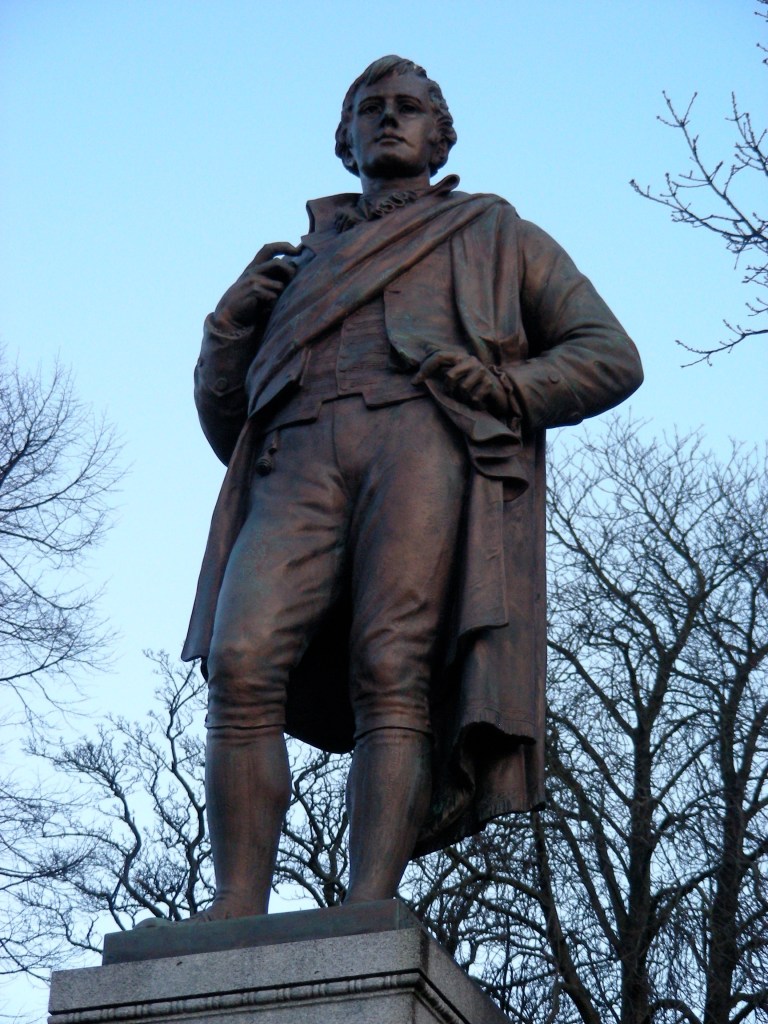
Yesterday was celebrated in Scotland (and in many other countries) as Burns Night. Here’s a photo I took of a statue of Robert Burns. This particular statue is in Stirling so it’s the one I walked by most frequently in my life.

I’ve often reflected on the fact that one of the statues in my home town is of a poet. Do you have any statues of poets in the town where you live?

It’s common in France to find statues of poets and writers, which, I think, adds to the sense that literature in general is an important part of French culture.

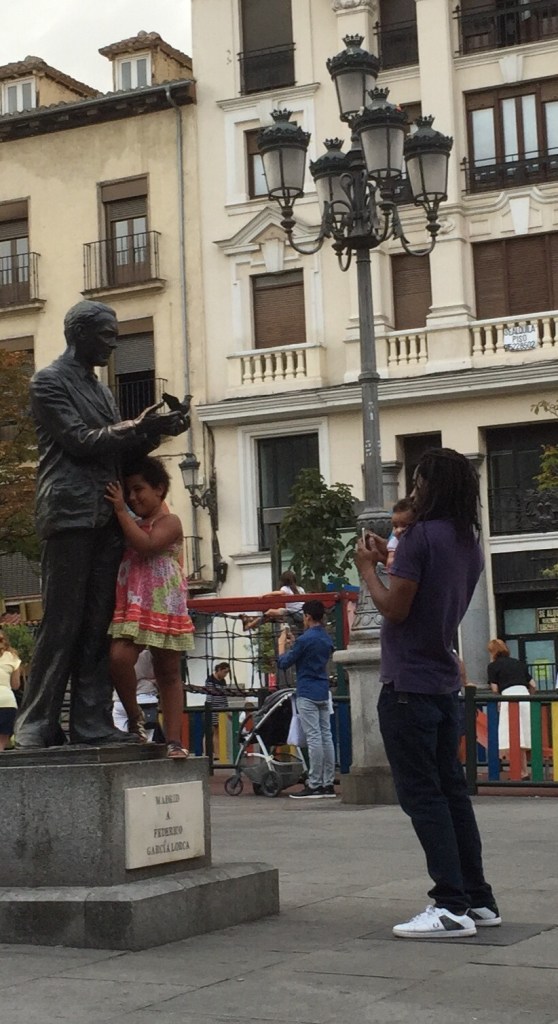
The other statue of a poet which comes to my mind is that of Lorca, in Madrid.

But I’m sure there will be some commemorated poets you’ve encountered in your travels.

How often do you read poetry? I hope it’s not just once a year! Do you collect your favourite poems anywhere? I gather mine in a beautiful notebook, and I described that here. I recommend that. Taking time to copy out a poem by hand allows you to spend more time with it, to relish it. And having your own personally curated collection allows you to find your favourite poems again quickly.

Did you watch “Afterlife” on Netflix? I don’t think it’s for everyone. The appallingly bad language will put many people off and it’s been criticised for being unnecessarily crude, and I think those two factors will be insurmountable barriers for some viewers. However, I enjoyed it, found it deeply moving in place and challengingly thought provoking. At the end of series 3, Lisa records a video message for Tony to see after she dies, and, in it, she recites the famous poem, “Do not stand at my grave and weep”.

Honestly, it’s devastating! But if you want to experience the power of poetry I recommend it. Here’s the clip….(have a box of tissues handy)

Read Full Post »

Human impact

Taken at the same time as yesterday’s photo, here’s another staircase down the side of the dam.

What strikes me so powerfully about this image is the contrast between natural and built environments. The central element in this photo is the concrete stairway with the zigzag shadow of the iron handrail giving it the appearance of a giant zip!

To either side of the staircase we see the growth of a diverse, seemingly random number of plants, from flowers to substantial bushes. I’m guessing nobody planted any of this.

The contrast couldn’t be more stark. The human creation is full of straight lines, looks rigid and fixed. There isn’t the slightest doubt that either the staircase or the wall of the dam have been placed there. They didn’t grow and they won’t grow. In fact, we know that over time they will degenerate, break down and crumble.

Nature, or Life, on the other hand thrives by grasping opportunities and adapting. That vegetation you can see will most likely grow and spread if left to its own devices.

This world we live in offers up the possibilities of life. It supports and promotes survival, growth and thriving.

Don’t we, the human species, need to get on board with that project and pour our energies and creativity into supporting sustainable life on Earth?

You don’t have to look far to see the effects of industrialisation and capitalism on the planet…..the combination of consumption and destruction is an ugly one. Abandoned mines, polluted lakes and rivers, plastic infested oceans…..it’s quite a tally.

We can do better than this I’m sure by turning our focus towards care and beauty, and away from short term greed and long term ugliness.

Read Full Post »

Stairway to…..

I took this photo at a reservoir in the south of France one January and looking at it again today I thought of the title “stairway to the deeps” because as I contemplated the image my gaze moved down the steps into the water.

I must say this pandemic has, at times, felt like a descent to the depths. It’s felt like being submerged, surrounded by uncertainty, living with threats and restrictions, a slide down into obscurity. It can still feel like that.

However every staircase exists to enable travel in two directions, so you can look at this the other way and see an emergence. It’s possible to see those dimly visible steps as the first glimpse of improvement. Soon we will climb up and step clear of the waters.

It’s also easy to see this image as a metaphor…a stairway connecting our unconscious to our conscious mind.

What with all the social distancing there’s been a lot of isolation which has produced both periods of sadness but also, for many, opportunities to reflect and reconsider values and goals. For some that’s thrown them into higher level states of anxiety or chronic despair, but, hopefully the re-evaluations are leading to some positive life changes – changes in work patterns, changes to where someone lives (I’m thinking here of how many have not gone back to the jobs they had, how many have sold their city dwellings to go live in smaller towns or in the country, and so on)

The truth is polarities and opposites are at the heart of reality. Life is never “only this” or “only that”.

We’re up and down that bloody staircase a million times a day! Or so it can seem.

Well Life is movement. That’s it’s nature. And every descent will be accompanied by an ascent. Which brings me to my final point. The staircase itself is beautiful and it’s the moving up and down that is our everyday life.

I guess we’re all trying to find a rhythm that works for each of us.

Read Full Post »

The power of myth

I came across this group of photos today. Each is a unicorn picture taken in and around Stirling Castle several years ago, one January.

It got me wondering again about the place of myth, and particularly, mythical creatures, in culture and society. A quick browse online reveals that only a tiny handful of countries have mythical creatures as emblematic. The vast majority of countries have adopted real animals in this role. The other thing that struck me was that Wales also has a mythical creature – the dragon. But England goes for a lion. Two Celtic nations, two mythical creatures.

There are two series of unicorn tapestries that I’ve seen. One in Stirling Castle, and the other in the Cluny in Paris. I love them both. They are immense works of art and overflowing with symbolic creatures and plants.

If you ask French people what they think of when they think of Scotland the commonest answer, I find, is “castles and ghosts”. Oh, and “mists and mountains”. All four of these, it seems to me, spark the imagination.

Is this why I love stories so much?

Is this why I have such a strong belief in not just the power, but the importance, of imagination in life?

Symbols, myths, legends, stories, art, poetry, music and dance…..such essentially human characteristics and activities. Sometimes I think we need to reclaim that place for imagination, expression and creativity in our societies.

Read Full Post »

Looking at water

One of my most favourite activities is looking at water! Maybe you share that fascination and delight?

This first photo is from the Bracklinn Falls that I told you about. There’s a beautiful bridge over these falls and you often see people standing on the bridge, mesmerised by the sight and the sound of the tumbling waters.

I think when you allow yourself to be captured by the sight of water, you slow down and start to notice more…more colours, more shapes, more ever changing flow and movement.

I know a still photograph doesn’t do justice to the experience but look at how many colours there are in that image! So many more than we see “at first glance”.

This second photo is the Mediterranean. Again, see the colours! What a palette! Standing at the edge of a sea or an ocean is just as mesmerising, just as enchanting, just as meditative, as watching water in a waterfall.

This third photo is the River Forth in the town of my birth, Stirling, with the Wallace Monument in the background. Rivers are especially fascinating, not least because, as Herodotus said

No man ever steps in the same river twice, for it’s not the same river and he’s not the same man

Isn’t it kind of mind boggling to think of a river as a “thing”, to give “it” a name, like we name cats, dogs, people we know? Because what exactly is this river we name? The water in it, which is never the same water, minute by minute? The banks, which change over days, weeks and years? When you look at the River Forth from Stirling Castle you see an astonishing trail of winding, looping water – loops which change over time? Is the river named because we can trace its origin in the hills and its destination in the sea?

Whatever we think a river, it’s clear “it” isn’t a fixed “thing” at all…..and that’s what I find fascinating about water. It’s always changing, always “becoming not being”.

Read Full Post »

You don’t really get a sense of scale from this photo but these rocks are about two metres high…..which is what makes them all the more remarkable. Rain, water, ice and wind have all shaped this rock over many, many years, slicing it up like a loaf of bread!

I took this photo on one of my most favourite walks in the world, up the hill behind Callander in Scotland, to the Bracklinn Falls.

Callander is a pretty, small town, not far from Stirling, the town of my birth. I’ve never known a time when I didn’t want to be a doctor. I first expressed the desire when I was 3. I don’t know where the idea came from. There were no doctors or nurses in my family. I guess it’s truly one of those “calling” things. A “vocation”. But I do remember watching a tv series when I was still very young – “Dr Finlay’s Casebook” – and thinking “that’s the kind of doctor I’d like to be”. That story was set in the fictional town of “Tannochbrae”, which in real life was Callander. When you walk up to the Bracklinn Falls you pass the house which was used as Dr Finlay’s surgery in the tv series.

I read a quotation from the artist, Jesse Murry yesterday…..

…….through the power of imagination to progress beyond the literalness of fact to the poetic dimension of fiction.

I thought of that again as I wrote this piece today….how, through the power of imagination we transcend the literalness of fact to enter “the poetic dimension of fiction”.

What would life be like without imagination? What would it be like without stories?

A sorry, harsher, more plain life I suspect. We need to be enchanted and we need to make sense of our lives….Thank goodness for imagination.

I wonder what stories there might be about these massive rocks at the Bracklinn Falls? I wonder what those shapes might have inspired in a storytellers mind?

I wonder if these rocks will stimulate your imagination……

Read Full Post »

A few years back I got a Lomo fisheye 35mm film camera. I found some photos I took with it in the January of that year.

I came across this stone circle with a tree growing in the middle of it and used the Lomo. The prints from the Lomo fisheye come back looking as if you are peering through an opening. I rather like it! It focuses your attention and encapsulates the subject in a sort of wholistic circle. The colour tones are very sepia like in this photo which enhances the sense of looking at something quite ancient.

This photo, taken with this kinda quirky camera, enables me to engage with the scene differently. I’m not someone who routinely alters the photos I take, I suppose because I tell myself I want them to be “realistic” but the truth is all perception is a creative process and allowing yourself to play with ways of looking at a scene both broaden and deepen the experience, don’t you think?

Here’s another one…..

Same stone circle, but this time resting the camera on the roof of the car to include the reflection of the tree I saw there. This particular “take” looks as if it is showing both the tree and its root system. In fact, if you wanted to draw a representation of a tree with its branches and its root system in the same image, it would look a lot like this!

I think allowing yourself to play and get creative does many things. It gives you new perspectives. It makes you aware of the creative component of all perception and it re-enchants the world.

What not to like?

Have fun….

Read Full Post »

The extraordinary

Looking through my photos taken in the month of January in years gone past I came across this one from many years ago.

We have good friends who live in South Africa and on one of our trips to see them they took us to a safari park. I’d never been to one before and I was astonished at how difficult it was to see such large animals as elephants and giraffes. Their camouflage allows them to move through the bush very close to you without you noticing.

Then we turned a corner towards a watering hole and look what we saw!

I’d never seen so many elephants in one place! And neither had our friends who had lots of experience of time spent in the bush and in safari parks.

I know I emphasise the remarkable, the astonishing, the wondrous in the everyday, as captured by the French phrase “l’émerveillement du quotidien”, but sometimes what’s completely extraordinary is exactly what you don’t see every day!

So I thought I’d share this photo of a truly extraordinary, unprecedented, unrepeatable experience. Because these rare events really do enhance the quality of our lives too.

Read Full Post »

« Newer Posts - Older Posts »