Feeds:
Posts
Comments

Making life good

There are lots of ways to make life good, but, here’s two practices which work best for me.

The first is, “stop”. Take a pause. We have a tendency to go through life semi-consciously, following habits, zoning out, and just not noticing the here and now. We can drive a regular route and when we arrive at our destination we can’t remember what we saw on the way. We can get to the end of January and think “Where did that go?” Everything is getting faster…..the news cycle, where the latest drama shocks you and upsets you, then, before you know it, it’s gone, as if it never existed, having already been replaced with the next shocker. Technology develops faster and faster, and the latest smartphone is virtually redundant from the moment you buy it, because already they are hyping the next “better” model. “Fast fashion” is just that….try and keep up….what you bought today is out of date tomorrow. “Doom scrolling” hooks us into an endless flow of mini posts, headlines, adverts, each one forgotten within days, of not within minutes.

The counter to all this is to slow down and pay attention. Yes, it might even involve actually stopping. You can set off today with an intention to notice…to see what catches your attention, to notice beauty, to allow yourself to be curious. But you have to slow down to reap the benefit. You have to pause, to really become aware of the present – what do you see, hear, smell, or taste, or what can you feel, right now?

The second is “reflect”. You can reflect right within the moment…as you notice something, take a moment to reflect on it, to contemplate it. And the other thing I like to do is take out my phone and take a photo. If you photograph what caught your attention, you give yourself multiple opportunities to reflect on it later.

There’s my two practices for today – “Stop” and “Reflect”. Try them both.
Ideal home

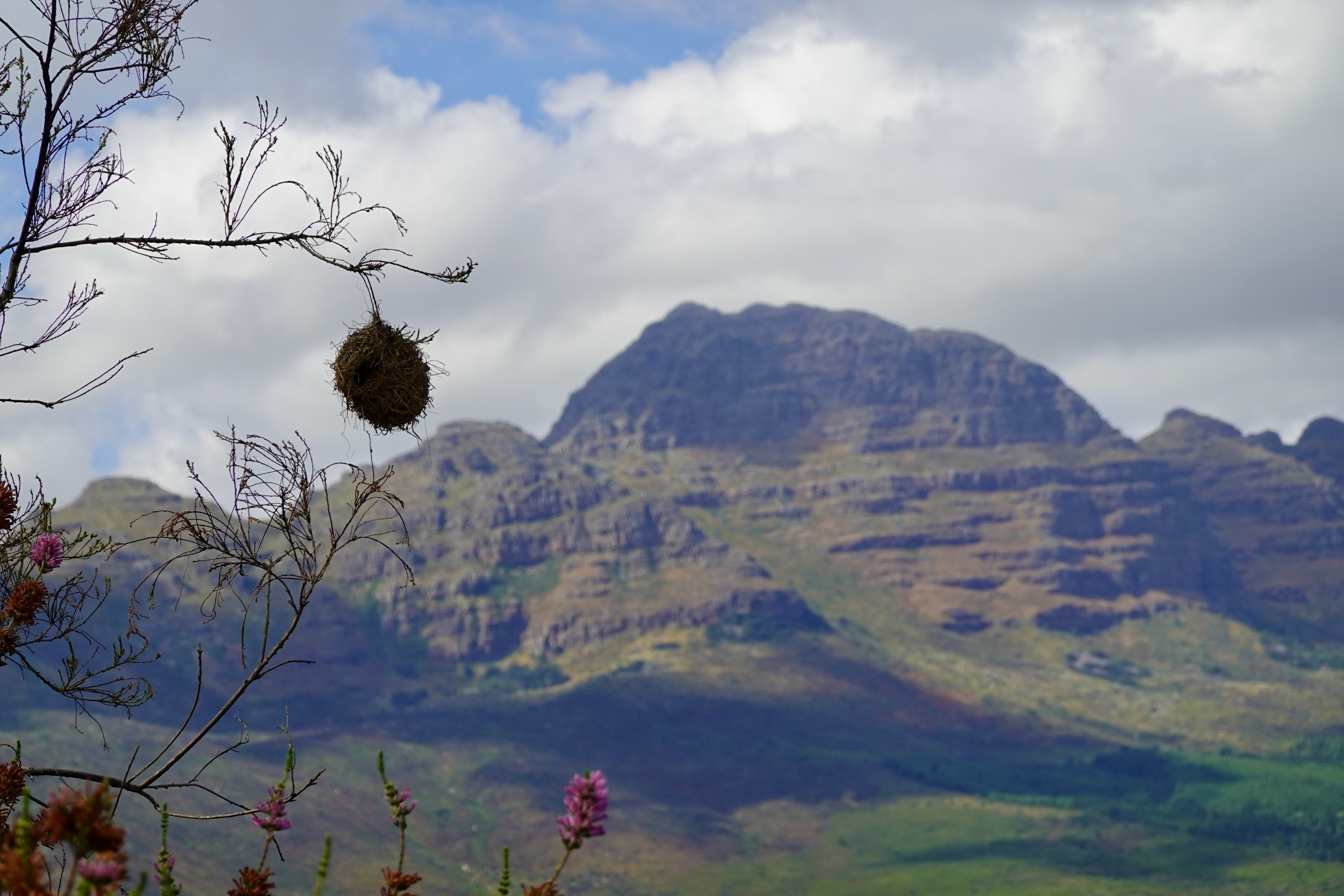
Look at this nest hanging from a tree in a garden at the foot of the mountain. Some nests are pretty amazing. This one is a sphere with a small entrance on one side. Why has the bird has chosen this exact spot to create it? We don’t know, but I’d imagine it’s got something to do with safety. After all, isn’t that one of the most basic needs of all forms of life? Shelter. But why hang it way out on the branch like this, where, surely, it’ll be buffeted by wind and rain more than it would be if it were closer to the tree trunk, or in a more dense area of branches and twigs. Again, I expect it’s about security. I expect it’s harder for predators of all kinds to reach it way out there.

But the other thing I thought about when looking at this photo, is the location of the nest in the surrounding landscape. A phrase from one of TS Eliot’s plays came to mind, where a character asks if people huddle together in cities in such large numbers because they like to be close to each other. I saw a graphic the other day showing the growth of cities over the last fifty years. Tokyo is the most densely populated city in the world by far, with something like a quarter of the whole population of Japan living there. I live in a hamlet of about 20 houses, just at the edge of a small village, surrounded by fields and trees. There are so many little villages and towns in rural France where you can pass through without seeing a single soul. All you see is shops and businesses which have long gone, and many abandoned old houses in various stages of disrepair. There’s a common issue in small to medium towns in France where they have developed shopping malls and zones around the edges of the town, and now, the middle of the town is almost dead. When we used to live near Cognac, we could walk down the main streets hardly seeing another soul, but as we passed the shopping outlets on the edge of the town we could see the parking lots were full to overflowing.

Why do we choose to live where we live? Of course, that’s a very complex question, related to where you were born, where your relatives live, where you can find gainful employment, where there are the necessary services providing education, health and social care. And a host of other factors too. But there’s also the issue of personal preference between city dwelling and country dwelling. There’s no doubt some people really prefer city life to that of a small town, or a village, and there are others who have the exact opposite preferences.

What would be your ideal place to live? If you could choose freely, what size and type of community and environment would you like to live in? And, do you know why?

Our brains have evolved a brilliant talent for spotting patterns, and one of the patterns it is best at noticing is a face. Not only do we have an ability to recognise a face quickly in a crowd (even if we have trouble putting names to faces as we get older!), but we see faces where there aren’t any.

Look at the surface of this rock. Doesn’t it, for all the world, look like a painting by Munch? A distorted face, perhaps, but a face all the same. These faces which are not really faces, but simply face-like patterns, always amaze me. I tend to see them most commonly in trees and rocks, but sometimes they are apparent in flowers or even buildings.

What’s the point of that? I wonder. What’s the value in being able to see faces which are not actually faces? Is it just a sort of side effect of the face-pattern-spotting skill? Maybe it is. However, even though I don’t know why we’ve developed this ability, I love it. It speaks to our capacity for imagination and creation which is so fundamental to human life. And it adds a layer, or, better, perhaps, reveals a depth, to perception which takes it beyond the mere utility of seeing. It can inspire. It can bring us moments of wonder and delight. It can spark our creativity and slow us down, stopping us from just breezing past, not really noticing. It brings beauty and reflection to life itself.

What face-patterns have you spotted recently?

It’s all flow

We don’t live in a world of entirely separate, fixed objects.

We live in a massively interconnected world of flow.

Every living organism is an open system. There is a continuous flow of materials, energy and information into, through, and from every animal, every plant, every ecosystem.

Yet, we continue to swallow the idea of reductionism, which tells us everything is made up of separate, smaller parts, and the way to understand anything is to isolate parts and observe them as if they aren’t connected to anything else. It’s useful to focus closely on something. It’s useful to analyse something and consider it at various different levels, but it’s dangerous and delusional to fail to see that everything is always in a state of flow…..affected by, and affecting, other organisms, by the environment and by the multiple contexts of its existence.

And we continue to be taken in by dualism….the belief that there are objects and subjects….objects which are measurable and “real”, and subjects which are individual and “imaginary”. I’m not going to get into the complexities of the “hard question” here….of how consciousness can emerge from “stuff”….but this dualism leads us to deny or dismiss human experience, when, actually, experience is THE fundamental characteristic of reality.

We are not machines. We are not machine like. We are living creatures, every one of us with a continuous, ever flowing, experience of consciousness. A consciousness which enables us to appreciate beauty, truth and goodness. A consciousness which enables us to be aware and to direct our attention to whatever interests us, whatever moves us, whatever makes us wonder.

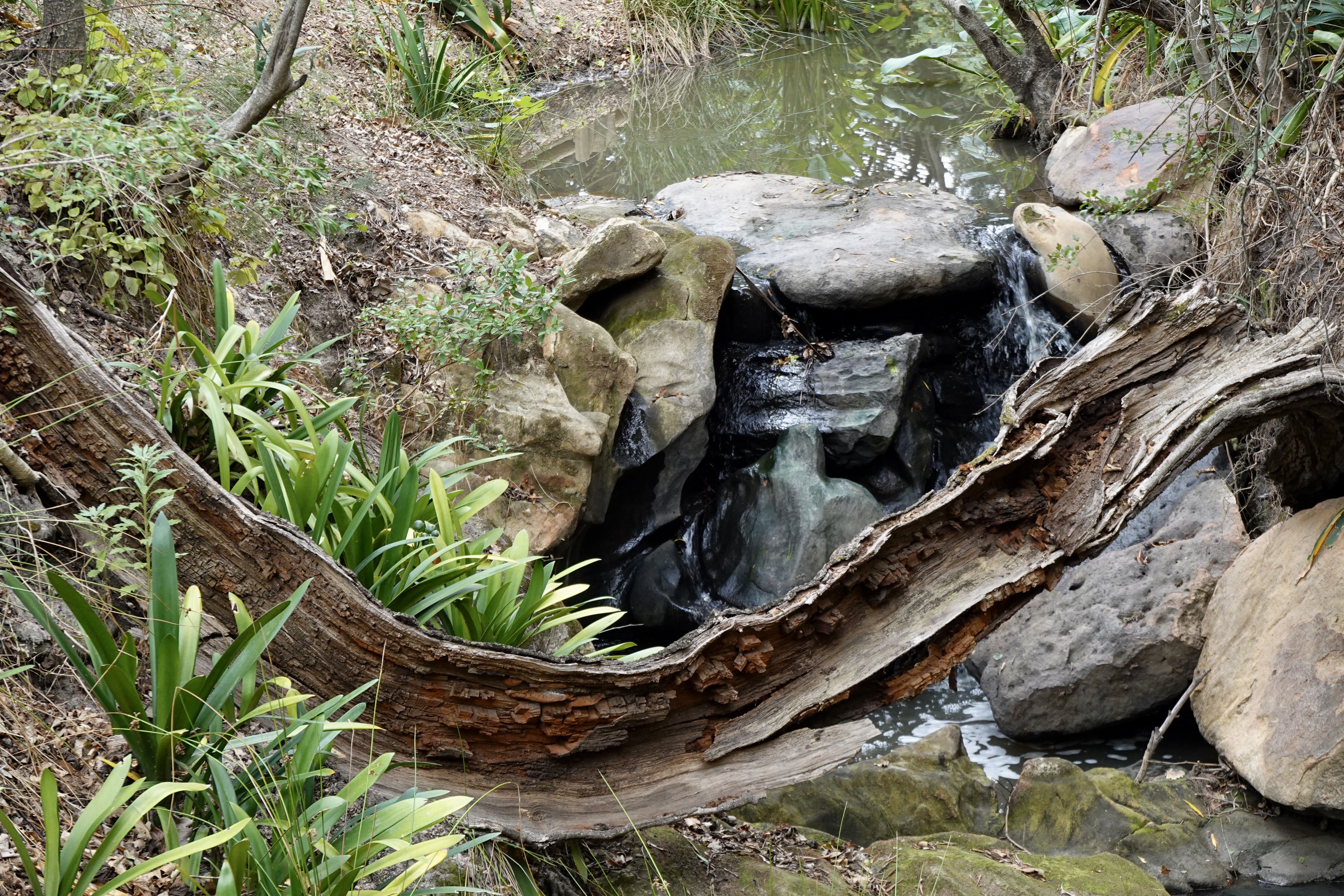
When I look at this photo, I see “flow”. I see it represented in the water. I see it represented in the wood. I see it represented in the green plants. I see it everywhere.

Now feels a good time to share this old clip from Charlie Chaplin’s “The Great Dictator” movie.

We want to live by each other’s happiness – not by each other’s misery. We don’t want to hate and despise one another. In this world there is room for everyone. And the good earth is rich and can provide for everyone. The way of life can be free and beautiful, but we have lost the way.

This is such a positive view of humanity. Quite different from the one we are fed daily in the media. We have lost our way (maybe we were never on it?), but we can find our way now. The reality is that this is one small shared planet. Everything we do is dependent on contributions from others, past, present and future. Everything we do affects others. We are not separate, self-standing, “units”, surviving only by being stronger and more violent than anyone else.

You are not machines! You are not cattle! You are men! You have the love of humanity in your hearts! You don’t hate! Only the unloved hate – the unloved and the unnatural!

We are not machines. We are not machine-like. The organisations we create to educate and care for each other are not factories. They shouldn’t be run on the principles of industrial capitalism. But rather on the basis of humanity, compassion, and even, yes, even that old idea of professionalism and a “calling”.

Dictators free themselves but they enslave the people! Now let us fight to fulfil that promise! Let us fight to free the world – to do away with national barriers – to do away with greed, with hate and intolerance. Let us fight for a world of reason, a world where science and progress will lead to all men’s happiness. Soldiers! in the name of democracy, let us all unite!

Dictators, and, I’ll add, “Strong men leaders”, “free themselves but they enslave the people”.

Ultimately this is a positive, hopeful rallying call to live our lives differently, and to create the political and social structures which will counter greed, hate and intolerance, structures which will promote happiness, compassion and beauty.

Order and wildness

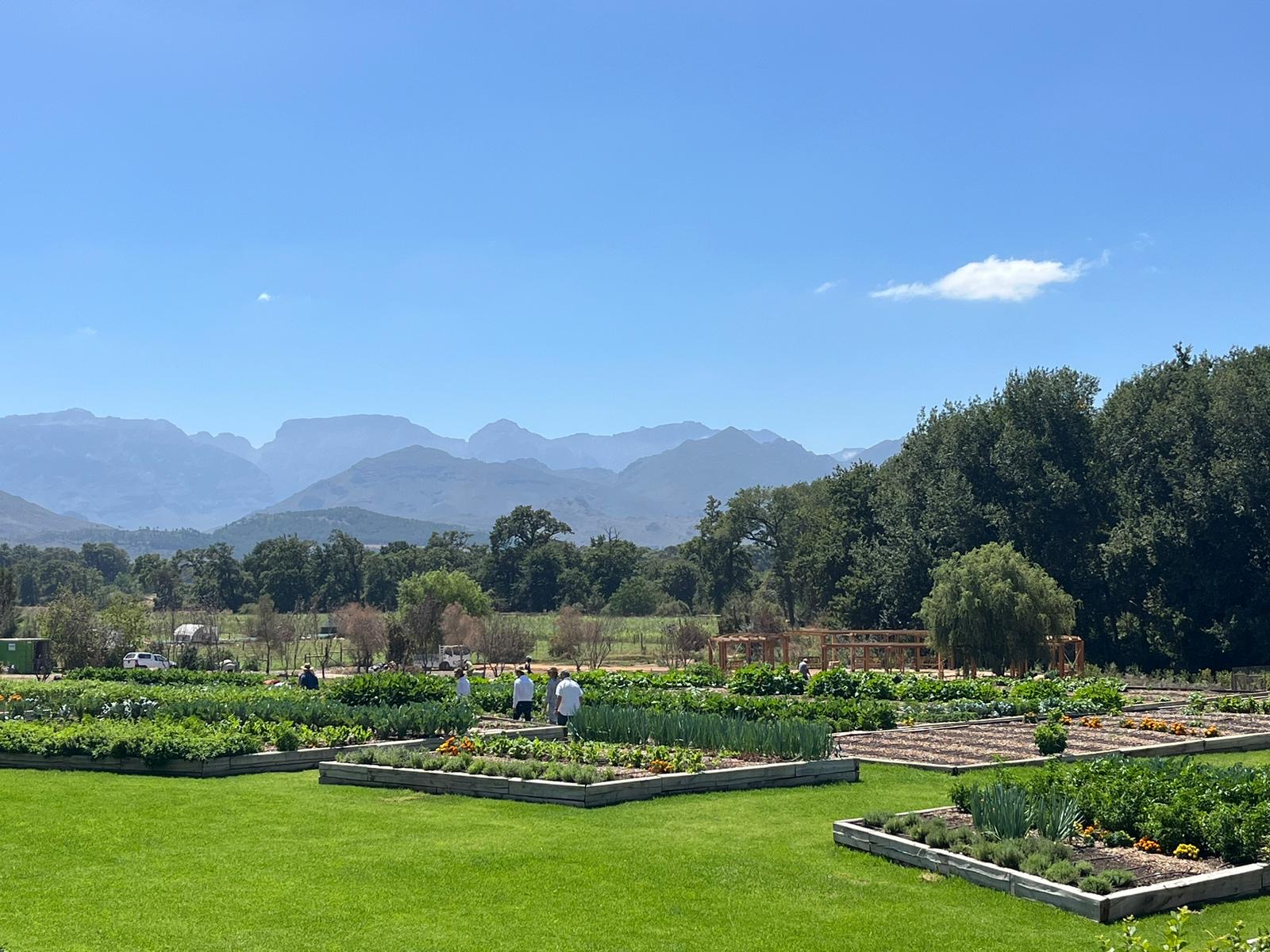
This photo of Boschendal garden in South Africa always makes me think of two forces of the universe – order and chaos, or, as Thomas Berry says, discipline and wildness. Everyone who writes about these polar opposite forces argues the same point – we need both, and we need them in a particular kind of balance. Too much of either destroys what we have.

We live in an ever more divided world, presented, day after day, with a black and white version of reality, with one pole presented as “right” or “true” and the other presented as “wrong” or “false”. Genuine dialogue and understanding disappear under the noise of anger, indignation and distrust.

Reality is full of paradoxes and polarities. And it’s not that some “happy medium”, or some bland “neither this nor that”, is better. It’s about understanding and acceptance, about seeing the necessity of apparent opposites.

Reality emerges from the synthesis of these two forces, not from their dilution, or from the exclusion of one in favour of the other.

To have wings

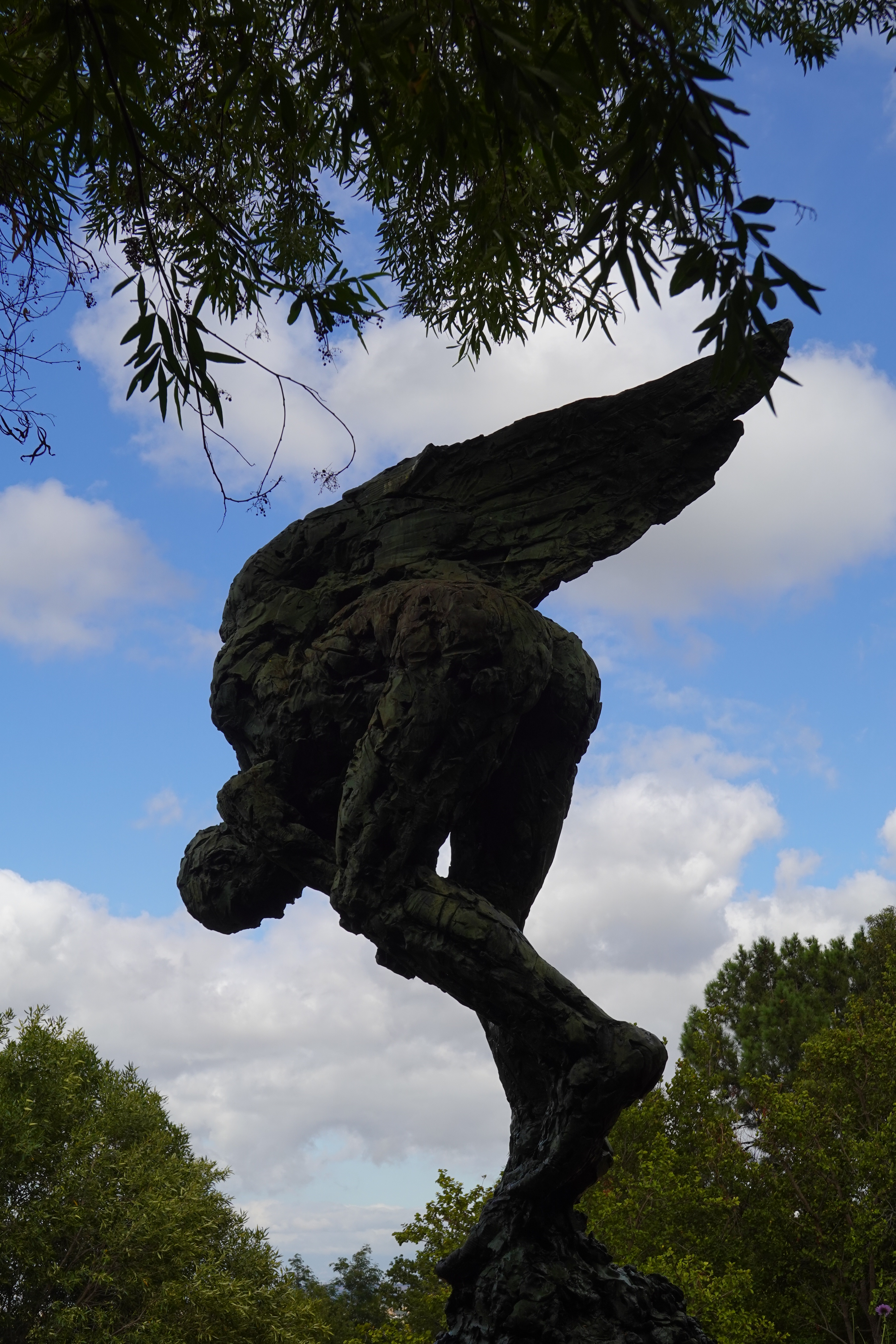
I wonder if we have dreamed of being able to fly. I know that many people experience some kind of flight in dreams. If you listen carefully, their descriptions are quite different. Some people have the experience that they are flying like “Superman”, zooming here and there, able to go wherever they have the fancy to go. Others don’t have that experience of being in control but, rather have the feeling that they are being blown long distances by the wind. For yet others they find themselves following a winding road or river, tracing its twists and turns. And, for many, it’s not so much a flight, as a fall. In this latter case, it’s quite common for the dreamer to have the actual sensation of falling, so vivid that it wakes them with a start.

I take great pleasure from listening to, and watching, the birds in my garden. For much of my life I was either too busy in my medical career, or I lived in a top floor apartment without any outside space, but since I retired to rural France I’ve been blessed with a garden, surrounded, in my first house, by vineyards, and, now, by trees and fields, and I have the weather for most of the year to be able to just be outside….either gardening, strolling, noticing, photographing, swimming, or sitting reading….and I am surrounded by birds.

I’ve had a number of very special exchanges with particular birds over these last ten years or so, and I feel their presence more than I ever did. I don’t know if that’s a common experience, or peculiar to me.

What’s your experience with flying dreams? What place do birds have in your life?

Ancient and evolving

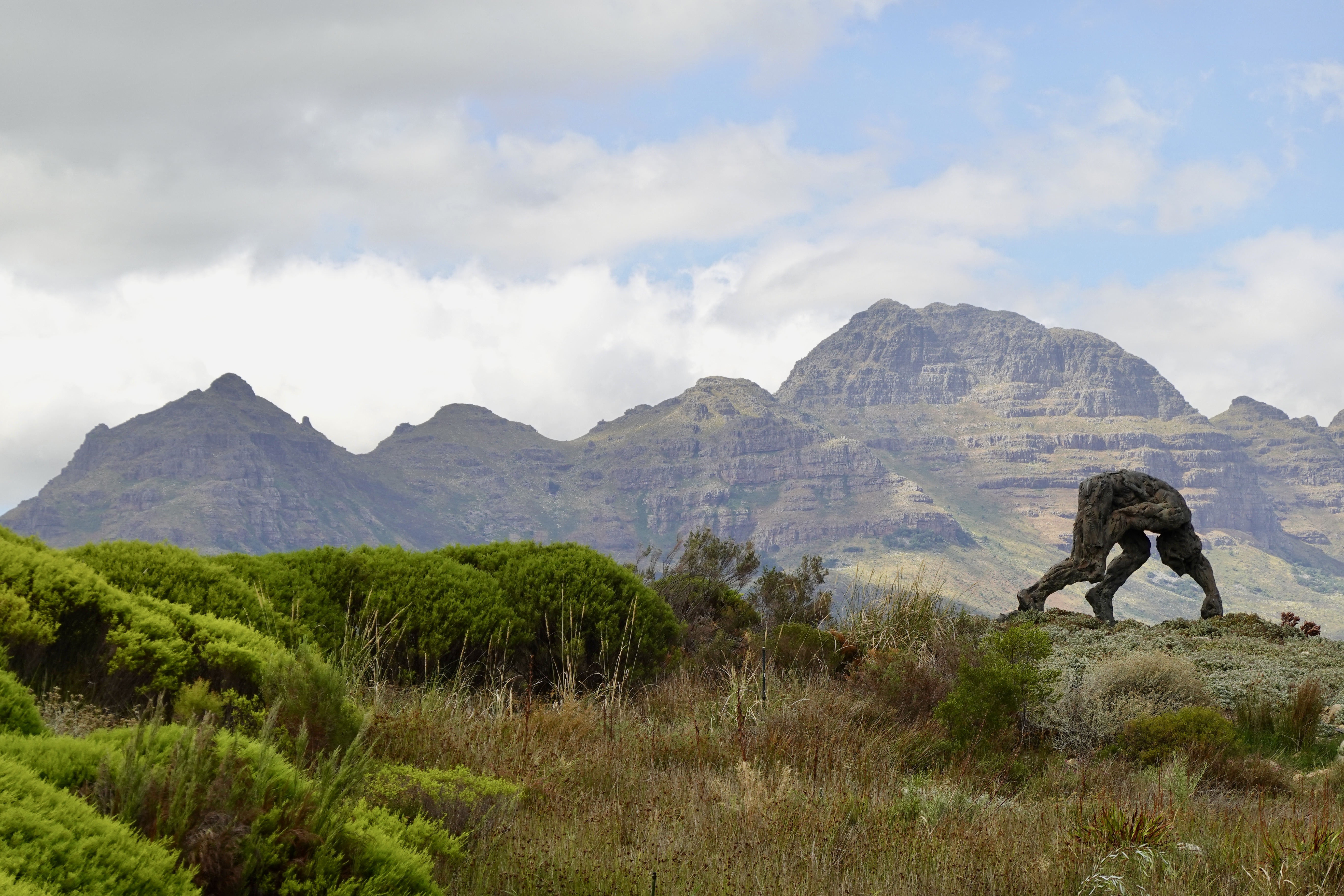
This sculpture in the Dylan Lewis garden in Stellenbosch evokes the sense of an ancient primate, maybe an early human, maybe a creature evolving between the higher primates and first human as we now know them.

I love how he’s captured the sense of the creature walking, not quite yet upright, but still using a hand to get around. I did think, at first, maybe it was someone bending over to pick something up, but I think the positions of the legs convey a feeling of movement, not simply stooping. I also love how the shape of the creature’s back echoes the shapes of the mountains in the distance.

I enjoy sculpture in nature. It often arrests me, capturing my attention, my gaze, and stimulating my thoughts and reflections. The whole Dylan Lewis garden is large and has many, many sculptures, placed throughout it, and its position at the edge of a wilder area, without any fences or walls around it, make it feel much more natural, although, I believe, it was created in a massive work of landscaping just a few years ago. It looks ancient, and it’s embedded in the even more ancient.

His sculptures often capture a kind of betweenness – in this case, a stage of evolution, between primates and modern man.

Riding the wave

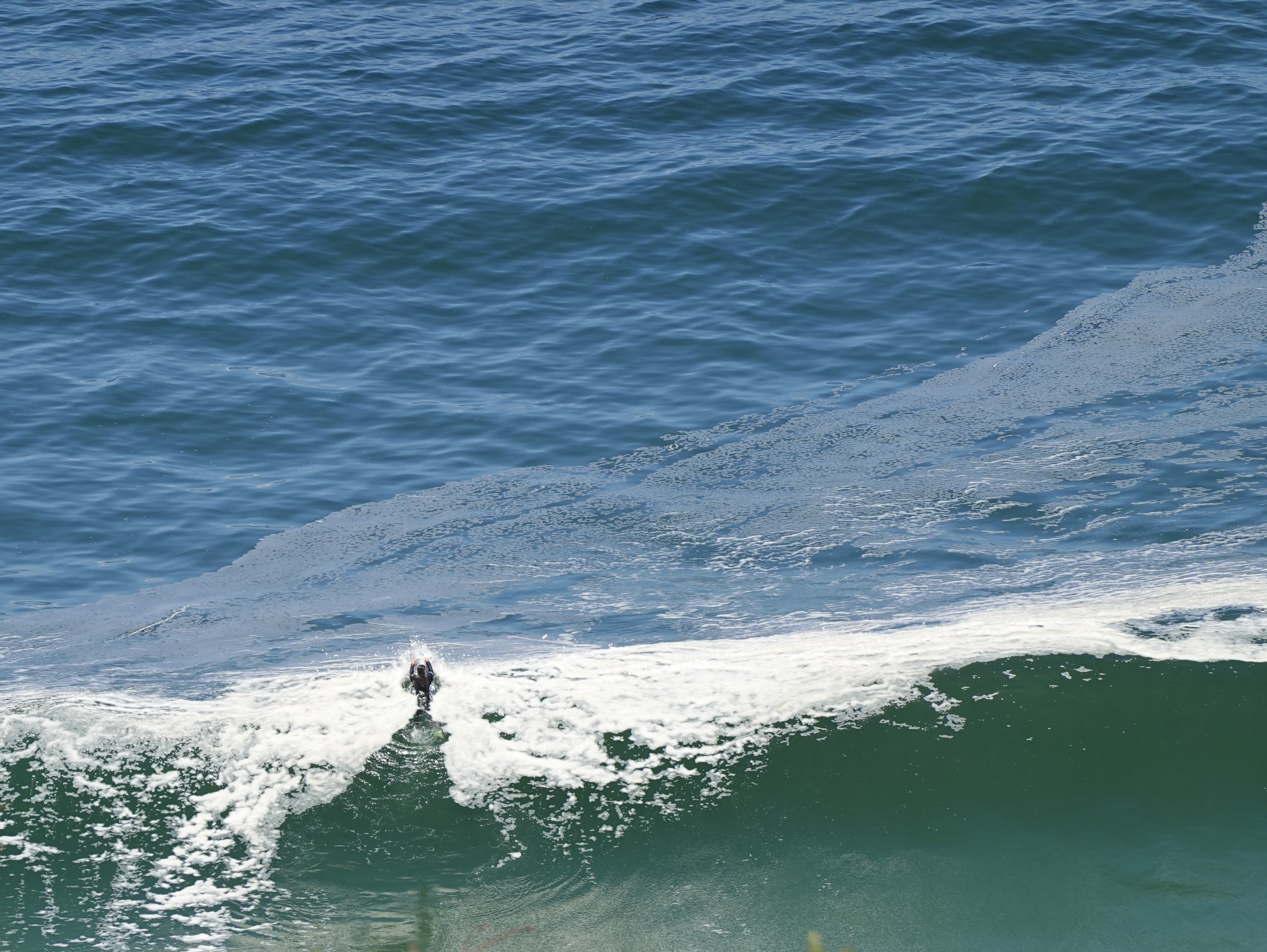
I’m a fan of the idea of “going with the flow”, and I’ve written about it often, but when I was in South Africa last January I saw this person in the sea….not so much going with the flow, as “riding the wave”. This latter phrase isn’t one I use so much, but these feel like turbulent times, and it feels as if the flow is also turbulent….there are great waves, one after another. Waves of significant change, eye catching, attention grabbing waves. It would be easy to feel submerged by waves like these. It would be easy to feel that they are going to wash us all away. So maybe this is a time to learn how to “ride the waves”, to “rise above” them. To tap into their energy and use that to go my own way.

I think it comes down to the attitude we strike – if we approach these waves with fear, then, surely, we’ll drown, or, at best, be driven this way and that, against our will. But if we approach them with confidence, with a sense of wonder and curiosity….then we can play with them, create what we want to create, drawing on the energy and power within the wave, without blindly following its direction.

This does feel a time of great change, but, that can be exciting when we begin to see a potential evolution, a possible phase change, allowing us, as individuals, as communities, and even as a species, to move on to very different world, a very different way of living.

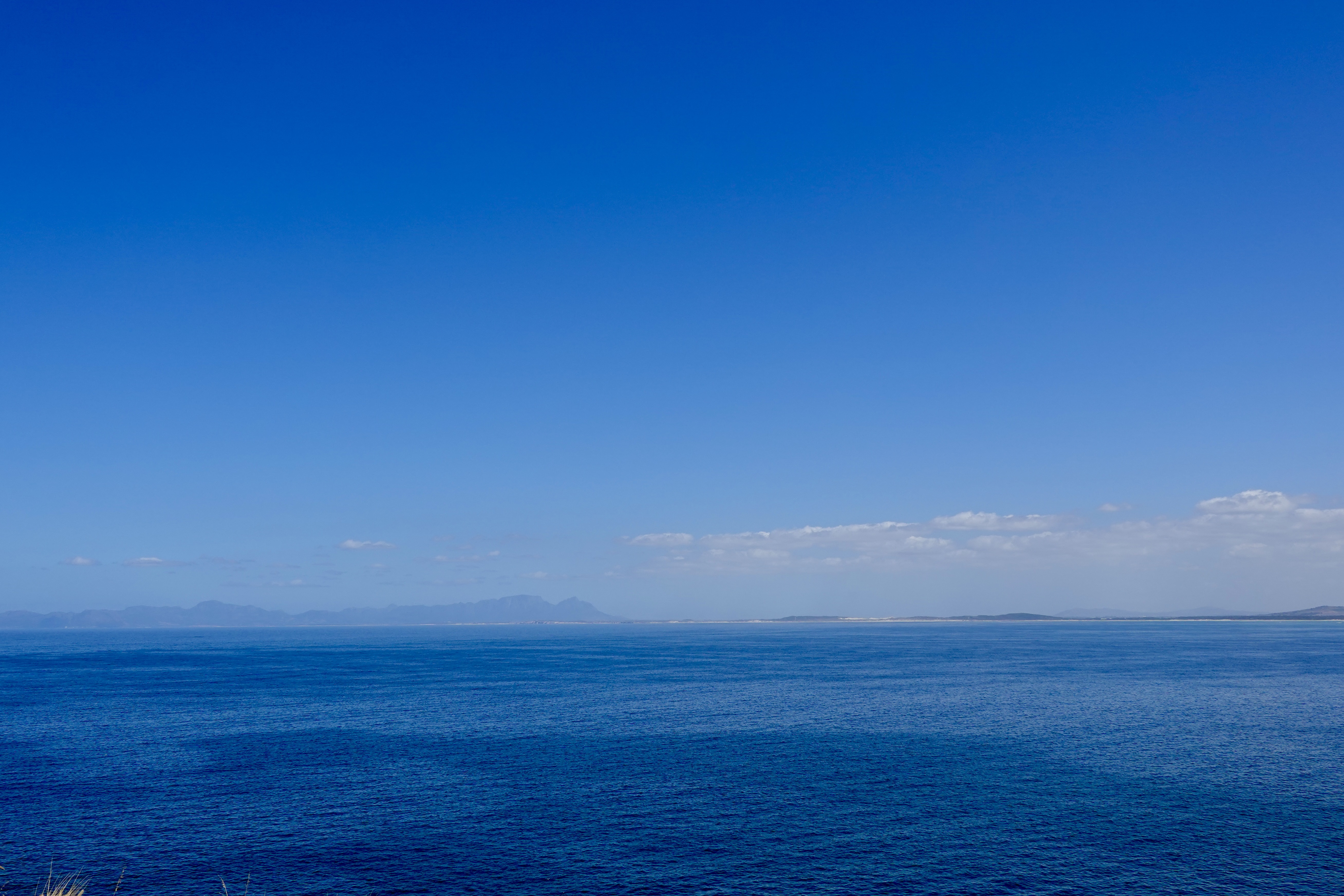
Here’s a gift for you today – a blue, blue scene which I find SO calming, and I hope you will, too.

I took this photo a year ago when visiting good friends who live in South Africa. The sea was especially calm that day, and the sky so clear, even though there were thin white clouds in the distance.

Rebecca Solnit writes incredibly beautifully about blue in her wonderful “Field Guide to Getting Lost”…you can read an extract here.

Meantime, just take a moment and immerse yourself in this gorgeous palette of blues.