Throughout my career as a doctor I always looked forward to meeting new patients, every one of whom would tell me a brand new story. By taking a focus on uniqueness I’d be unceasingly curious. Who is this person? What, exactly, are they experiencing? How did it come about? What are the circumstances of their life now, and what were they when their illness began? And so on and so on. You get the idea. When you focus on uniqueness, it opens your mind to find out more. Making a diagnosis, naming the disease, is no longer an endpoint of the consultation. Finding out just how different this patient is from the others you’ve met becomes an ongoing quest.
But a focus on uniqueness brings value to anyone’s everyday, not just to doctors and patients. The ancients taught us to begin each day with the knowledge that every upcoming experience would occur for the first time in our lives. We have never lived the day ahead before. And they taught us to begin each day with the knowledge that every upcoming experience would occur this time only. Today is our last chance to experience today.
A focus on uniqueness makes you aware of the here now, knowing, as Heraclitus taught, that we can never step into the same river twice.
A focus on uniqueness encourages a sense of wonder – l’émerveillement du quotidien.
A focus on uniqueness makes us more aware of transience and change. Transience is beautiful, and precious, teaching us to savour and relish every single moment.
And it does something else, too. It opens our minds to appreciate diversity.
Try it for yourself. Set out today with a focus on uniqueness.
Sally Rooney, talking about her new novel, discussed the word “mutual”
mutual is a word and idea that repeats throughout Intermezzo. Henry James often uses that term to indicate the moment when subjectivity transforms into intersubjectivity, consciousness into shared consciousness—or, as you put it in Intermezzo, when two people’s “thoughts interpenetrate”
I love that phrase “the moment when subjectivity transforms into intersubjectivty”. That’s what I sought in every consultation in my clinic…that phenomenon where “two people’s thoughts interpenetrate”.
We live in a society, a world even, which is increasingly divided and people are alienated from each other and from the planet. Or in the terms explored here yesterday, increasingly we are “uncoupled”.
But the truth is we are not alone. The human being, with their long period of infancy, has evolved to be highly social, highly interdependent. As Thomas Berry said, we are not a collection of objects, but a community of subjects.
I have long been a critic of reductionism. I mean, I get how it brings something to the table. Our ability to isolate a certain element from within the flux of phenomena and experience, to focus on that element closely, allows us to further our understanding of the world. I suspect it also does, what Iain McGilchrist describes as a left hemisphere trait….it allows us to grasp, to manipulate and control. Therein lies its power.
But it all goes wrong when we fail to integrate our new understanding of a part back into the reality of the whole.
In her novel, Elixir, Kapka Kassabova, writes –
Medicine emerged from alchemy’s noble attempt to marry the subjective and the objective, matter and mind, inner and outer, and in this way, to lift humanity out of superstition and senseless pain.
But like magic, the bias of modern medicine went too far in the opposite direction. Like magic, it assumes too much and has many blind spots.
These blind spots come from its many uncouplings, one of which is the uncoupling of psyche from soma, the soul-spirit from the body. Another is the uncoupling of one organ system from another, and another is the uncoupling of the human being from her environment.
Both Folk Medicine and Western Medicine discourage you from taking ownership of your well-being through knowledge. Both of them keep you dumb and dependent.
In this passage she critiques both Modern and Folk Medicine for taking power away from individuals. Too often Medicine, in all its forms, comes across as a body of secret knowledge, with an expectation that patients will have faith, and hand themselves over to the practitioner with the superior knowledge.
Personally, I think this is a terrible way to practice Medicine. Diagnosis, prognosis and potential treatment should be a joint process emerging out of a caring, open relationship between a practitioner and a patient. Ultimately, the goal should be to increase an understanding of the self, and to empower individuals towards greater knowledge and autonomy.
I love how Kapka describes Medicine as emerging “from alchemy’s noble attempt to marry the subjective and the objective, matter and mind, inner and outer, and in this way, to lift humanity out of superstition and senseless pain.” That’s exactly how it felt to me. Medicine, at its best improves the lives of others by “marrying the subjective and the objective, matter and mind, inner and outer.”
But in fact what really strikes me most in this passage is “These blind spots come from its many uncouplings, one of which is the uncoupling of psyche from soma, the soul-spirit from the body. Another is the uncoupling of one organ system from another, and another is the uncoupling of the human being from her environment. ” It’s that use of the word “uncoupling”.
I’ve never used “uncoupling” in this context before. But it resonates with me much more deeply than “reductionist”. This, surely, is the heart of the problem – when we “uncouple” one organ system from another, “uncouple” the mind from the body, “uncouple” ourselves from each other, and from the rest of the lived world with whom we share this one, finite, interconnected, little planet.
The economist, Thomas Picketty, recently wrote this on his blog – “In France, the combined wealth of the 500 largest fortunes has grown by €1 trillion since 2010, rising from €200 billion to €1.2 trillion.”
What he’s highlighted here is the massive increase in the wealth of the already wealthiest in the world over the last decade or so. There are lots and lots of other figures you can find if you go searching for them, but they are all examples of exactly this phenomenon – while there is great child poverty, millions of people suffering from a “cost of living crisis” and a decline in Public Services in European countries, some people……those who already hoard the most…..have been absolutely coining it in. This is despite such “crises” as the pandemic and the war between Russia and the Ukraine.
At the same time, politician after politician complains about “the National Debt” and how “we can’t afford” to give people decent lives, decent houses and decent jobs.
There have also been a number of articles in recent times about what has been coined the rise of the “inheritocracy” – increasingly, this large shift in wealth away from the general public into to hands of a tiny minority, is leading to more and more younger adults becoming wealthy because they happened to choose the right parents. This isn’t a meritocracy. And it isn’t about rewarding those who work the hardest and contribute the most. There’s a trend underway, and Picketty highlighted that trend in his best seller, “Capital” – that capital is growing faster than the economy, so inequality will continue to increase.
It strikes me there’s something seriously wrong with this system. But let me just pull another issue into this, because these are the things rattling around my brain this morning – the other thing we hear politician after politician go on about is “growth”. “Growth” – the answer the Life, the Universe and Everything! In the UK Labour have built an entire set of policies on this premise – get “growth” and all the good things will follow – better family incomes, better Public Services, less hardship. But, don’t you ever stop to wonder – “growth of what?” I do. Not least because it’s clearer than it’s ever been that we live together on one, finite, massively interconnected planet. We cannot keep growing the global temperature. We cannot keep growing the oceans of plastic waste. We cannot keep consuming more (just consuming more, it apparently doesn’t matter what) every single year. At some point, we’re going to hit the buffers. Aren’t we?
Look, I don’t have all the answers. It’s just that these are a couple of the issues which trouble me these days – both issues, which, along with Climate Change, pollution and species loss – lead me to conclude – there is something deeply wrong with this current world economic/political system.
We humans, like all other living organisms, are “complex adaptive systems”, and as such, we share a fundamental capacity to self-organise, self-defend, and self-heal. We know that, don’t we? Whenever you’ve had a cut, within a few days, the wound has been repaired, and often, without even leaving a scar. Whenever you’ve broken a bone, whether or not you’ve needed surgery or the help of a temporary plaster, your body repairs the damage. Whenever we’ve caught a virus, usually within a few days, our body has got rid of it, and repaired any damage done.
But in Modern Medicine, we don’t pay much attention to any of that. We are sold the idea that drugs “cure” or “heal”, when, actually, what they do is modify disease activity within the body.
There isn’t a single drug on the market which has been designed to stimulate and/or directly support self-healing.
And I’m not aware that any drug companies or research groups are even working on trying to do that.
Yet, nobody, but nobody, will recover from any illness without the natural self-healing functions doing what they are designed to do. There is no “artificial healing” (just as you could argue there is no “artificial intelligence”) – there is only natural healing. Natural healing is limited, of course. We are mortal creatures. Every single one of us will die, one day, from something….trauma, infection, or disease. Despite claims that some drugs are “life saving”, the marketers don’t actually mean they can stop you from ever dying! Similarly, natural healing can only achieve what is possible within the biological limits of a living creature.
I’ve no doubt many drugs can make life more comfortable, and many can modify the life history of a chronic pathology. But is that enough? Shouldn’t we, routinely, be exploring, with our patients, what we can do to promote and sustain self healing?
Take the example of post-surgical recovery. When we create the conditions which support self-repair and healing, then patients require less painkillers, develop less complications and make a longer lasting, quicker recovery.
If we don’t use the methodologies which are directly intended to stimulate and sustain self-healing and/or we don’t help patients to access the care and environments which are conducive to self-healing, we aren’t really doing a complete job. Are we?
So, here’s my challenge. See if you can find out what we know supports self-healing….then look to draw upon some of that any time you, or your patient, is ill.
A wide ranging review of General Practice in the UK has just been published in the British Journal of General Practice. It makes for disturbing reading. Here’s one of their conclusions –
Overall, these findings reveal a system that is approaching — or, in some cases, beyond — breaking point. Staff members are stressed, demoralised, and leaving; clinical care appears to be compromised; and many patients are dissatisfied, frustrated, and unable or less willing to seek care. We believe there are significant risks to patient safety and to the future survival of traditional general practice in UK.
Here’s another –
Quality efforts in UK general practice occur in the context of cumulative impacts of financial austerity, loss of resilience, increasingly complex patterns of illness and need, a diverse and fragmented workforce, material and digital infrastructure that is unfit for purpose, and physically distant and asynchronous ways of working. Providing the human elements of traditional general practice (such as relationship-based care, compassion, and support) is difficult and sometimes even impossible. Systems designed to increase efficiency have introduced new forms of inefficiency and have compromised other quality domains such as accessibility, patient-centredness, and equity. Long-term condition management varies in quality. Measures to mitigate digital exclusion (such as digital navigators) are welcome but do not compensate for extremes of structural disadvantage. Many staff are stressed and demoralised.
I first expressed the desire to be a doctor when I was three years old. The role model I had was the family doctor who attended the home birth of my younger sister. I was trained according to the dominant values of the time (which are referred to within this study) – “relationship-based, holistic, compassionate care, and ongoing support to patients and families”. The authors of this study find that it is increasingly difficult, and in many cases, impossible, to practice according to these values, even though, GPs still hold them. This results in stress, frustration, and burn-out which impacts adversely on both recruitment and retention of doctors in Primary Care.
So, what’s going on? How did we get here? This paper outlines several factors, not least financial austerity, underfunding, increasing inequality, increasing complexity of illness and an ageing population. But it also highlights a problems which arise from a particular management philosophy – the authors don’t actually use that term – where on the grounds of so-called greater efficiency, health care teams have become more diverse, digital and both algorithmic and protocol-driven services delivered by less qualified staff have increased, and the whole service is disintegrating. The efficiency actually goes down, the dangers increase, and dissatisfaction mounts (in both patients and staff).
The authors don’t give any quick and easy solutions but they shine a bright clear light on the problems, and put their finger on at least one issue at the heart of the problem – the loss of continuity of relationship-focused care delivered by holistically and compassionately.
They do use the word “dehumanised”, and that’s long been my experience. We need to get back to those traditional values and stop doing what impairs them. We need to get back to a health service which puts patients and their GPs at the heart of the system, and stop thinking we can use new technologies and industrial management practices to make things better.
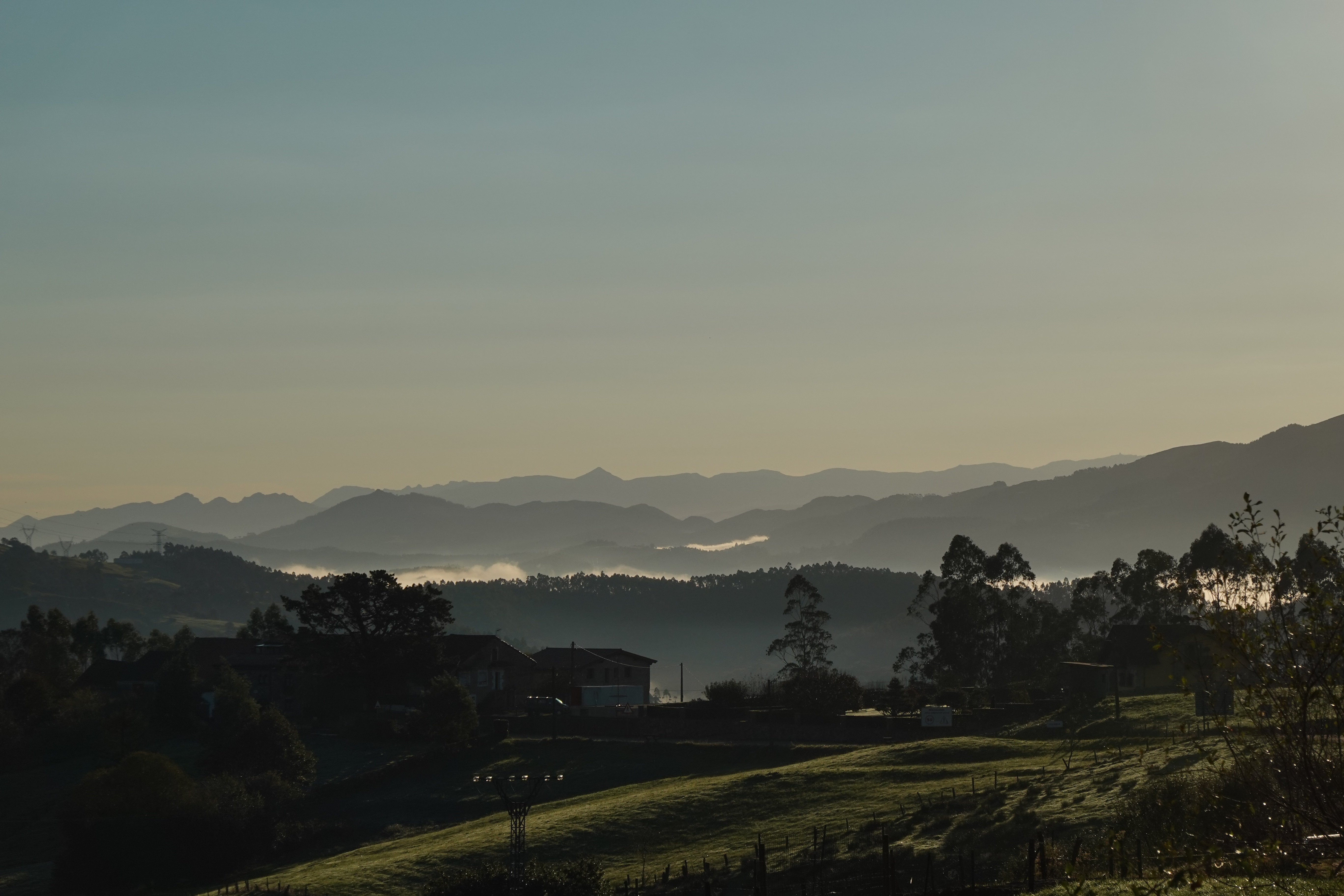
I was driving up the road from Comillas to the sequoia forest early in the morning and as I turned a corner the patches of mist lying in the valleys caught my eye, so I pulled in to a lay-by and took this photo. In fact, I took several photos, and also took a few moments to gaze from side to side and into the distance, just taking in the whole landscape stretching out before me.
As I look at this photo now I see even more than I saw when I stood at the side of the road. Yes, of course, I still see how several valleys are holding the morning mists, giving the impression of white river, and maybe a soft white lake. And as the range after range of mountains recedes into the background I notice, as I have done many times before, how the distance is, so often, a shade of blue….although at this moment, the early morning autumnal light brings a green tinge to it all.
But now I notice the electricity pylons, the ones in the foreground with their insulators catching the sunlight, and the more distant, much larger ones in the top left of the scene. I see a fence, where someone has claimed this little patch of planet Earth for themselves….something we humans have done for centuries, producing borders, privatising the commons, creating a distinct “mine” and “yours” (or, at least, “mine” and “not yours”!). I see a handful of houses, and a van. I see a road sign telling drivers to keep to less than 50 km per hour….a rule somebody has decided to impose, no doubt with the intention of keeping pedestrians safer. There’s a sign with the name “Valoria”, a tiny village of a handful of houses.
I love taking photographs, particularly of anything which catches my attention. I find that when I upload them to my computer and take my time with them, I invariably notice much more than I did when I was actually there. It’s not that the photographs are better than being there (in fact, if I hadn’t been there, I couldn’t have taken the photo anyway), but they enrich and enhance the experiences I had at the time.
I think it’s good to slow down. It’s good to take your time before you press the shutter and take a photo. And it’s good to return to the image you’ve created, time and again, to explore, to savour, to enrich.
One of the things which frustrates me most about Medicine is this question – “Is it physical?”, which may be asked in a slightly other form – “Is it organic?”, (or, the apparent opposite – “Is it functional?”), “Is it a problem of the body or the mind?”. This way of thinking which divides illnesses into two categories, separating out the mind from the body, is still way too common. It’s common in patients who refuse to accept their illness could have anything to do with their mind – “it’s a virus”, “it’s a hormone problem”, “it’s my genes” – usually because they have been led to believe that a problem involving the mind is a “mental problem”, which strangely continues to carry a stigma that an infection, or a broken leg don’t carry. Separating out the mind from the body is a common misunderstanding not least because it is promoted by doctors who should really know better by now.
The human being is a living, multicellular organism. Starting from a single, fertilised egg cell, the foetus doubles and doubles and doubles the number of cells, until the fully formed human being is born with trillions of cells on board. Trillions. It’s too big a number to visualise. In fact, the number of cells in a human body are estimated, not accurately counted, partly because cells die and are replaced constantly. None of these cells exist in isolation. They are all in constant communication with, and respond to, other cells within the organism, so that although we each have a heart, two lungs, a stomach, a liver, a brain etc, none of these organs exist by themselves. Every single one of them is “integrated” with all the others – that means each is in an active two-way relationship with other organs, tissues and cells. The cells of your body don’t compete with each other. They collaborate. They work together to make the whole organism healthy, so that it can adapt and to grow.
The mind, as best we understand it so far, is more than a function of the brain. It’s embodied. There are extensive neural and endocrine networks throughout the body which work together to produce what we call the mind. This understanding of mind is sometimes referred to as “embodied mind”. Search for that term online to learn more if you like. It’s a useful concept which allows us to see that the mind is not confined to the skull.
It turns out that terms like “heart felt”, and “gut feeling”, are not mere metaphors, but reflect biochemical activities and phenomena which involve, not only the heart and the digestive system, but the whole organism.
I used to say to patients and medical students, I only ever saw a body without a mind in the mortuary, and I never met a mind without a body.
It makes no sense to me to separate out the mind from the body, because when illness occurs, it might arise in a specific tissue, or organ (or it might not), but the response to the disorder is a whole being response – we use the powers of every system within the body, and our abilities to think and to feel (I mean emotional feeling), to defend and repair.
The big problem with separating off the mind from the body and looking for “physical” or “organic” problems is that if all the lab tests and imaging comes back within normal limits, an illness ends up being classed as “mental” – and treatments for mental disorders are then offered. Or worse, it is dismissed as “not real”.
But there is another way to look at all of this – a holistic way – where we don’t separate out the mind from the body and whatever the disease, we seek to address the person, not simply some of their cells or organs. Yes, maybe there are cellular pathologies which can be, and should be addressed, but healing and repair always involves a whole person.
Wouldn’t it be better if we never limited ourselves to addressing “pathologies” in cells and systems, but, rather, in addition (and not or, remember), we engaged with the whole person through their story, their actions, their thoughts and feelings? Shouldn’t we address the circumstances of their lives, because nobody lives in isolation from environmental influences?
It makes no sense to me to address only a pathology found in a particular tissue or organ. Medicine isn’t a kind of mechanics. It’s an art, and science, of understanding and relating.
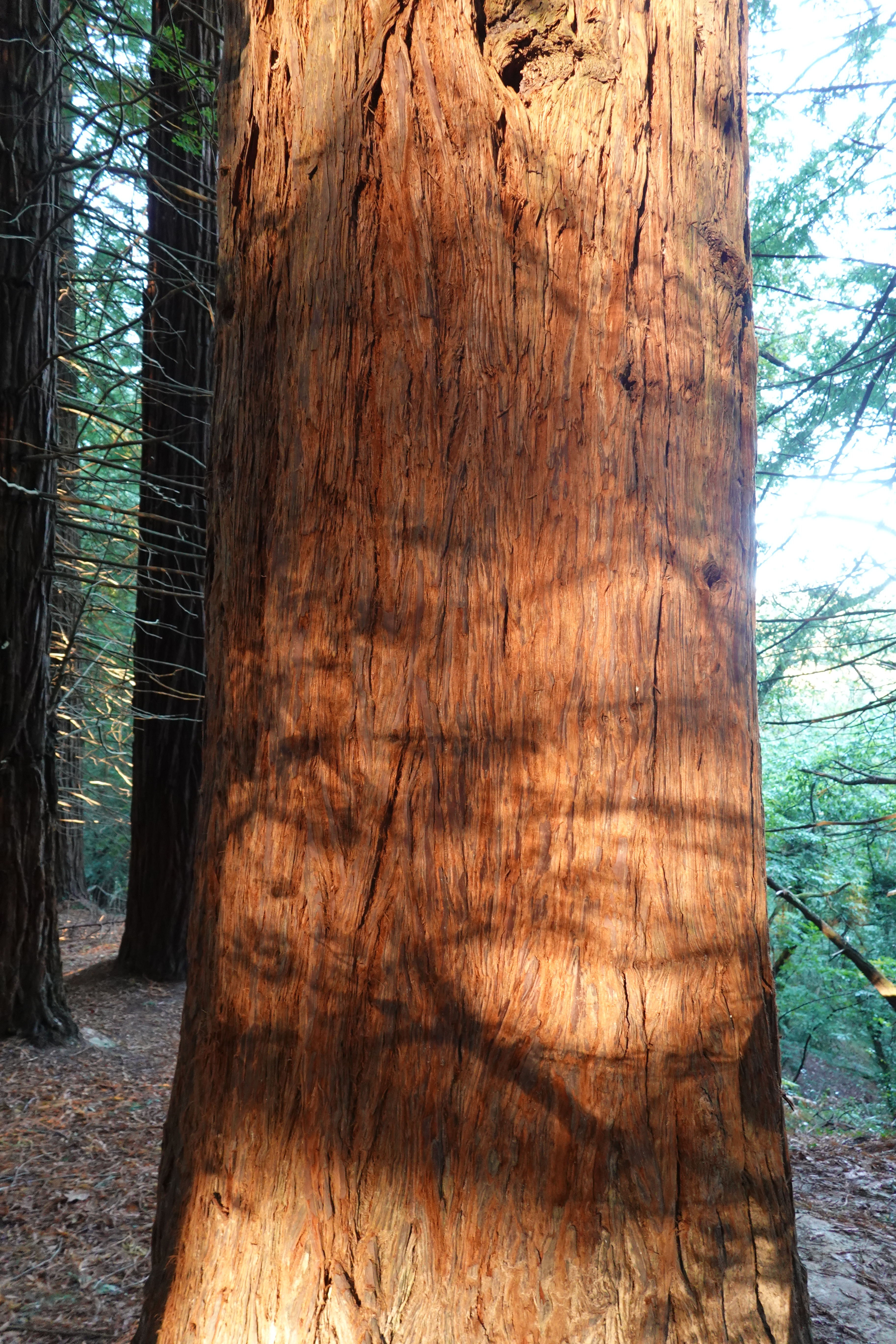
By the way, do you think you can see the suggestion of a heart on the bark of that sequoia in the photo I’ve posted above?
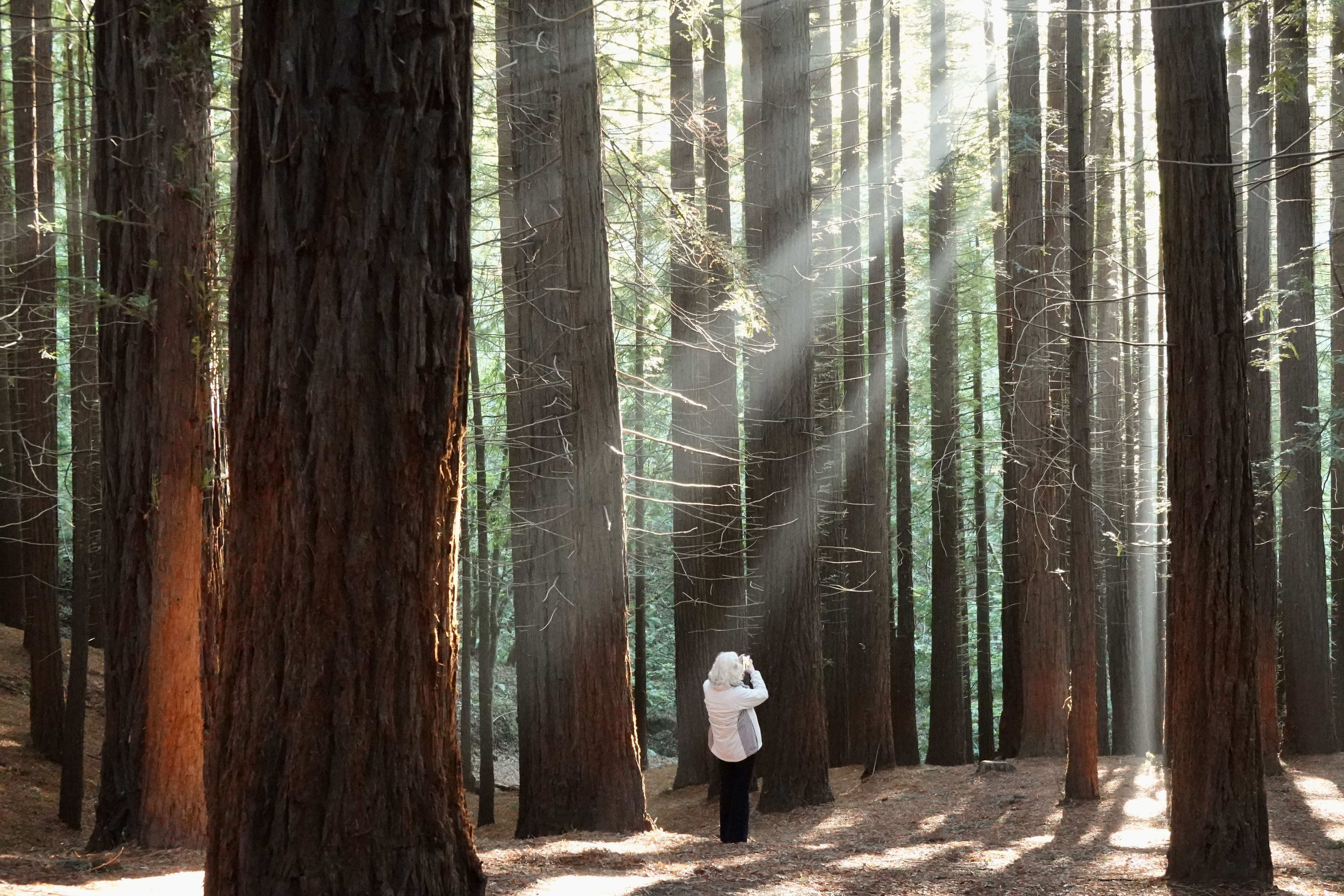
We made a visit to a sequoia forest in Catalonia recently and this is one of the many photographs I took. When I look at it now a passage from C S Lewis comes to mind. It’s many, many years since I read his little essay, “Meditation in a Toolshed”, but I’ve never forgotten it. It’s pretty easy to find online if you search for it. It starts like this –
I was standing today in the dark toolshed. The sun was shining outside and through the crack at the top of the door there came a sunbeam. From where I stood that beam of light, with the specks of dust floating in it, was the most striking thing in the place. Everything else was almost pitch-black. I was seeing the beam, not seeing things by it. Then I moved, so that the beam fell on my eyes. Instantly the whole previous picture vanished. I saw no toolshed, and (above all) no beam. Instead I saw, framed in the irregular cranny at the top of the door, green leaves moving on the branches of a tree outside and beyond that, 90 odd million miles away, the sun. Looking along the beam, and looking at the beam are very different experiences.
He goes on to describe several examples of the difference between “looking at” and “looking along”, where he juxtaposes the “objective” vs the “subjective” (although he doesn’t use those terms), the “quantitative” vs the “qualitative”….and issue which has been at the heart of my career and my life. He summarises his idea with this –
We must, on pain of idiocy, deny from the very outset the idea that looking at is, by its own nature, intrinsically truer or better than looking along. One must look both along and at everything. In particular cases we shall find reason for regarding the one or the other vision as inferior.
Most of the essay is about how we seem to have developed a habit of favouring the objective over the subjective to the point where the latter is dismissed as irrelevant, or even, unreal. I’ve heard a junior doctor say that his mentor told him “You can never believe patients. They lie all the time. You can only believe the results (the laboratory findings)”, and time and again, in neuroscience, our inner thoughts, sensations and feelings are reduced to biochemical reactions and neural pathways….as if the MRI scans and biochemistry reveals “the truth”, whereas the patient’s reported experience is dismissed as “anecdote”, or, worse, “illusion”.
As I look at this photo I see my wife, Hilary, standing in a sunbeam in the middle of the forest. I am “looking at” her in the forest. She is “looking along” the sunbeam and photographing the illuminated trees. And I know in that moment that these are two different representations of reality. Both are true. But there’s more – because as I am “looking at” this scene in the forest, I recall, and re-create, the experience I had of standing in the forest surrounded by the massive trees. I feel again the awe which I felt as the sunbeams shone through to the forest floor. I feel again the wonder I had standing amidst this community of trees (which, by the way, were planted only about seven years before I was born!)
We can understand a lot by measuring, by being objective. But we fail to grasp reality if we dismiss both the inner experience of others, and our own subjective one.
That means we need to value personal stories. We need to be curious about them, to respect them and to listen with non-judgemental empathy. Otherwise, we are only scratching a surface. Worse than that, we are in danger of replacing an understanding of what it is to be human, with a distorted and demeaned mechanistic one.
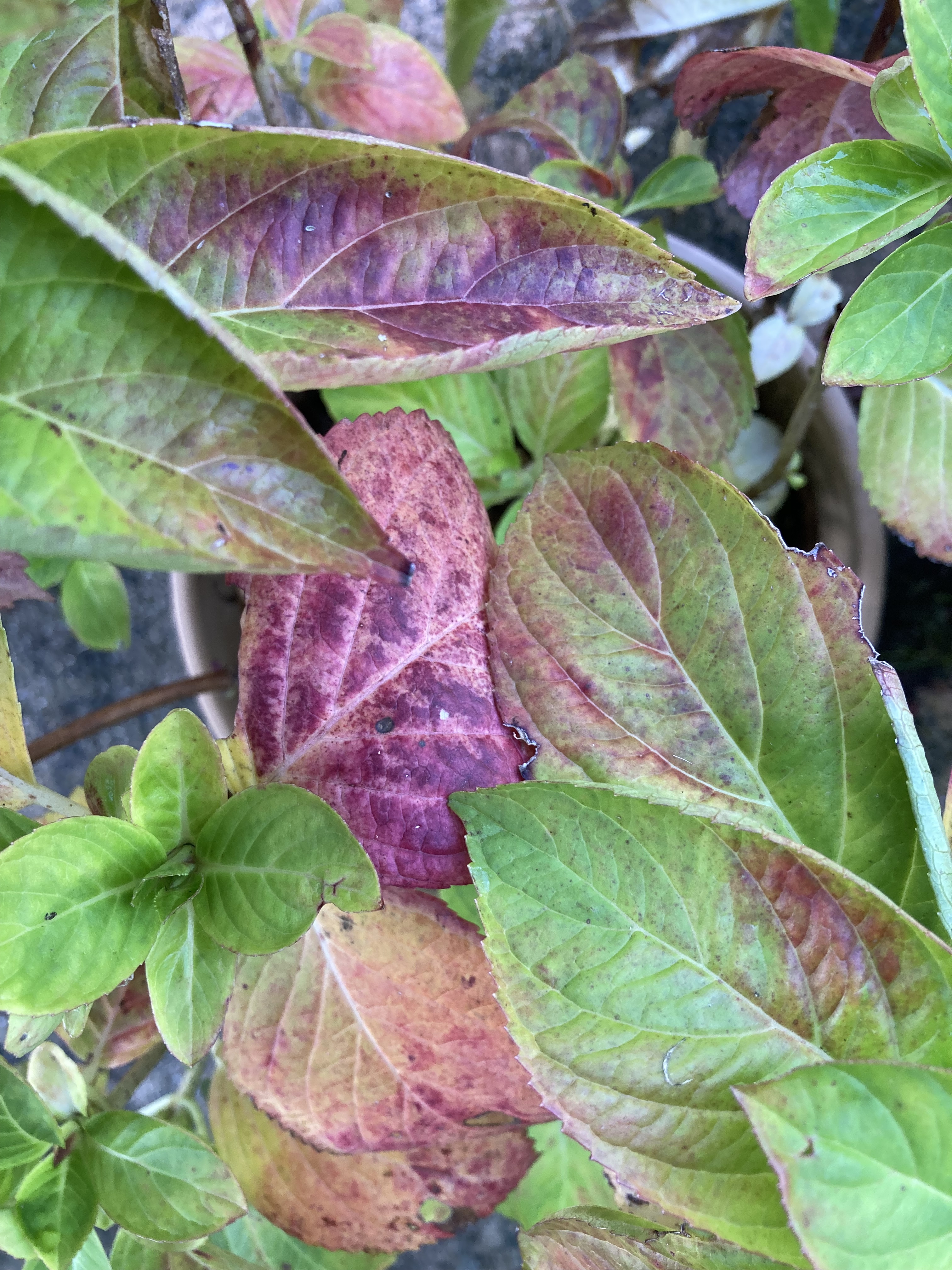
Spring and autumn are the two seasons where I notice change happening right before my eyes. Right now, in October, here in France, we are beginning to see leaves change colour. I love to gaze for a few moments at a plant like this, where some of the leaves are still bright green, some have patches of red or brown appearing, and some have gone fully deep red or even purple.
This reminds me of two things – the first is that change never stops. Everything in the world is constantly undergoing change. We are not the same today as we were a few weeks ago, and we are very different from what we were a few years ago (just browse through your photo albums to see how you’ve changed since you were a baby). The reality is that we change moment by moment. That’s why the advice to “be present”, or to “be here now”, is so relevant. Every single moment is unique, and if we breeze past it without noticing, it will be gone forever (except, of course, in the background of our subconscious the changes never cease to play their part).
The second is that change is so variable. It is heterogenous, not homogenous. You and I are unique. Our daily lives are unique. Our moment to moment experiences are unique and become even more unique over time, as nobody shares with us an exact personal history, an identical string of experiences. Just looking at this one plant and seeing the huge variation in colour as the leaves begin to change makes me even more aware of this uniqueness, of diversity.
So awareness of change slows me down, inspiring me to savour this moment, to live today as fully as I can. It inspires me to pay attention to the flow of Nature, to be aware of the fact that there are no fixed objects in this world, only different rates of change.
And awareness of change does something else for me – heightens my appreciation of uniqueness, of difference, and of diversity. Reducing life to abstractions, selecting single characteristics and bundling everyone who shares them into a single category is such a deluded way of living. We need to stop putting people into little boxes, labelling them and judging them, because when we do that, we just stop seeing them as they really are.
I welcome constructive criticism and suggestions. I will not, however, tolerate abuse, rudeness or negativity, whether it is directed at me or other people. It has no place here. ANYONE making nasty comments will be banned.


 Heroes Not Zombies