
Nature’s abundance never fails to amaze me.
This is the spiral staircase from the upper consulting rooms at the NHS Centre for Integrative Care, down into the garden.
Astonishing
Nature’s abundance never fails to amaze me.
This is the spiral staircase from the upper consulting rooms at the NHS Centre for Integrative Care, down into the garden.
Astonishing
Posted in from the consulting room, from the dark room, life, photography | 1 Comment »

“For there is nothing that grows or lives that can approach the feathery grace, the symmetry of form, or the lacy elegance of pattern of the Ferns: and to be blind to all this beauty is nothing less than calamitous” – Herbert Durand, in “The Field Book of Common Ferns”, quoted in Mary Oliver’s poem, “More Evidence”, published in her collection, “Swan”.
Posted in creativity, from the dark room, from the reading room, life, photography | Leave a Comment »
From Mary Oliver’s “What can I say?”
The leaf has a song in it.
Stone is the face of patience.
Inside the river there is an unfinishable story

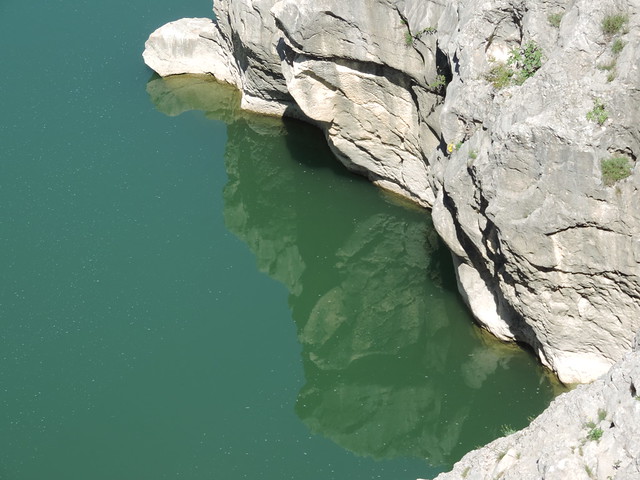

Posted in creativity, from the dark room, from the reading room, life, photography | Leave a Comment »

We have developed a strange way of thinking about the relationship of human beings and Nature. In fact, that very sentence is an example of how we think. There’s us, human beings. And there’s Nature. They are different. We separate ourselves out from other forms of Life, and from all the other ways Life manifests itself in Nature. We think we are not the same as other creatures. Maybe a bit like apes, maybe a bit like other mammals, but certainly not like flowers or trees. And even if we identify with LIFE in its multitude of forms, we still think of ourselves as separate from the other forms of Nature – earth, rock, water, wind, energy.
But we don’t stop there. We don’t just consider ourselves separate from, and in some way outside of, Nature. We tell ourselves Nature is there for us to exploit, to consume and to control. We think of being in a constant battle with Nature, wrestling with its power and its potential to do us harm. We conceive of the evolution of Life as a perpetual competition, a striving to survive, and only the strongest will win that battle.
But what kind of lives does that kind of thinking create for us? What kind of Nature does that attitude bring into existence? What daily experience do we have when we live from that perspective?
Over the last hundred years, physics has shown us that there are no separate, discreet, irreducible “particles” which are the “building blocks” of reality. We have begun to understand (or maybe rediscover) that any sense of separateness is a creation of the human mind. In particular we use our left cerebral hemisphere to filter and re-present the phenomena of reality to ourselves. This gives us a view which declares boundaries, and which creates the impression of separateness. As we explore the connections, the bonds and the relationships we begin to experience Life quite differently. And as we take on board the phenomenon of integration – of the creation of mutually enhancing bonds between well differentiated parts – we begin to see how co-operation is the basis of evolution, at least as much as, if not more than, competition.
So we can change our focus, taking on board Einstein’s question of whether or not we think of the universe as a friendly place, and then we see in Nature not just the inter-connectedness of everything, but how this Earth is perfectly created to sustain and develop Life itself. How everyday life is only possible because of the innumerable beneficial links between ourselves and others, between ourselves and other species, between ourselves and those who have lived before us, and between ourselves and the rest of the Universe from which we emerge.
The image above is a path. I think it is beautiful and shows an intimate relationship between human beings and trees. Here’s another path, quite different from that one, but which also makes me think about the paths we create as we live in this world.

Maybe it’s time to create a better path? A more “natural” path?
Posted in from the dark room, from the living room, life, perception, personal growth, philosophy, photography, science | Leave a Comment »
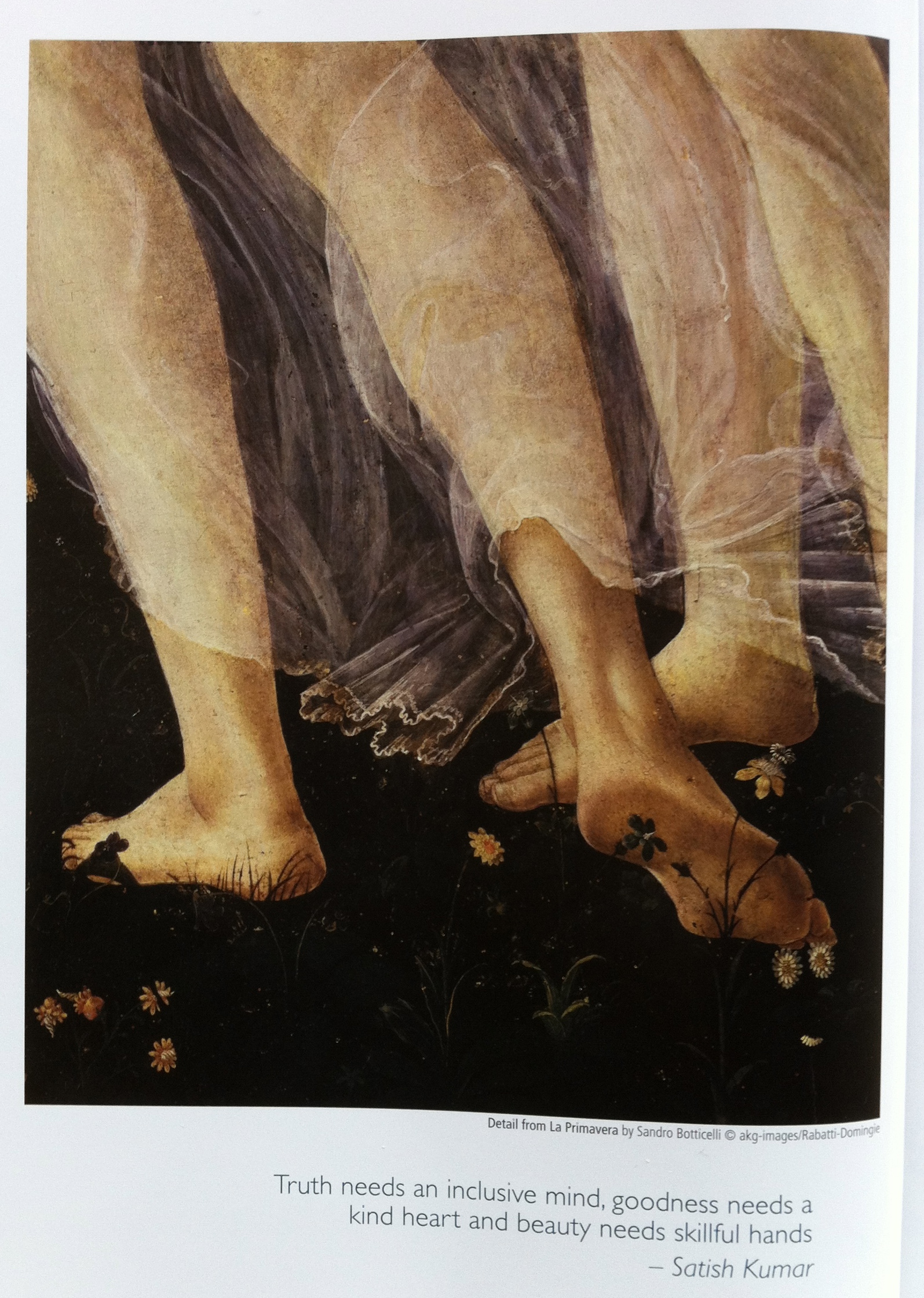
I’ve been a subscriber to Resurgence magazine for more years than I can remember. The latest issue has an editorial by Satish Kumar which eloquently talks about the interconnections between Truth, Goodness and Beauty – which he refers to as TGB.
What I particularly like the way he embodies truth, goodness and beauty…..
There is a corresponding trinity: head, heart and hands. With our head, with our thinking and intellect, we comprehend truth; with our heart we experience goodness and with our hands we create beauty
I think it’s interesting how he highlights the issue of this consumerist society promoting physical goods and shopping so highly, with a constant drive to make these physical goods as cheaply as possible. It’s not that we hold our physical objects, or those who make them, in the highest esteem
According to the prevailing ethos of our society manual work must be done by machines as far as is possible, or by cheap labour, either at home, or by immigrant workers from poorer countries. Most ‘manually manufactured’ goods are expected to be made in countries like Bangladesh by poorly paid artisan craftsmen and women; the economy of a country like England aspires to be transformed into a ‘knowledge economy’. This is a very unbalanced state of affairs.
He concludes with a classically INTEGRAL vision
Our society needs a bigger picture – a holistic vision. The hallmark of a balanced society is to honour and respect mental work and manual work equally. We need both. Only then we can develop our head, heart and hands in total harmony; science, spirituality and the arts need to be in complete coherence leading to the trinity of TGB – truth, goodness and beauty – as an integrated whole.
Posted in from the living room, from the reading room, life, personal growth | Leave a Comment »
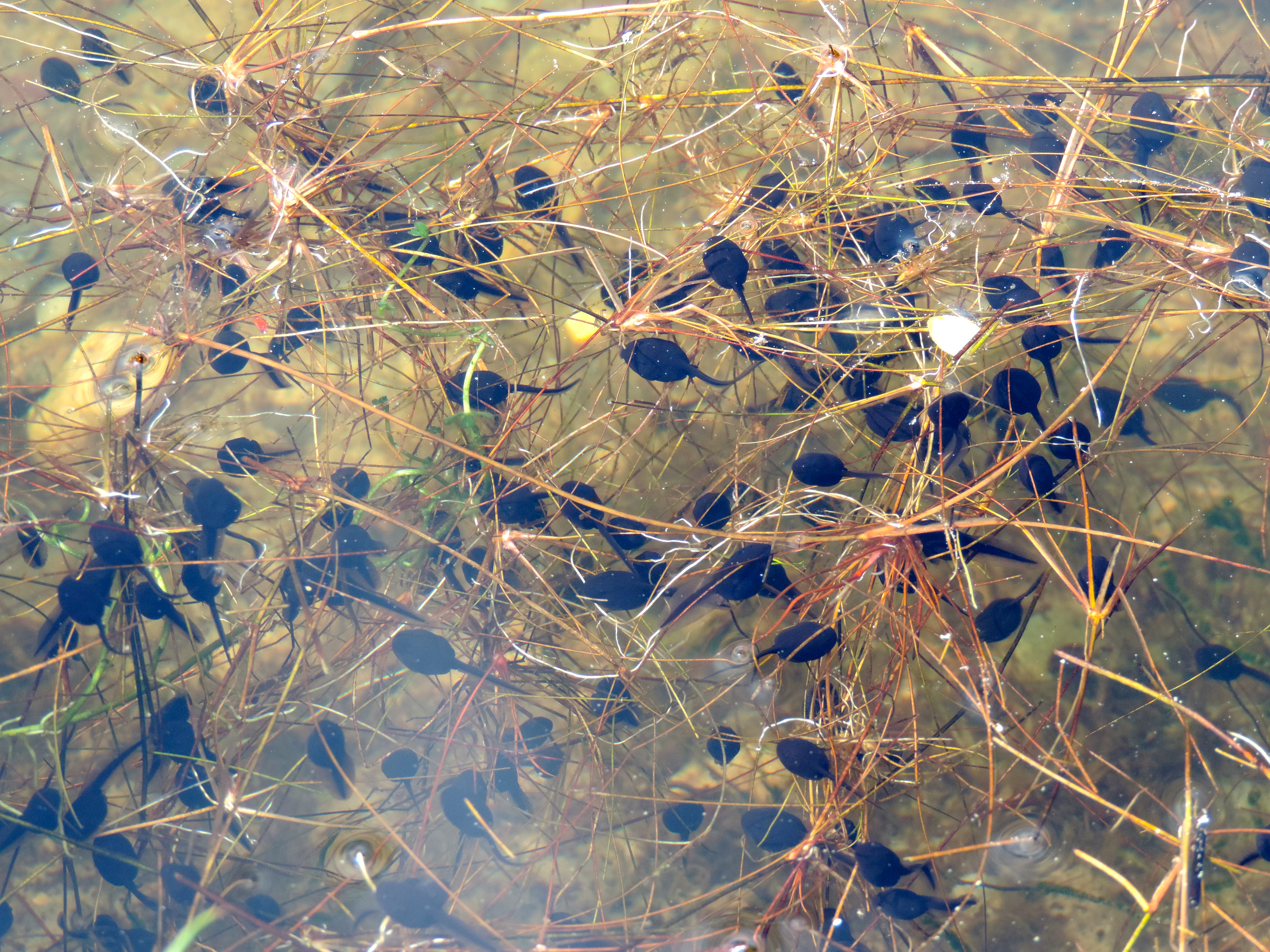
Spotted these tadpoles in a pond up near Aberfeldy yesterday. This shot of them captured only a small portion of the hundreds swimming around the edge of the pond.
What do you think about when you think of tadpoles?
I bet you don’t think what I do.
Here’s what happens when I see tadpoles. I hear a song in my head. “Share it” by Hatfield and the North.
Do you know that song? Do you know why I hear it when I see tadpoles? Well, when I was a teenager, my friends and I were great fans of bands like Soft Machine, Caravan, Camel, and Hatfield and the North. So when Hatfield and the North played the Student Union at Edinburgh University we went along. My friend Ian seemed to know all the words of their songs and sang along. At the end of the concert, Ian made for the front and asked Richard Sinclair, the singer a question. The question?
“I can make out all the words of ‘Share it’ apart from the first one. It’s “something is screaming in my ear” but what’s the something? Richard Sinclair leaned down from the stage and whispered one word into Ian’s ear. What was the word?
Tadpoles.
If you don’t know the song, here it is
Listen carefully to the very first word. You’ll see he wasn’t kidding!
But do you know what amazes me most about tadpoles? Metamorphosis.
During metamorphosis, a tadpole loses it tail, grow legs, loses its gills and grows lungs, rewiring it’s nervous system and on and on…..the number of changes are astonishing. How does it do that? We know a little bit about some of what’s involved (hormonal changes and different responses in different tissues to the same hormones) but we absolutely don’t know how these these massive changes are co-ordinated.
Amazing. Completely amazing
Posted in from the dark room, from the living room, from the music room, life, music, photography, science | Leave a Comment »
Sleep.
Is that a problem for you?
I’m afraid if it is, you’re not going to like this next sentence…….Sleep is my core skill. I seem to have some kind of spirit level in my brain, so that whenever I lie flat, the sleeping potion floods my brain and, instantly, I mean instantly, I’m asleep. I move between the two states of sleeping and waking the same way. It’s like some kind of switch. Click. I’m asleep. Click. I’m awake. Now you know what really puzzles me about this? I have absolutely no voluntary control over this switch. I can’t just “decide” to move between the two states. Mind you, if I need to be up at a certain time, then I tell myself that before lying down, and usually, (I’m not confident enough to not use an alarm), I wake up about 2 minutes before the set time (and switch the alarm off before it goes off by itself!) How does the brain do that? How can it do it so accurately?
There are many, many mysteries about sleep and I know lots of people really struggle with sleep, whether it’s trouble getting off to sleep, or waking repeatedly or just too damn early. In my role as a doctor I suggest a number of things….I don’t have a one size fits all approach to anything, but try Heartmath for starters. Lots of people find that helps. I don’t just mean try it before sleeping time, I mean integrate it into your day. I believe various different meditation practices can help, as can the usual areas of exercise, diet, and “sleep hygiene” (which involves establishing pre-sleep habits).
People sleep differently in different cultures too. Tokyo must the be city with the greatest number of day time sleepers. You see people asleep in cafes, on the metro, everywhere really. It’s quite surprising for a visitor. The countries on the Med have a habit of the siesta, which might have more to do with sunshine than anything else (“Mad dogs and Englishmen…..?”)
So, have a think about sleep this week. What patterns and rhythms work best for you? What induces a “good” sleep for you?
And here’s a couple of photos of sleepers I took earlier (first one in Tokyo, second one in the afternoon in Provence)


And here’s what we all hope for (this taken again in Tokyo, on the hoarding around a building site)

Posted in from the dark room, from the living room, health, life, personal growth, photography | 1 Comment »

It seems we didn’t evolve into human beings in a smooth, seamless way, but more with a pattern of great leaps and long, slow changes.
One of these great leaps was in the growth of the size of the brain. One of our pre-human ancestors, Homo erectus, had much smaller brains than we do, but over the course of 200,000 generations (2 million years), their brain size roughly doubled in size, taking them up to about the same size as brain as we humans have (since about 500,000 years ago).
As Stephen Oppenheimer states, rapidly increasing brain size was a key feature that set humans apart from the walking apes that lived before 2.5 million years ago. Since then our brains have trebled in volume. This increase was not gradual and steady: most of it came as a doubling of volume in Homo erectus 2 million years ago. The greatest acceleration in relative brain size occurred before 1.5 million years ago – early in our genus. Modern humans – and Neandrathals – living before the last ice age 20,000 to 30,000 years ago had bigger brains than do people living today. (from)
Interestingly, brain size in humans hasn’t increased over the last half million years (indeed it’s shrunk a bit!), but what has happened is rapidly increasing asymmetries in the brain. It’s not just that our massive cerebral cortexes are asymmetrical, but within each area of the brain there are highly specialised areas. In other words, its a story not just of an increase in size, of adding more and more neurones, but of complexity.
Here’s one of the puzzles about evolution though – how on Earth did brains evolve so quickly? You might say 2 million years doesn’t seem that quick but look at the speed of change.
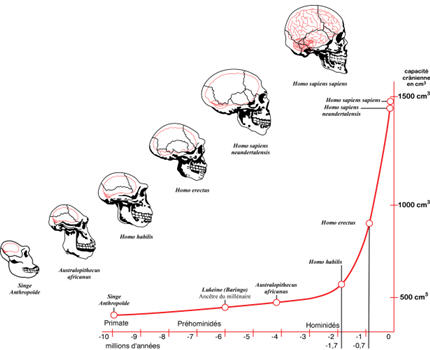
This is why some people refer to the growth of the human brain as the second “Big Bang”…….although I do like the idea of a “Great Leap”!
Posted in books, education, from the dark room, from the living room, from the reading room, life, neuroscience, personal growth, psychology, science | Leave a Comment »


Don’t you love a good mystery?
For me, I love mystery not only in fiction, or in movies, but in life.
I am regularly amazed by the every day, and I know now that the future emerges from the present in ways which are always surprising, always mysterious.
So, I was delighted to find these lines in a Mary Oliver poem, “Mysteries, yes”
Let me keep my distance, always, from those
who think they have the answer.Let me keep company always with those who say
“Look!” and laugh in astonishment,
and bow their heads.
Posted in from the dark room, from the living room, life, personal growth, photography | Leave a Comment »


I came across this phrase of Emerson’s the other day
Tis curious that we only believe as deep as we live.
And the first thing I thought was “Tis curious that we only live as deep as we believe”! But then I decided to track it down and see it in its context. It comes from his “The Conduct of Life” in the section where he writes about beauty. There are some real gems in that piece of writing.
Our books approach very slowly the things we most wish to know. What a parade we make of our science, and how far off, and at arm’s length, it is from its objects! Our botany is all names, not powers: poets and romancers talk of herbs of grace and healing; but what does the botanist know of the virtues of his weeds?
Can we really know about plants only by treating them as objects to measured, weighed and classified? And what happens when we apply that approach to human beings too?
We should go to the ornithologist with a new feeling, if he could teach us what the social birds say, when they sit in the autumn council, talking together in the trees. The want of sympathy makes his record a dull dictionary. His result is a dead bird. The bird is not in its ounces and inches, but in its relations to Nature; and the skin or skeleton you show me, is no more a heron, than a heap of ashes or a bottle of gases into which his body has been reduced, is Dante or Washington.
“The bird is not in its ounces and inches, but in its relations to Nature”. Wow! How true is that? And isn’t that exactly where our present approach often falls down? We fail to see what we are studying in its “relations”.
The motive of science was the extension of man, on all sides, into Nature, till his hands should touch the stars, his eyes see through the earth, his ears understand the language of beast and bird, and the sense of the wind; and, through his sympathy, heaven and earth should talk with him. But that is not our science. These geologies, chemistries, astronomies, seem to make wise, but they leave us where they found us.
and
Science in England, in America, is jealous of theory, hates the name of love and moral purpose. There’s a revenge for this inhumanity. What manner of man does science make?
These last two passages raise a subject we don’t hear much about, but I think we are beginning to hear more now, and will hear even more in the years ahead. It relates to Einstein’s famous question about the Universe….
And it also relates to Iain McGilchrist’s point about the two different approaches to the world from our two different cerebral hemispheres. If it’s true, which I think it is, that we create the world we live in through what we pay attention to, what our values and beliefs are, then what kind of world do we create from this detached, materialistic scientism?
What is life like for someone who sees things that way? And what’s life like for someone who sees things the way Emerson is suggesting? Do you think the Universe is a hostile place, that everything happens by chance, and nothing has any meaning?
What I share here in this blog is just my experience, just snippets from the life of me, how I experience life, what stimulates my thinking, my passions, my imagination. But it’s the way I approach the world which creates this particular world I’m living in and sharing with you.
Posted in books, from the dark room, from the living room, life, personal growth, philosophy, photography, science | 1 Comment »


