Feeds:
Posts
Comments

I’ve long been bemused by the lack of reference to health in healthcare training. The standard clinical textbooks of Medicine not only have no chapters on health, books like Davidson, still a standard medical school text don’t even have an index entry for health.

Then the other day I stumbled on an old document from 1938 entitled “The Wheel of Health”, by G T Wrench MD. The content of the text is not what I want to mention today, but I’d like to share the following paragraphs from the author’s introduction.

Why was it that as students we were always presented with sick or convalescent people for our teaching and never with the ultrahealthy? Why were we only taught disease? Why was it presumed that we knew all about health in its fulness? The teaching was wholly one-sided. Moreover, the basis of our teaching upon disease was pathology, namely, the appearance of that which is dead from disease. We started from our knowledge of the dead, from which we interpreted the manifestations, slight or severe, of threatened death, which is disease. Through these various manifestations, which fattened our text-books, we approached health. By the time, however, we reached real health, like that of the keen times of public school, the studies were dropped. Their human representatives, the patients, were now well, and neither we nor our educators were any longer concerned with them. We made no studies of the healthy–only the sick.


1938! He could have written that today!

Does this not surprise you?

Otagi Nenbutsu-ji

Just outside of Kyoto, up near Arashiyama, there is a little amazing temple – Otagi Nenbutsu-ji.
The most striking and unique thing about it is the 1200 or so rakan sculptures representing disciples of the Buddha.
Here are just a couple –

Untitled

Untitled

Untitled

And here’s a short video I shot to give you an idea of the scale of this….

Do you remember the news story about the old lady in Spain tried to restore a fresco? (http://www.bbc.co.uk/news/world-europe-19349921), well I think she’s been to Japan too!

Untitled

Watery reflections

Untitled

Spirit of the forest

Untitled

The traditional today

In Kyoto it’s a daily occurrence to meet people dressed in traditional dress, and it’s even more common to see people visiting temples and shrines to bring their thoughts, their prayers, their hopes and their wishes into the present moment

Prayer

Prayers and wishes are tied to trees…

a wish

….but the traditions don’t seem stuck in the past. They cross the bridge into the present…

the bridge

…and are enjoyed with a light heart

Untitled

kyoto

Buddha blue sky

Untitled

zen garden

environments like these make you just want to slow down and become aware of …..

meditation

….this present moment.

These moments are worth their weight in gold….

gold

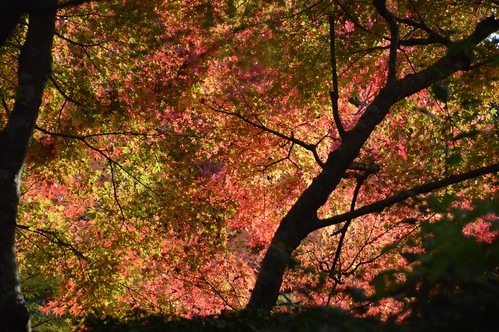
Autumn has been a little late arriving in Kyoto this year (warm weather for longer!), but it’s lovely to be able to witness the early turn of colour…..

kyoto autumn

Did you notice the flock of birds flying over the river?

As I looked up from the bridge I saw this one too….

Untitled

the hills

I look out onto Ben Ledi every day from home….

rain on the mountain

….so when I opened the blinds in my 32nd floor hotel room in Tokyo imagine my surprise when I thought it had followed me!

Tokyo view to the hills

Of course, once I looked more closely I could see it wasn’t Ben Ledi at all, but then again, I’ve never looked out over Tokyo and seen the hills like this before……something new every day!

Glimmers below

Look carefully….that eerie glow is the light from cities at night shining up through the clouds.

Cities at night

Stories and power

The Scottish Storytelling Centre in Edinburgh hosted the International Storytelling Festival last week and I participated in a series of workshops entitled “Stories and Cures”. What a fantastic, stimulating, rich experience with a diverse range of nationalities and disciplines taking part. Right at the start of the week I heard something I’d never heard before.

Back in the 18th and early 19th centuries throughout Europe when a person wished to consult with a doctor, there was a practice of letter writing. Someone would write a letter to the doctor whose advised they wished to receive. The letters were typically the person’s story, in their own words, describing what they were experiencing and the contexts of those experiences. In other words, the letters weren’t just lists of symptoms, and certainly weren’t tables of figures or readings, but, rather, they were highly personal, unique life stories.

The doctor would then write back, commenting on parts of the person’s story and giving a range of advice , often touching on issues of morals, hygiene or spiritual life. This was the beginning of a conversation which might be followed up with further exchanges of letters and/or with meeting up for face to face consultations.

Joanna Geyer-Kordesch, whose research as a Professor of the History of Medicine was the basis for this series, has read hundreds of such letters in English, German and French.

I didn’t know such a practice had ever existed.

Just think for a moment how different this practice was from our current doctor-patient relationships.

First of all, the record of the person’s illness is now created and held by the doctor. The stories have been turned into case notes and typically it would be extremely difficult to gain any understanding of who the person is if you were to read these notes. Doctors notes (I don’t think they usually could be stretched to be considered as stories) are mainly lists of symptoms, physical findings and results of investigations, then diagnostic labels based on pathology. The advice recorded certainly isn’t in the form of a conversation or exchange with the patients. In fact advice is more likely to have been replaced by a list of drugs prescribed.

What are the consequences of this change?

There has been a shift in power – from the person to the doctor, or the institution. This shift in power is so great that the words recorded are much more likely to be the doctor’s words and his or her interpretations of the person’s experience, rather than any record at all of the story the person has told (it’s not like that where I work because we have a tradition of writing down the patient’s actual words as much as we can – however, it’s still the doctor making and holding the record, not the person whose life it is)

There has been a shift in focus – from the person to the pathology. As Eric Cassell so beautifully describes in his “The Healer’s Art”, and “The Nature of Suffering”, illness is what the person goes to the doctor with and disease is what he comes home with.

It seems to me we’ve lost sight of the human being in the process. By reducing someone to a mere physical body to measured and imaged, we have dehumanised Medicine. The PERSON has been lost. How do we get the PERSON back into the centre of the stage? How do we get the individual’s agenda back at the heart of the medical engagement? How do we regain the truth of the uniqueness of every single human being and move away from the mass production processes of reducing people to diseases, diseases to “managed”, rather that people to be healed?

A good starting place would be to enable people to tell their stories – in their words, in their order of priority, in their own style – to reveal not just their sensations and experiences, but also their choices, their values and their beliefs (and what about the creation of the record? How and where would you create the record of your illness and your healing?)

Maybe valuing each individual’s story would begin to let us re-humanise Medicine?