Feeds:
Posts
Comments

Last year I learned how to teach the Heartmath technique – find out more about Heartmath here.

Here’s a simple guide to the theory and the practice.

Here is a map called “the emotions map”
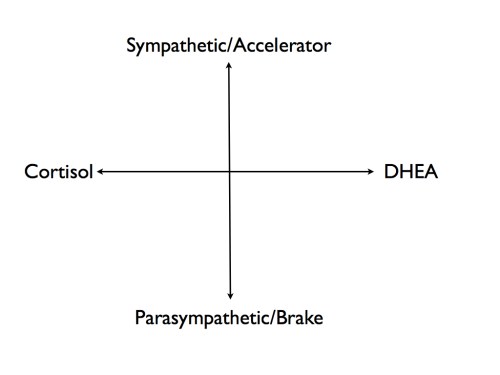
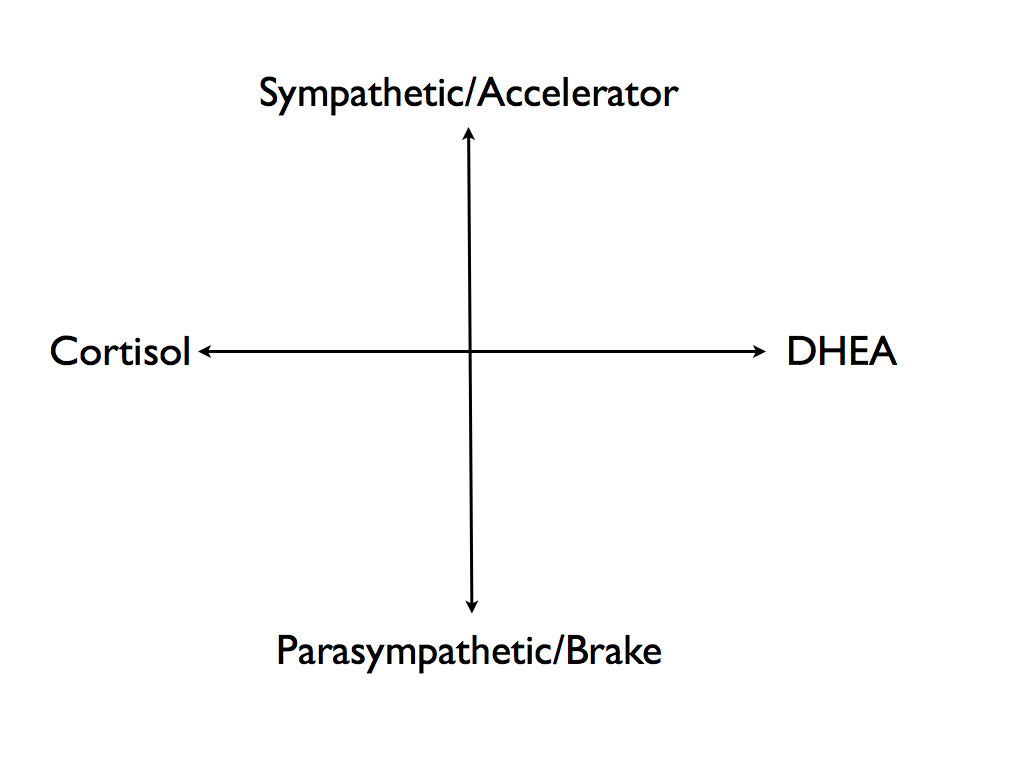
It has two axes – the vertical one shows the “autonomic nervous system” – this is the part of the nervous system which is responsible for the survival responses of “Fight of Flight OR Freeze” reactions. The autonomic nervous system is divided into two pathways – sympathetic and parasympathetic. Think of the sympathetic as being like the accelerator – when it is active there is a lot of adrenaline released into your system, your heart beats faster, your breathing is faster, and your body mobilises oxygen and energy to all your muscles ready to help you “fight or flee”.

The other path is the parasympathetic and can be thought of as a brake – through activation of the “vagus nerve” it slows down the heart, quietens and closes down your systems – the “freeze” reaction. We frequently oscillate wildly between these two extremes, flying from panic to collapse and back again!

The second axis, the horizontal one has one of the body’s main defence hormones at the left – cortisol. This is necessary for normal defence, but in excess cortisol can do a lot of harm. It’s sometimes called the “Stress hormone”. The right hand edge of this axis is “DHEA”, sometimes known as the “vitality hormone” – when there is a lot of this in the body, all the cells age more slowly and growth is stimulated.

What we want to achieve is a harmony of these systems – when we are in the top left quadrant our heart rhythm is chaotic. The heart rate varies all the time in a normal heart, but when the “heart rate variability” is chaotic, we’re not in a good place! Interestingly, when we are in the zone on the right of this chart, our heart slips into “coherence” – a kind of overlaid smooth, harmonious rhythm of the heart rate variability. In coherence we have harmony, we reduce the stress hormones and the excess autonomic activity, and we redress the balance between cortisol and DHEA.

Now here comes the fascinating bit – each of these zones or quadrants is associated with particular emotional states, with particular feelings.
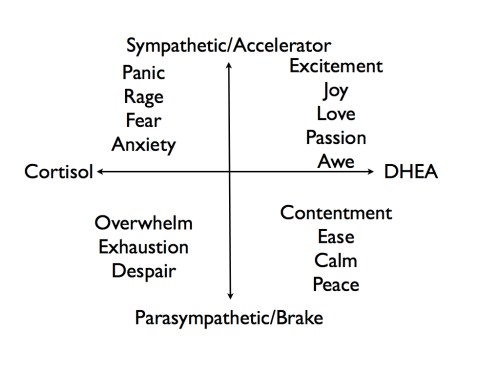
The Heartmath technique consists of re-experiencing one of the “positive” emotions on the right of this chart by recalling and reliving an episode or even where we felt such a feeling.

There are three steps to achieve “Quick Coherence” – a basic Heartmath technique.

Step 1. Heart focus. Bring your attention or your focus to the heart area of your body.

Step 2. Heart breathing. Take three, slow, deep, even breaths, filling the heart area of your body with oxygen, then emptying your lungs of all the carbon dioxide. Slowly in, slowly out, for three breaths.

Step 3. Heart feeling. Now recall an event where you experienced one of the positive, heart felt emotions. Here’s a couple of ones I use to give you an idea of the kind of event I mean. One is one of my grandchildren running up to me, shouting “grandpa!” and jumping up into my arms. That’s a great one! Another is looking out over Ben Ledi from my living room window when we have one of those gorgeous deep red sunsets – just amazing! Pick one of your own, and recollect it. Stay with that memory until you become aware that you are feeling that feeling again. This is about recreating a feeling. Once you have it, that’s it. You’re there.

Congratulations, you just managed “Quick coherence”.

Do check out the Heartmath Institute website – lots of great resources there to explore this technique in more detail!

What lies beneath?

The buildings opposite me fell down in the storms recently. At the weekend, I looked out of my window at the site which is now being cleared and saw this…..looks like the top of a tree breaking through the puddle and the ice!


DSC_0229

Just the way my mind works, I guess, but I’ve been re-studying Jung recently, and been musing a lot about the significance of the discovery of the unconscious. How strange to become aware that most of what goes on in my head remains below the level of conscious thought…..what exactly is this “me” that contains so much I’ll never be able to consciously consider…? And how strange to think about a “collective unconscious” out of which our psyches grow…..

Far away up close

camphor trees

300 year old camphor trees

Recently I had the amazing experience of visiting Vergelegen (which translates approximately as “far away place”). It’s a beautiful wine estate, but what I really loved were the 300 year old Camphor trees. Look at the size of them! They are immense!

Have you ever touched a 300 year old living organism? I don’t think I ever have before. It’s really something to be in the presence of a creature (yes, it IS a creature) which has not only been alive for 300 years, but is flourishing. Yikes! Our human lives seem so short in comparison!

How wonderful that these ancient trees which were planted in such a far away time have grown so great in a far away place…….and how especially wonderful to get up close!

ferns unfurling

peacock

A recent edition of the BMJ took a big focus on the issue of “surrogate outcomes” – in other words, changes in some lab tests instead of changes which matter to the patient.

Does this comment surprise you?

“In order to fully engage our patients in treatment decisions, we must understand how therapies affect outcomes that are important to them,”

It shouldn’t really, but in recent years, certain flavours of “evidence based” enthusiasts have completely dismissed patients reports of differences in their health experience. Often the patients reports are dismissed as either “anecdotes”, as “soft evidence”, or as “just feeling better” (ie not REALLY better – whatever that means!)

I think health is a subjective experience as well as a state of potential change in objective signs or measures. I’m delighted, therefore, to see these calls for a PRIORITY to be given to “outcomes which matter to patients”. After all, whose life is it?

Here are a couple of examples from the BMJ articles –

Citing the 2010 report from the US Institute of Medicine, which urged much greater caution in how we use surrogates, Moynihan called for a shift “from numbers to people” so that patients and doctors stop mistaking “a numerical benefit for a genuine one.”

and

From their perspective within the world of diabetes they warn that surrogates like HbA1c generally show much larger responses to treatment than “hard” outcomes that matter to patients, such as renal and visual impairment or quality of life.

Why are they arguing for this?

What’s the problem with surrogates?

Why have doctors become so invested in surrogate markers? The main reason is that the evidence base is built from trials that focus on the effect on surrogates. Since they respond sooner than outcomes that are important to patients, surrogates are better suited as end points in clinical trials that need to be completed quickly and at low cost. Evidence that builds in this way shapes practice and policy. Consequently, clinicians see this evidence converted into guidelines, quality of care measures, and pay for performance targets. We could speculate that the short term goals of the drug industry contribute to the predominance of surrogates in clinical practice. But this is an oversimplistic analysis. A historical view points more broadly to an alliance of public health advocates, scientists and clinicians, professional societies, and test and treatment companies who see their interests coincide. Idolisation of the surrogate end point has turned doctors away from the focal point of patient centred therapy based on hard end points. (Yudkin)


We need to change this primarily to reduce the potential harms caused by promoting drugs which don’t actually make patients lives better, but where the side effects can be fatal (think flecainide or rosiglitazone), but also….

Focusing on outcomes that matter to patients should improve decision making and patient engagement. It should also stop us spending money on treatments that deliver minimal or no benefit.

Nobody can define “benefit” better than the patient whose life is being affected by the disease and by the treatment.

Walking along Melkbosstrand beach near Capetown recently I came across LOTS of people kite-surfing. Have you ever seen this?

kite surfing Melkbosstrand

Kite surfing Melkbosstrand

kite surfing Melkbosstrand

There’s something lovely about flying a kite, but this flying WITH a kite is something else!

It struck me there’s a lot of this kind of activity in South Africa. It’s not that people try to conquer Nature, it’s that they challenge themselves in their interaction with Nature. You see it in their mountain climbing, their long distance cycling, their expeditions into the Bush, but most impressively, you see it in this kite-surfing.

I love how a kite surfer interacts with both the wind and the sea at the same time – what a great example of FLOW!

Sunset or Earthrise?

sunset

In Ian McCallum’s “Ecological Intelligence” he mentions how Copernicus brought about one of the great revolutions in human thought by convincing us that the Earth moved around the Sun, not the other way around. However, centuries later, we haven’t really managed to take this radical shift on board. We still tend to think of ourselves as being the centre of everything. We betray our perspective through the language we use.

We talk about sunset and sunrise. But the sun doesn’t set, it stays where it is. And the sun doesn’t rise, it’s the Earth which turns.

He postulates shouldn’t we be thinking instead of talking about the Earth rising into the night, and dipping into the day?

Stop and think about it for a moment. What does it feel like to think of the Earth rising into the night instead of the Sun setting?

Is Nature “out there”?
Are we, as human beings, separate from Nature? Is Nature there for us to exploit? To have dominion over? To control? To dominate?
Much human activity seems based on this set of beliefs, but it is a delusion.
There is no separate “Nature” from “us”. Every creature, every life form, every natural force, energy and phenomenon is interconnected.
This idea that we are separate from Nature is deeply to connected to a way of thinking which separates the “subjective” from the “objective”.
The idea of “objective” contains a tendency to turn experiences, phenomena, even other people into “things”.
It’s a stance which dehumanises, and denatures.

Look at this fence –

the living fence

I love how this fence instantly challenges the view that it is a “thing” – you can see it’s a living organism.

Whilst on holiday recently, I stumbled across a book by a South African author, Ian McCallum. Ecological Intelligence. [978-1555916879]

He argues that we need to reconnect to other animals and to Nature, and interestingly writes a lot about the concept of the “field”.
I find that concept so useful.
In my Be The Flow, I muse about the relationship between a wave and the sea. In this analogy, the sea is the “field” and the wave is a person. We emerge out of the field assuming distinct, identifiable, unique form. But we don’t leave the field. The wave is at no point separate from the sea. The wave constantly changes throughout its life. It is transient, dynamic, and, soon, its gone. Where does it go? It returns to the sea which in fact, it never left. It “disappears” into the field.

chameleon

Oh, just look at this wonderful little chameleon. I’ve never seen one “in the wild” before. This was ONE of my moments of “emerveillement” this day. (I recommend you look out for at least one such moment every day….probably not a chameleon most days!)

cloudfall over Table Mountain at night

As the cloud falls over Table Mountain at night it is lit by an ethereal pale light……caught it with this long exposure, propping my camera against the edge of the door to the balcony of the flat we’re staying in.