Feeds:
Posts
Comments

Harmony

I’m a long time subscriber to Resurgence magazine. It’s usually a very beautiful production and comes at things from both a “green” and a spiritual angle. The current issue flags up the theme of “harmony”, which is a great concept to rally around. Here’s a bit from Satish Kumar, the editor, in his lead editorial –

at the Tagore Festival, the Iranian Sufi scholar Hossein Ghomshei explained what he understood by the word ‘harmony’: “Harmony is the existential principle of the universe. Knowledge of universal harmony is science, expression of it is the arts, and the practice of harmony is religion. Which means there is no conflict between science, the arts and religion – all three operate within the context of the universal harmony.” The sun is in harmony with the soil and the seeds, the oceans are in harmony with the land, bees are in harmony with flowers, and the five elements harmonise and cooperate with each other to maintain life on Earth. We are all related. “Reality is not a thing, reality is relationship amongst things,” says Iain McGilchrist, author of The Master and his Emissary. Reality is reciprocity and mutuality; dark and light, below and above, left and right complement. And, in the words of E.M. Forster, all we have to do is “only connect”.

Oh yes, I like this. I often think about health, and what it is, playing with words like holistic, integrative, vitality, resilience etc….but for some reason I hadn’t considered the word “harmony”. What I love about harmony is, like beauty, or wellbeing, you just know it when its there. It’s both holistic and intuitive. Harmony is also produced by the fitting together of different elements. It’s not about everything being the same, so it’s completely consistent with the “integrative” idea of a good relationship between well differentiated parts.

We are such complex creatures, and the idea that healthy working together, or relating of the multiple different parts, is “harmony” is very appealing. In fact, we are embedded creatures, in constant relationship with others and with our environment. To be in “harmony” with others, with the rest of Nature, with the planet, (hey, even with the universe!) strikes me as an excellent goal.

I particularly like Hossein Ghomshei’s mention of science as knowledge of harmony, art as its expression and religion as the practice of harmony. Wonderful echoes of Deleuze and Guattari’s three ways of thinking – science about function, art about affects and percepts, and philosophy about concepts. And then a great quote from the magnificent Iain McGilchrist – “Reality is not a thing, reality is relationship amongst things,”

So, is my Life in harmony?

And, how can I work towards greater harmony?

On a daily basis, with each choice I make, is that choice likely to produce greater harmony? Or to produce discord?
Wiping your memories

One of my favourite lines from Bob Seeger is “I wish I didn’t know now what I didn’t know then”.

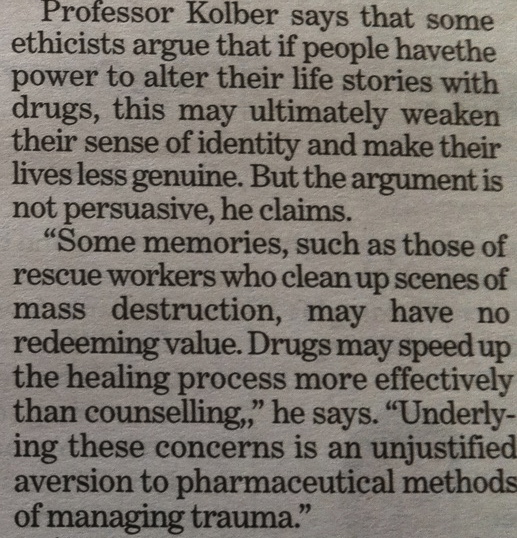
However, I was a little startled by a piece in the “i” newspaper last week about drugs which can wipe out memory. Here’s a jpeg of the bit of the article which really took me aback….


I don’t know about you, but as best I understand it our memories are a key part of the stories we tell ourselves and others to create both a sense of self, and to make sense of our lives.

Who’s to say that a painful memory has no value. A painful memory will probably always be a painful memory, but our responses to painful episodes can be the important foundations of who we become.

Before I go…..here’s the song in question (performed by Toby Keith)

I am frequently impressed with the writings of Ray Moynihan, and his article in this week’s BMJ is probably one of his best. It’s entitled “Surrogates Under Scrutiny” – not a title which immediately appealed to me because I mistakenly thought it would be an article about surrogate pregnancy. I was wrong! It refers to use of “surrogate” markers for health outcomes. I must confess I’ve never come across this use of the term before, but he relates it to The Institute Of Medicine’s report “Evaluation of Biomarkers and Surrogate Endpoints in Chronic Disease“.

This is, potentially, an enormously important article (or, at least, it’s a great introduction to an enormously important issue)

It’s a constant source of frustration to me that the reductionist, materialistic promotion of “evidence” in Medicine, seems to prioritise biomarkers, and to trivialise patient centred outcomes, or any attempt to capture the narratives of health and wellbeing. I now understand more clearly why.

It’s also a source of concern for me that human beings are consuming ever greater quantities of pharmaceuticals without any evidence that is producing greater health, wellbeing or happiness. Don’t get me wrong. Drugs can produce great changes in disease and, consequently, can open the opportunities for people to thrive, grow and experience better health. I wouldn’t like to see diabetics trying to get by without insulin for example. However, the limited view that only drugs can produce better health, strikes me as fundamentally naive. In fact, in many situations, the balance between potential harms and potential benefits has swung way far in the direction of harm. I now understand more clearly why we’re getting this wrong.

Let me just replicate for you here the closing paragraphs of Ray Moynihan’s article, because I don’t think I could put it better myself.

Shift from numbers to people

A major rethink of the role of surrogates in medicine is timely. Routinely approving and prescribing therapies on the basis of their effects on someone’s numbers, rather than their health, is increasingly seen as irresponsible and dangerous. And even when evidence suggests clinical benefits of popular “preventive” medicines for those at lower risks, a rational assessment reveals many people must be treated to prevent one adverse event, so most users gain no direct benefit despite years of treatment. The cost effectiveness of this approach is unsurprisingly in doubt. More disturbing still are the questions about whether some of the suggested clinical benefits are real or simply artefacts of sponsorship bias. The rigour of the evidence informed approach to medicine has in recent decades helped us all understand the limitations of relying on surrogates, and for one of its key architects—McMaster University professor Gordon Guyatt—this problem is both historical and cultural. He argues that central to putting American medicine on a scientific basis was the assumption that an understanding of biological mechanisms would translate into improved management of patients. And while medical students over a century later are still taught to focus on fixing a person’s biological numbers—whether it’s cholesterol or bone density—what is urgently required is a new approach that provides genuine improvement for the person. Understanding biological mechanisms and diagnosing by numbers has undoubtedly brought great benefits. Yet as the definitions of medical conditions relentlessly expand via that porous relationship between the science and business of healthcare, this fragmented reductionist approach is conferring multiple medical labels on vast swathes of healthy people, who are then treated with preventive drugs that won’t help most of them and may hurt many. The magic of numbers may help corporate profits and professional pride, but at what cost to the health of ordinary people who mistake a numerical benefit for a genuine one? Surely it’s time to ask if there might be a healthier new model for medicine based on far less harmful and costly ways to try to reduce human suffering.

…as I walked past the park this morning, something caught my eye …


rockin robin

What was it? Who was it?

robin

Lost worlds, emerging worlds.

I’m reading Saul Bellow’s “Humboldt’s Gift” at the moment and it’s one of those novels which contains phrases and sentences which make me stop and think. I like that in a book.

Here’s one passage which has really got me thinking…

….one of Humboldt’s themes was the perennial human feeling that there was an original world, a home-world, which was lost.

That’s so true, and so appealing….from Eden, to Atlantis, to Shangri-la, to……well, think of the lost world stories which have appealed to you so much. Even modern science fiction, like the later version of Battlestar Galactica, with the search for a lost home (Earth), or even Wall-E, with the longing for the home-world before it was destroyed!
Then I came across this post on Mark Vernon’s blog (a post about Owen Barfield)……

Barfield called this earlier consciousness ‘participatory’. He argued that we moderns are passing through a phase of alienation – one that objectifies the world and so brings the great goods of science too. But it is not sustainable, because we distantly recall our participation. What we seek, he thought, is ‘final participation’, a form of consciousness that by deploying the analytical mind in conjunction with a more expansive imagination might move us to a phase where we can know ourselves as subjects and objects. Such a sense is not here yet, on the whole, but various individuals capture glimpses of it, and it draws us to itself.

In the middle of a week where rioting has broken out on English city streets, where people are beginning to ask about compassion, and connection and belonging, the themes of alienation, “smash and grab individualism”, and we are witnessing the collapses of economic, political and social orders in countries around the world, these texts seem particularly pertinent.

What’s the nature of this alienation? Of this sense of being cut off from a better world? I’m sure you could read whole libraries of research and opinion on this subject, but let’s just think of it for a moment in terms of consciousness as Barfield suggests. Don’t we need to support and promote an evolution of consciousness? From the immature, egocentric one, with it’s world-view of separateness and the reduction of human beings to objects, to a much more mature, world-centric one, where we come to know ourselves and others as both subjects and objects.
I hope that more compassionate, more humane, and yes, more human virtues and values will arise from this time.

poppy

How about photographing something purple this weekend and sending me the link to where you post it? Or tweet it to @bobleckridge with #purpleweekend

What do you see?

cloudy heavens

A church? The sky? Clouds? Spirituality?

Be The Flow

I woke up in the middle of the night (was it the night? It was dark at least) in a plane somewhere between Paris and Tokyo. I didn’t feel too good. To deal with that, I began to do a little TM (Transcendental Meditation), and quickly, the discomfort melted away. I then slipped into something of a dream, or a meditation state, or I don’t know what, and had what I can only call an instruction. I didn’t hear any voices and I had no visual content to the dream but I had clear “instructions”. I can’t say I’ve ever had an experience like this before, or since.

The instructions were “you must write about the three rivers of Life”.

What’s that? I asked

The three rivers of Life are energy, time and consciousness.

Energy, time, consciousness. Energy, time, consciousness. Energy, time, consciousness, I kept repeating to myself, determined not to forget them and feeling that the moment I “woke up”, like with many dreams, what was clear now would disappear in an instant.

The three rivers of Life are the three flows which create Life. Everything emerges from these three rivers, and everything returns to them.

What have I to write?

Write about the three rivers. Write about flow. Write about this meditation you are going to do now.

I then practised the Three Rivers Meditation.

Why not try it for yourself?

Be the flow.

summer clouds

Can you remember a time when you looked up at the sky, a blue sky with distinct white clouds in it, and as you looked at one particular cloud you could watch its shape constantly changing? You probably noticed how the cloud would thin out at the edges and, in many cases, especially with the smaller clouds, you could watch as it gradually disappeared.
If you can’t remember ever doing that, then do it as soon as the weather allows. Pick out a fairly small cloud and watch it constantly change shape, constantly thin out at its edges and gradually disappear.
Where does the cloud go?

The cloud doesn’t disappear. It becomes the sky as the sky flows through it.

Come and check out my new project – http://www.betheflow.net