Feeds:
Posts
Comments

What’s your vision for health care?
I remember once hearing a spokesperson for WHO (the World Health Organisation) being asked that question and he said his dream would be that every child in the world was vaccinated against every known disease at birth. I wondered what planet he was living on.
One vision is based on “mapping the genome”. When I heard the idea that one day we’ll all be given a map of all the diseases we might expect to suffer AND a predicted age of death, I had this image in my head of some 30 year old walking out of the laboratory clutching his gene certificate telling him he would live to 102, so engrossed with the result that he doesn’t notice the bus heading towards him as he steps out into the road……
The main vision for health care currently doesn’t involve much in the way of direct interventions to improve health, but rather, is about “managing” diseases – which means drugs, and more drugs.
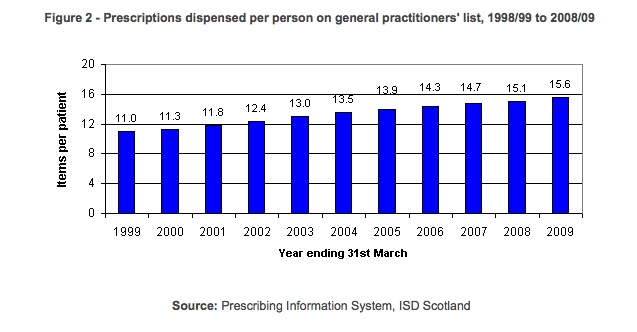
One in ten of over 15 year olds in Scotland now take daily antidepressants, and look how the number of prescriptions over all is rising……

Is this the big idea? More drugs?

gormley edinburgh

gormley edinburgh

gormley edinburgh

gormley edinburgh

I found four of the six sculptures on one day’s walk, but I’ll need to go back and try and find the other two.
One thing which really struck me about these figures is how different they are in their individual contexts……not just a bit different, but VERY different.

How do we heal?

Here’s a scenario to try with any health care professional you know –

Imagine a patient presents with an infection in their bladder (cystitis), with burning pain passing urine, frequent need to pass to urine and some blood in the urine. You send a sample of the urine to the lab and they grow “E Coli” (a commonly implicated bacteria) sensitive to “Trimethoprim” (an antibiotic). You prescribe the recommended “Trimethoprim”. What does it do?

The only correct answer is that it kills the bacteria.

So, how does the inflamed, swollen, bloody bladder wall return to normal?

Only through the body’s natural healing system.

Drugs have effects. Antibiotics in particular can kill bacteria which might otherwise cause us great harm. But prescribing a drug is only part of the job needing done. If we only prescribe a drug and do nothing to support or stimulate self-healing, then we leave healing to chance……as if healing isn’t part of a health care professional’s job.

So, here’s something I wonder about. Why don’t they teach how to heal people at medical school? Why do they only teach how to “manage” diseases, remove diseased tissue, or suppress symptoms?

There’s the BIG gap in biomedical practice – how do we encourage and develop healing?

Shouldn’t we be using approaches which focus on healing as well as those which focus on disease?

The first time I saw Antony Gormley’s “The Field“, I was transfixed. The room filled with those hundreds of small terracotta creatures all gazing at me gazing at them!

It’s an image which has stayed with me ever since and it’s one I think all health care professionals should expose themselves to.

Every patient I see has something in common with some other patients I’ve seen. That’s the basis of “diagnosis” in the way biomedicine considers disease. But every patient I meet is different. No two have the same experience of this disease. No two tell the same story. And here’s another aspect to that…….nobody stays the same, the story constantly evolves and changes. Without attention to the present, without an open-ness to difference, we fail to see what makes every single human being unique and special.

Medical myths

Myth 1

There are two kinds of treatments available – those which work, and those which don’t.

The real world isn’t so simple. There’s not a single treatment on the planet which “works” for every person who receives it. I’m sure the drug companies wish they did have such a product – it would have no competitors. Even treatments which work for most people, don’t work for ALL people.

Myth 2

The placebo effect is distinguishable from a pharmacological effect.

Randomised controlled trials typically have two groups. One group receives the study drug and the other, the placebo. If the improvements in the first group statistically exceed those in the second group, the drug is considered to be effective. However, the placebo effect occurs in both groups. It is impossible to know whether any individual in the first group has gained their improvements from the drug, and not from the placebo effect.

In clinical settings, with any individual patient, it is impossible to know whether the drug has “worked” or whether the improvement is due to placebo.

Myth 3

Giving a placebo is the same as doing nothing

This graph is from Irvin Kirsch’s “Emperor’s New Drugs“. It clearly shows that placebo and doing nothing are not the same.

Myth 4

The NHS only funds “evidence based” treatments.

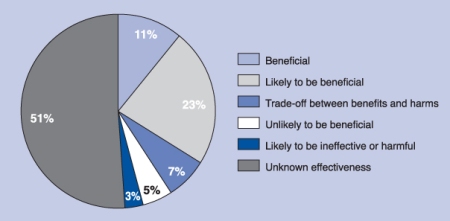
51% of treatments rated by the BMJ group’s “Clinical Evidence” are of “unknown effectiveness”

Myth 5

Objective findings are of value, and subjective reports are value-less

Health is a lived experience. Only a person can report that experience. To dismiss the patient’s narrative is bad medicine.

Rock faces

Walking around the ochre forest recently, I noticed one of the rocks looked like a face.

rock face

Having noticed this face, it then seemed there were faces in the rocks everywhere….

rock face

rock face

rock face

rock face

rock face

rock face

sentier d'ocre

sentier d'ocre

sentier d'ocre

Have you ever seen a landscape like this? See how red the path is……

sentier d'ocre

sentier d'ocre

It can be hard to remember this is a landscape on our planet….

sentier d'ocre

sentier d'ocre

sentier d'ocre

sentier d'ocre

Where is this?

Roussillon, Provence.

roussillon

roussillon

On the outskirts of the village the old ochre works have been transformed into a visitor centre = Le Conservatoire d’ocre

conservatoire d'ochre

conservatoire d'ochre

conservatoire d'ochre

conservatoire d'ochre

conservatoire d'ochre

conservatoire d'ochre

colour!
provencal cafe colours
glass
running for the boat
weaving
matching staff and customers

Here’s two reasons why I’m concerned about using “Evidence Based Medicine” to make decisions about what should not be available on the NHS.

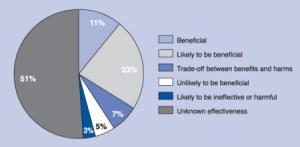
The first reason is we actually don’t have good convincing evidence for most of the treatments we currently deliver. The BMJ’s “Clinical Evidence” highlights this on its front page.

They categorise treatments into “beneficial, likely to be beneficial, trade-off between benefits and harms, unlikely to be beneficial, likely to be ineffective or harmful, and, unknown effectiveness. This in itself is controversial –

Dividing treatments into categories is never easy hence our reliance on our large team of experienced information specialists, editors, peer reviewers and expert authors. Categorisation always involves a degree of subjective judgement and is sometimes controversial.

In other words, the categorisation process is a matter of opinion and the opinions will be influenced by the authors’ values, beliefs and personal experiences.

Actually, it gets worse, because earlier on the same page, “Clinical Evidence” says

we wish to highlight treatments that work and for which the benefits outweigh the harms, especially those treatments that may currently be underused. We also wish to highlight treatments that do not work or for which the harms outweigh the benefits.

The thing is, in the real world, you can’t divide treatments into two such categories – those which work and those which don’t. There are NO treatments which “work” for every single patient. We are all individuals. It would be much better to publish the spread of responses experienced, and to resist this simplistic and delusional two-value “works/doesn’t work” categorisation.

And here’s the stunning statistic – 51% of the treatments are rated as “unknown effectiveness” (sometimes referred to as “insufficient evidence”). Were we to remove ALL of these treatments from the NHS, not only would we throw out a lot of babies with the bathwater, but does anyone seriously think we’d have a better health service?
The second reason to worry is just how appallingly distorted the evidence base is by the failure of companies to publish research which does not demonstrate positive effects of their drugs.

The German Institute for Quality and Efficiency in Health Care has published a study in the journal Trials.

they assessed hundreds of articles from journals and other sources, which covered areas including treatment for psychiatric disorders, pain, heart and circulatory disease, skin disease, cancer, and infectious diseases. A wide range of interventions was affected: from drugs and vaccines to medical devices such as ultrasound or devices for wound care.

What did they find?

an analysis of 90 drugs that had been newly approved in the US showed that they had been tested in a total of 900 trials. However, even 5 years after approval, 60% of these studies were unpublished. On the second level only selected outcomes from studies are published

Comparisons of protocols and journal articles of studies showed that in 40% to 60% of studies, results had either been completely omitted or analyses changed.

This does not only affect studies sponsored by the pharmaceutical industry. In their paper, the IQWiG authors also cite an analysis in which 2000 studies on cancer topics were analysed according to sponsorship. The proportion of published studies was extremely low: of the industry-sponsored studies, 94% were unpublished; however, even 86% of university-sponsored studies were also unpublished.

Irving Kirsch found similar significant distortions of the evidence base when he got hold of unpublished trials of anti-depressants.

The claims to certainty by the advocates of those who seek to make decisions about health care solely based on published research are misguided.

What’s the answer? Well, first of all bringing the current advice up to date by doing what these researchers have done, getting hold of the unpublished research and seeing how that changes the picture. Secondly, a bit of humility would help! It’s delusional to claim certainty about treatments for individual patients. Human beings just aren’t that predictable. They’re not machines. Thirdly, developing a greater wariness about categorisation. It doesn’t make sense to pretend there are treatments “which work” when we know there are no treatments which work for everyone. As Dr Roses of Glaxo said –

The vast majority of drugs – more than 90 per cent – only work in 30 or 50 per cent of the people,” Dr Roses said. “I wouldn’t say that most drugs don’t work. I would say that most drugs work in 30 to 50 per cent of people. Drugs out there on the market work, but they don’t work in everybody.

Finally, let’s put people back at the heart of our decision making. Health care can only be individual. It’s a mistake to consider statistics more useful than a patient’s personal experience.
See the light

sunlit

Ok, try this today…..notice the light.

Just let some light catch your attention and stop for a moment and wonder. How does it look? How does the world reveal the light to you? How does the light make you feel?