Feeds:
Posts
Comments

It is impossible to understand anything in isolation. If you really want to understand something you have to consider it in its contexts or environments. I think that plants make that point beautifully. Think how a plant cannot exist all by itself. Think how it connects to other parts of nature in order to live, to grow and to reproduce.This time of year you can see an amazing diversity of strategies that plants use to spread their seeds.

Wind dispersal

Wind dispersal can carry the seeds to some pretty unusual places –

Plant gutter from afar

Some of those places are more useful to the plant than others –

Seeded web

A quite different strategy is to hook onto passing animals. I’m not sure if this is a Scottish term or not but we call these “burrs” –

Burrs

These are such vivid ways of showing us the interconnectedness and interdependences of nature.

Humans are the same. We spread ideas, thoughts and even feelings. We can spread them deliberately, or randomly, but in neither case can we control where they’ll end up!

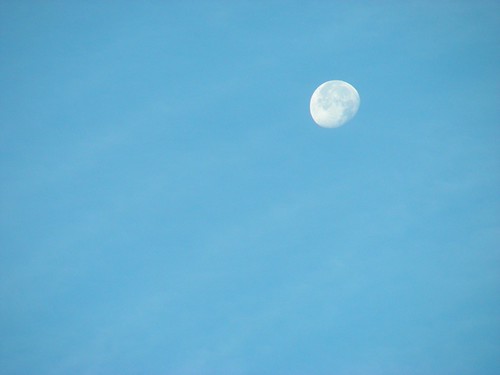
Day Moon

Day Moon, originally uploaded by bobsee.

The moon at night is often beautiful but when it comes up in the daytime I think most people don’t even see that it’s there.
Here it is!
Look!

Ben Ledi Grey and Pink

Ben Ledi Grey and Pink, originally uploaded by bobsee.

The view from my window…….I find this very soothing.
I can’t see and a grey and pink scene like this without having one particular song play through my mind…..


Wesley Fryer’s excellent Moving at the speed of creativity blog has an interesting post today on “Measuring Engagement“. Engagement is, I think, a key quality of a healthy life. But what does it mean exactly?

I think of it as being in active exchange with your environment – both consciously and unconsciously; physically, emotionally and spiritually. There are three elements to this –

  1. the environment
    We are embedded in multiple environments. By that I mean you can’t see who you are in isolation. Nobody exists out of all context. Our environments are multiple – the physical environment of air, light, heat, noise and so on; the relationship environment of our place in our own personal networks of people (family, friends, colleagues, society etc); the semantic environment of meaning – the sense we make of the signals and symbols around us; and so on…multiple life contexts.
  2. being in exchange
    Within our environments we are continually receiving and responding to signals – detecting changes and adapting to them.
  3. active
    By active I especially mean conscious – the greater our awareness, the greater our ability to choose between possible responses to the changes in our environments. In addition, by active, I mean creatively active, because when well we don’t just respond to changes in our environments, we initiate changes too.

Wesley Fryer’s area of interest is education. I’m primarily a physician but a significant part of my job is education so that perspective interests me too. I share his interest in web technologies and it’s a Facebook development that seems to have stimulated this particular post. Facebook has measured applications on the basis of numbers of users but is now changing that to measure “engagement” instead – by this they really mean they are measuring a number of ways users interact with an application. Jeremiah Owyang argues that this is not really “engagement” but just “interaction”. Whatever you think about the Facebook model, Wesley goes on to consider how teachers measure engagement in the classroom (as opposed to just participation).

So, all this got me thinking. If I believe that engagement is a key quality in health, how do I know how well that is functioning in a particular patient’s life? Let me explain a little further…….

When someone has chronic suffering, be it pain, breathlessness, depression, whatever, their lives can become much smaller. They can retreat from work, from social interaction, and even from the basics of life – not noticing the world around them, collapsing further and further into a deep, black, hole. As they start to become well again they begin to notice more and respond to more around them, become more active socially and their lives gradually expand. This expansion is one of greater engagement (in illness, the contraction of life is a loss of engagement).

So, here’s my query – how do you know you are more or less engaged in life? Are you aware, when your world is either shrinking or expanding, of what it is that’s changing? What does “engagement” mean to you?

Life

What are the characteristics of Life? (as opposed to those of inanimate objects and the dead?)

It’s a strange truth that if you consult a textbook of biology you probably won’t find an entry in the index for “life” (it’s equally strange that the standard medical textbooks, such as Davidson’s Principles of Medicine, don’t have an index entry for “health”)

Varela and Maturana at MIT invented a word – “autopoiesis” – for what they thought was the key characteristic of living organisms. They explain that autopoiesis means “self-making capacity” and say that only living organisms can do this.

I think Life has at least these two main characteristics –

  1. the capacity to detect and respond to change AND
  2. growth.

We are continually perceiving and sensing the world and constantly responding to all the signals we are picking up. We respond to maintain our health (a function known as homeostasis describes the organism’s capacity to maintain internal stability). But we don’t just maintain an adaptive status quo……we grow.

Growth involves development, expansion, and novelty. Growth is our creative function.

Zombies don’t perceive and adapt. Heroes are consciously aware, reflective and responsive.

Zombies don’t grow. Heroes accept challenges and grow in the process.

That’s why I think our true nature is as heroes, not zombies.

Celtic cross

Celtic cross headstone, originally uploaded by bobsee.

Maybe it’s because it’s part of my culture and has been familiar to me all my life but Celtic knots, and Celtic crosses are very appealing to me.
Probably one of my favourite symbols in the world is the “yin-yang” symbol but I think the Celtic Cross captures a lot of the same ideas as that Eastern design for me.
I love the circle around the cross itself which creates a very pleasing sense of something holistic but its the Celtic knots which I really love. I love tracing them with my finger, following the curves and sweeping lines, under and over each other, intricately intertwined. Such a strong sense of the inter-connectedness of everything.
I love how there are no beginnings and no endings.
And most of all I love the continuous FLOW of the lines.

Patterns

Patterns in river and fields, originally uploaded by bobsee.

What caught my eye here was how the pattern in the river was so like the pattern in the field. Almost like a fractal or something. And the more I look at this, the more it pleases me.
It shows me how amazing the human brain is, especially at spotting patterns. We’re doing that all the time. They catch our eye and then we wonder “what’s that pattern about? what does it mean?”
I suppose we often don’t get the answers, or we don’t stop long enough to ponder to allow the answer to be discovered.
Here’s something to do today – what patterns do you see around you? And when you see one, could you just stop for a wee while and ponder it?
Tell me what you see

A couple of posts yesterday got me thinking about this whole “gut feelings” or “intuition” thing. First off, on the Petri Project, “No guts, No glory”, discusses the work of Gerd Girenzer, who has just published “Gut Feelings: The Intelligence of the Unconscious”. Apparently, Malcolm Gladwell’s “Blink” was based on Girenzer’s ideas. He’s shown that the apparently “rational” approach of making big lists of pros and cons before making a decision can lead to worse decisions than following your gut instincts. I particularly liked this quote –

One should also not overlook that in science itself, you need intuitions. All successful research scientists function, to a degree, on gut instincts. They must make leaps, whether they have all the data or not. And at a certain moment, having the data doesn’t help them, but they still must know what to do. That’s when instinct comes in.

Then on Christopher Richard’s wonderful SlowDownNow site he’s written “Creativity, the slow way where he writes about Guy Claxton’s “Hare Brain Tortoise Mind”. Apparently, Guy Claxton has coined the term the “undermind” for that mental function of slow knowing, or intuition. Christopher is so right when he says –

I appreciate science. I don’t want to give the wrong impression. But the scientific way of thinking now dominates how we think about everything. We have become myopic. Mathematics and science are the most valued subjects, but the arts are now second-class.

There are many ways to know something. Rationalism is good and has its place but there’s a kind of approach to science these days that seems to say that all that matters is what can be measured. Well, love, passion, well-being, health, meaning, purpose, beauty, aesthetics…….I could go on…..are not quantifiable. Yet they matter to us. We make our choices using more than rational thinking (and, don’t make the mistake of saying the alternative is “irrational” thinking). Intuition, aesthetics, and emotions all come into play, along with logic, in trying to lead an examined, worthwhile life.

Science, however, shouldn’t be limited to what can be measured. I think Deleuze had it right – science is a way of thinking – a way of thinking about function. Science helps us to understand how things work. But we also need to think about concepts, percepts and affects. It’s not “anti-science” to be clear about the limits of science.

Great post (in fact great series) across on successfromthenest on creativity. It was the title of the post which caught my attention “Saying you’re not creative is like saying you’re not human.” I couldn’t agree more.

I do find it helpful to understand people by considering how they adapt to (or cope with) changes and challenges, how they engage with the world and how they create – I agree with Tony Clark about this – a lot of people think they aren’t creative because they don’t draw or write but we are all creative every day. How you make decisions, how you problem solve and how you express yourself is all based on creativity.

blackberries, originally uploaded by bobsee.

This season, moving out of summer and into autumn, is a time of berries coming to fruition.
These ones look juicy and ripe. They are the advance guard. The first to come to this stage.
Ripe. Ready. Just waiting to be picked and enjoyed. I never buy berries like this but I do enjoy them as I walk to work only at this time of year. This is one of the tastes of autumn for me.
What tastes, colours, smells, do you associate with particular seasons of the year?