What is this?, originally uploaded by bobsee.
What do you think this is?
I took this photo recently and when I uploaded it to my computer I thought…..what on earth is that??!!
I remember now.
But what do you think?
Can you figure it out?
What is this?, originally uploaded by bobsee.
What do you think this is?
I took this photo recently and when I uploaded it to my computer I thought…..what on earth is that??!!
I remember now.
But what do you think?
Can you figure it out?
Posted in from the dark room, perception, photography | 9 Comments »

Golden sunburst, originally uploaded by bobsee.
We’ve had a lot of rain in Scotland this summer.
But sometimes the sun bursts through the clouds.
Just like this.
And it makes me gasp.
Posted in from the dark room, photography | 1 Comment »
Last weekend’s Sunday Herald carried an article about Edwyn Collins. The headline spread over two pages was “I’m happy basically….but before my stroke, I wasn’t really”. Well, as you might imagine, that caught my attention.
Edwyn Collins is a singer. You maybe remember his 1994 hit “A girl like you”
Just over couple of years ago, aged 44, he suffered a stroke. A serious stroke, paralysing his right side and taking away his speech. But here’s a man who doesn’t give up. Through determined rehab with incredible loving support from his wife he’s not only singing again but is about to release a new album. Although right handed he’s also taught himself how to draw again using his left hand! It’s an amazing interview.
I have a stroke to deal with. But I’m feeling positive. And feeling relaxed, and generally focussed on things. I’m relaxed and dreaming all the time. So my life is happy at the moment. I feel connected. I feel alive again.
His wife adds
I think you’re a better tempered person. You cope. And you have patience. And you’re not self-pitying at all. You’re not even depressed………We’ve got so much to feel…….
and Edwyn finishes her sentence
…..to feel grateful for.
Well, what do you think? Health and the absence of disease are not the same. It’s wrong of us to write people off who have a chronic illness or disability. You can experience “health” in both the absence and the presence of disease.
This is a story of someone who believes their life got better through the experience of recovery from illness (same kind of story Lance Armstrong tells in his autobiography, It’s Not About the Bike). Notice the elements of Edwyn’s story. All of these were involved, sorry, are involved in his recovery –
Worth thinking about?
Finally, when I searched for him on youtube I first found A Girl Like You but then I found this – I’m sorry I can’t show that video clip here, the person who posted it to youtube has disabled embedding but please follow that link and listen to the lyrics. “Make Me Feel Again” was recorded in 1993. Don’t you think that’s amazing?
Posted in creativity, from the music room, from the reading room, health, life, video | 2 Comments »
I have a habit of buying the Guardian on a Thursday. It’s the Technology section that attracts me but I usually enjoy the whole paper. Do you ever read obituaries? I don’t often but I really should make a point of doing so more often. Reading an obituary of Hans Georg Gadamer in the Japan Times a few years ago completely changed my understanding of health and opened the doors for me to a mysterious and previously unexplored (by me) section of the bookstores – philosophy.
Today I read the obituary of Norman Cohn. No, I’d never heard of him either. He died aged 92 and this phrase was the first one in the obituary to catch my eye –
as a lecturer in French at Glasgow University (1946-51), he embarked on the studies that would make his reputation, despite having no formal training as an historian. Indeed, his very unorthodoxy may account for the originality of his insights.
Isn’t that such a great insight? How often does “formal training” and orthodoxy crush innovation and originality? The subject of his studies and publications was the recurrent myths which continue to underpin the demonisation and destruction of whole groups of people.
As Cohn himself pointed out, all his work was fundamentally concerned with the study of the same phenomenon: “the urge to purify the world through the annihilation of some category of human beings imagined as agents of corruption and incarnations of evil”.
This statement by writer, Richard Webster, really grabbed my attention –
The key to his extraordinary achievement perhaps lay in the fact that in his own life the personal and political were never severed, and matters of the heart were as important to him as matters of the head
Here was a man who obviously lived in a holistic passionate and highly individualistic way. His first wife, Vera, who he married in 1941, was
daughter of Menshevik revolutionaries, who had previously lived in a ménage à trois with Raoul Hausmann, one of the founders of Dada.
She died aged 96 and he subsequently married for a second time. Richard Webster, writes –
When I last met him in December 2004, he was genial, hospitable, radiant with his recent marriage to her and looking forward to a late honeymoon in Provence during which he would celebrate his 90th birthday.
And concludes
His greatness will always reside in the manner he combined deep scholarship with a passionate zest for life.
Wow! Is this an inspirational life, or what?
Posted in from the reading room, life | Leave a Comment »
In another post I’ve described this idea of virtues. What interests me is this. Which characteristics and qualities would I hope to develop in my life? I believe that we all create our own personal hero narratives as the main way of having a sense of self and of growing and developing that self. This kind of life project of growth has been variously described by other authors. Jung focussed on what he termed “individuation”. The evolutionary biologists, contemporary neuroscientists, and neurophilosophers have all shown that human beings are continuously in a process of development of strengths, characteristics and qualities.
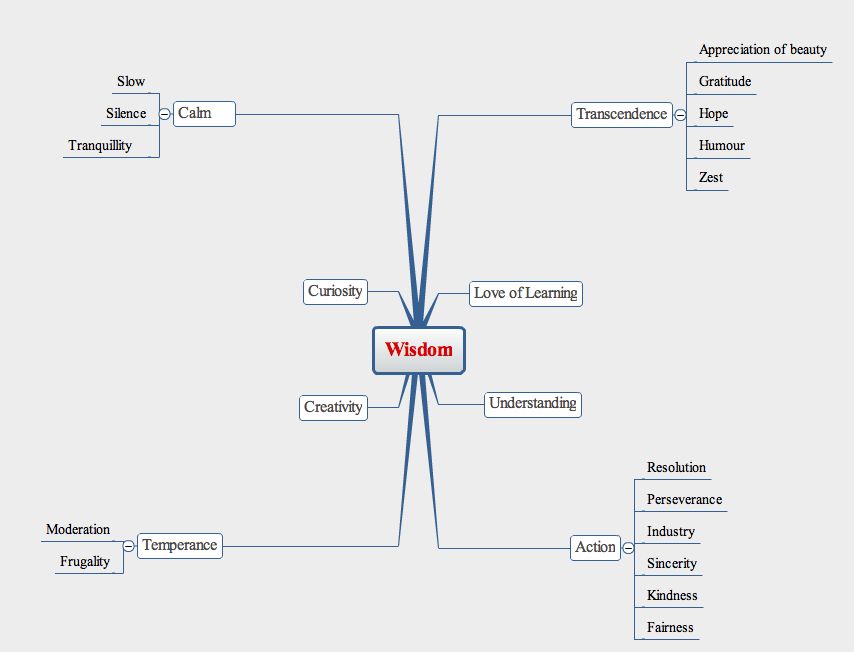
I’ve conducted my own synthesis of Franklin’s and Seligman’s virtues and strengths to come up with a personal virtue map.
Here’s an image of the map –
You’ll see this has five main “nodes” – each of these refers to a major virtue cluster – Wisdom in the middle (because for me that’s the centre of it all), then Calm, Action, Transcendence and Temperance. Around each of these nodes I’ve picked a few qualities or characteristics that I’d like to be part of how I grow.
Here’s a summary –
Wisdom (which is about awareness of the world)
Curiosity and Love of Learning are simply what they are – reflecting, enquiring and learning.
Creativity encompasses the ideas of ingenuity, of novelty, and of emergence.
Understanding encompasses the ideas of perspective, judgement, emotional intelligence and empathy.
Calm (stillness and serenity)
Silence is about finding times without talking, without music or noise. It’s also about valuing conversation, not trivialising it.
Tranquillity is that calm that allows you to remain unflustered or unfazed in the face of trivial difficulties and random events.
Slow is about taking your time, savouring and relishing what you are doing.
Action (engaging with the world and with people)
Resolution is deciding to do certain things and actually doing what’s been resolved to do.
Perseverance is sticking at something to see it through.
Industry is about being active
Sincerity, kindness and fairness are values which can be used to assess the quality of acts towards others.
Temperance (living within limits)
Moderation is about enjoying something without spoiling it by taking it to excess.
Frugality is about not being wasteful, spending productively and well.
Transcendence (living beyond our selves)
Appreciation of beauty in all things – the physical world, people, the Arts.
Gratitude and hope are the building blocks of positivity. Gratitude looks back and keeps positive experiences alive whilst hope looks forward and creates the conditions for positive experiences in the future.
Humour and zest are forms of passion. Humour is a lightening of the heart and zest is an energy of the heart.
So, what’s next? I created the mindmap using Mondomo (the map’s name is “virtues”) and exported it as a jpeg which I’ve now printed out onto a 6 x 4 inch index card. I’ll start carrying it around with me and my idea is reflect on it every morning and every evening. By doing that I hope I’ll bring focus and intention to these “virtues” – and if they’re worth developing, I’ll experience the payoff in an increased quality of my life. I’ll keep you posted!
Posted in life, personal growth, psychology | 5 Comments »
My brain seems to work in a particular kind of a way. It’s good at spotting connections, building patterns. I’d say it’s a creative brain. When I read a book certain words or passages ring bells, make lights flash, prod my memory of other passages I’ve read elsewhere and I build on what’s already there, not just in a way that gives me more knowledge in my store, but, rather, more dynamically creates something new. Some new understanding that can change my view of who I am and what kind of world I live in.
In my consulting room I find that’s one of the crucial questions I want to find the answer to – what kind of world does this person live in?
I think we all have brains that work that way actually. I think that’s how we learn, connecting new experiences and observations to our previous ones. It’s a constant process and, at best, it increases our understanding.
Sometimes the connections seem quite serendipitous. Do you get that? When a particular word or phrase or idea seems to keep popping up everywhere for a while? I don’t mean the obvious recurrences which come from reading a few books on the same subject area. I mean they pop up in books, newspaper articles, movies, song lyrics and so on. I’m sure I could write a post or two on specific words that do that but let me tell you about one of the ones that’s popping up just now – virtue.
Now this is a word I’d say I probably have never used and it’s not even a word that has held any appeal for me, but I was reading The Happiness Hypothesis recently and came across Jonathon Haidt’s discussion of virtues. He begins by telling of Benjamin Franklin (you can read about his virtues here). I’m a Scot living in Scotland but I quote Benjamin Franklin almost every day. Not a wide range of quotes mind, just one. However, this was a brand new story and it intrigued me. What do I do when something catches my interest? Google it, of course. Well, Franklin’s virtues sounded a bit archaic to me but his little descriptions of each one I thought revealed a man of remarkable insight and balance. But they didn’t feel quite right for me.
Haidt goes on to link this idea of virtues both to the ancient Greek and religious virtues and to the modern practice of positive psychology. That lead me to pick my two Seligman books off my shelves again and remind myself what he’s said. I say remind myself but to be honest I had no recollection of him using the term virtues at all so it was really going back to notice what I failed to notice first time round. Seligman’s virtues seemed different from Franklin’s. Different but not completely different (sorry, this is the way my mind works but now I’m thinking, I wonder what Monty Python’s virtues are? OK, back to the subject) You can read about Seligman’s virtues here.
What I did next was what I often do with such things. I sat in a cafe with a notebook and pen and wrote the words down over a two page spread. It’s a kind of mind mapping technique (not the fancy Tony Buzan variety, just a simple way of seeing connections and patterns). What I do is take the key words or phrases that are bubbling in my brain and write them out not randomly but in clusters so that words which have some connection for me are written close to each other and those that don’t seem so strongly connected are written further apart. Am I making that clear? I should take some photos of the process cos its actually quite a visual thing.
That gave me three clusters of Franklin’s virtues and four of Seligman’s. Only two of the clusters overlapped. Continue Reading »
Posted in life, personal growth, psychology | 1 Comment »
Daniel Gilbert in Stumbling on Happiness makes the point that we make things up when we remember, we make things up when we observe the here and now and we make things up when we imagine the future.
He uses a version of a card trick in his book to illustrate a point about how we observe and remember. I tracked down an online version of it – look at this card trick and see if you can work out how its done.
Then when you’ve done that, watch this video of another card trick. The video also explains how the trick is done and the revelation really is a revelation. You’ll be amazed!
Posted in creativity, perception | 3 Comments »
When I read Authentic Happiness by Martin Seligman I was very taken by the notion of identifying your strengths and building on them (as opposed to the more traditional New Year’s Resolution method of picking out your greatest weaknesses and hopelessly wrestling with them!). At the time, somehow, I missed his reference to “virtues”. Then when I read The Happiness Hypothesis recently, Jonathon Haidt’s description of virtues and his reinforcement of the idea of a link between ancient virtues and the findings of positive psychology sent me back to read Seligman’s book again. And there it is, clearly, in black and white – he lists what he says are the SIX main virtues (dropping seven of Franklin’s?) and the 24 “strengths” which lead to the development of those virtues.
Here are his SIX virtues –
Quite different from Franklin’s, at least, at first sight.
Let me summarise his “signature strengths” for you. These lead up to the virtues.
Wisdom
Courage
Humanity
Justice
Temperance
Transcendence
Now, I’m sure you’ll see when we come down to the level of what Seligman calls strengths there is considerably more overlap with Franklin’s virtues. However, there are significant differences.
If you’d like to read more about Seligman’s Signature Strengths and Virtues I suggest you go have a look at his website (it’s free) and read the book Authentic Happiness.
Posted in from the consulting room, life, personal growth, psychology | 8 Comments »

Sandstone, originally uploaded by bobsee.
Everything changes.
We say “solid as a rock”, don’t we? Well, over time, even rock doesn’t stay the same.
Look at this amazing sandstone. I saw this in a wall at St Andrews. Isn’t it incredible how soft and malleable it appears? And isn’t it amazing how as the wind and the rain interact with the stone this web-like structure emerges from would’ve initially been a smooth-surfaced stone?
Posted in from the dark room, photography | 3 Comments »
I was inspired recently reading about Benjamin Franklin’s virtues tool for personal growth. Apparently he wanted to continuously improve his character so he read a lot about virtues to see what people said about the qualities and characteristics a person might hope to develop. He summarised the various authors by collecting together the 13 virtues which he thought most authors agreed.
He then made himself a chart with the 13 virtues down the first column and the seven days of the week making up the other columns. Every day he reflected on his behaviour and put a black mark in any box where he felt he had acted in a way which failed a particular virtue. He did this throughout his adult life, focussing on one particular virtue each week to improve himself.
He showed himself his improvement through the decline in the numbers and spread of black marks.
Now I have issues with that particular method but I’ll return to that in another post.
The 13 particular virtues are interesting and although written in what now seems old fashioned language, the principles he elaborates in relation to each virtue show he had a thoughtful, tolerant and balanced approach to virtues.
Have a look at them. What do you think? Would you sign up to all of these? If not, which would you remove from your list? And would you add any he hasn’t included?
If you want to follow in his footsteps you can download of pdf of his chart here and use it either as a standalone or as an integral part of the marvelous HipsterPDA project!
Here they are –
Posted in from the reading room, life, personal growth, psychology | 6 Comments »