Feeds:
Posts
Comments

The Happiness Hypothesis by Jonathon Haidt. ISBN 978-0-099-47889-8.

This book is by a Professor of Social Psychology at the University of Virginia. The book’s subtitle is “Putting Ancient Wisdom and Philosophy to the Test of Modern Science”. I read it because it was one of three books about happiness discussed by Jean Kazez here. I really enjoyed it. His writing style is easy and at times humorous. He discusses the understanding of happiness from the perspective of ancient Buddhist and Greek thinkers and in the light of findings from cognitive science and the more recent positive psychology.

He makes a good case for the idea that happiness in the result of several factors – some genetic (the given of the physical functioning of an individual brain), some situational (the conditions of life) and some behavioural (the choices we make, the actions we take). I’ve not really considered the first of those before. I guess I’ve thought that things like happiness, depression, optimism and pessimism are all learned phenomena that emerge from the experience of the events which happen in an individual’s life and the sense that individual makes of those experiences, the stories they tell themselves and others about their life. Recently though, both with certain patients in my practice and with what I’ve been reading in that crossover area between neuroscience, psychology and philosophy, I’ve been coming to understand the more complex and intimate links between the body and the mind and between the physical and the subjective. So it makes sense to me that as we don’t all have either a body or a mind which functions exactly the same way as anybody else’s that experiences of positive and negative emotions will be present to different degrees in different people. What he refers to as a person’s “affective style” emerges from the interplay of approach and avoidance behaviours which is influenced both from their genetic make-up and their early life experiences. I find that a helpful concept.

He shed a light on quite a few other issues for me. I like this phrase –

…those who think money can’t buy happiness just don’t know where to shop

He then goes on to explain the different effects of spending money on objects as opposed to spending it on quality time and activities with loved ones.

He distinguishes pleasures from gratifications – a pleasure is a sensory and/or emotional delight. It’s transient and if repeated too often the brain adapts to the stimulus and the amount of pleasure drops (you might like ice cream but eat too much of it at a sitting and the pleasure payback fades). A gratification is an activity which fully engages you, draws on your strengths and allows you to lose your self-consciousness. Gratifications improve your mood for longer and you don’t tire of them in the way you tire of pleasures.

He comes down in favour of positive psychology and its emphasis on understanding your strengths and playing to them, linking this to the older idea of acquisition and development of virtues. What goes along with this is his emphasis on taking actions rather than passively sitting waiting for happiness to just float past.

It is vain to say that human beings ought to be satisfied with tranquility; they must have action; and they will make it if they cannot find it. (Charlotte Bronte)

I liked what he had to say about goals. I often find that talk of goal-setting lacks something but I found it quite hard to put my finger on why. Here’s the explanation. First from Shakespeare –

Things won are done; joy’s soul lies in the doing.

And from the scientific perspective he describes “effectance motive” – we are all driven to make things happen. We get more pleasure from striving towards our goals than we do in achieving them.

His conclusion is this –

Happiness is not something that you can find, acquire, or achieve directly. You have to get the conditions right and then wait.

And he recalls Tolstoy to point to the areas where we need to get the conditions right –

One can live magnificently in this world if one knows how to work and how to love…..

Through love and through work (in the broadest sense, not work just as employment) we can be engaged with others and with the world and we can experience the joy of making things happen, drawing on our strengths, building our characters, and experiencing meaningful lives.
Now the trombone is not an instrument I have much affection for but this little animation I found on youtube is immensely pleasing and the music is by the Voodoo Trombones – on this track they sound like a Carribean flavoured variety of Lemonjelly

Makes you want to dance, lifts your heart……

Happiness

I read a really fabulous article by Jean Kazez on Philosophy Now. It’s a review of three books about Happiness. I was SO impressed with her discussion that I popped over to Amazon and bought all three (while I was there I put her own book into the basket too). I’m almost finished the first one now “The Happiness Hypothesis” by Jonathan Haidt and I am thoroughly enjoying it. I’ll post more about later but for now let me say he writes very well, and with a nice sense of humour. He considers what Buddhist and Greek thinkers have said about happiness and sets them against modern, scientific insights from neurology, evolutionary biology and psychology. He’s keen on positive psychology and that’s another point of agreement for me. I can’t remember right now how I stumbled upon positive psychology but when I was teaching in Japan a few years back one of the doctors there asked me if I’d heard of “Solution Focussed Approach”. I hadn’t, but when I read the textbooks they immediately made sense. See, one of my bugbears about health care is that it isn’t focussed on health at all – it’s focussed on disease, so to read about a therapeutic approach which explicitly focussed on how an individual might become well again was very appealing. It wasn’t long after that when I came across the writings of Martin Seligman. I was VERY impressed. So, reading Jonathon Haidt’s summary of Martin Seligman’s “Happiness Formula”, and his linking of the old idea of virtues to the new ideas of positive psychology sent me off again to the Authentic Happiness site where there are loads of interesting questionnaires which will help you understand what your own greatest strengths are. Go check it out if you haven’t done so already. I really recommend it!

Proof

The movie {Proof} starring Gwyneth Paltrow, Anthony Hopkins and Jake Gyllenhaal got me thinking (well, there’s a surprise you might say!) It got me thinking about a number of issues. Here’s a couple of them.

How do you prove anything? The basis of the scientific method is (according to Popper) falsification. He meant that nothing can be proven but testing can reveal a hypothesis to be false – and so science progresses, coming up with more and more robust hypotheses which are harder to disprove. Of course, in mathematics, advances are made by writing “proofs” which are solutions to puzzles or dilemmas I suppose (don’t ask me, I’m not a mathematician!). A key part of this movie is how to show who actually wrote the groundbreaking “proof” – the father (Robert), or the daughter (Catherine)? What’s the solution? Well, can it be shown that the daughter could NOT have written the proof? If that can’t be shown, then her claim to have written it can gain strength.

OK, I know, that all sounds pretty convoluted. Don’t let that put you off. This is an intriguing and engaging movie, and not at all hard work!

So that’s the first theme – how do we know what we know? How can we ever be sure of anything?

The second one is the theme of how our traits, skills, and qualities come from our roots, from our origins. We can see qualities in ourselves that seem inherited and we can see some of our qualities in our children. We don’t start with a blank sheet, but neither do we start with a fully written script. We make our lives our own and each and every one of us is unique and different but there are threads that run through us which trail way, way back into other people’s pasts. Catherine seems destined to carry forward her father’s work having inherited his mathematical genius but she hopes she has not also inherited his madness. When her father dies, her challenge is to become herself in her own right. This reminded me of Kieslowski’s Blue.

In “Blue” Kieslowski considers how loss creates the possibility of new beginnings. The main character, Julie, loses her husband and her daughter in a car crash in the opening scenes of the movie and her way of dealing with her grief is to try to rid herself of all memories and connections with them. She tries to start again. But there’s no such thing as a clean sheet. Deleuze showed that we are in a continuous process of becoming and that in every present there is the past and the future. Interestingly, in “Blue” there is also the question of exactly who created a work. In this case, who composed the great music – Julie, or her husband? How can we know?

{Proof} also made me think about what it’s like for two people to create together and how, when it works well, what is created can NOT be attributed solely to one person. Yes, sure, an individual can sit alone and create, but something different manifests itself when the creative process is shared. I think that’s a good example of why its important to know a person within the contexts and connections of their life.

Here’s a fanvid of {Proof} – clips set to “I think I’m Paranoid”, by Garbage

And here are the last few scenes of Trois Couleurs; Bleu

To become the hero of your own life you need to express your uniqueness and your creativity. Without uniqueness you disappear as one of the many. Without creativity you don’t express yourself and you don’t give to the world.

Here are two of my most favourite music videos. Both of them have uniqueness and creativity by the bucketload!

(just in case you are wondering, the first one is Around the World by Daft Punk, and the second one is OK Now with their amazing dance to Here It Goes Again)

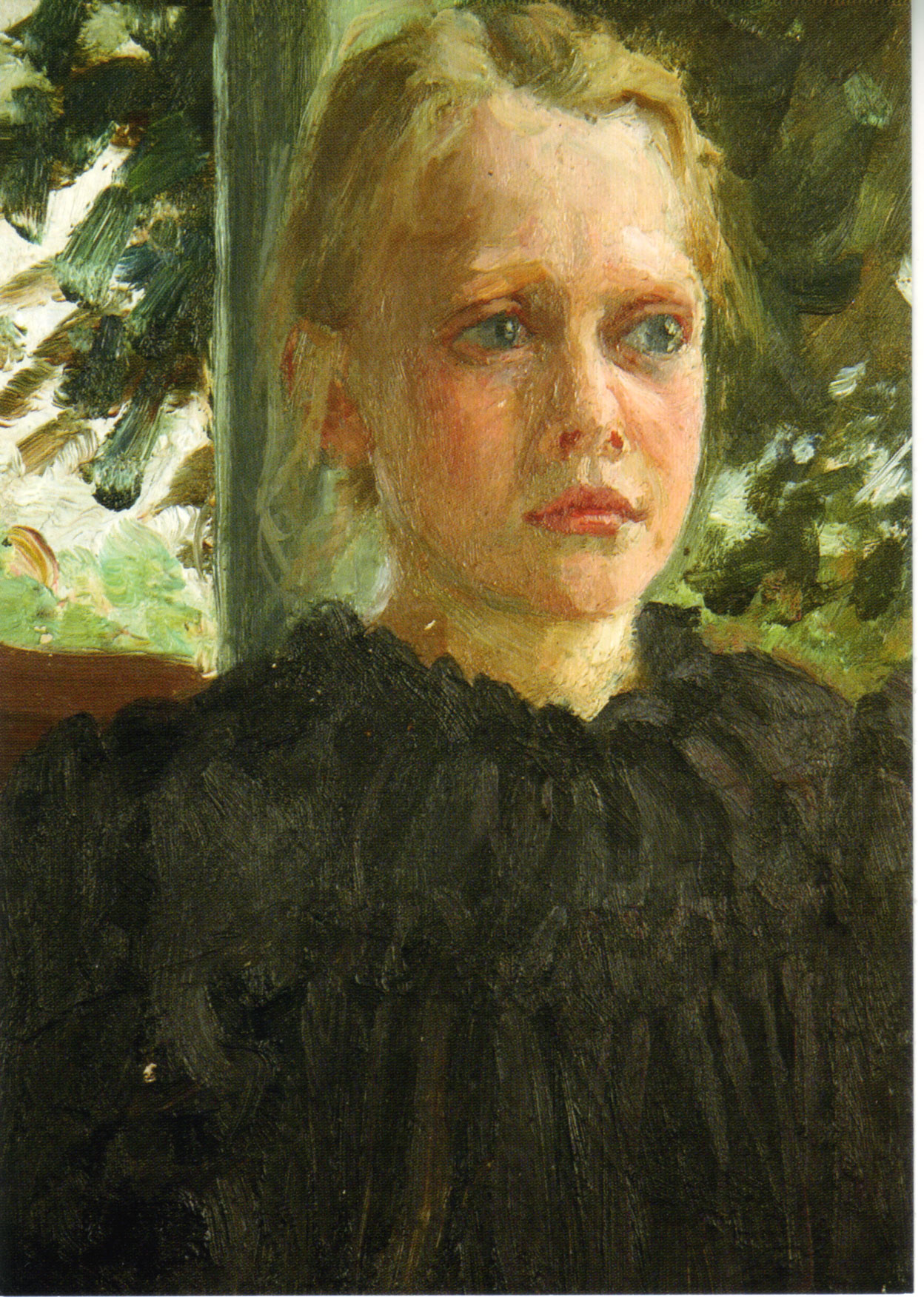
Eva Bonnier

Julia Hasselberg

I found myself captivated by this portrait of Julia Hasselberg painted by Eva Bonnier. Eva Bonnier was a Swedish artist and this painting is of her lover’s illegitimate daughter who Eva adopted after Julia’s father’s death.

This girl has a look which is very familiar to me. It’s a combination of pain and resilience. There’s reserve, distance, independence and spirit here. The kind of spirit that emerges from suffering to strengthen and protect. I find it both moving and powerful.

You can find this portrait and others by Eva Bonnier along with a really interesting short biography of her on the Giornale Nuovo blog. Thank you for posting this Mr h.

All Eva Bonnier’s portraits which you’ll see in that post share these characteristics for me. These are powerful people, fiercely independent, with that special kind of strength which emerges from suffering. One thing that fascinates me is this description of Eva Bonnier

She is reputed to have been an intelligent, strong-willed and sharp-tongued woman who ‘could neither in private nor as an artist charm or flatter her contemporaries.’

How much does the character of the artist influence their portraits of others? How much do they see a bit of themselves in their subjects and, unconsciously, highlight those qualities in them? What do you think Ester?

french family, originally uploaded by bobsee.

Here’s a variation on my Five Days, Five Colours idea.
I was in France on the weekend of Bastille Day so I thought I’d go out and photograph red, white and blue.
Here’s the set of photos I took

Who am I?

It is that loving you as much as I have been able to manage has defined the person that I am. That is who I have become.

Sebastian Faulks. Human Traces.

How do we gain a sense of self? How do we answer the question “Who am I?” It seems to me that we gain a sense of self through the stories we tell ourselves and others. It’s a narrative process and it’s an always unfinished, creative process. We are all unique. Every time I conduct a clinic I meet new patients. Never once have I heard a patient tell me the exact story I’ve heard before. Everyone has a new, unique narrative. But this implies that the creation of a sense of self is all internal. It isn’t. We create a sense of self through our boundaries, our connections, our interfaces and interactions. We create a sense of self through our experience of love – its presence, its absence, its possibility, its loss.

Loving you, I become me.

Evolution is a passage from the most automatic to the most voluntary.

Sebastian Faulks. Human Traces.

The zombie life is the automatic life. Becoming the hero of your own personal story involves developing awareness and making more and more conscious choices.

traces…..

ripples in the sand, originally uploaded by bobsee.

Then the long trail of her footprints, stretching back towards the sea, became slowly indistinct as each one filled with water and edged in upon itself; and in a matter of minutes, as darkness began to fall, the shape of the foot was lost at every place until the last vestiges of her presence were washed away, the earth closing over as though no one had passed by.

Sebastian Faulks. Human Traces