Feeds:
Posts
Comments

Stirling Castle and Wallace Monument, originally uploaded by bobsee.

What does it mean to live in a place with a castle? I was born in Stirling, Scotland, and now, after a few years living in Edinburgh, I live in Stirling again.
The town of Stirling grew up around the castle and in my opinion it’s the loveliest castle in Scotland. I do like many other castles but for different reasons. There’s something of real beauty about this castle and the fact it’s not a ruin somehow gives it continuing power over the town and countryside around it. It has lovely gardens inside the castle walls and that’s one of its most unique features.
For me, this castle, which I see every day (unless I’m away on a trip), gives a sense of history, of roots, of durability, of strength and of constancy.
I BELONG here. I feel a sense of home that somehow stretches way back to long before I was born here.
For some people a castle is scary. They think of ghosts, or of soldiers, and, sure, there have been many soldiers in Stirling Castle over the centuries and there may well be ghosts (but I don’t know anyone whose ever seen one there!) Stirling Castle isn’t scary for me. I draw strength from it, power from it, a sense of reassuring calm from it.
If you look carefully you can see Wallace Monument behind the castle. It’s a powerful symbol of this area too but it doesn’t have the same impact as the castle for me.
I realise as I write this that our experience of our lived environments is complex, affected by both personal and collective histories. For every one of us a physical structure (like Stirling Castle for me) not only influences how we feel but we interact with it, imbuing it with our own views, our own perceptions, our own stories.
What physical structures influence you?

On the plane to Tokyo I watched three movies. The best one (the one I’ll buy on DVD to watch again and again) was “Stranger than Fiction”. One of my all-time favourite end of movie voice-overs is Kevin Spacey in “American Beauty”. I play that end scene frequently and it gets me every single time. Well, at the end of Stranger than Fiction we hear Emma Thomson as Kay Eiffel saying this –

As Harold took a bite of Bavarian sugar cookie, he finally felt as if everything was going to be ok. Sometimes, when we lose ourselves in fear and despair, in routine and constancy, in hopelessness and tragedy, we can thank God for Bavarian sugar cookies. And, fortunately, when there aren’t any cookies, we can still find reassurance in a familiar hand on our skin, or a kind and loving gesture, or subtle encouragement, or a loving embrace, or an offer of comfort, not to mention hospital gurneys and nose plugs, an uneaten Danish, soft-spoken secrets, and Fender Stratocasters, and maybe the occasional piece of fiction. And we must remember that all these things, the nuances, the anomalies, the subtleties, which we assume only accessorize our days, are effective for a much larger and nobler cause. They are here to save our lives. I know the idea seems strange, but I also know that it just so happens to be true. And, so it was, a wristwatch saved Harold Crick.

Kay is an author whose voice Harold (played by Will Ferrell) hears in his head. Hearing voices that nobody else can hear is usually regarded a sign of mental illness but Harold refuses to believe that. The voice is clearly narrating his life as if he is the main character in a novel. That would be disturbing in itself but when the narrator makes it clear she is about to kill off her main character Harold decides he has to find her and persuade her to change the ending – he doesn’t want to die yet! It’s a clever movie based on a really interesting idea. After all, aren’t we all the main characters in the stories of our lives? Where do the stories of our lives come from? Are we both author and reader as we create a sense of self? I think so!

There’s a good scene where he goes to consult a psychiatrist who diagnoses schizophrenia but when he declines medication and asks for an alternative solution she sends him to a Professor of English Literature (played by Dustin Hoffman). I love that this is the character who helps him make sense of this problem rather than a doctor who prescribes drugs. This is a scene I think I’ll use when teaching medical students.

A big added bonus is the character Harold falls in love with, Ana Pascal, played by the wonderful, always interesting Maggie Gyllenhaal. She plays unusual, challenging quirky characters so well. Did you ever see “Secretary“? Probably one of the worst packaged DVDs I’ve ever bought – terrible cover! It’s actually one of the most challenging movies about relationships and sexuality you’re ever likely to see.

So does Harold die at the end of the movie? Dustin Hoffman makes it quite clear the novel is great with the ending which kills Harold off (and tries, successfully, to persuade Harold, that’s that how it should be left), but, he argues with the author, that with a different ending the novel would be just ordinary. What do you think of that? Is it the ending that makes a novel great? Reminds me of that Penguin project Amy blogged about.

“This relentless restlessness liberates me,” Bjork sings in “Wanderlust,” which she calls the album’s manifesto. “I feel at home whenever the unknown surrounds me.”

These lines leapt out at me as I read this interview with Bjork in today’s International Herald and Tribune (no, I don’t read this paper every day but I’m in Tokyo this week and the hotel pops a copy under my door every morning). She’s being interviewed about her new album, Volta.

What strikes me are two statements here. “This relentless restlessness liberates me”. I so identify with that. I know it’s good to rest and it’s good to be still at times but I have this passion for life and an insatiable curiosity and wonder about the world. I know what that relentless restlessness feels like – and it IS liberating! We hear a lot about balance these days but we grow by pushing at the edge of things, accepting challenges, moving out of our comfort zones. The second statement is a really interesting one about creativity – “I feel at home whenever the unknown surrounds me.” Now, a lot of people are scared these days, and they are particularly afraid of the unknown. There’s an incredible drive for certainty and control in our society today. But creativity doesn’t thrive in controlled conditions. The biological concept of emergence is about the unexpected happening – the unknown and unknowable – until it happens – its the Black Swan.

Creativity is a basic human condition. It comes out of exploring, out of a movement from the known to the unknown.

Full moon

Full moon over Tokyo

Here’s a shot from my 19th floor hotel room in Tokyo tonight. That bright light up in the sky is a full moon. One of the homeopathic remedies I’m teaching here tomorrow is Antimonium crudum, one of the key features of which is “sensitive to moonlight”. Most people who live in cities these days are pretty much unaware of the moon’s phases but the full moon has a longstanding reputation for influencing our moods.  Despite that reputation statistical studies have failed to prove any of those influences. However, what interests me is whether or not YOU feel any different at different times in the month (menstrual cycle not withstanding!). Are you aware of feeling any different around a full moon? Or a new moon? A waxing or a waning room?

It’s not that the moon’s effects need be physically mediated, it’s more the way our environments affect us. Our environments include not just the physical environments in which we live but also the psychological and social environments. The frequent mentions of the effects of a full moon on lovers in stories and songs doesn’t need to be confirmed by a physical explanation. Human phenomena, life experiences, are so much more than merely physical.

So, how about it? Any lunar effects in your life?

Across on the Ririan project there’s this great post.
Steve Jobs is a really inspring character. You get the impression he just loves what he does in life and he’s so creative! I’m a mac convert over the last 18 months or so. I had used Windows pcs for years and years – yep, right back to those earliest of Windows years and up to XP, but then my wife bought me an iPod for Christmas 2005 and I couldn’t get it to work with my ageing Sony Vaio with its USB 1.1 ports so I went out in the January sales and bought an iMac. Oh my! Did I love it right out of the box! Not only did it set itself up without a hitch but it found my internet connection and configured itself without a problem and when I pressed the button that said “add printer” well, blow me, it just went ahead and did exactly that! I had NEVER had such an easy straightforward experience with Windows pcs. And the machine was just lovely to look at. A friend called and asked “where’s the box?” – he meant, where’s the tower that the computer lives in! There isn’t one! Elegant, that’s the word. Anyway, I started using iTunes and soon got into the get all my CDs onto the computer project. Just under 7000 tracks later they’re all there and new ones getting added as soon as I get the wrapping cellophane off the boxes (hey, that’s another story entirely! Packaging rage!!). The iPod goes EVERYWHERE with me. I completely love it. Next up I got into iPhoto hooking up my new digital camera and you know its just that everything works so easily experience that gets to me. It still amazes me. So when it came time to upgrade the ageing Vaio (OK, it was well past time) I bought a Powerbook. I just cannot imagine wanting to use Windows ever again.
For me, the mac is my creativity tool. For words, for pictures and for music, and I have barely scratched the surface with them so far.
So for me, Steve Jobs counts as a hero.
Here’s the summary of the quotes the Ririan project used to collect their “10 golden lessons”

  • “Innovation distinguishes between a leader and a follower.”
  • “Be a yardstick of quality. Some people aren’t used to an environment where excellence is expected.
  • “The only way to do great work is to love what you do. If you
    haven’t found it yet, keep looking. Don’t settle. As with all matters
    of the heart, you’ll know when you find it.”
  • “You know, we don’t grow most of the food we eat. We wear clothes
    other people make. We speak a language that other people developed. We
    use a mathematics that other people evolved… I mean, we’re constantly
    taking things. It’s a wonderful, ecstatic feeling to create something
    that puts it back in the pool of human experience and knowledge.”
  • “There’s a phrase in Buddhism, ‘Beginner’s mind.’ It’s wonderful to have a beginner’s mind.”
  • “We think basically you watch television to turn your brain off,
    and you work on your computer when you want to turn your brain on.”
  • “I’m the only person I know that’s lost a quarter of a billion dollars in one year…. It’s very character-building.”
  • “I would trade all of my technology for an afternoon with Socrates.”
  • “We’re here to put a dent in the universe. Otherwise why else even be here?”
  • “Your time is limited, so don’t waste it living someone else’s
    life. Don’t be trapped by dogma – which is living with the results of
    other people’s thinking. Don’t let the noise of other’s opinions drown
    out your own inner voice. And most important, have the courage to
    follow your heart and intuition. They somehow already know what you
    truly want to become. Everything else is secondary.”

I got that summary from Lifehack, a blog I read regularly and thoroughly recommend.

powered by performancing firefox

Now here‘s and interesting piece of research. Meyers-Levy and Rui Zhu from the University of British Colombia have shown that ceiling height affects the way we think. When the ceiling is higher, people think more abstractly and when it is lower they think more specifically.

Now that’s interesting! Because they are not saying that one particular ceiling height is good and another bad but that the physical environment in which you sit or move will be conducive to a particular way of thinking.

So, next time you want to be creative, think freely, brainstorm, or whatever, maybe you should get yourself into a room with a high ceiling! What about outside I wonder? Is that better? But, next time you want to focus in on the specifics, the details of a piece of work you might be best to find a more tightly enclosed space. Reminds me of something I read about writers who use a garden shed to write in! I wonder if the different kinds of rooms writers write in suit different kinds of writers?

What do you think? Are you aware of the effects that a room’s dimensions can have on your thought processes?

Ben Ledi

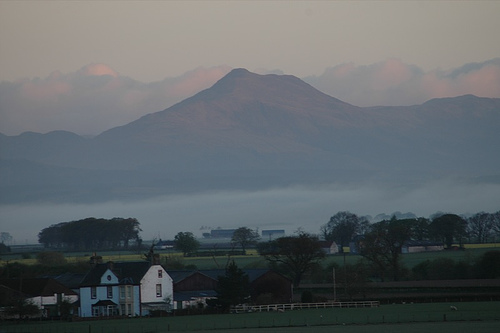
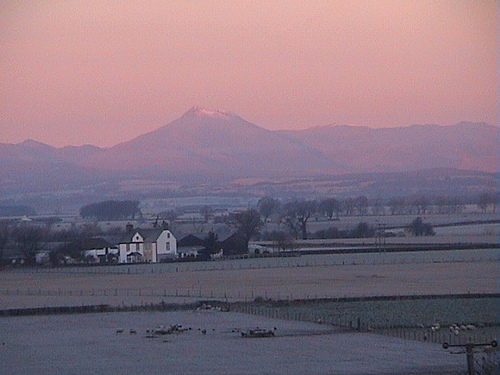
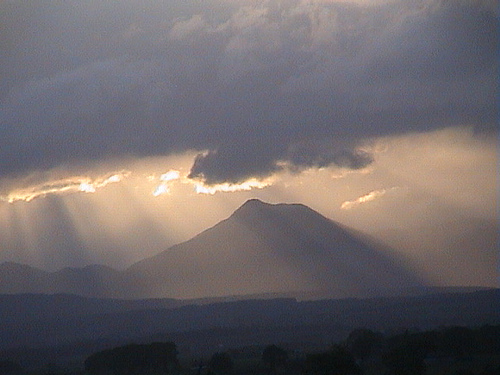
From the window of my apartment I can see across to the hills. One hill in particular stands above the others – Ben Ledi. I got to thinking the other day about how things change, how everything constantly changes, but how if something changes slowly we think its staying the same. You know what I mean. A plant changes quickly, growing from a seed to a seedling and blossoming under the sun’s rays to show its petals to the world, then developing its fruit or its seeds and withering away again, in endlessly repeating cycles. But mountains, now, they change so slowly they look the same for hundreds or even thousands of years. Don’t they? But then, as I gazed out of my window across the fields at the light and the shadow on the hillside, I thought to myself, actually, Ben Ledi looks different every day. OK, the rocks probably don’t change very much, but Ben Ledi is more than its rocks. The Ben Ledi I see from my window is not just the rocks, the slope, the shape of the peak. It’s foliage, the colours, the light and shadow. When I look at Ben Ledi I see something different every day. Here are four (of many!) photos of Ben Ledi all taken from my window.

Ben Ledi just after a storm.

benledistorm.jpg

Ben Ledi with morning mist.

benledimist.jpg

Ben Ledi covered in snow.

benlediwinter.jpg

Ben Ledi in a winter setting sun.

benledipinksnow.jpg

If you like these Ben Ledi photos you can find more on my Flickr page here.

Patients’ stories are often dismissed by doctors as being too subjective to be of value. Objective information is rated more highly. In fact the dominant paradigm of the biomedical model is “evidence-based medicine” where a hierarchy of value has been created which emphasises the findings from research trials conducted on groups of patients over the individual stories of doctors and patients. Let’s understand and maybe challenge this hierarchy.
By subjective we usually mean a person’s unique experience. No two people can have identical experiences because no two people are identical. The dismissal of a patient’s story is the dismissal of personal experience.
We tend to think of objectivity as being outside ourselves, as being a phenomenon which is free from individual prejudice, as if it is unfiltered or pure. However, objectivity is actually just a consensus of personal, subjective views.
Take a look around your room now. What do you see? A computer probably! Maybe you can see a chair. Let’s just focus on the chair for a moment. This experience you are having right now of seeing that chair is subjective. It is YOU who is seeing the chair. But if everyone who comes into your room can also see that chair then seeing that chair becomes objective. The observation becomes more reliable in the sense that you could say to a perfect stranger “Come into my room and tell me what you can see” and, amongst other things, the stranger will report seeing that chair.
But subjectivity and objectivity are not mutually exclusive, either/or, categories. There’s a range or degrees of objectivity. For example, what colour is that chair in your room? The answer to that question will vary. Not everyone will agree about the colour of an object because colour sensation is a highly subjective phenomenon. Let’s push this one step further. Is it a comfortable chair? Well, now the consensus will become seriously shaky. You cannot be sure that a stranger coming into your room will describe that chair as comfortable.
The greater the consensus of experience, the more we are likely to call it objective, because we know that there will be a high probability that almost everyone will concur.
However, what matters to me if I have a pain is my experience of the pain. Nobody else can experience my pain. The concept of objectivity becomes irrelevant. If I take a painkiller, only I can tell you if it is working for me. No doctor or scientist knows better than you do about your pain. So claims that only treatments which are “evidence based” ie which work for many other people should be offered to patients are not supportable. Clinical trials (group experiments) reveal useful information about possibilities and even probabilities but they should never be treated as the last word on something. “Evidence” is never complete. However, although a majority of people may claim relief of their symptoms from a particular treatment, we can never guarantee that that treatment will work for this particular patient. Some people will only respond to a totally different treatment, possibly one which has never been shown to help the majority of patients. We should never prevent patients from having the treatment that works for them just because that treatment hasn’t helped most other patients.
How many patients should get relief from a drug before we can claim this drug is “evidence based”? Well,
However, as Dr Roses of Glaxo SmithKline, specialist in pharmacogenomics at Glaxo SmithKline famously said,

“The vast majority of drugs – more than 90 per cent – only work in 30 or 50 per cent of the people,” Dr Roses said. “I wouldn’t say that most drugs don’t work. I would say that most drugs work in 30 to 50 per cent of people. Drugs out there on the market work, but they don’t work in everybody.”

That’s a minority then. This falls far short of objectivity as consensus. Why is that? Because what matters is not just what most people experience but, when it comes to your health, your illness, it’s your story that matters. A doctor can, and should, tell you that a particular treatment has been shown to help a certain percentage of patients but you will decide which treatment to continue with solely on the basis of your unique personal experience. It’s your story, your feelings, your sensations that matter most when it comes to your health.

Black swans

There’s a website called Change This. They publish articles which they call “manifestos”. I just came across this one. Nassim Nicholas Taleb argues that unpredictable events are like “Black swans” – until one is seen we lack the imagination to even think such a creature is possible basing our expectations entirely on our previous experience. Taleb says a Black Swan is rare, its occurrence has a large impact, and it is predictable only retrospectively (we explain it with a narrative we make up after the event).

It’s an interesting idea. There’s a phenomenon described in complexity science which is similar to this. It’s called “emergence” and it means the kinds of events and behaviours that occur which are brand new and have never been seen before. For example, when a particular hurricane suddenly starts to behave differently from all previous hurricanes. I see this all the time in patients. There is a terrible tendency in Medicine to focus on diseases rather than the people who have the diseases. Once a diagnosis has been made (the disease has been named) a prognosis is made on the basis of how other cases progressed. But the thing is that again and again patients just don’t comply with statistics. Take Stephen Hawking as an example. He has a disease called Motor Neurone Disease. Usually people die within two years of a diagnosis of this disease. Stephen Hawking was diagnosed over 40 years ago.

People are different. It is impossible to accurately predict an outcome for any single individual with a particular diagnosis. The future is, and always will be, uncertain. That’s not a bad thing, though we crave certainty. I once had a patient who told me her husband had been diagnosed with cancer and had been told he had six months left to live. I asked her how she felt about this and her answer took me completely by surprise (you could say it was a Black Swan!). She said “I’m angry. Very angry. It’s not fair. How come he gets to know how long he’s got and I don’t get to know how long I’ve got?!” I had to explain that actually he might not die in six months time!

But Taleb’s idea about Black Swans makes another interesting point which is about the human use of narrative to make sense of things. Even though an event might be totally unlike any event we’ve ever seen before we’ll do our best to explain it as if it had been predictable all along. This further feeds our tendency to believe in certainty and predictability.

The contemporary practice of Medicine as strongly based on encouraging decision making on the basis of what’s already known (this is called Evidence Based Medicine), but as I once heard Dr Harry Burns (Chief Medical Officer of Scotland) say “If we base all our treatments on what we already know how can we come up with new, better treatments?”

We need imagination. Without imagination we cannot see what might be. Even with imagination however we’ll still have masses of experiences which we didn’t expect. That’s how life is… I don’t want a wholly predictable life. Do you? Understand me here, I’m not saying I want nothing to be predictable. I do want to know that when I catch the 0735 Glasgow train it’s got a good chance of getting me to Glasgow at 0820 (OK, maybe one day!!). I like routines and rhythms. But I like surprises too and the fact that every single patient I see tells me something I’ve never heard before makes my day. Every day.

It’s time

Time for what? Well, what I’d like to suggest is that you take the time to find out something new about somebody today. I work at Glasgow Homeopathic Hospital and a few months back we had a temp on reception. Her name was Louise Rutkowski. One day over lunch break I got chatting to her and found out that temping was not Louise’s main thing in life. She was a singer and had previously worked with This Mortal Coil. We had some interesting chats about following your dreams and doing what you love in life while also finding a way not just to make a living but to support your dreams. Anyway, recently Louise emailed me and told me she was in the middle of making an album.

Listen to this. It’s called “It’s time”

I love it. On her myspace page she lists Blue Nile and Kate Bush amongst her inspirations. You can really hear that in this song. There is nothing more wonderful than seeing or hearing somebody realise their dreams. This is Louise’s best song ever (IMHO) What do you think?