Feeds:
Posts
Comments

France

When I retired from medical practice in 2014 I sold my flat and moved to France. A long time ago I decided I would like to spend part of my life living in a different country, immersed in a different culture, from that of my native Scotland. We had taken many family holidays in France over the years and I fell in love with the country. I enjoyed the food and wine, the pace of life in the countryside and the language.

It was a huge move but I thought of it as a kind of mixture of an adventure and a way to develop and grow (the opposite of what many people envisage about later years in life which can easily become about the world getting ever smaller).

There have been many challenges and learning the French language is certainly a project for the rest of my life. I continue to learn skills I never knew I’d need and daily life is filled with new discoveries, delights and wonders.

There’s something remarkable about living in a different culture and language. It opens up whole new dimensions to life, completely different ways to see the world, and challenges many beliefs and values which I had adopted unconsciously.

Maybe one of the most important things I’d say about spending part of life in another country and culture is that it inspires me to appreciate difference over preference. What do I mean by that? Well, sometimes I’m asked which I prefer – Scotland or France – and my answer is I don’t have a preference. I continue to enjoy and value both countries. I don’t think France is a “better” country than Scotland and I don’t think Scotland is a “better” country than France.

There’s no doubt my life is richer, bigger, and deeper because I’ve made this move. I will always be an advocate of “freedom of movement”, and will always extol the benefits of migration, which, let’s face it, is something we humans have done from the earliest days of our emergence in planet Earth.

Here’s the key though – it’s about integration – building new, different, mutually beneficial relationships and bonds.

Ripples in stone

Yesterday I wrote about ripples on the surface of water and how they emerge from the turbulence which appears as flow meets resistance, and how that resistance is an integral part of the flow itself.

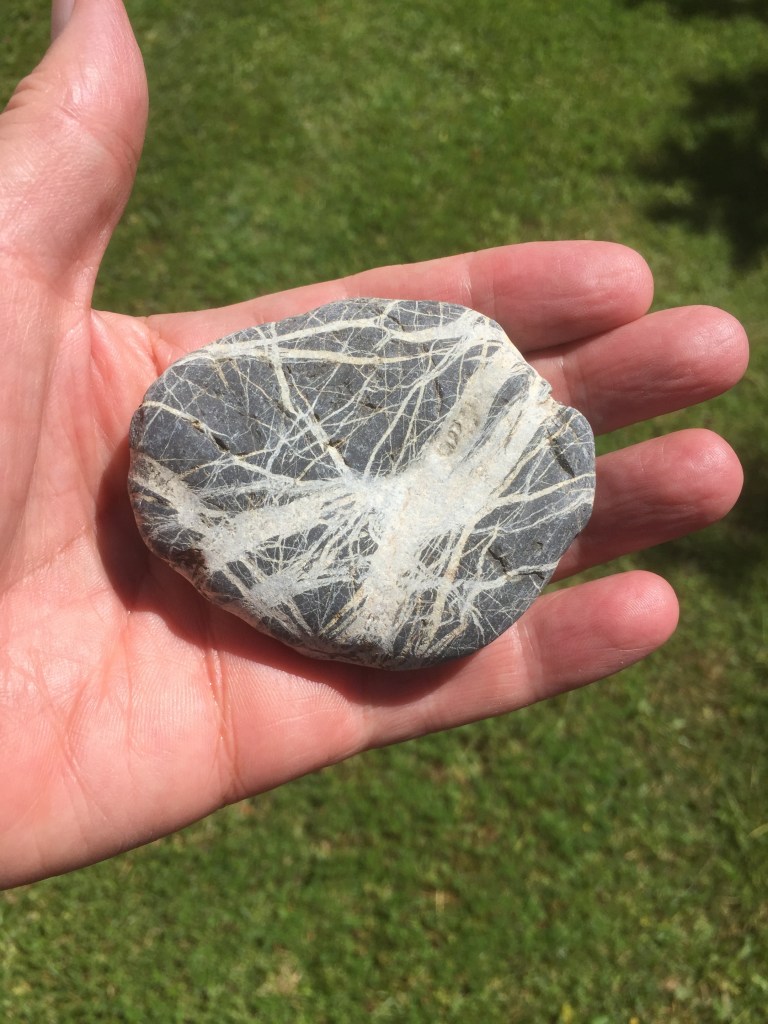
When we look at water we see change happening right before our eyes so it’s easy to be aware of flow and turbulence. But what you see here in this photo looks like a very similar pattern. Very similar because these are very similar processes – the result of the interaction between flow and resistance.

Flow, change, and the emergence of patterns all occur much more slowly in stone than they do in water….but it’s just the timescale which is different.

This is one of my favourite stones because as well as revealing the underlying principles of flow and resistance, it focuses my mind on how massively interconnected the universe is. It boggles my mind to think of the individual atoms produced in the furnaces of distant stars which ended up on our little planet and combined to make this particular stone.

It also reminds me of the ridiculous over simplicity at the heart of understanding our world as made up of separate objects each the result of a single chain of cause and effect.

Reality isn’t like that.

Instead we see and experience events which emerge from the vastly interconnected web of all that is. The connections are non linear. The system is open, not closed. So there are no utterly separate objects and there is no simple chain of cause and effect.

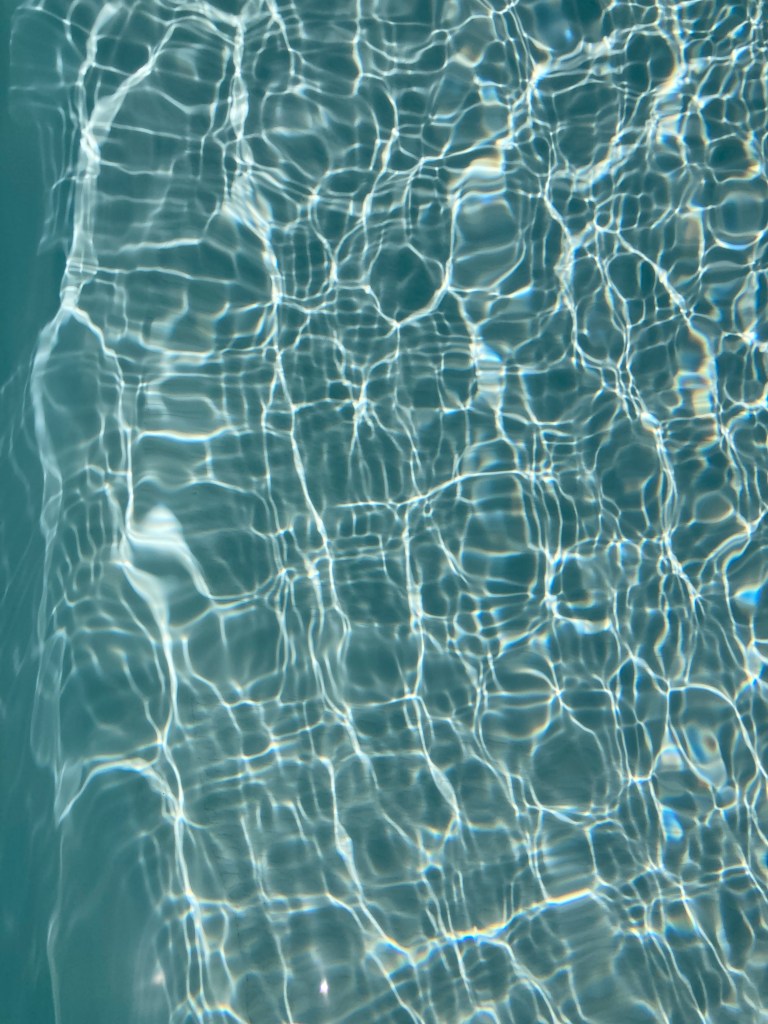
Light on water. Isn’t it mesmerising? Water has fascinated we humans for centuries. The constantly changing shapes which appear on the surface are an art form, and a metaphor for all of Life. Schelling wrote….

Think of a stream, which is itself pure identity. Where it meets resistance, it fiend an eddy. This eddy has no permanence, but it is constantly disappearing and reappearing. Originally nothing in Nature is differentiated; all that she produces is at that point unseen and dissolved in the general productive potential. Only when there are points of resistance are Nature’s products gradually precipitated out, emerging from the general identity. At every such point, the flow is broken up…but at each moment he swell renews, and fills the sphere afresh.

I’ve been fascinated by both concept and phenomena of flow for a long time. I’ve often explained how it seems to me that we are all like waves which appear on the surface of the ocean of Life, manifesting as unique, different beings for very short periods of time before we are reabsorbed back into the Flow.

I’ve also been convinced for a long time of the idea of a vital force, not as a mysterious invisible entity, but as the very life energy within which we all exist.

But I haven’t really properly considered the issue of resistance. This image, and Schelling’s observation, make me think about it more seriously. The principle is recognition of how resistance occurs within the flow itself. It needn’t involve any obstacles. Isn’t this a fascinating idea?

All that exists emerges from the flow as the flow itself interacts with its own existence.

Life is inseparable from the Universe. Everything is a unique, temporary emergence within the whole. Everything really is inextricably interconnected.

Our worlds

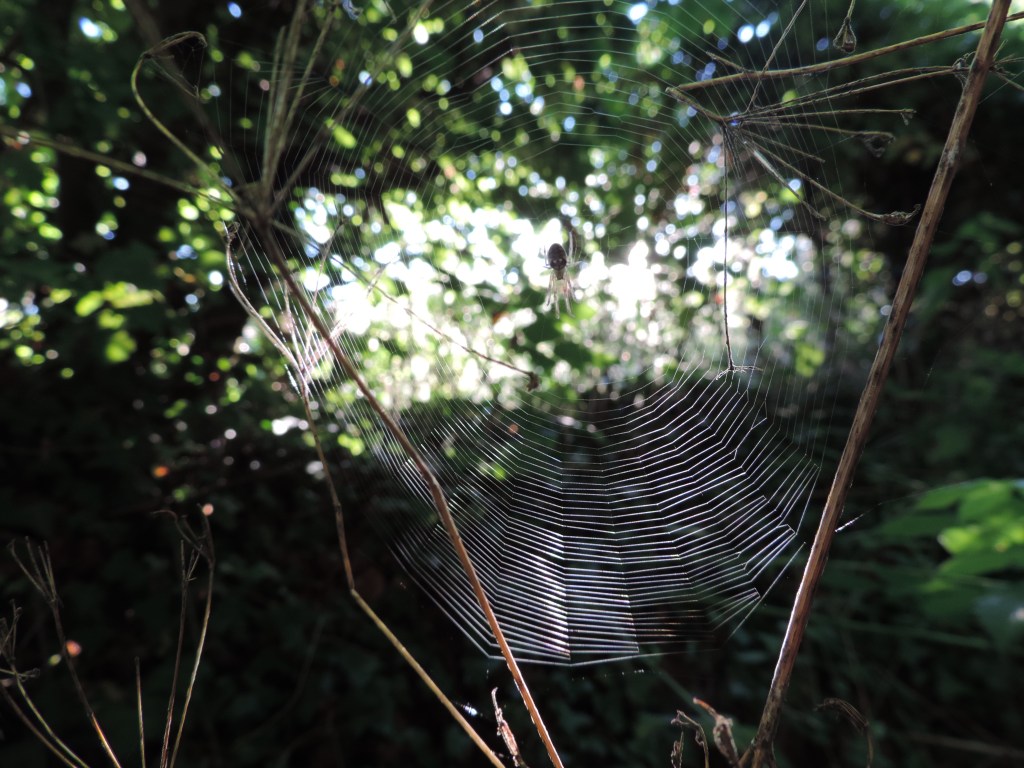
Look closely and you’ll see who has woven this web.

Webs fascinate me. I love when they sparkle when covered in morning dew, and I love when they catch the light this way.

Water and light together make the webs much more visible. I notice that every morning as I walk through the garden spider webs tickle my face and arms, but unless the sun is shining in the right direction I don’t see any webs at all.

When I look at this spider sitting in the middle of her creation I am astonished by her abilities. She inspires me and sets off a train of thought about how we create our own worlds.

Every one of us weaves a web of relationships, experiences, stories, thoughts and feelings around us every moment of every day. We co-create the reality of our daily existence.

Every one of our webs is unique. I hope yours sparkles and gleams today.

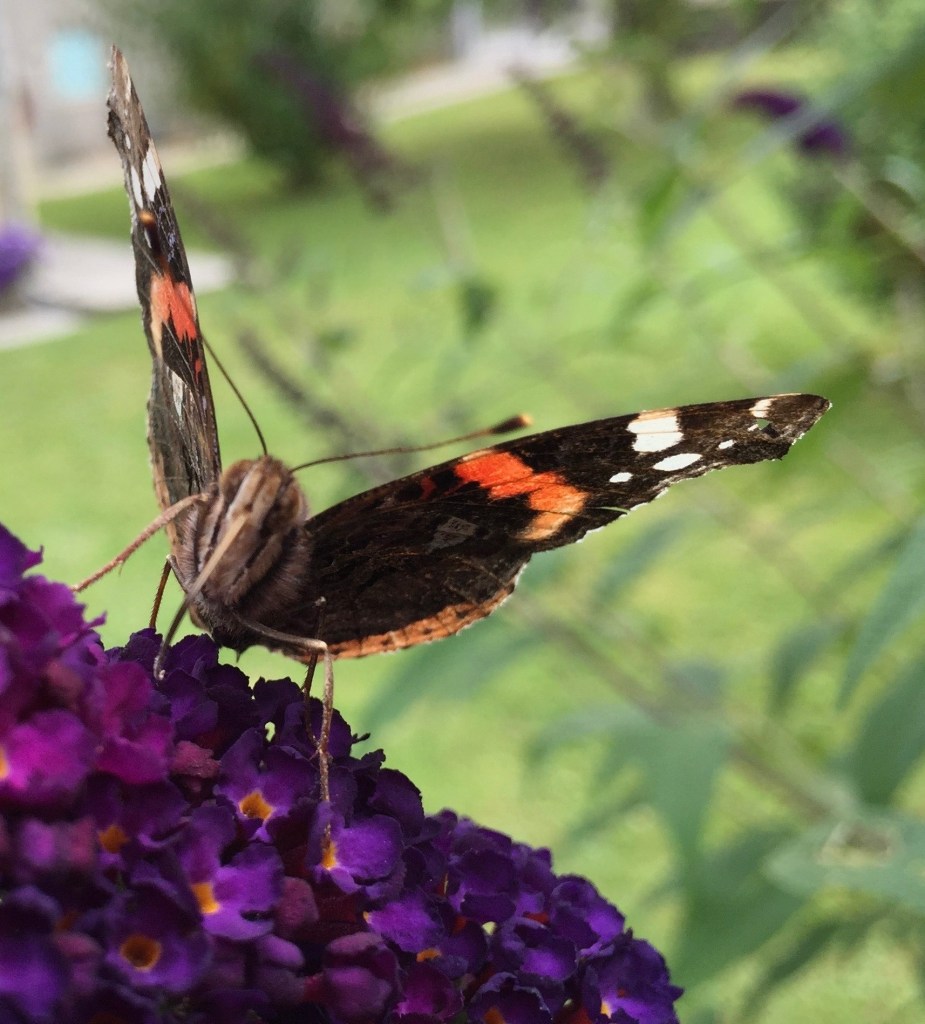
Butterflies amaze me. When I see one flying in the garden I am astonished by their flight. They seem to fly in such irregular, even random, ways. You just can’t tell where they will go next. However they also fly with fantastic accuracy, landing exactly on a particular flower to suck up its nectar. When you see two or more of them flying together they seem to dance around each other at great speed without crashing into each other.

The colours and patterns on their wings are beautiful and I was amazed to read that the colours are created by a sort of prism effect in their structure, not by pigments! At least, if I understand it correctly, that’s true of iridescent ones.

When I get a chance to look at one up close I marvel at the shape and form of them. If you were to try and imagine an alien creature nobody had ever seen before would you come up with something as elaborate or complex as this?

And I can’t see a butterfly without thinking of how radically different it is in each of its life stages. Does anyone understand how it undergoes such profound metamorphoses?

Beautiful and awe inspiring. Such common yet such extraordinary creatures. They delight me and make me so aware of the limits of human knowledge. How little we know about the everyday world we live in.

I took this photo because the shape of that tree is so strange. I’d never seen a tree grow in such a peculiar way. When I looked at the photo later I thought the two trees together looked like a pair of legs. It makes me smile every time I look at it now, imaging I caught an “Ent” running!

I return to this photo again and again. Look at the twists and turns taken by this tree! I wonder what the story is. What happened each time the trunk changed direction. Although it might not be so obvious our lives are like this. Every event we encounter, every experience we have, every choice we make, changes us, takes us off in a particular direction. The twists and turns of our everyday lives give our lives the distinct, unique shapes which develop as we grow.

But this photo makes me think of something else too….the dynamic uncertainty at the core of reality. Everything changes all the time. Living creatures change most of all. The changes are co-created by ourselves and the environments in which we live. And these changes are unpredictable in detail.

The more closely we consider an individual life, the more we understand them, but the more we realise we cannot predict the future.

Who could have described the shape of this tree we see now from its appearance as a young sapling? Who could have known which direction the trunk was going to take at each of those twists and turns?

The bridge

I’m quite a fan of bridges. Many of them are beautiful constructions and I have lots of photos of bridges. I think I like them both as constructions in their own right, and what they facilitate – connections.

When we talk of building bridges between people or communities we are thinking of developing relationships. A bridge functions as a two way connector. It connects one bank of a river to another, an island to the mainland, or even one country to another.

It strikes me we need to do a lot more bridge building in this world. There is so much division. We’ve fractured into multiple groups of “us and them”, on the basis of gender, race, nationality, generation…you name it.

Each of us identifies with others with whom we share certain characteristics, and we gain a strength from that. But we need diversity in nature and in our lives. We need to “integrate” – to form mutually beneficial bonds.

Bridges enable that. Walls and fences separate and divide.

Whilst healthy boundaries and borders are good, we have to be aware of getting trapped into little worlds, narrow worlds, which constrain us and inhibit growth. So, we need the bridges, pathways and gates which let us venture further, to make new friends, discover new ideas, other ways of living.

Here’s to the bridges……let’s build more!

Abundance

One of the commonest forms of seed propagation is wind dispersal. You’ll know it best from dandelions but many plants use this method. I love the beauty of such seed heads. They look so soft and delicate.

When you look closely you see just how abundant they are. I’m sure someone has probably counted the average number of seeds on one stem like this but without taking the time to do that it’s pretty obvious there is an exceptionally large number.

Nature likes abundance. Whether it’s on one seed head or in a forest, a meadow, or in the sea.

I’ve read in several places that this Earth has an abundance of resources available to sustain life, no, not just sustain it, but to enable life to flourish. Yet we humans have created an economic system which seeks to convince us that what we need is scarce. Scarcity is a fundamental tenet of capitalism. And this same economic system encourages ever greater consumption, ever greater production of waste, and calls that “growth”.

We’re going to have to change tack if we want a sustainable way of life. We’re going to have to invent a different economic system. Not one which encourages grabbing and hoarding. Not one which measures success by the amount of resources gobbled up and destroyed.

Can we do that? I believe we can.

There are plenty of economists, scientists, creatives, and thinkers who have got practical ideas to take us forward but we still need more stories based on a vision of a different way of living together on this one little planet.

Have you read any stories, or come across any ideas, which have enabled to, not just to see reality differently, but which have inspired you to see other possible ways of living….personally and/or collectively?

Like this seed head, the more we can develop our potential and spread it far and wide, the more successful we will be at both surviving and flourishing.

I was struck by this passage in Gavin Francis’s “Recovery. The Lost Art of Convalescence”…….

This was my repeated experience both as a GP and as a Specialist at the Glasgow based NHS Centre for Integrative Care. The term “clinical encounter” is a much better one than “consultation” for this kind of experience. I used the term “consultation” a lot throughout my training and as a GP but it became increasingly clear that there was a lot more going on in these “encounters” than the word “consultation” could capture.

On multiple occasions patients told me they’d been able to tell their story for the first time in their lives, that they’d felt well heard and hadn’t been judged. Those encounters frequently led to profound changes in life…..certainly changes for the patients but also for me.

As I witnessed these changes over months and even years I was inspired. Time and again individuals broke through my limits of expectation and time and again I was amazed by and filled with admiration for their ability to recover, for their resilience and for their resurgent vitality.

I learned to expand my expectations. I learned to listen attentively and without judgement. I learned to be fully present. Again and again.

As I think about this passage again, I realise the same principle applies not only in clinical encounters but in every relationship we have.

Every meeting we have, every event we share with others, every conversation and interaction we have changes both of us – me and you. I think that applies when we meet physically but also when we meet “virtually” – through social media, email, or through connected screens.

There is an alchemy in encounter.

Health care

I read Dr Gavin Francis’s “Recovery. The lost art of Convalescence” this week. I really enjoyed it and his approach to General Practice seems absolutely in line with what I was taught and tried to practice. His book is about convalescence as it says in the subtitle. The human capacity to self repair and self heal is at the core of my medical values and I agree with him, it’s a whole area which isn’t taught in medical school and is practiced only rarely.

It takes time to heal but it takes more than time. It takes care, personal support, good food and a good, natural environment.

The old model I grew up with still had convalescent hospitals, but they were already being closed down and sold off for housing developments. The hospitals I worked in still had traces of the “sanitarium” ideas of exposing patients to nature. For example, the respiratory department, which we called “the chest ward” had a covered terrace which enabled patients to spend time in fresh air, even if they were still bed bound.

However, I’m not of the opinion that everything was great in the past. It definitely wasn’t. That said, it seems to me that we’ve gone way too far down a road of “cost effectiveness”, “targets”, and so on which are more appropriate to the running of a factory which manufactures machines than to delivering care which promotes healing.

Gavin Francis mentions that the number of hospital beds in the U.K. has been reduced from 300,000 in the late 80s to 150,000 now. How’s that going?

All this in the face of every increasing numbers of elderly people in society and of people living with several concurrent chronic ailments. The numbers of GP consultations has sky rocketed, as have attendances at Accident and Emergency Departments, ambulance call outs, and hospital admissions.

Those who designed the NHS thought that over time demand would diminish as the health service made people healthier. Trouble is the health service was never designed to make people healthier. It was designed to deal with crises. And it’s done that brilliantly. Emergency care of acute conditions and trauma has developed tremendously in the last fifty years. But emergency care isn’t enough.

The economic and management philosophies which are dominating health care don’t seem able to cope with demand, reduce demand, or enable sufficient numbers of staff enough time and resources to stay healthy themselves while they deliver the best care they can.

All of the recommendations in Gavin’s book are very familiar to me. These are not new solutions, nor are they idealistic. They are achievable and reasonable but we need to shift the thinking from reductionist, mechanistic ones, to genuinely human centred holistic ones.

We won’t create healthier populations through health services but by addressing poverty, inadequate housing, job insecurity, inequality, poor nutrition, climate change, biodiversity loss and pollution.

We need the wisdom shared in “Recovery”, and we need to implement it. Maybe we should recommend it to health service managers and policy makers.