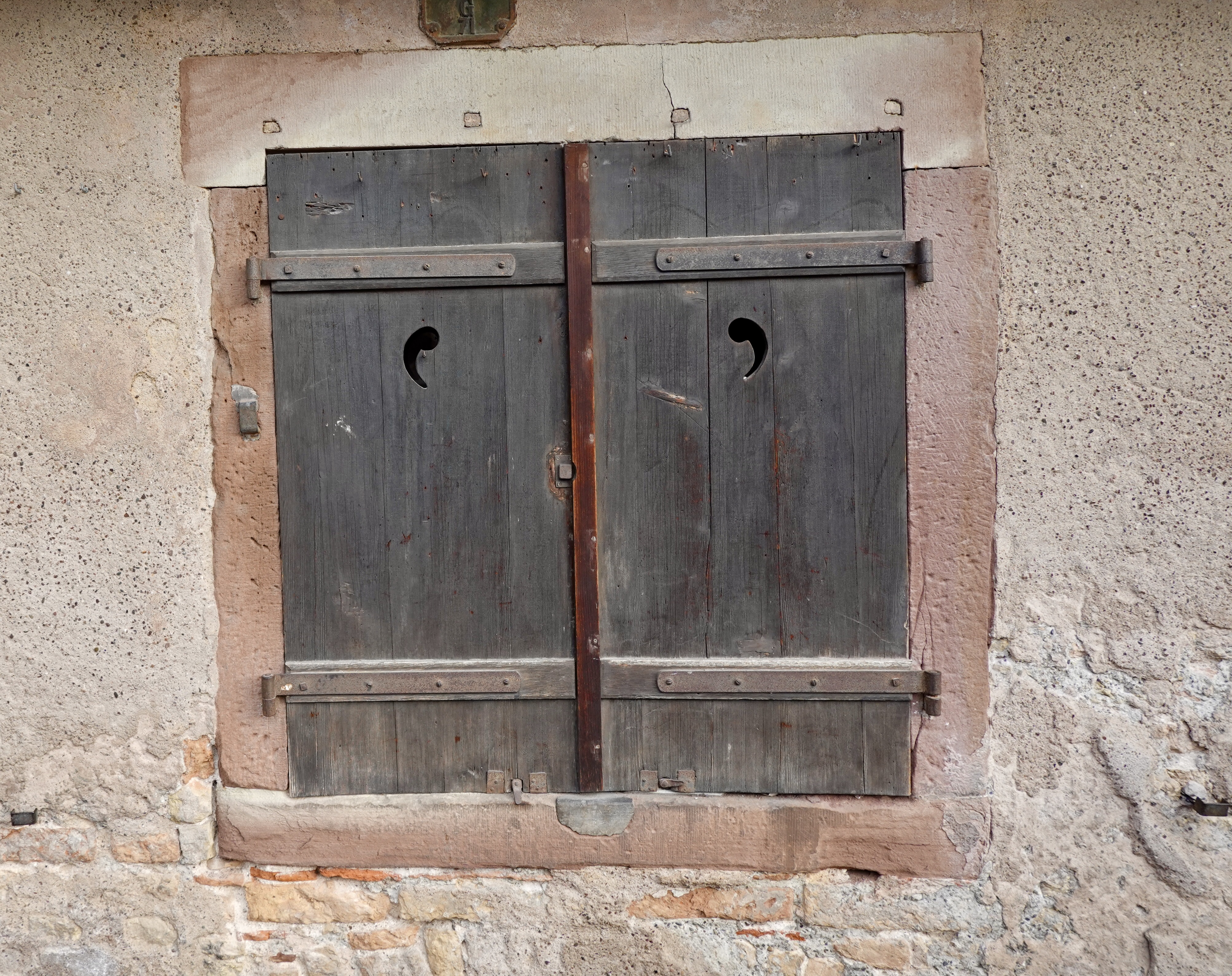
You could argue that these little “commas” cut out of the shutters covering this window are to let some light in. But if you wanted to let light into the room, you’d open the shutters, wouldn’t you? But maybe you just want some light in, not much. So why cut the holes into these carefully crafted shapes? Or maybe we need to think of this from the other side. Maybe these are holes to look out through….viewing points to see a bit of the world outside. But there again, why make them this shape? You know what? Maybe they aren’t carved for a utilitarian function. Maybe they are neither for letting in light, nor for facilitating observations of the street outside.
Maybe the creator just wanted to make something beautiful. Because they are beautiful, aren’t they? And without them, the shutters would look pretty, well, uninteresting. It’s the comma-shaped holes which have caught my attention, made me pause, take a photo, and return to it again to wonder……what are these all about? Who made them? Questions to which I’ll never find the answers. But, this much is sure…..they bring me a moment of delight and wonder…..”l’emerveillement du quotidien“.
I’ve looked at these shutters several times now, spent some time with them, reflecting, and wondering. But this morning, something else comes up – don’t they suggest a word? If you look at them, there is one on the left, a space, then another on the right, and if you saw them on a page like that, you’d assume that in that space there should be a word. Wouldn’t you? A word. Or a quotation.
So, here’s something to play with today…….what word, or what words, would write in this particular space?
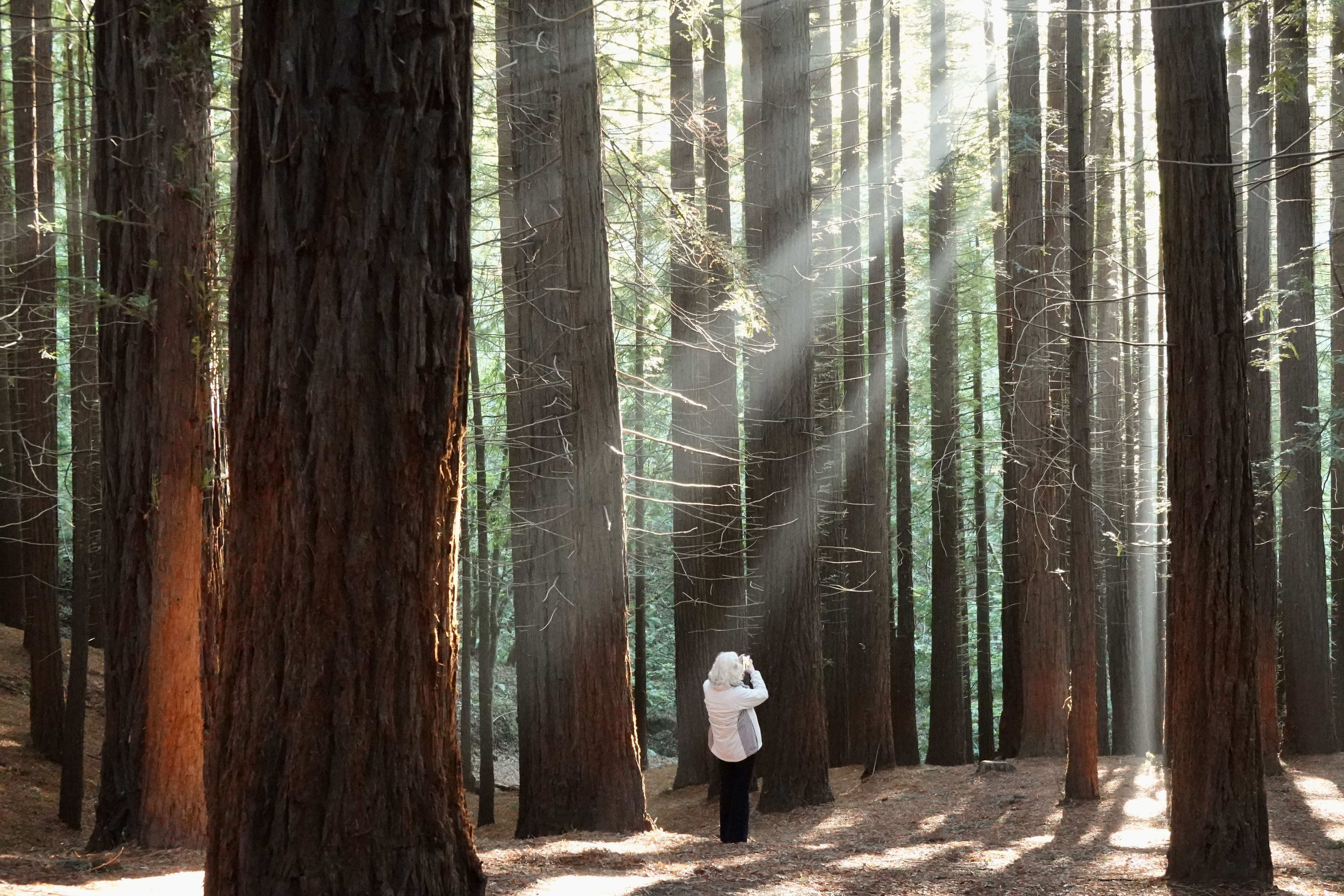
We made a visit to a sequoia forest in Catalonia recently and this is one of the many photographs I took. When I look at it now a passage from C S Lewis comes to mind. It’s many, many years since I read his little essay, “Meditation in a Toolshed”, but I’ve never forgotten it. It’s pretty easy to find online if you search for it. It starts like this –
I was standing today in the dark toolshed. The sun was shining outside and through the crack at the top of the door there came a sunbeam. From where I stood that beam of light, with the specks of dust floating in it, was the most striking thing in the place. Everything else was almost pitch-black. I was seeing the beam, not seeing things by it. Then I moved, so that the beam fell on my eyes. Instantly the whole previous picture vanished. I saw no toolshed, and (above all) no beam. Instead I saw, framed in the irregular cranny at the top of the door, green leaves moving on the branches of a tree outside and beyond that, 90 odd million miles away, the sun. Looking along the beam, and looking at the beam are very different experiences.
He goes on to describe several examples of the difference between “looking at” and “looking along”, where he juxtaposes the “objective” vs the “subjective” (although he doesn’t use those terms), the “quantitative” vs the “qualitative”….and issue which has been at the heart of my career and my life. He summarises his idea with this –
We must, on pain of idiocy, deny from the very outset the idea that looking at is, by its own nature, intrinsically truer or better than looking along. One must look both along and at everything. In particular cases we shall find reason for regarding the one or the other vision as inferior.
Most of the essay is about how we seem to have developed a habit of favouring the objective over the subjective to the point where the latter is dismissed as irrelevant, or even, unreal. I’ve heard a junior doctor say that his mentor told him “You can never believe patients. They lie all the time. You can only believe the results (the laboratory findings)”, and time and again, in neuroscience, our inner thoughts, sensations and feelings are reduced to biochemical reactions and neural pathways….as if the MRI scans and biochemistry reveals “the truth”, whereas the patient’s reported experience is dismissed as “anecdote”, or, worse, “illusion”.
As I look at this photo I see my wife, Hilary, standing in a sunbeam in the middle of the forest. I am “looking at” her in the forest. She is “looking along” the sunbeam and photographing the illuminated trees. And I know in that moment that these are two different representations of reality. Both are true. But there’s more – because as I am “looking at” this scene in the forest, I recall, and re-create, the experience I had of standing in the forest surrounded by the massive trees. I feel again the awe which I felt as the sunbeams shone through to the forest floor. I feel again the wonder I had standing amidst this community of trees (which, by the way, were planted only about seven years before I was born!)
We can understand a lot by measuring, by being objective. But we fail to grasp reality if we dismiss both the inner experience of others, and our own subjective one.
That means we need to value personal stories. We need to be curious about them, to respect them and to listen with non-judgemental empathy. Otherwise, we are only scratching a surface. Worse than that, we are in danger of replacing an understanding of what it is to be human, with a distorted and demeaned mechanistic one.
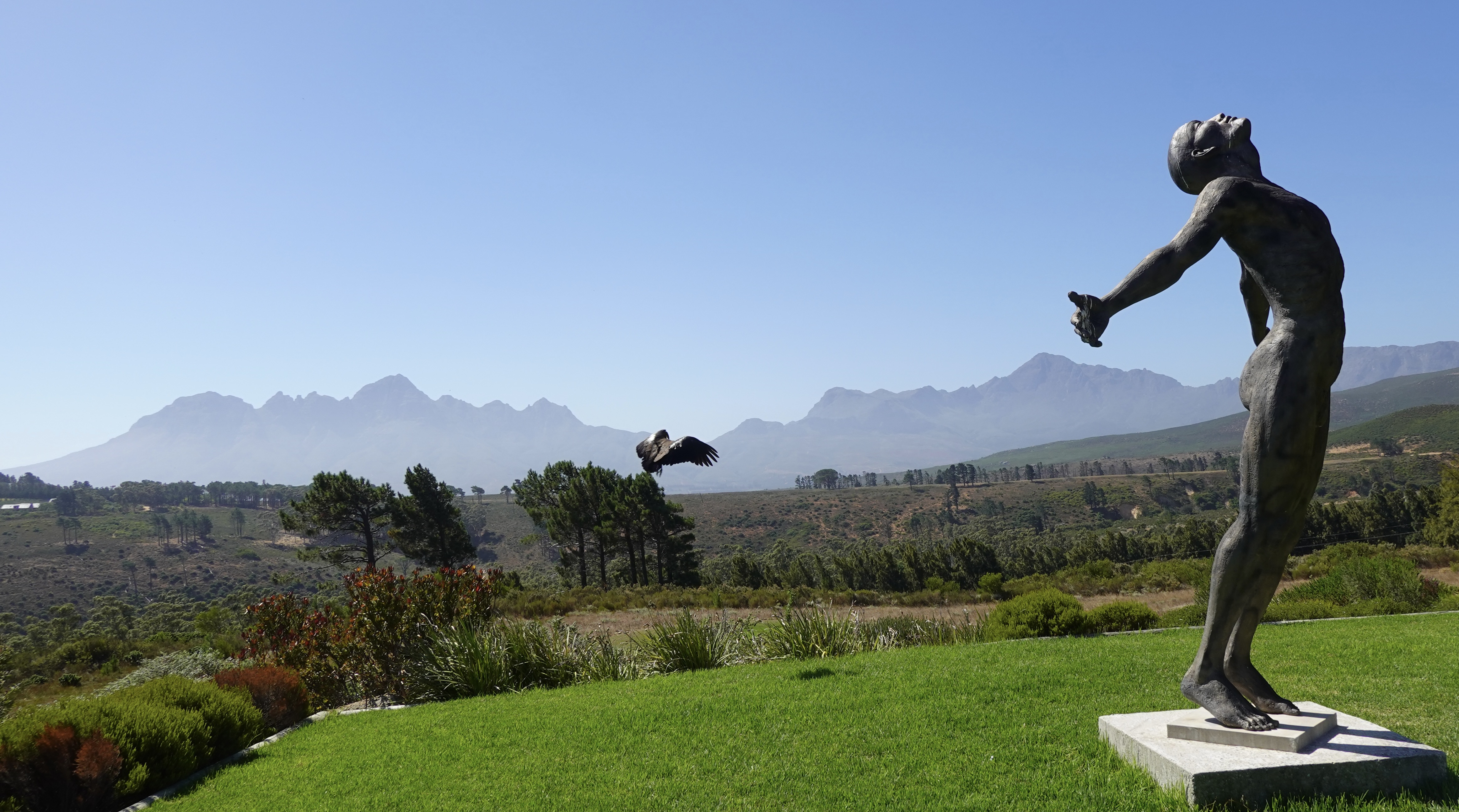
It’s not uncommon for human beings to want to fly. I know we’ve partially met that desire through technology by inventing machines which can fly, but we can’t fly the way a bird can fly. We can’t just leap up and head off into the blue mountains. We can’t soar above the forests and the oceans. But we imagine it would be pretty great if we could.
I think flying like a bird represents freedom for us. It’s a freedom of movement which lies only in our imagination.
Of course, we say “flights of imagination”, or “flights of fancy” too, don’t we? Because our imagination has less boundaries than our bodies do. There’s that additional element to flight – not just a freedom of movement, but an ability to go beyond limits, beyond invisible borders created by people to keep other people away, or to attempt to control human beings, preventing them from doing what humans have always done – move freely across the face of the Earth, or at least, dream of moving freely. Don’t we also talk about “spreading his wings” when we want to say someone is developing, growing, expanding their horizons?
The posture of this sculpture is one we all recognise. When we want to feel a sense of freedom, we stretch out our arms, opening ourselves wide to the world. But we can’t take off, the way the bird is taking off.
Have you ever wondered why angels have wings? As far as I know, nobody imagines angels as having scales, fins or a tail. Even though fish have a freedom of the oceans just as great as the freedom of the skies enjoyed by birds, we don’t really say “I’d like to be as free as a fish”. We say “I’d like to be as free as a bird”.
I really enjoy the sights and sounds of the birds when I’m in my garden. I saw the little redstart yesterday. He’s just arrived back from his winter travels, and I also heard a hoopoe calling all day long. And the Celandine has flowered in the garden, it bright yellow petals telling me it’s time for the swallows to arrive. (I’ve only seen one so far)
Birds connect us with greater dimensions of nature. They connect us to the rhythm of the seasons. They remind us, with their migratory patterns, that Life inhabits this whole planet. But I think they also connect us to what is more than merely material in this world. They connect us to a sense of spirit, to something “higher” or “greater” than us. They inspire us, and awaken a sense of wonder and amazement, don’t you think?
The Seasons of the Soul: The Poetic Guidance and Spiritual Wisdom of Herman Hesse [ISBN 978-1583943137] – one of the most pleasurable, delightful, stimulating and enjoyable books I’ve ever read. It’s years, no decades, since I read Herman Hesse’s books, but this beautiful collection of poems, with enlightening and inspiring introductions by the translator, Ludwig Max Fischer has reignited my passion for his writing.
Here’s what Ludwig Max Fischer says about Hesse’s work
His gentle voice, full of truth, reminds us of the greater dimensions, the larger forces acting in our lives, beyond the immediate dramas of fear and desire. The soul, love, inspiration, the mysteries of nature, the unknowable divine, time and the stages of life are the major agents in Hesse’s world and are as relevant today as when he distilled them from his life experience.
and in Hesse’s own words –
My only goal in life is to be able to love this world, to se it and myself and all beings with the eyes of love and admiration and reverence….
and
It is a mysterious and yet simple secret known to the sages of all ages: the most minute act of selfless devotion, every act of compassion given in love makes us richer, whereas every effort towards possession and power weakens our strength and makes us poorer.
There’s a lot more like that in this book, and many inspiring poems too. I’ll give you one extract which strikes me as very relevant this Spring day. This is from his poem, Bursting With Blossoms –
Ideas too break open like buds of blossoms
at least a hundred every day
Let them unfold and roam as they wish!
Don’t ask for rewards!
There must be time for play and innocence in life
and room for boundless blossom.
Yesterday was the annual celebration of the birth of Robert Burns. As a Scot I’m pretty familiar with some of his poems but last night the last verse of one his most famous poems suddenly struck me.
In his “To a Mouse”, the last verse reads…
Still thou are blest, compar’d wi’ me
The present only toucheth thee:
But, Och! I backward cast my e’e
On prospects drear!
An’ forward, tho’ I canna see
I guess an’ fear!
Burns wrote this poem in response to accidently destroying a mouse’s nest whilst ploughing a field. In this last verse he recognises the difference between human beings and other creatures in terms of mental processes. The mouse can only focus on the present. It deals with life in the here and now. Human beings on the other hand have the continuous tendency to think back to the past, reflecting on hardships, hurts and grievances, or to cast their minds forward into the imaginary future where they worry about all sorts of things that might befall them.
This isn’t a new idea of course, and Tolle has reinforced the concept in his “Power of Now”, but I think this is beautiful, compassionate, wise writing. He doesn’t preach. He doesn’t advise. He just states it as it is.
Our so human tendency to hang on to the past, and frighten ourselves with imaginary futures, robs us of the capacity other creatures have to be continually present in the here and now.
Over the holidays I’ve been catching up on some of the TV programmes I’ve recorded on my hard drive and watched a spectacularly wonderful one about Norman MacCaig. There were many highlights for me, but the two which really stuck were his description of a friend as someone who showed him
the usualness of the extraordinary, or the extraordinariness of the usual
and a recitation of his poem, Small Boy
He picked up a pebble
and threw it into the sea.
And another, and another.
He couldn’t stop.
He wasn’t trying to fill the sea.
He wasn’t trying to empty the beach.
He was just throwing away,
nothing else but.
Like a kitten playing
he was practicing for the future
when there’ll be so many things
he’ll want to throw away
if only his fingers will unclench
and let them go.
I looked out the window this morning and saw this. And outside the temperature of the air has taken a dip – 7 degrees C it said on the car dashboard. I’m guessing Autumn’s arrived. It’s funny but years and years after I was taught poetry lessons at school I still can’t see a scene like this without hearing in my head –
Season of mists and mellow fruitfulness,
Close bosom-friend of the maturing sun;
Here’s the whole poem –
Keats. To Autumn

Season of mists and mellow fruitfulness,
      Close bosom-friend of the maturing sun;
Conspiring with him how to load and bless
   With fruit the vines that round the thatch-eves run;
To bend with apples the moss'd cottage-trees,
   And fill all fruit with ripeness to the core;
      To swell the gourd, and plump the hazel shells
   With a sweet kernel; to set budding more,
And still more, later flowers for the bees,
Until they think warm days will never cease,
      For Summer has o'er-brimm'd their clammy cells.

II

Who hath not seen thee oft amid thy store?
   Sometimes whoever seeks abroad may find
Thee sitting careless on a granary floor,
   Thy hair soft-lifted by the winnowing wind;
Or on a half-reap'd furrow sound asleep,
   Drows'd with the fume of poppies, while thy hook
      Spares the next swath and all its twined flowers:
And sometimes like a gleaner thou dost keep
   Steady thy laden head across a brook;
   Or by a cyder-press, with patient look,
   Thou watchest the last oozings hours by hours.

III

Where are the songs of Spring? Ay, where are they?
   Think not of them, thou hast thy music too, -
While barred clouds bloom the soft-dying day,
   And touch the stubble plains with rosy hue;
   Then in a wailful choir the small gnats mourn
   Among the river sallows, borne aloft
      Or sinking as the light wind lives or dies;
And full-grown lambs loud bleat from hilly bourn;
   Hedge-crickets sing; and now with treble soft
      The red-breast whistles from a garden-croft;

      And gathering swallows twitter in the skies.
Funny how the swallows were twittering hundreds of years before people started doing it!
I think poets have not only the keenest powers of observation but their words illuminate. The world looks different after reading poetry. I’m not referring to particular passages which have changed my perception or understanding of particular places or experiences. I’m referring to, well, what would you call it? The poetic stance? The poetic viewpoint? The poetic way of living maybe……
When I was a teenager (a LONG time ago) I bought a little book by the poet Stephen Spender. It was called “Life And the Poet”. It was a small paperback with a darkly yellowed cover. It was published in 1942 apparently. I’m sure I must have it somewhere but I can’t lay my hands on it right now and it’s almost 40 years since I opened it and read any of it. But I seem to remember two things he said. One was that he said poets should be like visitors from another planet. It was his way of saying a poet should approach the world with wonder and amazement (a bit like those French philosophers I read recently). I liked that a lot. It stuck. And he also said, I think (bare with me, this memory is a long way off!), that poetry taught us how to “make life anew” and that was a reason to live. That stuck too. (or maybe I’ve invented that for myself after all these years……I’ll need to find my old copy, or another one, and read it again)
As I browsed the shelves my eye was caught by a book entitled “Findings” by Kathleen Jamie (ISBN 978-0-954-22174-4). Never heard of the book before, and I’d never heard of the author either, but the back cover described her as an “award winning poet” who has an “eye and an ease with the nature and landscapes of Scotland”. I opened the book and the paper under my fingers made me stop and wonder. It felt lovely. A soft roughness if you can imagine such a thing. Immediately it felt natural, and special, and thrillingly sensuous. This feels like a lovely book, I thought. Now that doesn’t happen often. I can enjoy the weight, the feel, the scent of a real book (no, computers will never replace the book), but I can’t remember when I ever before picked up an unknown book like this and felt transfixed. It caught me. Physically. So I sat down in one of the many comfy, leather armchairs and I started to read. Did I have any doubts? From the moment I held it in my hand, did I have any sense that I’d put it back on the shelf? I don’t think so. I think I knew I’d relish, yes, that’s the right word, relish this book. I bought it of course.
It’s not a book of poetry, but a book of essays – a poet’s living.
Some of the subjects she writes about are familiar to me. Orkney, salmon ladders, prehistoric stone markings, the Surgeons’ Hall in Edinburgh and the Edinburgh skyline. But even the familiar seemed brand new in her eyes, in her words. She’s a keen observer of nature, especially birds, and in the essay entitled, “Peregrines, Ospreys, Cranes” she writes this…..
This is what I want to learn: to notice, but not to analyse. To still the part of the brain that’s yammering, “My God, what’s that? A stork, a crane, an ibis? – don’t be silly, its just a weird heron”. Sometimes we have to hush the frantic inner voice that says “Don’t be stupid” and learn again to look, to listen. You can do the organising and redrafting, the diagnosing and identifying later, but right now, just be open to it, see how it’s tilting nervously into the wind, try to see the colour, the unchancy shape – hold it in your head, bring it home intact.
That’s what I want to learn too – to notice, to look, to listen, without processing it all, but taking the experiences home and turning them over later. My camera helps me do that, but Kathleen Jamie’s words inspire me to write more down, to write it down as soon as possible……not the analysis, the experience, the perception, the observation. To relish the “emerveillement” of living.
I welcome constructive criticism and suggestions. I will not, however, tolerate abuse, rudeness or negativity, whether it is directed at me or other people. It has no place here. ANYONE making nasty comments will be banned.


 Heroes Not Zombies