Feeds:
Posts
Comments

Posts Tagged ‘science’

I read, recently, about “LUCA”, from whom, every single one of us is descended. In fact, not just every single one of we humans, but every single living creature. 

Isn’t that amazing? Yet, at some level, kind of obvious? 

We humans have a tendency to think that we somehow parachuted onto this little planet, just appearing from nowhere, with no history prior to our arrival. This kind of thinking leads us to consider that, on Earth, there is Nature, and there are humans. It’s almost as if Nature is something separate from ourselves, either a place we go and visit on our holidays, or the less important than us part of the world. 

But these two beliefs are delusions. 

We evolved on this planet, along with every other living creature, past and present. The history of our “arrival” isn’t sudden, but it isn’t disconnected from the rest of existence either. 

Advances in molecular genetics have revealed that all living things on Earth are descended from a single organism dubbed the last universal common ancestor, or LUCA, which emerged around 4 billion years ago. We also know that our planet is approximately 4.5 billion years old. During those first half a billion years, simple, then more complicated, organic molecules were spontaneously synthesised and assembled in larger complexes, eventually evolving into the primitive, single-celled LUCA. How did that happen? We really don’t know. But, then, we don’t really know what “life” is either, do we? We can’t even tell if a seed is dead or alive until it starts to change (or doesn’t). 

There are many, many “creation myths” around the world. Every culture seems to have its own. Over the last hundred years or so we’ve been introduced to new ways of thinking about who we are, and where we came from. Yet even with evolutionary thinking we have a tendency to think of ourselves as different and separate. We present Homo Sapiens as the most highly developed form of life on the planet, and we don’t really consider how we might evolve in the future. We tend to think that evolution led to the creation of we humans, and then it stopped. It somehow reached its goal. And we give less consideration to what we share with the rest of the planet. 

But, in fact, we came from somewhere, as did every other life form on our shared planet. Our ability to understand the molecules which exist inside our cells, and the discovery of how so many of the exact same molecules exist in other creatures, has opened the door to a different understanding. 

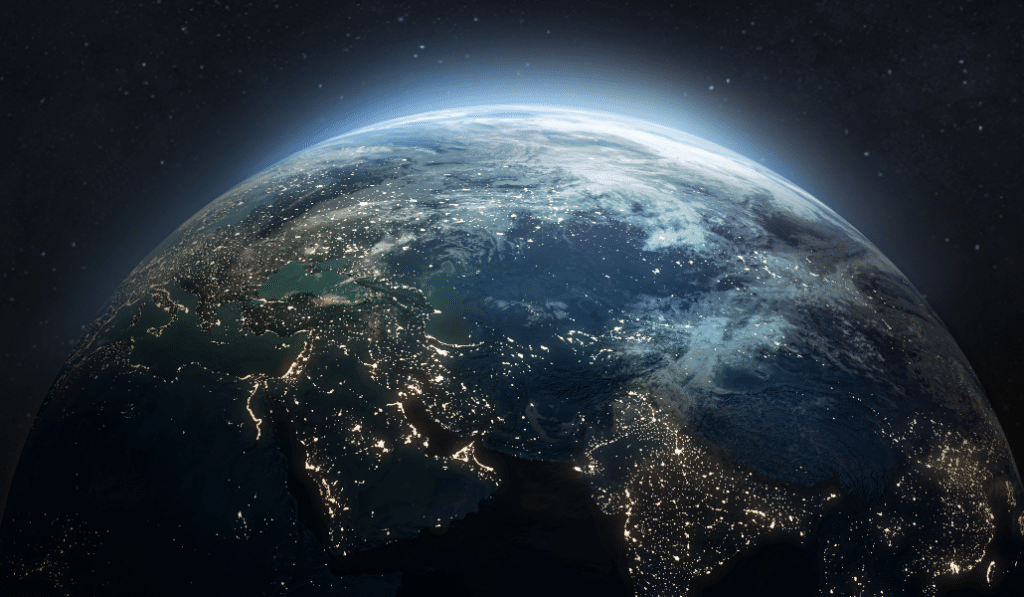
LUCA is our shared common origin, and as we begin to trace LUCA’s evolution into the abundantly diverse forms of life which we have discovered so far, we come to understand ourselves as embedded, inextricably in a web of Life on this planet we call Earth. This little blue marble where LUCA came into existence, and gave birth to us all. 

We are not disconnected. Neither from all the other living creatures, nor from each other. We share this planet. We share the same air, the same water, the same soil. We depend on each other. Despite the delusion of hyper-individualism, none of us can exist without creating mutually beneficial relationships with others, with our other common descendants. 

What kind of future could there be for us, for our children and grandchildren, if we all took that shared reality on board and put collaboration ahead of competition? If we began to rate mutual benefit over self-centred greed? If we put more energy and attention into the creation, and maintenance, of the healthy environments in which all of LUCA’s descendants can thrive? 
Read Full Post »

A recent book review in New Scientist opened my eyes to something completely new to me – microchimerics. I’m pretty sure I’ve never come across the word before. Here’s the introductory paragraph of the review, which, I believe, captures the essence of the book –

“We now know that during pregnancy, fetal cells cross the placenta into the mother, embedding themselves in every organ yet studied. Likewise, maternal cells, and even those that crossed from my mum to me, can make their way into my kids. And things might get even more chimeric – I have older sisters, so their cells, having passed into my mum during their own gestation, might have then found their way into me and, in turn, into my kids. This fascinating idea – that we are a holobiont, composed not only of human cells and microbes but also fragments of others – and its implications sit at the heart of Hidden Guests: Migrating cells and how the new science of microchimerism is redefining human identity by Lise Barnéoud.”

I’ve long been aware of the discoveries of Lynn Margulis, who back in the 1960s published “On the origin of mitosing cells”, from which she developed the theory that the component parts of our cells evolved from separate unicellular life forms collaborating and incorporating – in other word, “symbiosis”. We humans are perhaps the most complex of all multicellular organisms ever discovered, and, it seems, multicellular organisms evolved by separate, unicellular ones co-operating and collaborating. 

I was taught in Medical School, that each of us is composed of many more cells which aren’t of “human origin”, than we are of our “own” family ones. Whole communities of micro-organisms live on and inside our bodies. We’ve come to think of these communities are “biomes”, and the gut biome in particular has been shown to be crucially important in everything from our immune defences, to our emotions and, even, cognition. Quite simply, we couldn’t live without them. 

Another thing I was taught in Medical School was that all of our cells die off and are replaced, so that many times over the course of the average lifetime, we find ourselves with a complete set of cells which we didn’t have when we were younger. In many ways it’s best to think of ourselves, not as discrete, separate, fixed entities, but rather as flows – flows of cells, of chemicals, of substances, energies and information. 

So, at a biological level, we do indeed “contain multitudes”, as Whitman wrote so beautifully in his poem, “Song of Myself”. 

These latest findings about microchimeric cells are only the latest discovery into this reality….we aren’t just creatures with many facets, or features, we are creatures containing multitudes. 

All of this resonates with Miller Mair’s theory of mind which I’ve long found convincing – “instead of viewing any particular person as an individual unit, I would like you to entertain, for the time being, the ‘mistaken’ view of any person as if he or she were a ‘community of selves.’ I found this metaphor, of a community of selves, rather than a single self, to be incredibly useful in understanding both my patients and myself. It is the psychological equivalent of the biological one of “biomes”.

The “community of selves” idea came back to my mind recently when I read a post on social media where the writer said that when their father died, they lost not just him, but a part of themselves. I hadn’t really thought about that before, but it strikes me as very true. Because each of these “selves” which we experience arises within particular relationships, and we can become aware of how certain selves are only present within those particular relationships. Miller Mair describes how some of the “selves” in our “community” are short lived, whereas others persist and become more integral, or core, to who we are. I’m sure that’s the case with those who we love most, those about whom we care the most. So, there is, indeed, a part of ourselves which will be diminished, or even lost, when a loved one dies. 

I don’t know if you’ve ever encountered the story of the “air telephone” in the garden of a survivor of the 2011 earthquake and tsunami in Japan. It’s an incredibly moving story. You can read it here – https://observer.co.uk/style/how-we-live/article/wind-phone-japan-grief and it’s beautifully told in the “This American Life” podcast in this episode – https://www.thisamericanlife.org/597/one-last-thing-before-i-go-2016

The telephone box, containing a telephone which wasn’t connected to anything, became a place to grieve, by allowing survivors to spend some time speaking to their dead loved ones. This story came back to my mind the other day when I was watching the final scene of the final episode of DCI Banks, where the detective builds a small cairn up on a hill, as a place to go where he could speak to his dead loved one. 

Culturally, we’ve shifted away from graveyards filled with the headstones of those who have passed, to cremations, with the remains scattered in places of meaning, or, sometimes, behind a plaque, but, whatever we do, we need to find the special places to connect, to share some time and space, not just to mourn, but to keep alive the unique parts of our selves which those loved ones created with us. 

We do, indeed, contain multitudes. In so many ways. We are woven from such complex threads of DNA, of cells, of families, societies and cultures. We are not separate, and we are not alone. 

Read Full Post »

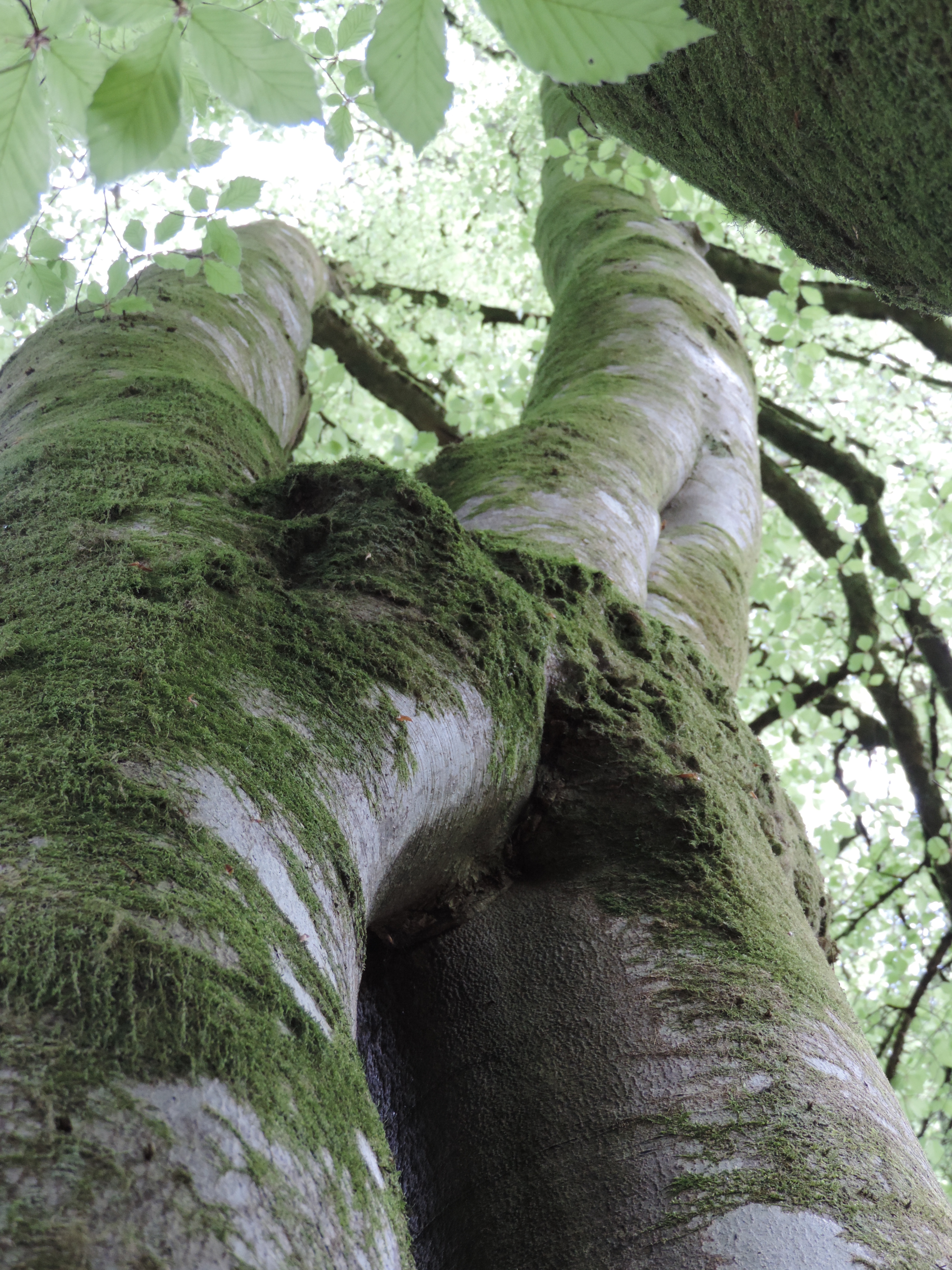
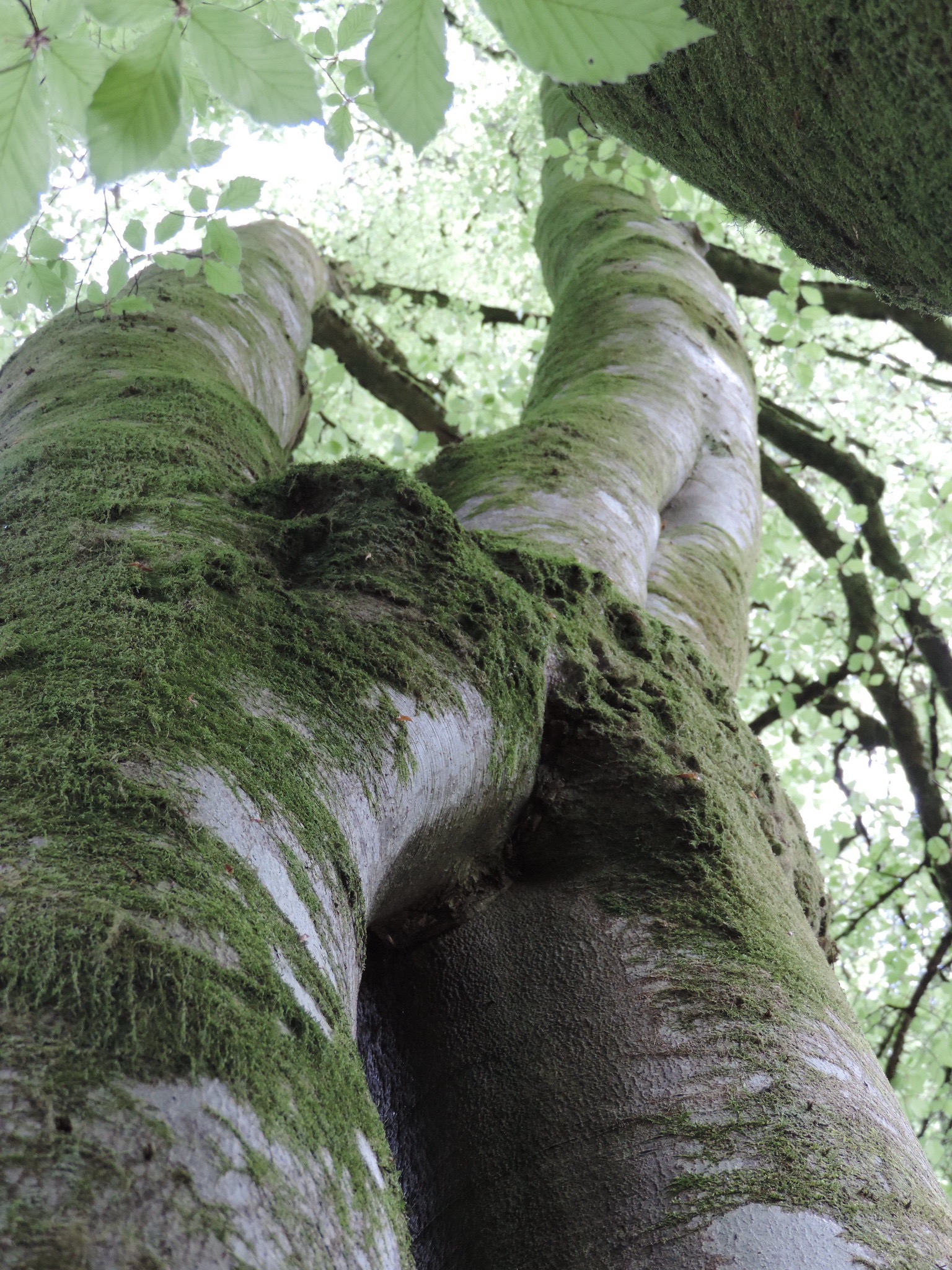
This is one of the most extraordinary trees I’ve encountered. The one on the left seems to have reached out to the one on the right, then the two trees have merged to continue upwards together as one trunk. I don’t know how they did this. It’s like grafting but as best I can tell this wasn’t a forest where there was active grafting happening. I’m pretty sure they’ve managed this all by themselves.

This image is one of my favourites and it always makes me think about the importance of connections. There really isn’t any species of life where each organism exists all by itself, disconnected, as it were, from its fellows, from other creatures, and from its environment. We can only imagine that an organism could exist completely separately if we think of it as a fixed, bounded object. But, in reality, there are no fixed, bounded objects.

As we zoom in and in to look deeper and deeper into any organism, or so-called “object”, we get down to the atoms we all learned about at school. But twentieth century physics has enabled us to look inside those, previously imagined, “fixed” objects, and we’ve discovered that there is no final, fixed material in there. Rather, even atoms are interactions between flows of energy and information, sparkling briefly in and out of existence. They aren’t fixed. They aren’t separate.

Human beings have evolved to have the longest period of dependency for their young. It takes years and years for babies to learn enough to be able to survive….I was going to say, “by themselves”, but, actually we never live “by ourselves”……..independently. So we have evolved superbly social capabilities. It has been argued that we are, in fact, THE most social of all animals.

Yet we swallow the myth of the “Self made man”, of the “hero”, or “genius”, who has somehow come to be all by themselves, without the help and support over their years, of others. It’s a nonsense. The narcissistic, massively egotistical politicians we see today are totally deluded. They only have what they have because of others, because of their connections. Same goes for the tech billionaires. They didn’t create money from nowhere, they grabbed it from others. They didn’t invent and build the technologies they own all by themselves, they profited from the skills and work of many others.

Maybe we need to follow connections a bit more carefully in order to realise just how co-dependent everyone really is.

Finally, let me zoom out a bit and consider nation states. These are inventions. They didn’t drop down onto Earth from the sky, fully formed. Some human beings, some time in the past, staked out the borders and said everything inside these lines is “mine” or “ours”, then fought off any attempts by their neighbours to live on any of that land. Those borders around the nation states are way more permeable than the politicians would like you to believe. The entire planet has one water cycle. You can’t keep separate what flows into one ocean from another. You can’t keep what flows into an ocean separate from the sky, the rivers and the lakes. Same with air. We have one atmosphere around the entire planet. You can’t stop radiation from a disaster like Chernobyl or Three Mile Island spreading freely across “borders”. Same goes for most species in the world – for bacteria, viruses (remember Covid??), insects, birds, plants and many mammals. As each species is lost through loss of habitats, connections are broken, and we are all diminished. We humans are one species. It doesn’t matter which part of the map someone has drawn is where we were born, or where we live now. Our fellow humans aren’t only those in our village, our city, or even our nation state. We are inextricably connected to them all. We are inextricably connected to the entire planet.

Read Full Post »

In his “A Sand County Almanac”, Aldo Leopold writes…..

The last word in ignorance is the man who says of an animal or plant: “What good is it?” If the land mechanism as a whole is good, then every part is good, whether we understand it or not. If the biota, in the course of aeons, has built something we like but do not understand, then who but a fool would discard seemingly useless parts? To keep every cog and wheel is the first precaution of intelligent tinkering.

Now, this language, from the late 1940s is too mechanical for my liking, but, actually it’s still not uncommon today. We humans are not machines. Plants are not machines. No living organism on the planet is “machine-like”. As a result of the dominance of left hemisphere thinking, reductionism, for all its results and benefits, has blinded us to reality.

A human being cannot be reduced, cannot be broken into separate, isolated parts, without, at best, ignoring the consequences of changes in the whole body which come about from changes in a part, and, at worst, without killing the individual human being. Reductionism can only ever be a stage on a journey towards an understanding. The reductionist work of the left hemisphere needs to be integrated back into the holistic perspective of the right in order to understand the connections and consequences.

The same can be said of any living form. There isn’t a plant, an animal, or any other living creature which can be fully understood except by exploring their relationships and connections with the world in which they live.

One of the most unfortunate consequences of reductionism (I don’t know if it results from it, or simply accompanies it), is a focus on utility. What use is this? What use is this plant? What use is this creature? What use is this person? Utility can, or should, only be considered as one aspect, one perspective. We know this instinctively, don’t we? We wouldn’t reduce a loved one to an assessment of their “usefulness”, unless we were suffering from some kind of psychopathy. So why do we allow that to happen when we create businesses and factories? Industrial capitalism has a tendency to reduce human beings to “human capital”, or “Human Resources”, to be weighed, assessed, and judged, only on the criteria of utility. If they aren’t useful towards to the goal of increasing profits, then they are “useless”. A sad, miserable way to view the world.

What’s the utility of music? What’s the utility of art? Of gardens, of beauty, of poetry, of stories? What’s the utility of love, compassion and care? What’s the utility of joy, of wonder, awe and happiness?

Do people think that way?

Actually, it’s not uncommon to find that they do. Have you read anything that tells you about how gardening is “therapeutic”, of how music can improve “your mental health”, of how sharing a meal with a loved one can be “good for your health”?

The thing is, a good life, a life worth living, is full of activities and experiences which we pursue, not for their utility but for joy, for love, and because they touch our souls. Don’t wait for “science” to “prove” that music is beneficial to your neurones, to your immune system, or your hormones. Don’t wait for “science” to “prove” that a walk in the forest modulates your immune system, or stimulates your vagus nerve. Live for the everyday moments of wonder, joy, love and delight. One day, “science” will catch up, and tell you what you already know…..music, nature, poetry, caring relationships, love, wonder and joy are all “good for you”.

Read Full Post »

The dominant narrative in our current industrialised society is competition. It’s held up as the key success factor in capitalism, in business, and even, often citing Darwin, in evolution. It’s presented as the main way in which we humans have improved ourselves, succeeding over other species, beating each other to the top. It’s presented as the way to power and wealth. The key to success and happiness.

There is no denying that competition exists, and that its greatest worth is how it pushes people to improve. Sport is all about competition. It’s exciting and it drives human performance constantly to do better than has ever been achieved before.

Clearly, competition has its place.

But putting front and centre of the whole of life seems seriously misguided to me. Throughout history it has brought war, violence, exploitation, abuse and corruption. Because it all depends what you are competing for. If it’s more power and wealth, it too often results in division, xenophobia, racism, selfishness and cruelty. If you’re competing to improve, to achieve your best self, to create the best, fairest, healthiest society, maybe it’ll help.

I worked all my life as a doctor, so my area of knowledge and skill is what makes human beings thrive. If you consider the human body you can see that it contains billions of cells. Billions. Many of those cells grow together to form body organs, like the heart, the lungs, the liver and kidneys. Many grow together to form tissues, like bone, ligaments, skin. Other grow together to form systems of chemicals and cells, like the immune system and the endocrine system. Are all these cells, all these organs, all these tissues in competition with each other to be the best they can be? No, they are not. If our heart was in a continual war with our kidneys, we would be sick. If our immune system was in a continuous race against our endocrine system, we would be sick.

A healthy body is based on collaboration. It’s based on relationships, especially “integrative” relationships. Integrative relationships are defined as “mutually beneficial relationships between two well differentiated parts”. In other words, health, and, life itself, emerges from a vast, interconnected web of collaboration. When it works, we have harmony. We have flow. We have ease. We have growth and maturation. When it doesn’t work we have sickness and death.

I often think of that when I read about society, politics or economics. Why base those systems on something more likely to drive violence and a world of “winners and losers”? The body doesn’t do that.

Not only that, stop for a moment and reflect. Which human being could thrive entirely by themselves? In isolation, with only their themselves to deal with everything? None. There’s not a single baby born who would have made it to adulthood without the care and support of others. There’s not a single human being on this planet who has made it to adulthood without a vast web of “integrative” relationships – between themselves and others, between themselves and other living creatures, between themselves and the rest of Nature.

What would society be like, what would politics be like, what would economics be like, if we based it on the natural reality of life on Earth………not excluding all competition, but putting collaboration, care and sharing at the heart of everything we do?

Read Full Post »

I like this kind of fountain where the water pools in a bowl, or on a table, and flows gently, but constantly over the edge. It’s common to see this type of structure in Japan, but I’ve seen them in many other countries too.

One of the things I like about this particular photo is how the water in the bowl is blue, green, purple and black, but as it flows over the edge it appears golden, silver and clear. I know that has a lot to do with the colour and structure of the container but that’s the thing with water….it adapts, morphs, according to where it finds itself.

Water is such a strong metaphor for change. It loves to flow. It hates to be stagnant. It loves to change from liquid to gas, sending up into the air both millions of invisible water molecules, and visible mists. It loves to firm up in the deep cold of winter, to become hard and to create spectacular structures from icicles, to snow crystals, to icebergs. Those hard, solid looking structures don’t appear to be flowing, but they don’t remain in any one particular form for long. They too give off molecules into the air, at the same time as they turn to liquid on their surfaces.

Without water there would be no life on Earth. We only have the one water cycle on this planet. We might artificially divide up areas of the world’s oceans and seas and give them names. We might try to claim ownership or rights over patches of water, or the seabed below them. But water knows no boundaries, and water continuously cycles into the air, onto the soil, and runs back down into the oceans again. You can’t keep any of the water separate from all the rest.

We try to keep the water out of our houses, but water goes where it wants to go, and no amount of concrete or sandbags can contain it for long. Are there more floods these last few years? It seems so. At least, here in France, it does. Do we understand that? Do we understand how the water cycle works and why rainfall is increasing? Do we understand how rivers are formed and how they flow? Because if we don’t understand these phenomena well enough, how are we going to live with them?

Coastlines don’t stay the same forever. River banks don’t stay the same for ever. We need to adapt to the changes. King Canute didn’t have the right idea.

Read Full Post »

Rates of change

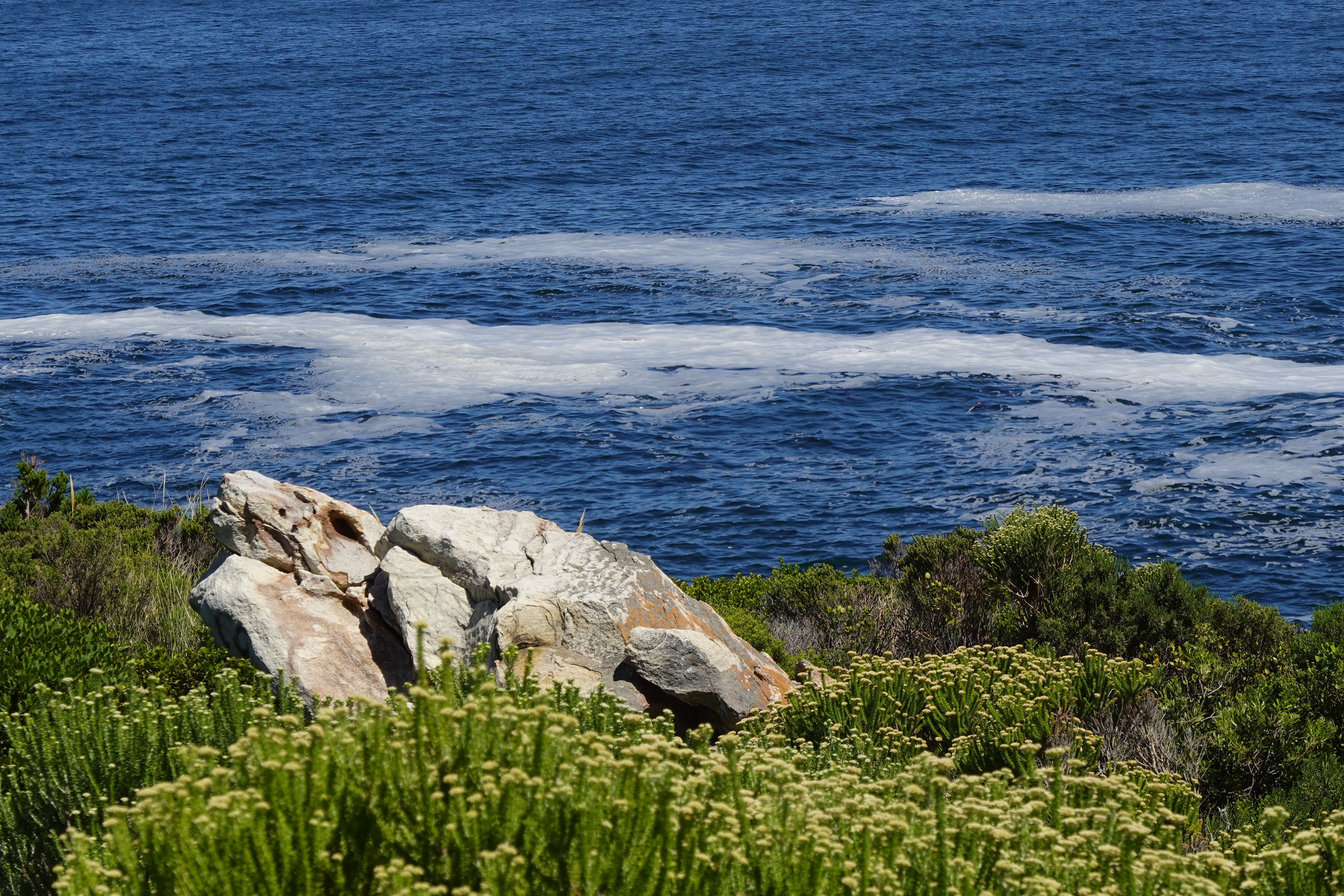
One of the things I like about this photo is how it captures three completely different rates of change in the world.

Most of the image is filled with the sea, which changes constantly and obviously. It’s never still (even when it looks calm). It’s always flowing, breaking into waves, surfacing water molecules and throwing them into the air, deepening others to hide them on the ocean floor. Every wave reminds us of how every individual appears distinct only for a little time, then dissolves back into the source, erasing duality, every one never really separating from the One.

Then we see a large rock. Stable and strong as a rock, we say. But rocks are constantly changing too. They are submitted to daily forces of wind, rain and sunshine. They are sculpted by the weather over thousands, even millions of years. Just as it is hard to see the minute hand move on a clock, it’s really difficult to see the changes taking place in a rock. But change is happening, all the same. Every rock reminds us of how every unique being emerges from the underlying flux of the universe to present a consistency, a transient integrity which allows them to appear as a whole, and separate individual. Just as I look back on my life after a number of years, I can see photos of myself as a baby, as a little child, as a teenager, as young adult, a parent, a maturing adult into retirement, and on, beyond the “three score years and ten”….but all those appearances, all those “selfs”, are a single self. Each photo from a different decade looks so different, but inside, they all feel like me.

We need both – the constant flow and flux of change AND the transient consistency of a structure, an ego, a self.

Thirdly, the foreground in this image is filled with plant life, an abundance of plant life. Plants change both quickly, from moment to moment, hour to hour, with the sunlight, the warmth and the wind. But also seasonly. They change in cycles. The life of a flower isn’t linear, it’s more like a spiral, looping round and round through the four seasons of the year, each season revealing its particular characteristics, of growth, blossoming, reproduction, fruition, then a winter of quiet and apparent inactivity.

We need this third energy too….the cyclical, seasonal, rhythmic change.

Constant flowing change, a certain resistance manifesting as consistency, and spiralling rhythms of reality.

Read Full Post »

The English philosopher, Mary Midgley, in her response to those who said the Self was an illusion, said “If the Self is an illusion, who is it who is having this illusion?”

Philosophers, psychologists, psychiatrists and neuroscientists, continue to debate exactly what the Self is. I’m taking a pragmatic, maybe simplistic approach. For me, the Self is what does the experiencing. Me, myself and I, as the song goes…….All the sensations I experience, are experienced by my Self. Yes, I know there are complex sensory cells and networks throughout the body which enable me to pick and process various signals, energies and waves which flow around and through my body. But, ultimately, the experiencing of the light, of colour, of sound, touch, temperature, taste….that’s all done by my Self. Similarly, it’s my Self which experiences my thoughts and feelings. Again, maybe thoughts and feelings involve a huge network of cells and chemicals in my body, but it’s my Self which experiences them.

I know that not everyone will agree with that conception of the Self, and I’m neither a philosopher, nor a neuroscientist, but I just want to describe, as clearly as possible, how I envisage the Self.

From that standpoint, I explore the world in which I find myself alive. I turn to Science to help me grasp and understand what is external to my Self. Primarily, that picks out elements from within the flux of reality, and considers them as objects…objects which can be measured and manipulated. I even turn to Science to discover elements which exist within my body, but which, I argue, are “external” to my “Self”. So developments in anatomy, physiology, pathology and so on, help me to comprehend the tissues, organs, cells and chemicals within my body, and, as a doctor, to understand them within the bodies of others. That helps me to make diagnoses and to suggest treatments when people fall ill.

Secondly, I turn to Art, to understand what is “internal” to my Self, to express what is “internal” to my Self, and to communicate with the “selves” of others. It’s through music, poetry, painting, sculpture, storytelling, novels, dance, and so on, that I attempt to show others what I feel, what I experience, what I think, from this unique perspective on the universe which I call my Self. Through Art I channel, and stimulate my creativity, my imagination and my empathy.

Thirdly, I turn to Spirituality to explore the connections between my Self, and the rest of the Universe. Through experiences of awe and wonder, I dissolve the boundaries of my individuality, and step into the Oneness of Reality.

I know these terms, external, internal, and beyond, are simplifications in their own right, but I reckon if I am to know a person, to really get to know and understand another person, then my best chance will emerge by taking a blend of these three approaches – science, art and spirituality. And, I’ll see more clearly that no single one of them can give me a comprehensive understanding.

Does this make sense to you? I’d love to hear your take on all this.

Read Full Post »

The concept of “and not or” is very important to me. “And” creates and explores connections. I broadens and deepens our experience. Whereas “Or” divides. It splits reality into pieces and asks us to choose. Iain McGilchrist’s superb explanations of how the left and right hemispheres of the brain enable to focus on the world in very different ways has taught me to try to use my whole brain, not just half of it (we, as a civilisation, and, as individuals, have privileged the left hemisphere approach at the expense of a whole brain one, for far too long now)

But there’s another way in which I apply the “and not or” approach, and that’s through the triad of ways in which we humans view and try to understand the world – science, art and spirituality.

Science provides us with ways of discovering what exists objectively. A core feature of science is measurement. The scientific approach allows us to separate out objects from the ongoing flux of reality, measure them, subject them to experiments and, from there, to make predictions which enable us to exert greater control.

Art, on the other hand, provides us with ways of expressing our inner experience, and of sharing those experiences with others. It’s a range of ways of connecting subject to subject. We use art to express and communicate love, beauty, joy, and unique, individual experience of life. We use music, dance, storytelling, visual arts, poetry etc to develop our creativity and to engage with each other subject to subject. These subjective experiences are not measurable.

Thomas Berry says that the universe is not a collection of objects, it’s a community of subjects.

Thirdly, spirituality, is, for me, that sense of being connected to what is greater than me. I experience it through moments of awe. I experience it everyday through what the French call “l’emerveillement du quotidien” – through wonder, amazement and awe.

I need all of these ways of engaging with the world to lead a deep, whole and meaningful life. Science isn’t enough by itself. It can’t help us to connect, subject to subject. Art isn’t enough by itself, it lacks science’s ability to isolate elements in the objective world to better understand and manipulate them. Spirituality isn’t enough in itself but it stokes our humility and our sense of connection with others and with the rest of the planet, even, the universe.

How about you? Do you enjoy all three? Science, Art and Spirituality?

Read Full Post »

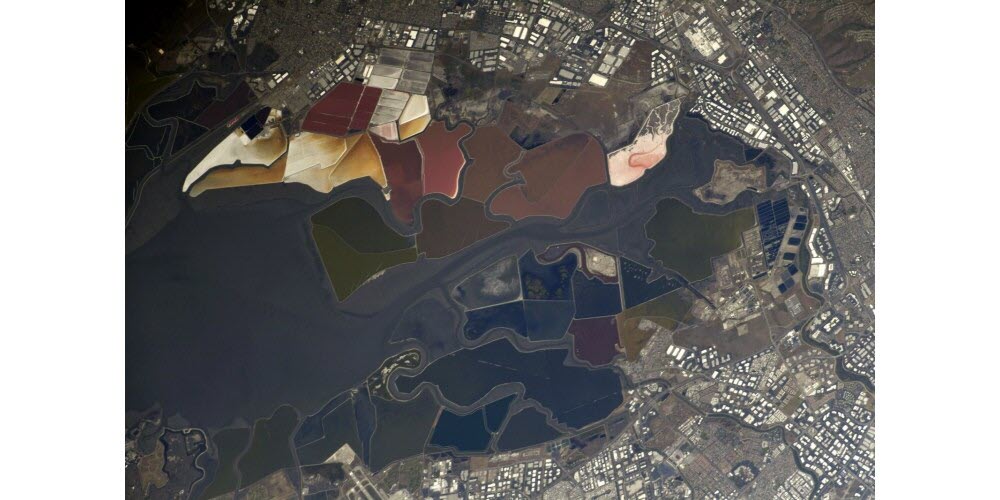
In “Orbital”, by Samantha Harvey, she describes how the astronauts aboard the International Space Station are first entranced by the Earth at night. It’s when night falls over the surface of the planet that the presence of human beings becomes most obvious….the networks of streets, buildings, roads sparkling and shining so brightly you can easily see them from Space. Then as daylight comes they see the Earth as a planet where humans beings are invisible, see it as a living, whole organism with its oceans, clouds, weather systems, forests and deserts. But then they come to realise just how much of the Earth is the way it is exactly because of human choices and actions.

We change the planet just by living here. How it changes comes down to our collective choices and those of the corporations and individuals with the greatest power and wealth.

Normally I use my own photos to illustrate my posts but, having never been to the International Space Station, this time, I’m borrowing a couple of photos from the French astronaut and photographer, Thomas Pesquet. Look him up. Check out his photos. They are simply astonishing.

“They come to see the politics of want. The politics of growing and getting, a billion extrapolations of the urge for more……The planet is shaped by the sheer amazing force of human want, which has changed everything, the forests, the poles, the reservoirs, the glaciers, the rivers, the seas, the mountains, the coastlines, the skies, a planet contoured and landscaped by want.” – from “Orbital” by Samantha Harvey.

This is the modern version of a very old philosophical exercise – taking the view from on high – to stand apart, above, and look out over the greater whole.

Read Full Post »

Older Posts »