“The more we pay attention, the more we begin to realise that all the work we ever do is a collaboration. It’s a collaboration with the art that’s come before you and the art which will come after. It’s also a collaboration with the world you’re living in. With the experiences you’ve had. With the tools you use. With the audience. And with who you are today.”
Rick Rubin, in his “The Creative Act”.
This really resonates with me. Over the last few decades we humans seem to have privileged competition over collaboration. Many people even call competition, “Darwinism”, because Darwin showed the role of competition in evolution. But Darwin also showed the role of collaboration in evolution. Why don’t we give that aspect, equal, or even greater, attention.
It strikes me that even in my lifetime here on this little planet, over these last just over seventy years, I’ve witnessed a growth of alienation and isolation. The cult of the Self, of the Ego, of the so called “self-made man” (a total delusion, by the way), contributes to this isolationism.
We are isolating ourselves from each other, because we are blind to how connected we are….to each other, to the past, to our ancestors, to our children, and their, as yet unborn children….to the myriad of other forms of Life on Earth.
We even think of “Nature” as something that is separate from us. We are never separate from “Nature”. We emerge within it, within this vast, complex web of relationships and billions of other organisms with whom we are in constant collaboration. The very cells of our bodies come into being from the flows of materials, energies and information which gather and co-exist for a short while to create what I experience as “me”, which create what you experience as “you”.
If we are going to heal ourselves, heal our communities, our societies, our world, we are going to have to become more aware of our connectedness, and to build creative, collaborative, “integrative” relationships (mutually beneficial ones).
Because “nothing begins with us”……and nothing ends with us, either.
My area of work was health. I worked as a doctor over four decades and I learned a lot about what made for a healthy environment and what was a more toxic or harmful one. I reckon the characteristics of healthy environments are pretty universal. We all need to breathe clean air, drink clear water, eat nutritious food, have nourishing and caring relationships. There’s a lot of evidence about the positive healing effects of natural environments. I say “natural” but what I mean is, as opposed to built environments. Trees and forests stimulate healthy changes in body and mind, but busy six lane motorways, not so much. But even within these universalities we are all different, so, for some, it’s healing to walk by the shore, or to gaze out at the ocean, breathing in the salt air. For others, the most healing environments are in the mountains and lakes, breathing the clear, fresh air of a little altitude, surrounded by birdsong and wildflowers (“and not or” remember…..both these environments can be good for the same person)
I read a section of Rick Rubin’s “The Creative Act” this morning (I’m working my way through, reading and meditating on, one section a day just now. It’s such a rich resource)….this morning’s section was “Setting” where he discusses what environments are creative, illustrating how very different ones allow us access to different flows from the universe, each of which can stimulate our intuition. He points out how tranquil natural environments allow us to appreciate the direct information from the universe, whereas, busy peopled places, like cafes, town centres etc, can allow us to tune in to the universe as filtered through human beings. In all situations it’s a question of detached awareness, so that we can notice patterns, but not allow ourselves to be overwhelmed by them. That made me think of the phenomenon we call doomscrolling, where we get caught up in social media feeds. They too can be sources of creative stimulation if we allow ourselves to notice the patterns and themes, and not get caught up in them. In fact, Rick also suggests cultural environments where we focus on reading, music, visual art, etc to pick up the information from the universe filtered through culture.
The most important point he makes is that we are all different. His conclusion is that we need to “hear the chimes of the cosmic clock ring, reminding [us] it’s time. Your time to participate.”
It is.
It’s your time to participate, to become aware, to trust your intuition and to engage.
I find “identity” a tricky concept. In my work as a doctor, I’d often encounter a patient who had identified with their illness so much that it had become the primary identity they presented to the world. They might introduce themselves by saying “I’m John, I’ve got MS”, or, “I’m a cancer survivor”, or “I’m a diabetic”…..in some ways, this is a phenomenon driven by the medical profession which, way too often, focuses on a patient’s illness or pathology, rather than on the individual patient.
I would start a consultation with an open question, like “Tell me about yourself”, or “Tell me your story”. A very common response would involve the patient telling me their diagnosis, perhaps some of the tests they’d had done, and procedures and treatments they’d had, or were still having. Then they’d stop. I’d stay silent, because at that point they hadn’t told me anything about themselves at all. I’ve no doubt this was because they were giving the response they expected doctors wanted. Sometimes I’d need to follow with something like “Tell me, then, what’s been your experience of [x]?” or “When were you last completely well?” followed by “Tell me what was happening in your life at that point?” The personal story, the individual experience, was always more complex and nuanced than the reduced, medicalised one.
Identity is used as a shorthand way of saying “This is me”, but there are several big problems with that.
It seems to me that behind the issue of identity, and, in particular, “identity politics”, lies a desire to be seen, to be acknowledged, accepted and treated fairly. All, perfectly reasonable, and important goals. But I still find it problematic because I’m not a fan of categorisation and labelling. I don’t want to be reduced to either one main label, or even a small set of them.
Too often, identity is reduced to gender, ethnicity, sexuality and/or age. Some wear these labels proudly, and if that suits you, then fine, but it comes with a huge risk – the risk of not being seen, not being acknowledged, accepted or treated fairly as the individual you are.
Adopting an identity can be a way of belonging. It can be like a membership of a club where all the members share the same identity. But such grouping also comes with the creation of “in” groups and “out” ones. Whilst it may give a sense of belonging to the members, it can create a sense of “the other”, both from the group towards those not in the group, and from those not in the group, towards the group.
Identities, in other words, tend to be simultaneously inclusive and exclusive, supporting the creation of relationships with others who recognise the same identity, whilst separating and dividing them from others who don’t.
However, my biggest objection to identity really is the fact that no human being can, nor should, be reduced to single feature, characteristic or category, not least because no human being remains the same throughout a lifetime.
Rick Rubin writes – .”…we are always changing, growing, evolving. We learn and forget things. We move through different moods, thoughts, and unconscious processes. The cells in our body die and regenerate. No one is the same person all day long. Even if the world outside were to remain static [which it can’t] the information we took in would still be ever-changing.”
The fact is, the universe had never created a life identical to yours before you came along, and it will never create another, identical to yours, after you die. Your uniqueness is a complex, ever changing blend of molecules, energies, and information, in constant co-creation with others and with the rest of the world. You can’t be truly understood, truly seen, acknowledged, accepted and treated fairly if your individuality is reduced.
Reduction opens the door to control, and the tech giants, the corporations and governments want control, not by seeing you and treating you fairly, but by categorising you and manipulating you. By limiting and monitoring you.
One of the key functions of our brains is the capacity to grasp opposites and hold them both at the same time.
One way to experience that is to spend time in nature. We can stand at the edge of the ocean and gaze out over it, struck by its beauty, fascinated by the patterns of waves, amazed at the infinite palette of colours. We can walk in a forest, inhale the scents of the trees and plants, listen to the symphony of birdsong, be astonished at the shapes and sizes of the trees. We can sit in a garden watching the clouds form, metamorphose and fly by, warmed by the Sun’s rays, cooled by the breeze. We can walk through a park at lunch time, noticing the signs of the season, the blossoming in Spring, the blazes of golds, reds and yellows in the Autumn.
In all these situations, as we start to feel joy, awe, wonder, delight, we become deeply aware of nature’s immensity, complexity, beauty, power and fragility. We become aware of transience and resilience.
It’s easy, in all these situations, to lose ourselves, for the repetitive thoughts, fears, worries, to be washed away. It’s easy to feel the boundaries between ourselves and the rest of nature fade, become porous, and for us to realise that we are not separate from any of this. As separation dissolves, we find ourselves, we discover our uniqueness and our commonality. We feel whole, and a part of the whole.
Spending time in nature gives us the opportunity to grasp and to hold these two phenomena at one and the same time – to lose ourselves, and to find ourselves.
A key theme of my blog, heroes not zombies, is about awareness. It’s about waking up, living more consciously, more engaged in the here and now.
When I was a teenager I used to listen to a pirate radio station, called Radio Caroline, which broadcast music from a ship outside of the jurisdiction of the UK authorities. Radio Caroline still exists, and I tune into it from time to time as an internet radio station – my goodness, how easy it is to find and listen to radio stations around the world now using the internet. There’s a great site, called Radio Garden, which looks a bit like Google Earth, but with the radio stations highlighted. You can spin the globe, zoom in on any country, any city, any town, and immediately hear the radio stations broadcasting from there. I recommend it, though, I think, in the UK, the authorities have blocked users from accessing any internet radio stations which aren’t based in the uk! I’ll come back to this kind of restriction another day, but, suffice to say, back when we used an old fashioned radio and scanned the world on ShortWave, nobody blocked us. Ho hum!
Anyway, I digress. In one of its phases of life, Radio Caroline adopted a slogan “Get the LA habit” – with “LA” standing for “Loving Awareness”. It doesn’t do that any more, but I liked that they chose for a while to promote not just “awareness”, but “loving awareness” – goodness knows, we could do with more of that in this world.
Back in the 1990s I read Anthony de Mello’s “Awareness” and it made such an impression on me that it sits on my special “books which changed my life” bookshelf in my study.
The thing about awareness, is that it grows with practice. If you decide to be more aware, for example, by savouring your meal, of by stepping into the garden and listening for the birdsong, or watching the sun rise, or gaze at the Moon when it’s full on a clear night, or go for a walk with an intention of noticing, then you’ll find that even when you don’t think “awareness” your brain starts to become more aware.
We see the same phenomenon, for example, with breathing. If you pause and take three deep, diaphragmatic breaths, you’ll interrupt an unconscious pattern of shallow breathing which can be keeping you in a state of chronic anxiety, or disturbing your sleep. Yes, if you have chronic hyperventilation during sleep, you can stop it by practising the three deep breaths a few times during the day.
When I was living in Stirling and working in Glasgow I walked from home to the railway station every day, then took a couple of trains to get to the hospital where I worked. That walk was a time to practice awareness, just by setting off with an intention of noticing. In fact, I found that if I took a camera with me with an intention of photographing whatever struck me, then I’d notice a lot more in the here and now (and who doesn’t have a camera with them these days, even if it’s only the one in your phone?)
Maybe it’s time for us all to get that old “LA habit” again, and practice a bit more awareness, no, not just awareness, but “loving awareness” every day.
Throughout my career, both in General Practice, and as a Specialist in Integrative Care, from time to time a patient would ask me if I had a diet sheet.
I didn’t.
But the question opened the possibility to discuss this particular patient’s current eating habits, and to give some guidance and recommendations. The reason I didn’t have a diet sheet is because, as with much else in life, there is no one size fits all.
There is no “perfect diet”.
There’s no diet which, no matter who you are, where you live, and what you normally eat, will be a healthier diet for you. I know, I know, there are masses of posts and articles which promise you that if only you’d eat this particular foodstuff every day, this other one twice a week, and add an extra helping of something else, then your blood lipids would plummet, your blood sugar would normalise, and the inflammation in your body would calm right down. I’m especially sceptical of those articles which claim that a particular food will produce a specific outcome – reduced risk of cancer, or strokes, or whatever. There really isn’t any way to know what a particular foodstuff will do for an individual, because there are so many other factors in play.
However, there are some broad guidelines which seem worthy of consideration. Michael Pollan. I like his “Eat food. Mainly plants. Not too much” because it captures three useful principles – that we should eat food which is nutritious, that we should privilege plants over meat, and that we shouldn’t over eat. I also like the principle that we should eat ultrahigh processed foods, as little as possible. It seems the bigger the list of chemicals whose names are hard to pronounce, or are presented just as letters and numbers, then the less likely the food will be to be nutritious (and the more likely it will have adverse effects on the body).
I also like the broad teaching that more colourful your plate, the healthier it is likely to be. There’s an awful of beige food in the world, and, to be honest, I prefer a bit of colour (as long as the colour doesn’t come from an industrial chemical!)
I also like the teaching to try to eat seasonally. In France, really every town of any size has a weekly, or more frequent, market, and it’s pretty obvious what’s in season, and what isn’t. I look forward to Corsican Clementines every year, for example, but there are many other plant based foods which only appear on the stalls when they’ve been harvested that year.
But, I think perhaps the most important thing to say before giving anyone dietary advice, is “tell me what you normally eat”. It can be difficult for people to that, so, sometimes I’d ask them to go off for a couple of weeks and write down in a notebook, every single thing that passes their lips. Reviewing their pattern, even over a fortnight, can be revealing. It’s also important to explore food allergies, sensitivities and preferences. So, as is usually the case, it’s best to start by listening, or, if you’re doing this yourself, by observing.
I think if you decide to keep a food diary for a period of time to discover your normal habits, it’s important to write down absolutely everything you eat or drink every day, and it’s actually better to it for thirty days, than just a fortnight. Also, no cheating! Because you’d just be cheating yourself! Don’t avoid what you’d normally eat, to record a diet which you think you SHOULD be eating!
Once you’ve listened or observed, then that’s the time to see what might be tweaked, or changed. And, at that point, it’s pretty obvious, we are all different. There’s no point recommending fish twice a week to someone who is allergic to fish, for example.
Bottom line is, there is no perfect diet, so there is no perfect diet sheet. What we can all do is become more aware, and choose to make the changes we would really like to make – whether that involves a move away from UHP foods, from takeaways, from snacks or sweets, or from cutting down on alcohol consumption.
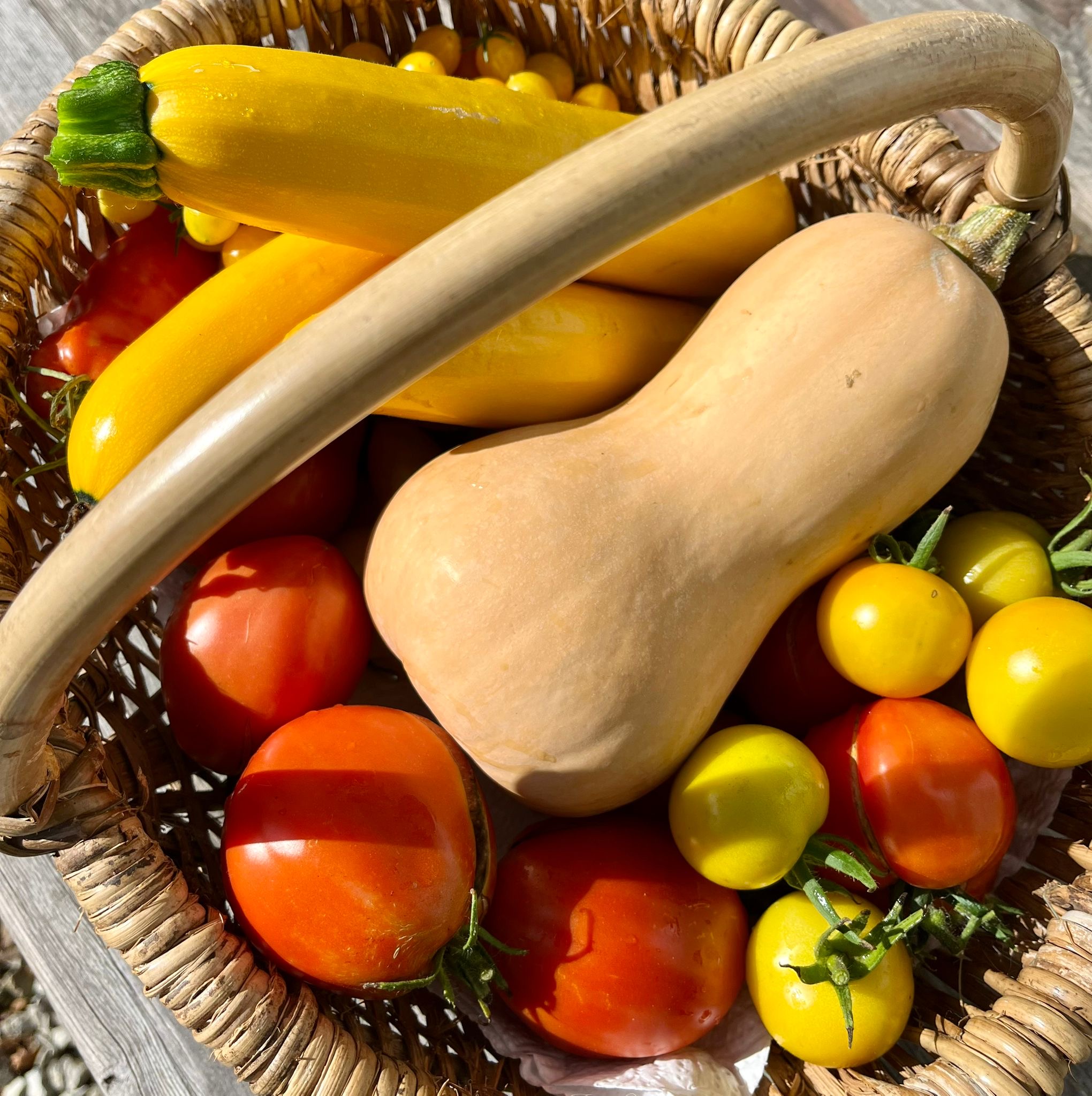
That photo at the top of this post, by the way, is one day’s harvest from our “potager” (veggie plot) here in France. I can honestly say everything in that basket tastes delicious, and all of it has enhanced my quality of life…..which strikes me as a pretty good way to choose my own diet. You should choose yours.
A key theme of “heroes not zombies” is waking up and becoming aware. It’s too easy to drift through a day in a state of semi-consciousness, doomscrolling social media, following routines, swallowing the stories corporations and governments want you to swallow. The Romans used “bread and circuses” to control the population. Modern capitalism uses algorithms.
But there’s a way to break out of these mind-numbing loops….paying attention to what strikes you.
In homeopathy, there’s a teaching about looking out for the “Strange, rare and peculiar”, the symptoms a patient relates which strike you, which stand out, which seem particularly relevant, or particularly unusual. These symptoms might be the key to understanding the patient and finding the right remedy for them. It’s a practice which is the opposite of seeking what is “usual” or “typical”. The thing is, in diagnosis you need to grasp both – the typical symptoms can point to a pathology, but it’s the particular, the personal, and striking ones which point to the patient who has that pathology, which open the path to understanding what the patient is experiencing, how this disease emerged in their life and how it’s affecting them.
I’ve often written here about the power of wonder and awe. I experience wonder and awe when something strikes me. I’ll be wandering through the forest and suddenly see a flower I’ve never seen before, or I’ll hear a bird call I’ve never heard before (or, certainly, not around here). The important thing is to follow that noticing. When something strikes me, I’m drawn to it, I slow down, stop, and explore further. I allow myself to pass a few moments appreciating whatever it is.
We can do the same through the day with lines we read in books. I’m sure you have the experience of reading a novel, or a non-fiction book, and a particular phrase or sentence leaps it out at you. It strikes you. When that happens, why not note it down? Why not slow down, and consider it? I use a mix of methods in this situation. In some books I’ll underline the particular phrase. In others, I’ll get out my phone and take a photo of the passage, then save that photo to my Notes app. Or I’ll get out my notebook and copy it down. “And not or” is my motto. I’ll often do a combination of those things.
Sometimes we’ll be struck by coincidences, or by a feeling of deja vu. These moments can be gold. They can stop us in our tracks and inspire some wonder, some reflection. They are worth noting down too.
Other times I’m struck by a phrase I hear, maybe just a snippet of a conversation, or a remark in the cafe, or in a queue. Again, it’s worth noting these down, taking a moment to consider them, to enjoy then, to reflect.
When I visit a gallery I’ll move fairly quickly through a room, scanning the works of art, then, almost always, some particular painting strikes me, grabs my attention, and stops me. Those always become my favourite paintings.
Wherever you are, whatever you are doing, noticing what strikes you changes your day. It jolts you out of zombie mode, and gives you an opportunity to make the day your own, to make the day special.
Try it out….notice what strikes you today, and explore it.
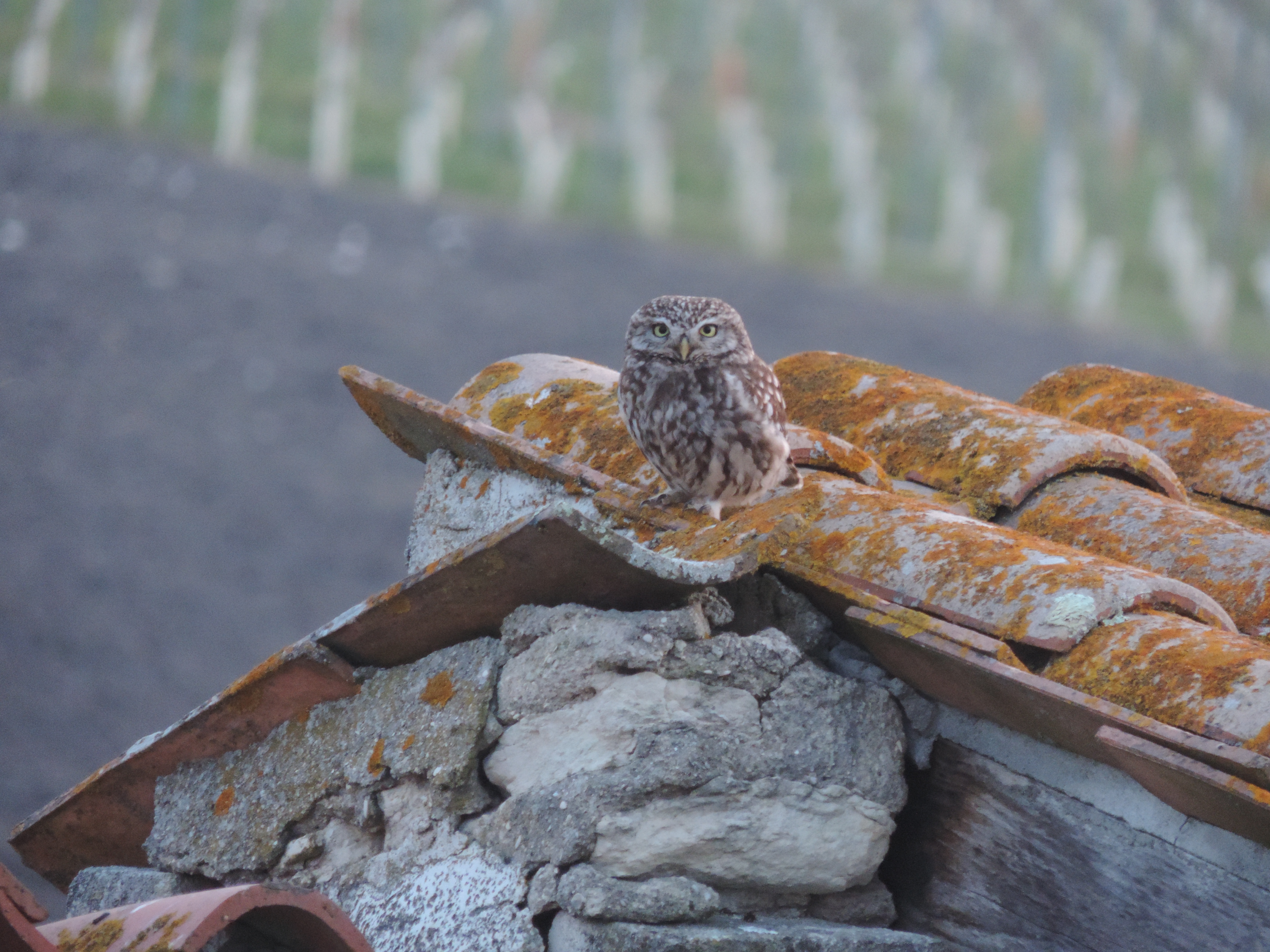
When I lived in Genté I had a studio upstairs looking out over old, abandoned barns to a hillside covered with vines. One day I had that sensation of being watched and when I looked out of the window I saw this bird. It’s a “Little Owl”. Yep, that’s what it’s called. There were several Barn Owls living both in one of the old barns, and in a dovecot cut into the wall of the house, just above our front door. I’d become quite familiar with them, but I hadn’t seen a Little Owl before. I reached for my camera and took this photo. No wonder I had the sensation of being watched! Look at that gaze!
We moved to the Charente Maritime, from the Charente, four years ago. I haven’t seen any Barn Owls since. But over the last few days I’ve heard a really loud bird call at night, and, then, more often, in the daytime too. I use an app on my phone to identify birdcalls. It tells me this is the call of a Little Owl. I haven’t managed to see him yet, but I’m hearing him loud and clear. I think he’s taken up residence in the forest area at the top of the garden.
But to return to this gaze……how do we sense that we are being looked at?
It can happen in a cafe, or restaurant. It can happen in the street. Somehow, we are attuned to the gaze of others (not just other people, but other creatures too). I’m convinced it’s not about scanning the environment and just noticing who, or what, is looking our way. It happens too often that I’ll look up from a book (yeah, I do a LOT of reading) and turn in the exact direction to meet the gaze of another. I don’t know how that works.
But, we all have a need to be seen, to be acknowledged, to be taken into account. Solitary confinement, “sending to Coventry”, and exile are powerful punishments. Intolerable, even. We are social creatures, and we can’t survive entirely without others. Yet, on the other hand, we can receive too much attention. We can wish for times where we aren’t noticed. We are living in a disturbing time of mass surveillance, where corporations and governments are watching, keeping an eye on us, and it’s not comfortable, or welcome.
Like so much else in Life, we have to find some kind of balance, some kind of harmony of two polar opposites. We need connections, we don’t want to be ignored or excluded. But we need privacy too, we don’t want others watching over us, following what we do, whether that’s to feed us advertisements, or policies, or to exert a control over us. And like the other balances we seek to achieve, there isn’t an end point, a place where we get to and then that’s it, we can move on. It’s a way of life.
There’s another question I have when I look at this photo. Why?
Why is this Little Owl looking at me? Why is he sitting out there on the roof, looking through the window into my studio, looking directly at me?
Fear? He’s keeping an eye on me, as a potential threat? I’m definitely no expert in bird expressions, but he doesn’t look afraid.
Because he wants to connect? Not, like have a chat, or start a beautiful friendship, but just to connect. Sometimes making a connection is enough.
One way to understand how deeply interconnected we are, and how change, not statis, is the norm, is to think of three flows – flows of materials, substances, atoms, molecules, and other particles; flows of energy, electromagnetic, gravitational, sounds, and other energy waves; and, information, language, symbols, ideas, and thoughts? You might have other examples for each of these three flows. You might dispute one or more of the ones I’ve chosen, but let’s stick with the general idea here – there are flows of materials, energies and information which swirl around this planet. The flow around, into and through us, for the most part, invisibly. And they flow out of, and beyond, us…changed.
It’s almost like we are a wave, or a vortex. A whirlpool perhaps, a coalescence, an efflorescence, transforming these flows into something which has self-integrity, something which appears separate, and consistent over the course of a lifetime. We, like everything else on this little planet, are transient, and exist only as a temporary flux. Some writers describe us as being like a wave which appears briefly on the surface of the ocean, a wave which can be pointed to, a wave which can located, even named. Waves don’t leave the ocean, and they don’t last for long, soon dissipating and disappearing back into the vast waters from which they came.
The chapter I read in Rick Rubin’s, The Creative Act, today, describes the idea of data, entering us, filling our inner vessel, where it is changed, not least by the relationships which from between it, and what was already there. He says these relationships produce our beliefs and stories, and, ultimately, our world view.
We can choose what we want to make with all of this – our unique stories, our art, our creations – and then we can choose to share them, where they set off, hopefully, to encounter others, other stories, other creations, other people.
I don’t like the word “data”. I’m sure it’s just a personal thing, but I have a feeling or disgust, or repulsion, when I come across the word “data”. I know, for many others, “data” is the stuff of their daily existence, maybe even what gives their lives meaning. But, I just don’t like it. I prefer the word “information”. I prefer “stories”. I prefer “encounters” and “relationships” and “patterns”. But, as I say, maybe that’s just me. I’m also not a great fan of the idea of a “vessel” inside us…..just as I’m not a fan of the idea of memory being like a filing cabinet in the brain somewhere. So, I prefer this concept of flows, flows of materials, energies and information, which we alter as they enter our inner “vortex”, and emerge changed as we breathe, or act, or talk them out into the world again.
Analysis is a secondary function. The awareness happens first as a pure connection with the object of your attention. If something strikes me as interesting or beautiful, first I live that experience. Only afterward might I attempt to understand it.
This strikes me as totally consistent with Iain McGilchrist’s insights into the functions of our two cerebral hemispheres. He says that each engages with the world in a different way, the right with a broad focussed attention, and the left with a narrow one. The right is where all the signals acquired by our senses travel to first. We engage with the world primarily through direct experience. It evokes our sensations of awe and beauty. Some of that information then passes to the left which zeroes in on elements, naming, labelling and classifying. This is our analytic function.
I take a lot of photographs. For many years I’d carry a camera with me everywhere. Since smartphones improved their cameras, I take most photos with one of those. However, I do deliberately take a small camera with me when I go out for a walk, take a day trip, or go and visit somewhere. I photograph whatever catches my eye, and I’ve written before about how going out with an intention to photograph heightens my awareness, enhances my ability to be present. The iPhone has an “I” button for information when you view a photo later. I use that to identify a plant, or an insect, or whatever, and then look up more about it on wikipedia, or whatever…..a clear pathway of experience first, enabling joy, awe and wonder, then analysing next, to better understand it.
I welcome constructive criticism and suggestions. I will not, however, tolerate abuse, rudeness or negativity, whether it is directed at me or other people. It has no place here. ANYONE making nasty comments will be banned.


 Heroes Not Zombies