Feeds:
Posts
Comments

Archive for the ‘from the living room’ Category

fern eclipse

David Suzuki, in ‘The Sacred Balance’, says

Many have believed in an animated, inhabited, sacred world surrounding them, the natural world that constitutes reality. These beliefs restore our sense of belonging, of being-with, which is threatened by our dividing, conquering brain;

Oh, this connects with so many other things I’ve read these last few months. That last phrase taking me back to ‘The Master and His Emissary‘ – “our dividing, conquering brain” – what a brilliant description of what our left hemisphere does! But it’s this sense of Life everywhere which really captures my imagination. Marc Halévy in ‘Ni hasard, ni nécessité’ writes about the concept of hylozoism….a term I had never encountered before. Look it up. I thought Halévy had invented it as a neologism – but he hadn’t. It’s a very, very old idea which, suddenly becomes very, very new and relevant now. It’s the idea that everything has life in it. He juxtaposes hylozoism to materialism and says

It reveals to us that all matter is alive, that all matter is an expression of life, that all matter is living. (my translation)

Without looking it up right now, I seem to recall Howard Bloom argues something similar in ‘The God Problem‘ too, where he makes the case that even neutrons demonstrate free will.

It seems that Life is everywhere, and that the Cosmos is where we belong, what we are part of, not apart from. Does it make you feel differently about our planet once you realise it isn’t a resource but a manifestation of a living universe
Read Full Post »

Marc Halévy describes three “incredible” leaps in the history of the universe –

The leap from light to matter

The leap from matter to Life

The leap from Life to thought

Reminds me of Thomas Berry and his “moments of grace” – from the forming of our solar system –

Such a moment occurred when the star out of which our solar system was born collapsed in enormous heat, scattering itself as fragments in the vast realms of space. In the center of this star the elements had been forming through a vast period of time until in the final heat of this explosion the hundred-some elements were present. Only then could the sun, our star, give shape to itself by gathering these fragments together with gravitational power and then leaving some nine spherical shapes sailing in elliptical paths around itself as planetary forms. At this moment Earth too could take shape; life could be evoked; intelligence in its human form became possible. This supernova event of a first or second generation star could be considered a cosmological moment of grace, a moment that determined the future possibilities of the solar system, Earth, and of every form of life that would ever appear on the Earth.

to the human moments –

when humans first were able to control fire; when spoken language was invented; when the first gardens were cultivated; when weaving and the shaping and firing of pottery were practiced; when writing and the alphabet were invented.

and right up to this present time –

So now, in this transition period into the 21st century, we are experiencing a moment of grace, but a moment that is different in its significance from any previous moment. For the first time the planet is being disturbed by humans in its geological structure and its biological functioning in a manner like the great cosmic forces that alter the geological and biological structures of the planet or like the glaciations. We are also altering the great classical civilizations as well as the indigenous tribal cultures that have dominated the spiritual and intellectual development of vast numbers of persons throughout these past 5,000 years. These civilizations and cultures have governed our sense of the sacred and established our basic norms of reality and value and designed the life disciplines of the peoples of Earth. We will never be able to function without these traditions. But these older traditions alone cannot fulfill the needs of the moment. Something new is happening. A new vision and a new energy are coming into being.

Does it feel like that to you? Does it feel like the old order is crumbling, and that we are about to take a new, “incredible” leap?

Read Full Post »

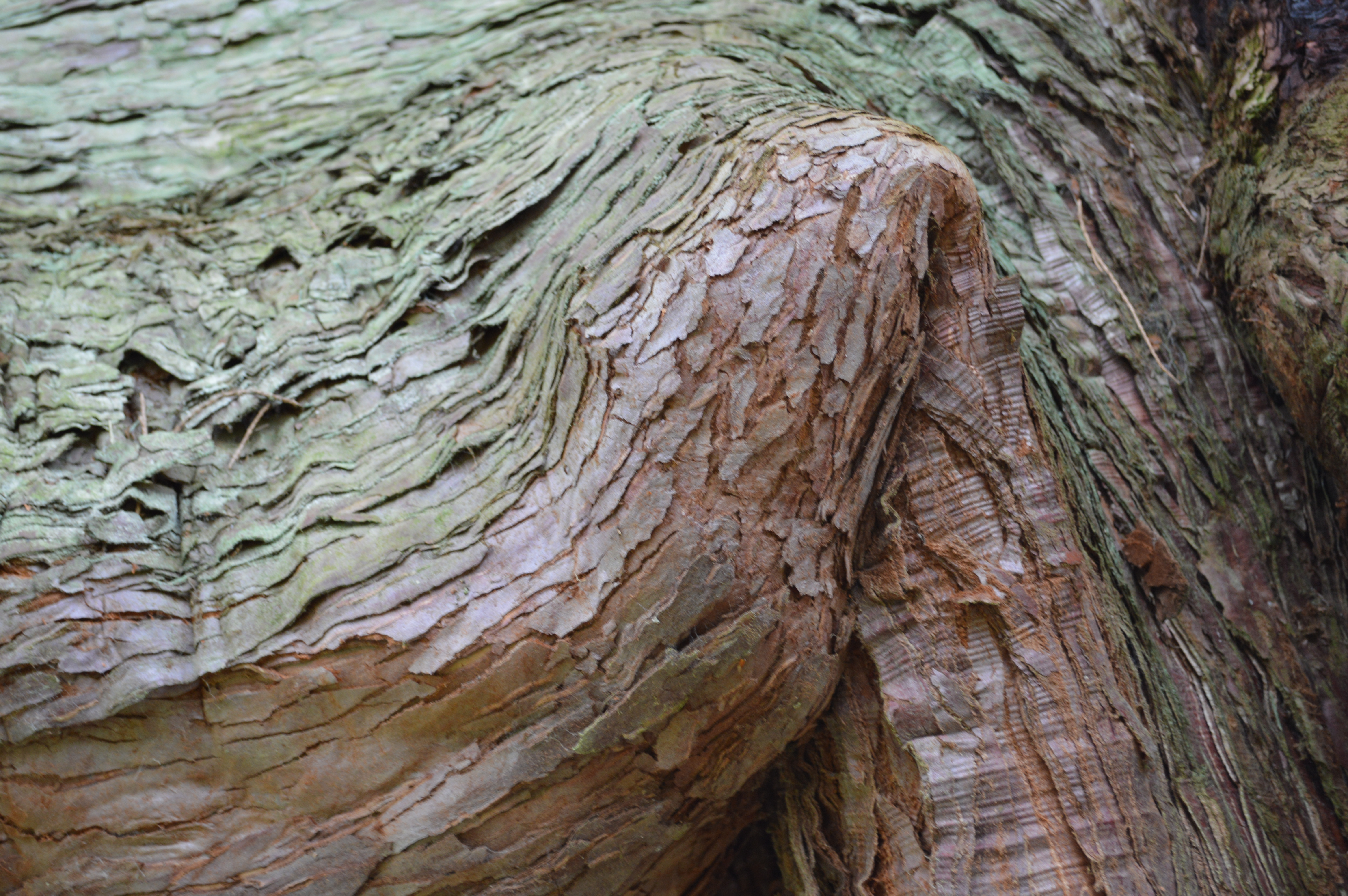
tree

A tree we might say is not so much a thing as a rhythm of exchange, or perhaps a centre of organisational forces. Transpiration induces the upward flow of water and dissolved materials, facilitating an inflow from the soil. If we were aware of this rather than the appearance of a tree-form, we might regard the tree as a centre of a force-field to which water is drawn….The object to which we attach significance is the configuration of the forces necessary to being a tree….rigid attention to boundaries can obscure the act of being itself.

Neil Evernden, in ‘The Natural Alien’

I don’t know how this particular tree came to grow this way, but when I saw it I was struck by how the form revealed the process….not only did it reveal the flowing, developing nature of the tree, but it presented a permanent memory of an event. One day something happened in this tree’s life and it took a turn to the left, a sharp turn. It looks like it was a pretty dramatic event, maybe even one of those events which could bring its life to an end, but it didn’t…..it survived, and coped, and flowed in a new direction.

Read Full Post »

Snowtop in the clouds


What’s this blog all about?

BECOMING NOT BEING

You can see that phrase in the title banner, and its that phrase which kick started my writing of this blog.

Look at this photo I took this week. I think it captures the absolute essence of “becoming not being”.

Start wherever you want. At the top you can see the blue sky, whispy clouds kissing and caressing the surface of the snow covered mountain, or is the snow blowing up into whispy clouds in the sky? You can see the shadows of the clouds darkening the surface of the land, and you know, you just know, that those shadows, those clouds, and, yes, the borders of the snow, are constantly changing.

In fact, it’s quite hard to see the boundaries up there. Where does the land end, the cloud begin? Where does the blue sky end and the cloud begin?

Then as you come down further you see the land without snow…..the blues, the greys, the browns……all, forever, becoming not being.

Read Full Post »

the people we love, the place where we live.

That’s a quote from David Suzuki’s book, “The Sacred Balance”. It comes just after this paragraph –

Although we know who we are, where we come from, what we are for, we give that knowledge no weight; our culture tends to deny or conceal that insight, and so we are left alienated and afraid, believing the truth to be ‘objective’ instead of embodied (my italics). A world that is raw material, resources, dead matter to be made into things, has nothing sacred in it. So we cut down the sacred grove, lay it waste and declare that it does not matter, because it is only matter. Just so the slavers of an earlier century declared their merchandise to be incapable of ‘proper human feeling’. Just so generations of experimental animals have been sacrificed in the name of research. Pesticides poisoning the lakes and rivers, fish disappearing from the oceans, rain forests going up in smoke – this is the world we have spoken so powerfully into existence, and we will continue to live in it unless we change our tune, tell a different story.

What a powerful piece of writing!

Aren’t there so many important points in that one paragraph? How we fail to recognise the embodied nature of reality, and instead create the delusion of ‘objects’ and ‘objectivity’. And how from that one delusion we create a whole story of separateness and objectification which colours our relationships to others, to Nature, and, ultimately, to ourselves.

We DO know very well what matters most to us – and that is the people we love, and the place where we live.

Shall we just act from that knowledge? Test our choices against that truth?

How would life look then? What story would we be telling……a love story?

Read Full Post »

Robert Burns statue

David Suzuki writes (in “The Sacred Balance”)

Definition identifies, specifies and limits a thing, describes what it is and what it is not; it is the tool of our great classifying brain. Poetry, in contrast, is the tool of synthesis, of narrative. It struggles with boundaries in an effort to mean more, include more, to find the universal in the particular. It is the dance of words, creating more-than-meaning, reattaching the name, the thing, to everything around it.

Iain McGilchrist, in his astonishing, “The Master and His Emissary“, describes the brain’s left hemisphere approach to the world as analytical, naming, classifying, analysing. And he cites poetry as one of the great functions of the right hemisphere’s way of engaging with the world. The right hemisphere “struggles with boundaries”, sees the connections, synthesises, holistically discovers “the universal in the particular”.

Read Full Post »

Untitled

Relationships – here’s the key to understanding living organisms.

We don’t understand a human being by measuring his or her parts and adding up the results. We understand a human being by studying how the parts relate, and how the person relates to the rest of Nature.

Fritjof Capra puts it this way

Systems thinking emerged from a series of interdisciplinary dialogues among biologists, psychologists, and ecologists, in the 1920s and ’30s. In all these fields, scientists realized that a living system – organism, ecosystem, or social system – is an integrated whole whose properties cannot be reduced to those of smaller parts. The “systemic” properties are properties of the whole, which none of its parts have. So, systems thinking involves a shift of perspective from the parts to the whole. The early systems thinkers coined the phrase, “The whole is more than the sum of its parts.” What exactly does this mean? In what sense is the whole more than the sum of its parts? The answer is: relationships. All the essential properties of a living system depend on the relationships among the system’s components. Systems thinking means thinking in terms of relationships. Understanding life requires a shift of focus from objects to relationships.

I find this completely thrilling and it explains so clearly why we can’t use reductionism to fully comprehend living beings.

Read Full Post »

Our global financial/economic system consists of a network of computers programmed to trade to make money. The system has one goal – to make money. For what? For whom?

Manuel Castells writes in his analysis (in The Information Age) –

The outcome of the process of financial globalisation may be that we have created an Automaton at the core of our economies that is decisively conditioning our lives. Humankind’s nightmare of seeing our machines taking control of our world seems on the edge of becoming reality – not in the form of robots that eliminate jobs or government computers that police our lives, but as an electronically based system of financial transactions.

And, as Marc Havély writes in Prospective 2015 – 20125 (my translation)

the modern economy has only one goal – growth – to the detriment of human beings who are enslaved by work and consumption, and to the detriment of the biosphere which is plundered, polluted and destroyed bit by bit.

Isn’t it time we stopped and asked ourselves what our economic and political systems are for? What’s their function?

Is it the support of human happiness, wellbeing and thriving; the deepening of the human experience of meaning and purpose; the flourishing of Nature and all of Life; the furthering of the evolutionary development of the Universe?

Can we agree greater goals than accumulation of objects, consumption of resources, and a numbing of the experience of living?

Havély asks that we ask of our work or our purchases –

  • Is this excellent for my health, physical, moral and mental?
  • Is this excellent for Nature, for Life and for the Earth?
  • Does this add good value and richness to human beings as a whole?

Read Full Post »

icing


How does ice form? Because the water gets cold? Yes, ice doesn’t form until the water molecules settle down their activity enough to form a crystal structure. But it needs something else…….a seed. For ice to form, there has to be a starting point, such as an impurity or a roughness on the surface of the container.

When it starts to happen, it is beautiful to watch. Here, in the garden of the hospital, the ice is just beginning to form at the edge of this lovely bowl. Can you see it?


Read Full Post »

DSCN0646


Two important characteristics of nature are uniqueness and change.

Every leaf is unique. The lifetime of every creature, every person on this planet is unique.

And that uniqueness cannot be captured, cannot be measured, cannot be fully described at any one particular point in a lifetime.

No story is complete.

Nothing is fully understood, and, as change never ceases, there is always more to unfold, always more to develop.

I love the wonder and awe which spring up from my heart in the face of uniqueness and change.

I love the humility that demands of me.

To know that I will never fully know means I always have more to discover. To know that nothing is ever “finished” means that every day is a new creation.

Read Full Post »

« Newer Posts - Older Posts »