Feeds:
Posts
Comments

Archive for the ‘health’ Category

Simon Baron-Cohen wrote a fascinating piece in the Guardian considering the reality of cruelty in human affairs. He proposes the notion that there is a scale of empathy – a scale which reflects the amount of empathy a person feels towards others.

People said to be “evil” or cruel are simply at one extreme of the empathy spectrum. We can all be lined up along this spectrum of individual differences, based on how much empathy we have. At one end of this spectrum we find “zero degrees of empathy”.
Zero degrees of empathy means you have no awareness of how you come across to others, how to interact with others, or how to anticipate their feelings or reactions. It leaves you feeling mystified by why relationships don’t work out, and it creates a deep-seated self-centredness. Other people’s thoughts and feelings are just off your radar. It leaves you doomed to do your own thing, in your own little bubble, not just oblivious of other people’s feelings and thoughts but oblivious to the idea that there might even be other points of view. The consequence is that you believe 100% in the rightness of your own ideas and beliefs, and judge anyone who does not hold your beliefs as wrong, or stupid.

I think this is a useful concept – Ian McEwan, the writer, wrote after 9/11 that the terrorists were guilty of a “failure of imagination”. It’s true that imagination is the faculty we use to put ourselves into the shoes of others. If someone really does get into the mental state of “zero degrees of empathy”, then I can see that it is likely they would be capable of far greater acts of cruelty.

I like how he goes on to consider the value of empathy –

Empathy is like a universal solvent. Any problem immersed in empathy becomes soluble. It is effective as a way of anticipating and resolving interpersonal problems, whether this is a marital conflict, an international conflict, a problem at work, difficulties in a friendship, political deadlocks, a family dispute, or a problem with the neighbour. Unlike the arms industry that costs trillions of dollars to maintain, or the prison service and legal system that cost millions of dollars to keep oiled, empathy is free. And, unlike religion, empathy cannot, by definition, oppress anyone.

Empathy, is, I believe, crucially important in health care. Yes, I need good clinical diagnostic and therapeutic skills and knowledge, but empathy is what drives me to find the best for every patient. It also seems to make a lot of sense to me that empathy, as it involves, active, non-judgemental listening and a desire to understand and know another person, makes it more likely I will actually arrive at a “correct” diagnosis. Aren’t doctors more likely to miss a diagnosis if they have zero degrees of empathy? (By the way, I suspect empathy isn’t a constant. We probably all move up and down along the empathy scale, day by day, week by week. Makes it a good idea to reflect on where you are at the moment though, doesn’t it?)
Read Full Post »

I came across an interesting article in the Japan Times on Saturday. The heading was “Relax…it might mean you live longer”. Most of the article was about the emerging research work from the Samatha project about the health benefits of meditation.

It seems almost every week there’s a new story about the health benefits of meditation, but the work this article focused on was the effects on “telomeres”. Telomeres shorten every time a cell divides, and, ultimately the cell dies, so it’s thought that protecting the telomeres from this effect can reduce, or slow, the aging process. The key enzyme responsible for telomere health is called “telomerase”.

It appears that people participating in meditation retreats have significantly higher amounts of telomerase than other people (in control groups). However, the headline of the article is slightly misleading – meditation is an active process. It’s not a form of “relaxation”.

You might like to know that it’s not only meditation which can improve the health of the telomeres – exercise, stress management and writing journals can all do the same. In fact –

in increased sense of control and purpose in life are more important than the meditation itself. Doing something we love, whether meditating or gardening, may protect us from stress and maybe help us to live longer. “The news from this paper is the profound impact of having the opportunity to live your life in a way that you find meaningful.”

I particularly liked the concluding paragraph of the article –

But researchers warn that in our modern, work-obsessed society we are increasingly living on autopilot, reacting blindly to tweets and emails instead of taking the time to think about what really matters. If we don’t give our minds a break from that treadmill, the physical effects can be scarily real.

Aha! Moving from zombies to heroes, huh?!

Read Full Post »

For a while I was quite taken by the idea of “mind body medicine”. I was even impressed by how, in the US and in Japan, I could find “Mind Body Medicine clinics”. However, for me, the idea has worn off. It just doesn’t work for me any more. Here’s why.

The good intention behind the “mind body medicine” idea is to stitch back together what the advocates claim Descartes separated. It signalled the intention to address the subjective experience of the patient, and not just the objective body. All well and good.

However, what I don’t like is that it continues the delusion of two separate entities – a body, and, a mind – as if these are two different “things” which are linked in some way. But I don’t think it’s like that. I’ve never met a mind without a body, and I’ve only met a body without a mind in the mortuary. Is it ever sensible to focus exclusively on the body, or on the mind, if your job is to provide health care to human beings? I don’t think so.

Worse than that, many people seem to associate “mind” with psychological issues (or in terms of mental health, with psychiatric ones). Yet there is a lot more to the mind than cognition – particularly once you start to understand the mind as “an embodied, relational, process of regulation of energy and information flow“. Or if you begin to understand both the embodied and the extended nature of mind. Discovering the phenomenon of neural networks around the hollow organs of the body, particularly the heart and the gut, made sense for me of those phrases which up to that point seemed mere metaphors – “heart felt”, “heart broken”, “gut feeling”. The mind can’t be corralled into the skull!

The other experience I encounter frequently is one where someone has pain, or dizziness, or nausea, or fatigue, or something, and “all the tests are normal”, so they are told, “Good news. There’s nothing wrong with you”. But they’re still debilitated by their symptoms…..so, what now? “It’s in your head” – which means, either “you’re making it up”, or, “you’re mentally ill”. I think that’s a lousy way to make a diagnosis. If someone has a mental illness, it should be properly diagnosed and understood. And, more importantly, why assume a person is “making it up” if you can’t find any abnormal blood tests? Isn’t trust a foundation of successful medical practice?

The understanding of the concept of “complex adaptive systems” helps us to see that people are whole organisms, that health cannot be reduced to the sum of component parts, and that any disturbance within the organism is likely to produce changes throughout that organism and not be confined to single organs – not even the brain!

I do hope the medicine of the future will start from this perspective – holistic and patient-centred, based on trust and the ability to avoid subdividing people into the delusional idea of two entities – a body, and a mind.

Read Full Post »

Health is a state of being of a whole organism. It isn’t reducible to either single elements, or to a cumulative total of elements. The whole is more than the sum of the parts.

A number of years ago, I read Hans-Georg Gadamer’s stimulating collection of essays, “The Enigma of Health“. He wondered about the strange invisibility of health. For example, at the moment I’m not particularly aware of having a left foot, but if something heavy were to fall on it, injuring it, I’d certainly be aware of it! I’m reminded of the Roger McGough poem, “Bits of Me”, where he refers to the bits of him which are making their presence know, when normally, they don’t! (a great, thought provoking, and funny poem)

I’m also very aware of how little “health” is discussed, taught or researched, what with both training and service delivery in health care being focused on disease discovery and management. But don’t we need to have some useful concept of “health” if we’re seeking to support and/or create it?

I recently came across some writings by the biologist, Brian Goodwin. He captures the issue beautifully here –

I take the position that there is a property of health of the whole organism that cannot be described in terms of the functioning and interactions of the constituent organs or tissues or molecules—whatever level of parts one wishes to consider. Furthermore, this property of the whole influences the functioning of the parts in identifiable ways; that is, it has causal efficacy. The absence of such a conception from mainstream biology and medicine is evident from the fact that there is no theory and practice of health taught to medical students that develops systematically such an emergent property of the whole organism with which one can work methodically. Health in the medical model is absence of disease, not presence of a coherent state that can be recognized and facilitated by an appropriate therapeutic relationship.

Wonderful. This is the understanding we need if we’re ever going to develop a science of health and a practice of health care.

Read Full Post »

I work in the NHS – the National Health Service. I was just wondering the other day……..why isn’t the NHS primarily about delivering services which are intended to improve health?

Pardon?

Well, think about it for a moment. Almost all of the services in the NHS are organised around diseases or body systems. Next door to where I work is the “Cancer Centre”. Around the rest of Gartnavel site there are departments of Infectious Disease, Dermatology, Rheumatology, Gastroenterology etc – all with a clear focus on delivering care to people with specific diseases and administering treatments designed to modify or manage disease processes.

That’s what health care does. It conceptualises illness as disease, usually by identifying objectively measurable changes in the body, then uses either surgery to cut out diseased tissue, or administer drugs “proven” to modify defined physical parameters (blood pressure, blood sugar levels, inflammatory markers etc). The hope, I’m sure, is that in doing this, health will emerge or improve.

My point is, that very little of organised health care seems to be structured explicitly, or directly, to stimulate or create a condition called health.

In fact, when I ask groups of doctors or nurses to give me their definition of health without referring to either illness or disease, they frequently struggle. Health doesn’t even get an entry in standard textbooks of Medicine, and the stated goal of Undergraduate Medicine is to teach doctors how to make a diagnosis (of disease). Despite that, I’m pretty sure most doctors and nurses would say they go to work each day to try to improve the health of their patients. The odd thing is that by focusing on disease and it’s management, health improvement is left to Nature, or chance, or hope. It’s kind of a side effect of the interventions delivered. A hoped for side effect.

Wouldn’t it be a good idea to have some of the Health Service focused directly on health? Might not a focus on health produce some useful impacts on the presence or progress of disease? Wouldn’t it be a good idea, in other words, to have another approach which directly intends to stimulate and increase health, and which hopes for a side effect of reducing disease?

But here’s the main idea – what about an integrated health service – where, with the focus centred on the patient, care is delivered which impacts on disease AND care is delivered which impacts on health – in each case, directly.

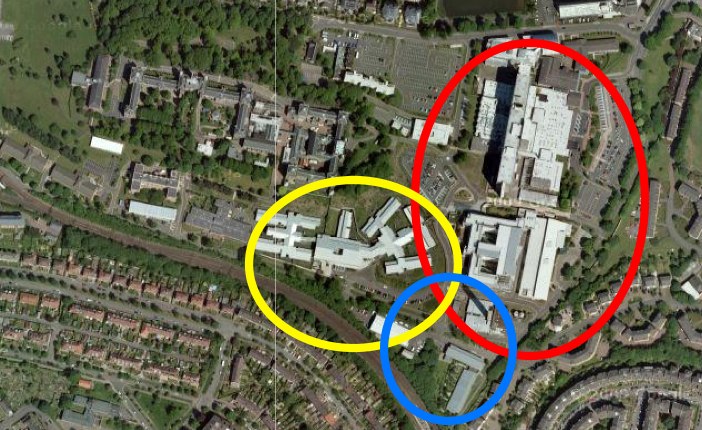
We’re well placed on the Gartnavel site in Glasgow. We’ve got the services focused on disease, but we’ve also got the Centre for Integrative Care, Glasgow Homeopathic Hospital, (where I work) which is focused on health. Here’s a photo of the site


The red circle is around Gartnavel General, the physical disease hospital, the yellow is around Gartnavel Royal, the psychiatric disease hospital, and the blue is around the Centre for Integrative Care, the health-focused hospital.

Read Full Post »

Here’s another study showing how pain can be reduced without using drugs.

In this particular study, the researchers had the subjects do one 20 minute focused attention meditation session daily for 4 days. The subjects rated the painful stimulus applied as “57 percent less unpleasant and 40 percent less intense”.

This is interesting for two reasons. Firstly, it’s another study showing the potential benefit of simple meditation techniques which anyone can learn and integrate into their daily lives. Secondly, as the article points out, it shows how quickly a benefit might be obtained.

If you do suffer from some painful condition, do you practice daily meditation? If not, why not? What’s to lose?


Read Full Post »

Here’s an interesting piece of research. Viewing pictures of a romantic partner can stimulate the “reward” parts of your brain and reduce your experience of pain.

In this trial the researchers compared three interventions – viewing a photo of your romantic partner, viewing a photo of another attractive person and a standard distraction test. The first and the third of these reduced the pain experienced most, and the parts of the brain “activated” by viewing the romantic partner were not the same as those areas “activated” in the distraction test.

I should just add that in this particular trial the subjects were in the first nine months of a romantic relationship……but, still, it’s interesting to see the demonstration of the impact of love (and desire?) on the pain reducing mechanisms of the brain.

Read Full Post »

What is that makes arrogance and ignorance go so hand in hand?

Why do people claim to know for absolutely definite whether something is right or wrong, whether something works or doesn’t, but, in fact, don’t know anything about it at all?

I heard a few stories last week of patients’ exchanges with specialists. One man with cancer spoke to his oncologist about changing his diet and got the response “What do you want to do that for? There’s no evidence changing a diet affects your cancer”. The patient was surprised, having read a lot about the research related to cancer and diet so challenged the oncologist mentioning a research paper or two (you can imagine how that went down! So many doctors, sadly, don’t welcome such an adult/adult discussion!). At this the specialist said he admitted that diet might have an effect on whether or not you got cancer in the first place but he didn’t think it had any effect once you actually had the cancer. The patient persisted asking some more about what diet effects the specialist was aware of, at which he responded “I’m not an expert on diet. I’ll refer you to the dietician”.

Another exchange…..man with cancer who hears about “Iscador” treatment (the details aren’t important here) – the oncologist responds “Well you can go to Mexico if you like but you’ll be wasting your money!” Mexico? What on earth has Mexico got to do with “Iscador”? (Answers on a postcard please…..from Mexico preferably!) When asked what the connection was the “expert” confessed he knew nothing about “Iscador”.

I could go on……I heard at least FIVE separate stories like this last week. Situations where a patient is keen to find something that might help and is dismissed, apparently authoritatively, by an “expert”, who, it turns out, is pronouncing on something he knows nothing about.

This happens a lot, not just in Medicine. Look at the nuclear disaster post-quake and tsunami in Japan. Or the financial crash of 2008. Plenty of “experts” would swear such things were impossible…..until they happened.

We could do with a bit more humility, a bit more tolerance and open-mindedness, and a lot less claim for being in possession of the final, definitive truth……about anything.

I would also like to see an increase in the ability of doctors to engage in adult/adult discussion, and to let go off parent/child type consultations with adults.


Read Full Post »

I’m always interested to hear about non-pharmacological treatments for depression (especially as antidepressants are no more effective than placebo for all but the most severely depressed). Here’s a study on depression in the elderly. The researchers compared those who were prescribed antidepressants plus a Tai chi class, to those who received the drugs plus weekly health education classes.

Researchers at UCLA turned to a gentle, Westernized version of tai chi chih, a 2,000-year-old Chinese martial art. When they combined a weekly tai chi exercise class with a standard depression treatment for a group of depressed elderly adults, they found greater improvement in the level of depression — along with improved quality of life, better memory and cognition, and more overall energy — than among a different group in which the standard treatment was paired with a weekly health education class.

It would be interesting to compare the Tai chi class to the antidepressants……

Read Full Post »

My place of work is “The Centre for Integrative Care. Glasgow Homeopathic Hospital”. It’s an NHS hospital with a small inpatient unit, a new day service, and a very busy outpatient department. Here’s an interesting fact about our budget – over 90% of our total costs are spent on salaries. That means less than 10% is spent on drugs, equipment, maintenance etc. Over 90% is spent on people. I think that’s amazing and something to be very proud of.

Health care is about people. It’s about people who are seeking help and those who are seeking to help. It’s about care, about compassion, relationships, communication and understanding.

Our particular approaches, our integrative approaches, prioritise the human aspect of health care. I’d be worried if the greatest part of the budget was spent on technology or drugs. (I understand that this is not the same in all departments – some acute medicine and surgery has to be very high tech, and that tech is very expensive – but even where non-people costs are great, I still think it’s important to prioritise the human beings – the patients and the carers)

Read Full Post »

« Newer Posts - Older Posts »