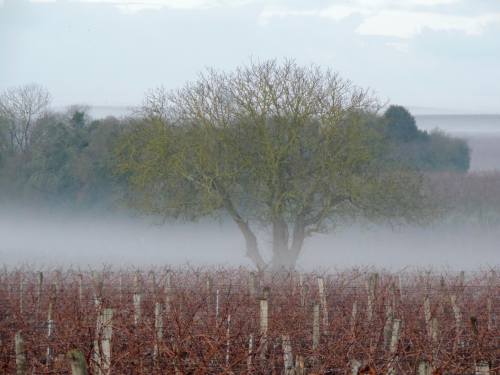
As I was opening the shutters yesterday morning I caught sight of some swirls of mist lying amongst the vines towards the next village. I took a few photos. Here’s one of my favourite ones. It pleases me. Enormously. There’s an entrancing beauty to it. And it’s one of those photos which stimulates all kinds of thoughts for me.
I look at this and I think of two of the fundamental forces of the universe – the ones which Thomas Berry called “wildness” and “discipline”. The large tree in the centre of the image grows wild. It grows naturally and it spreads out above and below ground creating this ever branching structure which looks like its reaching out to the world. It looks like it’s stretching upwards and outwards to feel the sky and the moist air. In front of it are rows and rows of vines, trained and pruned by human hand, disciplined to grow along the wires. The vines form a complex web of life. As I look at them now it’s hard to discern where one plant stops and the next one begins.
When I think of these two forces, I think of the two hemispheres of the brain, each with its distinctive style of engaging with the world. The right hemisphere exploring, seeking the new, making connections. The left hemisphere exploiting, grasping, structuring. Iain McGilchrist writes in “The Divided Brain“, that the right hemisphere characteristically seeks to care, it seeks to engage with “the other” empathically. The left hemisphere seeks to control, seeking to deal with “the other” by categorising, labelling and separating.
How we see these forces at work in the world today!
The other day I read an article posted in the Science section of Forbes.com. The title was “Earth’s skies are violet, we just see them as blue“. It explained how the different colours of light scatter differently in the Earth’s atmosphere according to their wavelength, with shorter blue light scattering most which is why the skies seem blue, but then goes on to point out that violet light has an even shorter wavelength than blue so our skies should look violet. Why don’t they? Well, it’s because our eyeballs have three kinds of colour light detector in them. We call these detectors “cones” and each is most sensitive to either blue, red or green (most sensitive to, not only sensitive too) – the blue stimulates most so the skies look blue….
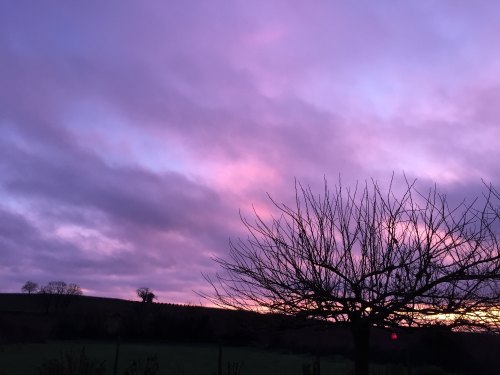
But, wait! Look at this from the other day here (no “post-processing” going on – just as I actually saw it)
Skies look blue, except when they don’t…….(thank you, clouds)
When the sun goes down just west of the village over the hill, it frequently turns the sky a gorgeous shade of red gold. It’s a quality of light which catches my eye.
I can be walking through a room and suddenly see the faint pink tinge on one of the walls, or sitting reading and look up to see a spreading, deepening glow, or walking to the front door and notice the wall change colour in front of my very eyes. Wherever and whenever it happens, I’m drawn.
First it catches my eye, then it focuses my attention. I move towards it. Either to stand on the wall in the far corner of the garden and just watch as the sun sinks below the horizon, and then to wait for a while as a tobacco colour seeps up from the ground once the sun has gone, or I turn my back to the sunset to look at the way the light and the colour changes the world to east, colours the whitewashed walls, and tints the earth and the air in front of me.
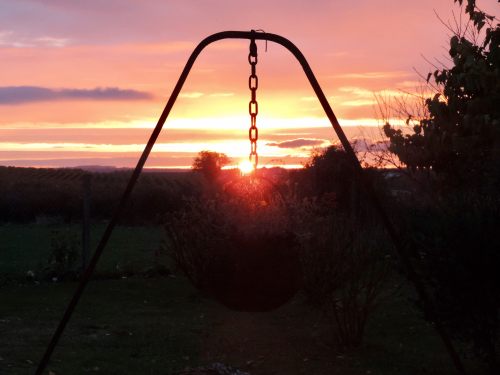
Often, I take a photograph. This particular day I adopted a different position. I walked across the garden and round the well then looked back at the setting sun through the well’s iron arch. I had to wait a few minutes until the sun sank a bit lower in the sky, then I saw this…the end of the day’s burst of setting sunlight shining as if from the end of the chain….creating the effect of a radiant light emerging from the bucket which hangs above the well (except there is no bucket hanging above the well, only the one in my mind’s eye)
Is this well a wishing well? It’s certainly a source, albeit of water a long, long way down beneath the ground.
This is the kind of experience which I find magical. It’s the magic of attention, which is first caught, then focused. The kind of attention Iain McGilchrist describes in The Master and His Emissary as having a quality of care, a right hemisphere directed attention. It changes what I see and it changes me. In that moment, I’m standing still, holding my breath, feeling connected. Feeling as if I belong. Here, in this moment, on this particular piece of the Earth, with water lying silently far beneath my feet, and the very air around me glowing with the fiery rose gold of the setting sun.
The sun sets, the Earth rises, on a day of my life, a day I’d never experienced before, and one I’ll never experience again. Until tomorrow, when another one will come, a new day, a different day, a unique day.
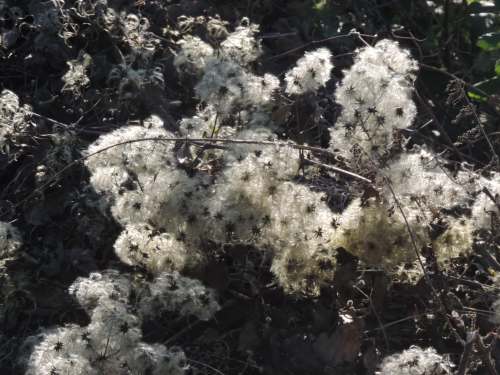
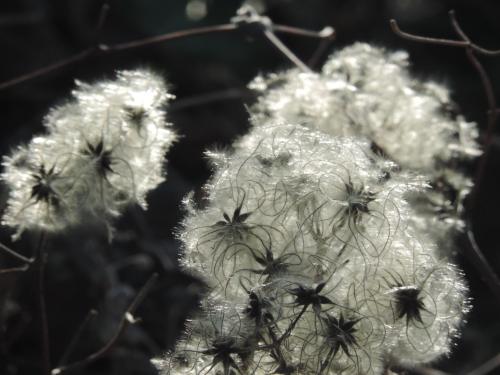
The sun illuminating these seeds caught my eye the other day. Aren’t they stunning? The way the light caught them they were glowing, almost as if the source of the light was from within them. When I looked closer I was stunned by their proliferation. It seemed they just suddenly appeared in the corner of the field. Look how soft and fluffy they are! There are various ways for plants to travel around the world, catching the wind is one of them, and it’s the method this particular plant intends to use.
What popped into my mind after I took this photo was part of a review of a book about the history of France which was published in “Le Monde” the other day. I know, that sounds strange, but bear with me. The part which really caught my attention was the author’s statement of his intention – he wanted to write a history of France from the perspective of the global forces which have shaped it, rather than the more traditional approach which focuses on personalities and events within France. It’s a shift from thinking of a country as a separate entity to be understood by looking within, to thinking of a country as it emerges in relationship with global phenomena – especially the global phenomena which pass over frontiers and the ones for which borders are irrelevant.
Migrants and goods pass over frontiers. They always have, and they always will. The British government’s determination to harden its borders focuses on the first of these – the movement of people. They seem to see people moving from one country to another as THE problem, which, if solved (they mean stopped completely or at least significantly), will allow a flourishing, healthy, happy country to emerge. However, at the same time, they want the free flow of the second of these phenomena – goods – claiming they want to create a “free trade” “global” Britain (as if they even knew what “free trade” is).
My own feeling is that of Europe’s “four freedoms” – freedom of movement of people, goods, services and capital – a government’s desire to stop only one of these reveals its underlying values. It’s the freedom of people they want to inhibit, not the freedom of goods, services and money.
The historian went on to describe some other country-shaping phenomena which pass over frontiers – ideas, symbols, pandemics, climate and technological revolutions. I think he could have at least added stories because whether its “fake news” or life-shaping mythologies, stories spread amongst human beings irrespective of frontiers.
Whether its the spread of the politics of populism, the scattering of radiation over thousands of miles after nuclear power plant disasters such as Chernobyl or Fukushima, global warming, the spread of “particle pollution” in the air, the actions of multinational corporations, or the growth of global economic inequality….there are countless examples of this insight that what shapes a country are the phenomena which cross frontiers.
No country can be understood from a narcissistic perspective which sees itself as disconnected and walled off in this world we all share.
The question facing us all is “how are we going to live together?” Because we all ARE living TOGETHER.
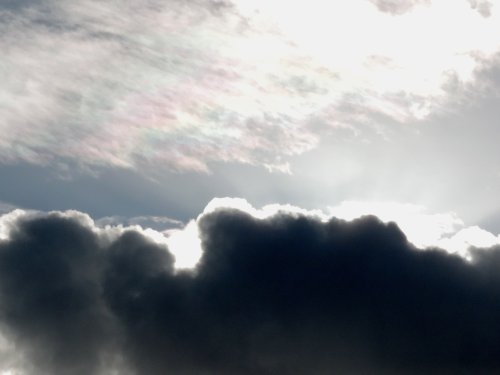
You know those moments when you’re walking in bright sunshine and suddenly the world seems to go dark? You look up and a cloud has drifted in front of the sun. How long will it take to pass? If it’s a cloud with pretty definite visible edges you know it might not be too long. If it’s one that stretches from one horizon to the other, well, it’s probably going to be a while….maybe even not until tomorrow.
When I looked up to see what was going I saw this cloud. Wow, does it look BLACK! But immediately behind it I could see a bright white one too….one of those times which confirms the old saying about every cloud having a silver lining. In fact, on this occasion it was so striking, I decided to take a photo.
But, wait!
What’s that above these clouds? It’s a rainbow of colours! Faint, delicate, and more like paint on the cloud than a proper rainbow, but clear as anything. Isn’t it beautiful? I haven’t altered this photo at all and maybe it doesn’t quite capture the intensity of the colours, but they weren’t actually very intense at all. Just a hint. A bit more than a suggestion. If I’d been concentrating only the contrasts between the black and the white clouds, I might have missed it.
I look at this again now and it sets off a few thoughts….there’s the silver lining first of all, and in this week with the news full of Donald Trump and Brexiteers I’m glad to be reminded of silver linings…..just not entirely sure what they are yet!
But it’s the colour spectrum which really fires my imagination. It’s as if it is literally reminding me that the universe is diverse, that it contains many more colours than we may be aware of, that it manifests a greater range of complexity and beauty the more closely we look. The contrast between the coloured area and the black and white one, inspires me again to remember that reality is rarely, if ever, “either this or that”. Everything we see, everything we hear, everything we experience lies on a spectrum of ever evolving, ever developing difference.
Those who try to convince us that the world can be divided into “us” and “them” are proven wrong every day by the rich manifestation of uniqueness which refuses to be stuffed into one of two boxes.
One of the most significant changes I’ve noticed since moving here to the Cognac region of France is the pace of life. One of the villages near where I live is part of the “CittaSlow” movement – the “slow city” movement which started with the “slow food” movement in Italy. The Charente river which winds its way through these parts as it heads west to the Atlantic is characterised as a “slow river” – mainly because as it passes through here its surface seems pretty unruffled most of the time. It’s the river equivalent of relaxed and steady.
“Slowness” isn’t really about pace at all. It’s about being present. It’s about paying attention to the here and now and savouring what the present moment has to offer.
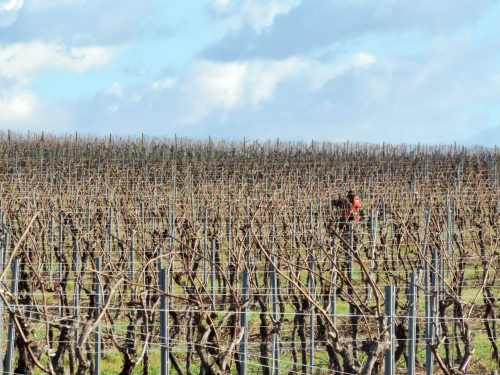
But there’s something else all around here which contributes to that value – the vineyards. Most of the land in this area is covered with vineyards which produce grapes to be turned into Cognac and Pineau. I was out walking yesterday and noticed one of the vineyard workers doing what they all do at this time of year – prune the vines. Look at him, or her (I can’t tell from this distance), working along the lines of vines. Every single plant is pruned back to two stems, one heading to the left, and one to the right, stem by stem, plant by plant. All done by hand by an individual. Seeing one person working a whole vineyard like this is common around here. Sometimes you can spot two people, or, I think, at most, three in the same field. But mostly it’s just one. Can you imagine? Can you imagine what it takes to work from sunrise to sunset, day after day, until the job is completed? Paying attention at every moment to the particular plant in front of you?
So, let’s add two other values to “slowness” – patience and persistence.
Between them these three, interlinked values seem to me to be fundamental to the creation of the particular qualities of life here.
Taking the time without feeling frustrated, pressured, or resentful. And having the determination and the energy to keep on keeping on.
Wow! It’s quite a triad! I recommend them.
Slowness
Patience
Persistence
And you know what? I think we need to add something else to the mix – loving attention.
If the vine worker doesn’t care about each and every plant, they won’t thrive. The way to get the best harvest each year is to care enough to take your time, and work steadily and patiently, until the whole vineyard has been attended to.
Peter Brabeck-Letmathe, the outgoing chairman of Nestlé’s intention is for Nestlé to develop food scientifically – synthetic food which will be better than “natural food”. He rejects the notion that food grown in the ground is best for us. He says
Nature is not good to human beings. Nature would kill human beings. The reason why homo sapiens have become what we are is because we learned to overcome nature.
What do you think when you read this?
Is “Nature not good to human beings”? Does Nature seek to “kill human beings”?
I was pretty astonished at this claim because I think human beings are part of Nature, not something outside of “it”. If we want to learn what’s good for us my own feeling is that we should look to the rest of Nature. As Idriss Aberkane says of “biomimicry”, Nature is a library, a source of knowledge, not a source of repository of fuel to burn.
So where does this idea that Nature is trying to kill us come from?
Well, as chance would have it I read an interview with the French philosopher, Michel Onfray, at the weekend, and he mentioned the definition of life given by Bichat, the physiologist
Life is the sum of the forces which resist death
That’s an interesting definition of life – life is resistance. Is death constantly attacking life? I think that’s a pretty miserable and negative understanding of life. But I think it might come from the notion of entropy. You know about entropy? Entropy is “the gradual decline into disorder”. The second law of thermodynamics states “entropy always increases over time”. You can probably see how this observation can lead you to think that we are only alive as long as we resist death, disorder, and decline. But is that enough to lead you to conclude that Nature is trying to kill us?
It seems to me that this entropic force in the universe is only one of the major forces at play. What Thomas Berry referred to as “wildness” is another way of thinking about this force. It’s the chaotic force. If this was all there was, or if this was the dominant force, what would the universe look like? Would there be stars? Would there be galaxies of stars moving together? Would stars have planets? Would there be any complex living organisms? How could there be? There is a second force. One Thomas Berry calls “discipline”. It’s the ordering principle, the structuring principle, which contains, limits and holds together. But what if that was the only force in the universe? What would the universe look like then? Would it be any more than a dense ball of energy? Would it be expanding? Would it show diversity? Or would whatever existed by “more of the same”?
I think there is a third force at work in this universe, because it seems to me, without it, there is a tendency for the first two forces to cancel each other out, or for there to be a significant tendency towards either chaos or uniformity.
That third force is creativity. The creative force is a force of integration – it integrates the two forces of wildness and discipline to produce astonishing levels of complexity. Look at the history of the universe. Is it a history of endless decline and degeneration, or one of stasis and constriction? Or is it a story of ever increasing complexity and diversity?
It’s this latter, isn’t it? The universe is on a course of increasing complexity. We humans, with our bodies, our brains and our consciousness, are the most complex phenomena the universe has produced so far. But we haven’t been about for very long.
The universe is on a course of increasing diversity. Not just the rich diversity of species and life forms on planet Earth, but in the diversity of unique human beings. Not one of us ever repeated. No single experience of a whole life ever duplicated.
So is Nature a threat to us? Or is Nature a manifestation of the creative force of the universe?
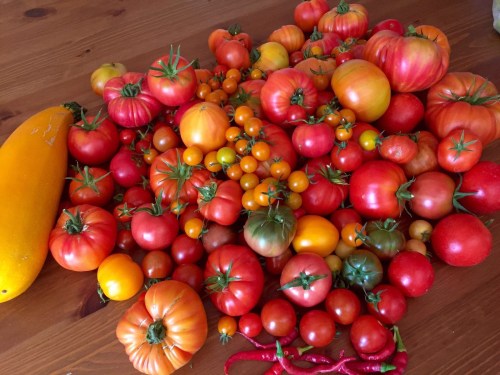
I’m opting for the latter view. And I’m going to continue to enjoy the fruits of that rich creative diversity, just like you see in my photo at the start of this post. I won’t be swapping “real food” for synthesised, chemically “enhanced” stuff any time soon!
Day twelve of the “twelve project”, the final day.
Over the last twelve days, starting on Boxing Day, I’ve uploaded one photo I’ve taken from each of the twelve months of 2016, then created a post about that photo, one per day. Here’s the final image, this one from December.
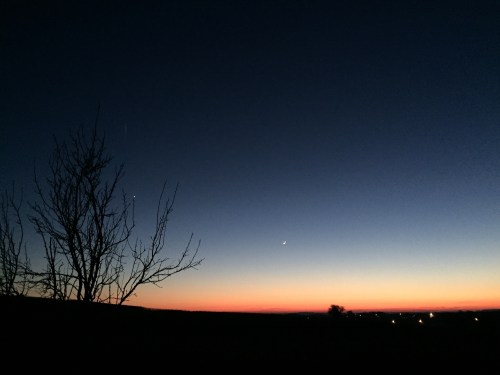
I think its particularly appropriate to finish this project with a sunset. One of advantages of living here is that there are many, many spectacular sunsets. It’s really not unusual to be so caught by the colours in the sky at sunset that we stop whatever we were doing and either open the windows to get a better look, or dash out into the garden to climb on the wall and gaze at this most wonderful, most extraordinary, most ordinary of natural phenomena.
You might think that we’d get used to it, see a sunset like this and just think, “that’s the sun going down”. But we don’t. When I lived in Stirling I looked out from my second floor apartment to some of Scotland’s mountains, in particular to Ben Ledi. I swear that every single day it looked different to me. I never ever tired of it. It never became so familiar that I stopped noticing it. It’s the same with these sunsets here. I’m sure it would be the same if I lived on the coast and looked out onto the sea. The sea, equally, is different every time you look at it. I think that’s why artists like Cezanne painted the “same view” so many times (Mont Sainte-Victoire in his case) – because he was entranced by how different even a mountain could look every day, or, indeed, every hour of the day.
But there’s more to this image than the colours of the sunset. If you look carefully you can see the Moon and the planet Venus. I adore those early evening planets and stars and I am more aware of the current phase of the moon than I have been at any time in my life. The skies here are pretty dark. Those little lights you see at the bottom right of the photo are from the houses in the next village. So, you can see, there isn’t a lot of “light pollution”. That means that once it gets really dark I can see the Milky Way very, very clearly, and I can see stars I’ve never seen before.
And there’s one more thing in this photo. To the left you can see the branches of the Mulberry Tree which grows in the garden here. I just love that tree. I love following its seasons, from buds in the Spring, to the rich cover of huge leaves which I shelter under in the heat of the Summer, to the abundant mulberry berries which are the strangest looking berries I’ve ever seen, to the pleasure of raking up the leaves in the Autumn, and the striking shape of the bare branches in the Winter.
For all of these reasons and more, this is a great image to end the year with. It’s good to be alive.
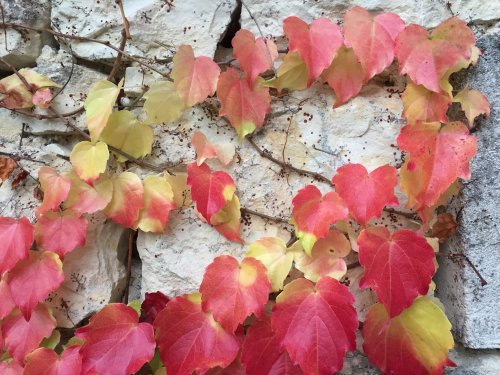
On a wall which runs the full length of one side of my garden grows a plant which isn’t like any other plant I’ve ever seen. It’s name in English is “Boston Ivy”, and its a kind of vine. One of my friends calls it “mile a minute” referring to its speed of growth.
One of the things I like most about it is its complexity. At different times of year its shape, colour and appearance is completely different. Right now in the winter when it’s lost all of its leaves it is a web of stems, creepers and woody trunks. In the height of the summer its lusciously green and is literally a-buzz with bees while providing protected hidden spaces for blackbirds to build their nests. There’s a point in the summer where the seed pods all pop and the sound of millions and millions of the pod shells falling through the leaves to the ground sounds for all the world like a waterfall. The first time I heard it I actually went to look for where the water.
But it’s in the autumn when the leaves turn these glorious shades of red, yellow and gold. It’s breathtakingly beautiful. Then once the leaves fall the plant reveals its gorgeous little bluish black berries on bright red stalks. The birds come in their dozens for those!
Having lived here for two years now I see every one of these phases in the context of the ones which came before and the ones still to come. It’s a very physical experience of the reality of stories, or better, of storied reality.
Day ten of my “twelve project” brings me to this photo which I took in October last year. It’s a picture of the river Charente as flows through the town of Jarnac, which is about a half hour’s drive from the village where I live.
The river gives its name to this whole region, the “Charente” and it flows to the Atlantic passing through the neighbouring region of the “Charente Maritime” on the way. But the river does more than give its name to this region. It is symbolic of, or maybe more accurately, it creates, the pace of life here. People say it flows steadily and calmly, just as you can see in that photo. I’ve been here just over two years now and I’ve never seen it churned up or terribly disturbed. It might happen sometimes but I’ve never ever seen it. Normally when you walk along its banks or look down from one of the bridges, it looks like this.
I encounter the river most commonly in three different towns. My “home town” of Cognac, half an hour to the East in Jarnac, where this photo is taken, and half an hour West to Saintes. In all three of these towns the Charente looks like this. Yet in each of these towns it is also unique and different, because a river isn’t just the water, it’s the banks and the land around the water.
I think it’s not just that it is calming to watch the water flowing so steadily, it slows you down. It slows you down by capturing your attention so that you stand and gaze at it for a while, or you are drawn to wander along one of the miles and miles of footpaths which follow its course, and as you wander it seems the river is keeping pace with you. It’s wandering too. Or is it the other way around? Do we unconsciously fall into step with the river? It slows you down another way too, because when it flows this way the surface is typically highly reflective. Look at the reflections in this photo. It was the sparkle of the sunlight on the lily leaves which initially caught my attention this day, and it was only just after that that I noticed the reflections of the little clouds floating by. It inspires you to reflect.
I love rivers. I grew up in the town of Stirling in Scotland. The River Forth winds its way towards, through and beyond Stirling like a great ribbon, or maybe a snake. You can see it best from Stirling Castle. Standing at the castle gazing down to the Old Bridge, following the curves of the river with my eyes as I look towards the Ochil Hills is one of my strongest memories. It’s one of those scenes which embeds that place in my identity.
I love the symbolism of rivers, how they are never the same two days in a row. As Heraclitus said “you can never step in the same river twice”, reminding us that every moment changes and every moment is unique. I love how you can’t look at a river without imagining both where it has come from and where it going to. It’s like a story. It is present in front of you now, but it brings into this present moment, the past, from the springs in the hills, through its journey of days or weeks, and it holds within it all the potential to become the river it will become as it flows towards the sea.
I can’t think of rivers without thinking of the incredible water cycle of the Earth. How the rivers flow to the sea, how the wind and the sun lift the water into the air, how it condenses to make clouds which then dissolve into rain on the hills and the mountains to create the streams which flow together to create the rivers again. I like that I can see at least part of that in this photo with both the river and the clouds sharing the same space in my picture.
I welcome constructive criticism and suggestions. I will not, however, tolerate abuse, rudeness or negativity, whether it is directed at me or other people. It has no place here. ANYONE making nasty comments will be banned.