I know there’s a tendency to promote the biggest as best – the greatest number of something, the largest something or the most powerful something.
I’ve read we live in the attention economy where businesses compete for our attention by promoting the outrageous, the extravagant or the ridiculous. They try to catch our attention with shock, fear and anger. It’s not very appealing is it?
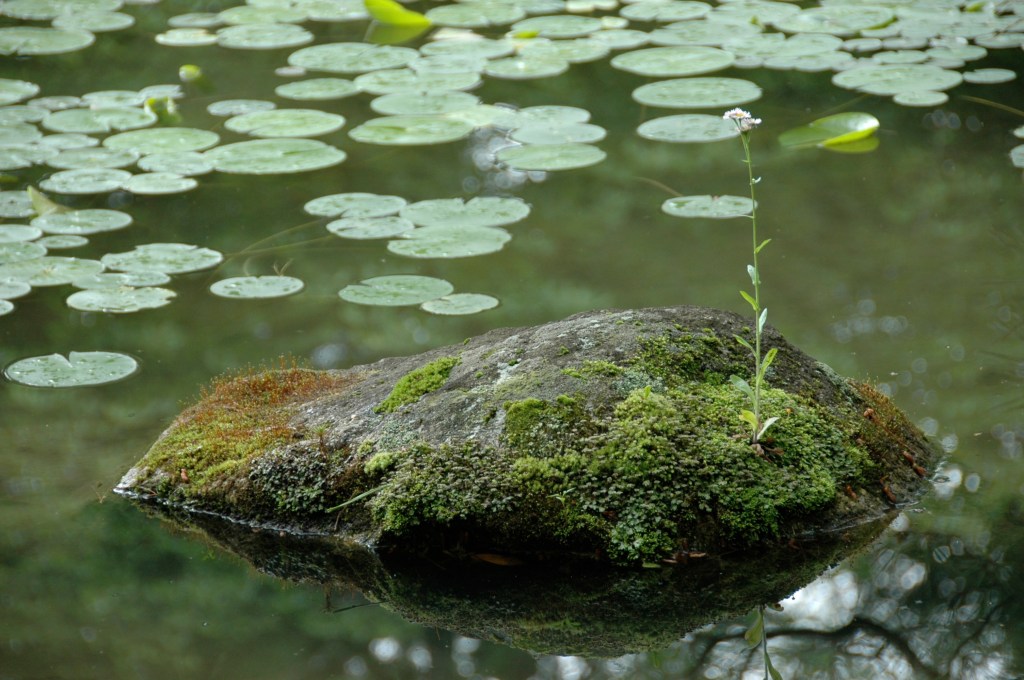
So at the opposite end of the scale I thought I’d share this photo I took of a single plant growing on a rock in the middle of a pond.
Doesn’t it astonish you? How does a little seed find the inner strength and driving vital force to grow sufficient roots on the surface of a rock and stretch itself right up towards the sun, then at the top of that spindly but strong stalk it flourishes, producing a delicate, and delightful, little flower.
I often think Nature is astonishing and it’s usually something small but remarkable like this which catches my attention.
Whenever I look at this photo I think of the phenomenon of bars or restaurants on the same street where one will be crowded and another virtually empty. The place I noticed that most was in Aix en Provence, along the Cours Mirabeau. It wasn’t even that one bar was awful so always empty. The crowds would move over a number of months, deserting the popular one to make a less popular one now THE place to be!
Maybe you’ve had a similar experience on holiday checking out the options for a place to eat. The really busy place exerts a pull, and those waiters hanging around outside the empty restaurant aren’t tempting.
Part of the explanation for this is the social instinct we humans possess (and other creatures, including these guys on this rock have it too). We are born with a drive to make connections. We have to bond to a carer to survive. In fact the social instinct is so strong in human beings that it surprises me that competitiveness is thought to play such an important role in development.
The other thing I think of when I look at this photo is the passage from T S Eliot’s The Rock –
When the Stranger says: “What is the meaning of this city ? Do you huddle close together because you love each other?” What will you answer? “We all dwell together To make money from each other”? or “This is a community”? Oh my soul, be prepared for the coming of the Stranger. Be prepared for him who knows how to ask questions.
Why do we congregate to form such large cities? Well, the social instinct is surely one of the factors. And here’s the thing, this instinct seems to operate primarily below the level of our awareness. Much of the time we don’t realise the power it is exerting over our choices and actions.
Look at this photo. What do you see? Do you see the light cast on the wall from the lamp, with an unusual shadow pattern in it?
What could be making that pattern? A cut out filter in front of the light bulb perhaps?
I think this is a very human phenomenon – we see connections between parts as we try to make sense of the world around us. That takes observation, imagination and memory.
However, this image isn’t what it appears. It’s a photo of sunlight shining first through a tree, then through a window to cast this pattern on the wall. By chance, the patch of sunlight is exactly above the fitted, electric light – which isn’t switched on.
Isn’t it beautiful? Doesn’t it catch your attention and fire up your curiosity?
I like this, “in its own right”, so to speak, but something extra gets added by imagination and curiosity.
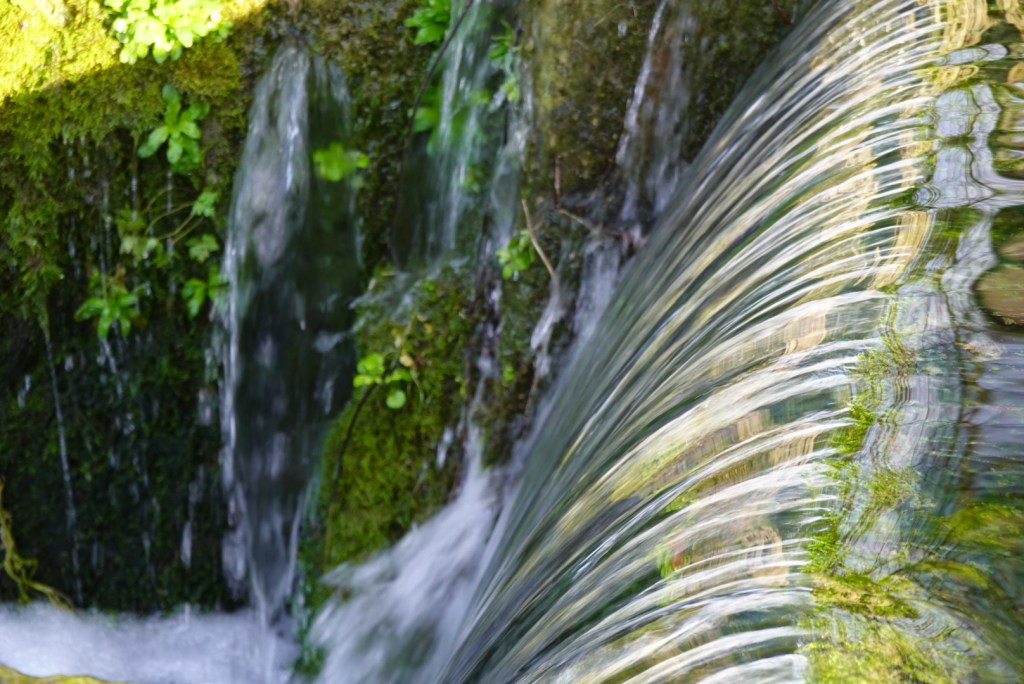
When I look at a photo like this I think of the word “flow”, but there’s a related word which comes to my mind as I reflect on this particular photo today – movement.
I took this photo yesterday in the “source”, or “spring” which lies a couple of hundred metres from my house. The water which appears in the pool and then flows strongly off down the old Roman water channels is as clear as you could imagine.
Standing looking at this “source” I can’t help but think that I’m looking at something which is alive – or, at least, something which is at the basis of Life.
One definition of Life is that which has a “self-moving capacity”. When we see a rock we know it’s not going to go anywhere under its own volition or its own steam. But all creatures, from single celled organisms right up to complex human beings and other mammals move all the time – they move on the inside with the flow of nutrients, chemicals, electrical signals, as they maintain an internal environment – we call that homeostasis. They consume, metabolise and transform other elements. Some have a beating heart, and/or lungs which cycle through inspiration and expiration. All forms of Life show continuous movement inside.
Living forms are also always on the move on the planet too – sending seeds great distances, stretching up and climbing walls, spreading roots deep underground or walking, running, flying, swimming from one place to another.
Many creatures are migratory traversing huge amounts of land and sea every single year. Others move habitat from one place to another. All are seeking to survive and thrive.
This is true of human beings which is why I find nation state attempts to control the movement of people so disturbing. People will always move. Individually, in families or in large groups. Dividing neighbours into “citizens” and “foreigners” is fraught with difficulties and injustices. Hatred towards “the other” is counter to the human need to connect, to travel, to migrate.
It’s also true of viruses. This pandemic is often described as a war we are waging on a virus – a virus we want to eliminate. Except it’s very hard, almost impossible, to eliminate any viruses from the planet.
As we move ahead I wonder if we need to change our emphasis and change our societies and systems to make them both more resilient and more adaptable. We can’t just ignore epidemics or pandemics. We need to respond to them. But maybe we do that best when we create populations which are well housed, well fed and well educated. Maybe we do that best when we develop health and social care to successfully treat the sick, and to care for the elderly and vulnerable in our communities.
So, I’m just reflecting today on the importance of movement in all its forms – change, adaptation, resilience, growth and flourishing.
Apparently it’s a reference to Janus, the god with two faces, one looking back to the past and the other looking forward to the future.
The symbol of Janus is a gateway or a doorway. When we stand on the threshold we are stepping forward into the future, from the past.
We do a lot of that around this time….looking back over the year just ended, remembering those we have lost, celebrating our best moments, making lists of best movies we saw that year, best songs we heard, best books we read. And we look forward with mainly hope, making plans, deciding what we want to change I the year ahead.
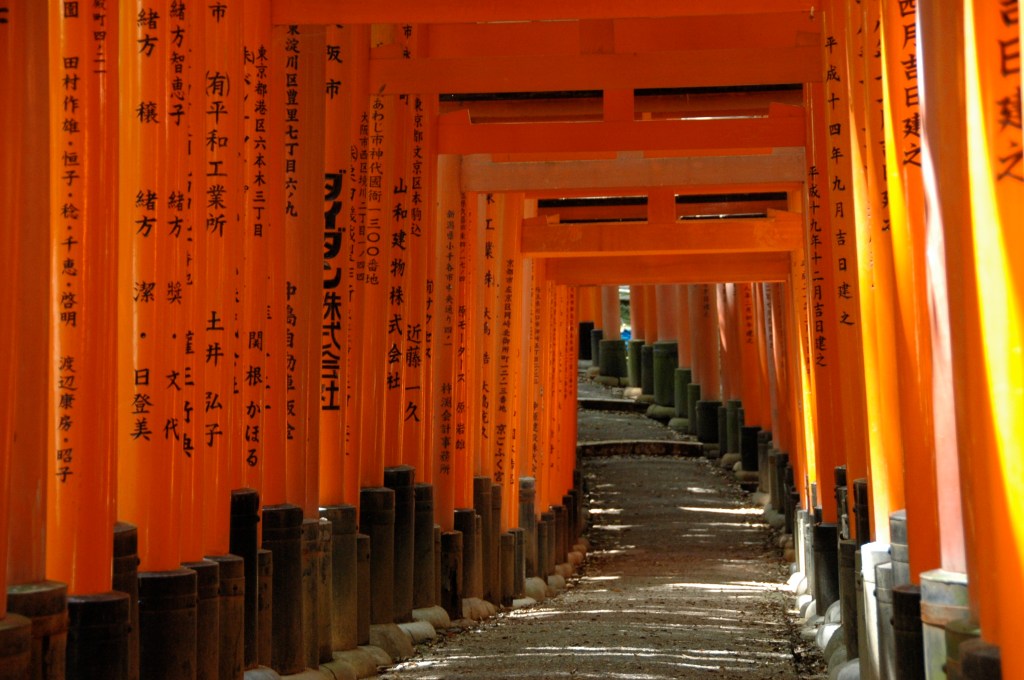
I was so lucky during my career to visit Japan on several occasions. One time I visited Fushimi Inari Shrine up the hill just outside Kyoto. That’s where I took this photo. The path up the hill winds it’s way through a forest and there are dozens of these bright red Torii gates straddling the path all the way up. There’s a tradition to visit it at the beginning of the year and to pray for prosperity.
The experience of stepping through one threshold after another (there are about a thousand) is hugely impressive. It becomes a meditative experience where each step and gate is a repetition as well as a unique and singular moment.
I always think of that now at this time of year.
I wonder what blend of memories, commemorations, celebrations, hopes, desires, dreams and goals you’ll be thinking of today.
Another year draws to a close and wasn’t it full of challenges? It seems we are all learning to live with uncertainty. It’s always been hard to predict the future, but this pandemic plus climate change seems to have taken it to a whole new level.
I’ve long since believed the future emerges from the present, flowing forward from the choices we make and the decisions we take today.
Seeds intrigue me. The fact that nobody can tell whether or not a particular seed is alive or dead astonishes me. The only way to know what that seed will grow into is to nourish it, to tend it, to care for it.
It seems that what we choose to give our attention to, is likely to increase. It seems that what we choose to nurture will thrive.
So what seeds are you going to nourish, to tend to, to care for in 2022? What will you encourage? What, therefore, is likely to grow and flourish in your life?
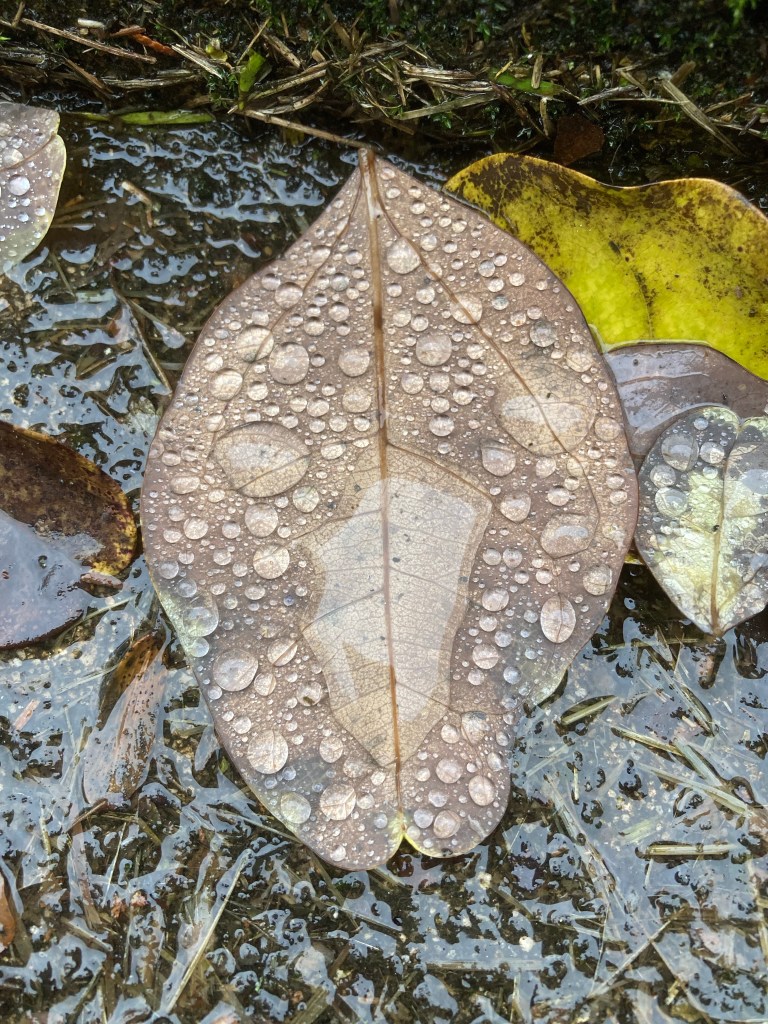
It’s been raining quite a lot these last three days but when it stopped for a bit I took a wee walk in the garden. The first thing that caught my eye was the glitter of sparkling water droplets on fallen leaves.
I took a few photos. This is one of them.
What caught my attention about this one was the large droplet in the middle, surrounded by various other smaller ones.
Actually when I look at it again now it kind of looks like a mask with two eyes and a nose. Do you see that? I didn’t notice that until now.
We don’t really think much about the shape of water. As often as not it takes the shape of whatever contains it. And raindrops, I presume most of us think of as all the same shape, although they definitely fall in different sizes.
But just look at these droplets! One is huge. Way bigger than the rest. And that big one has a very irregular shape. The ones that look like eyes are almost oval but still irregular and the rest a range of circular or oval shapes of an astonishing variety of sizes.
When I retired back in 2014 I emigrated. I sold a top floor apartment (a “flat” we Scots say) on the edge of Stirling. We had a great view from the windows there, looking across to Ben Ledi and the neighbours. I loved that view and took multiple photos of that landscape in all kinds of weather and in all four seasons. But the truth is I was engaging with Nature from a distance.
When I moved to France I rented an old house with a garden on the edge of a village. I was surrounded by vineyards. That change brought me much closer to Nature as every day I saw and walked amongst the ever changing trees, bushes, flowers and vines. The rhythms and cycles of the year became an obvious present reality.
My intention was to stay there for a few months while I worked out if this living in France idea was a good one, but I ended up living there for 7 years. Not exactly a gap year. Not exactly a pause. More a full life filled with wonder, delight and learning. But I’ve moved now, bought a house in a small hamlet, and I’m ready to put down my roots.
This feels like a settling.
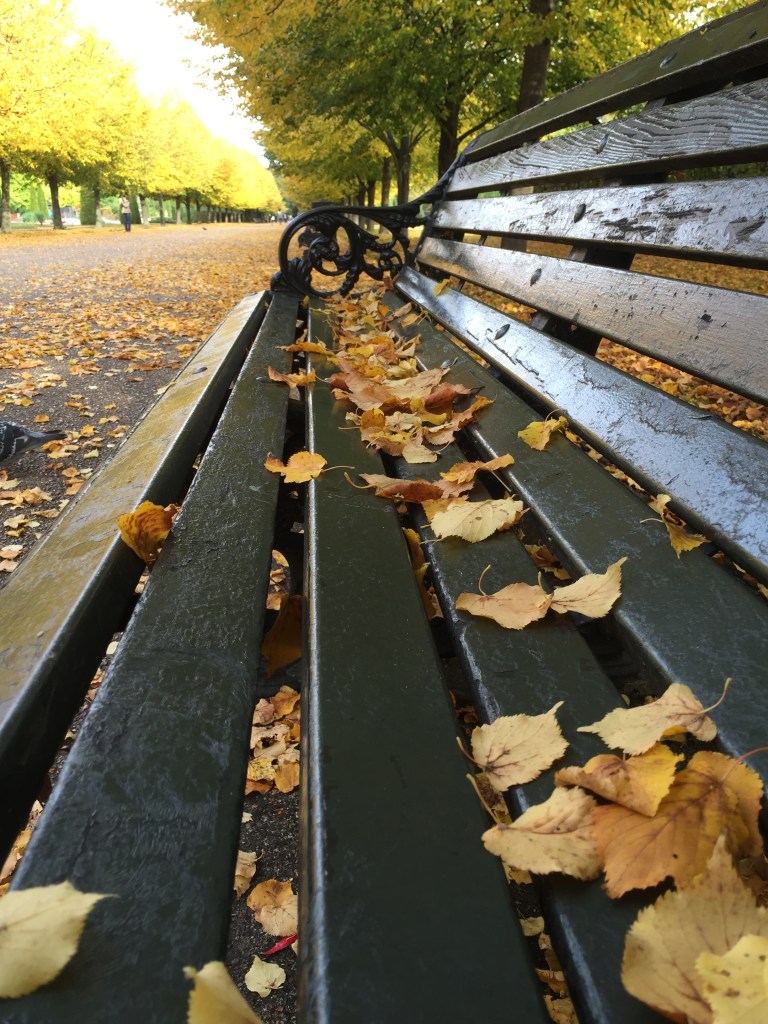
So when I look at this old photo of a park bench in autumn I think of the seasons of life, of how I’ve moved from my career years to my retirement ones…..not to “inactivity” but to a different phase of learning and creativity. I think of how much I’ve learned to notice the arrivals and departures of migratory birds, of the phases of growth, fruition and closing down in the plant world, as leaves are shed and the garden beds down for the winter.
I look at this photo and I hear music. At this moment, in my head, I hear “Old friends, sat on a park bench like bookends”, and I hear “Leaves are brown now, and the sky is a hazy shade of winter”.
Well, that takes me back. The first music I heard in stereo! I haven’t started to unpack all my cardboard boxes yet, but I know that “Bookends”, the “LP” (or maybe you call it “vinyl”) will be there, with the rest of the records I bought, mainly in my teens.
How many seasons, how many phases, how many life stages, have I lived since then?
It’s quiet here, in this old stone house in the French countryside. It’s a good time to be alive. But then isn’t today, isn’t the present, always the best time to be fully alive?
That’s one thing I’ve learned. To be awake, aware, conscious and fully present, in the here and now.
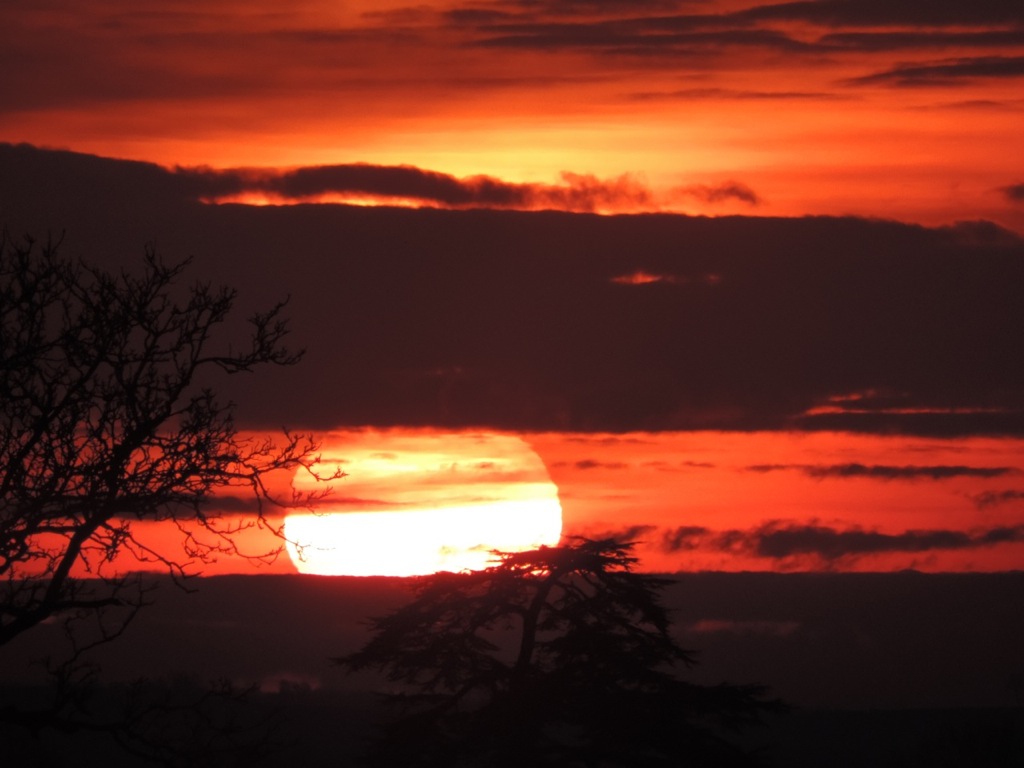
I love this photo simply for its beauty. The sun looks huge, the sky is so intensely red, and the silhouettes of the trees are like a puppet shadow play.
But when I look at it again now I see the fundamental essentials of Life. Without the energy from the sun there would be no life on Earth. With too much energy from the sun there would be no Life on Earth. Without water (here in the form of clouds) there would be no Life on Earth, without vegetation (here in the form of trees) there would be no animals, no insects, no humans here on Earth. Because we need the chlorophyll containing forms of life to capture energy from the sun, water and carbon dioxide from the air, and turn that into the basic sugars of the food chain.
This makes me feel intensely grateful. This fills me with awe. Every single one of these very non-human elements are essential for existence.
Isn’t that amazing? Isn’t that wonderful? Shouldn’t that determine our priorities when we construct the ways we live together on this small blue planet?
I moved house two weeks ago. I lived in the old place for seven years and got pretty familiar with some of the birds which shared the garden, the redstart, the robin, the owls and the hoopoes especially,
When we viewed the new house for the first time I heard, then saw, a redstart in the garden. I took that as a good sign.
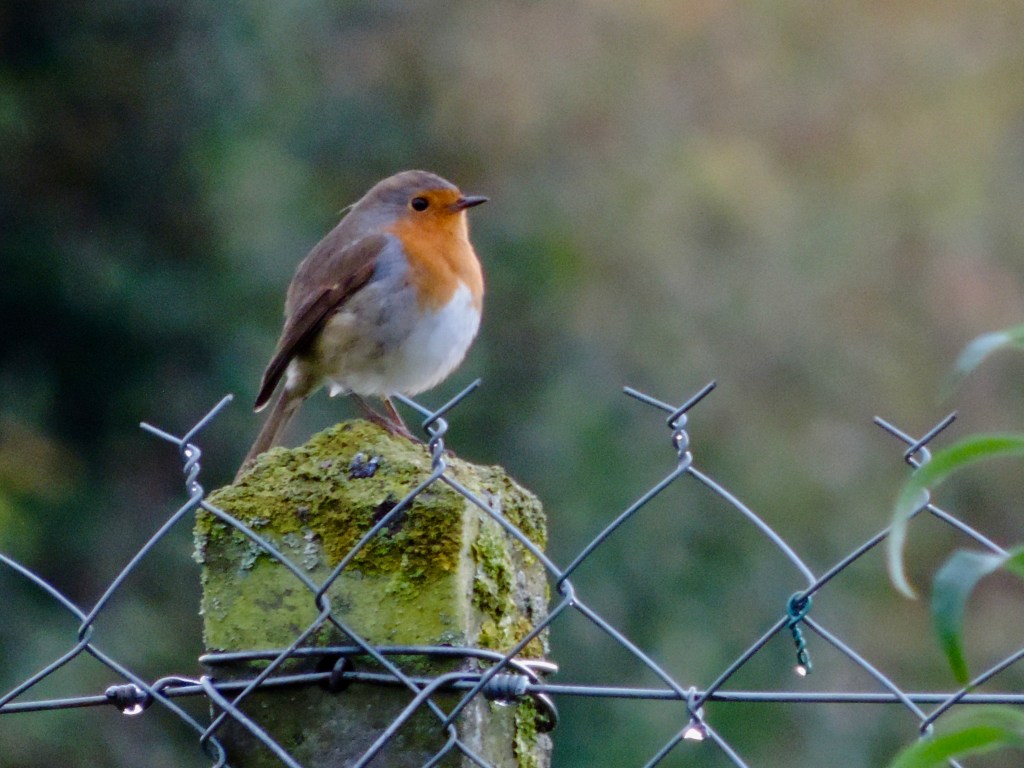
The first day in my new home I walked into the living room and there was a robin flying around. I’ve never seen a robin inside a house before so it was a big surprise. Mind you the robin seemed pretty startled too. I talked to him softly, moved slowly, and opened the window to let him fly back outside.
A couple of days later I was back at the old place doing some final clearing and when I walked into the shed there was a robin flying around inside. I’d never seen that in the seven years I’d been there. I stood aside and let him fly back out through the open door.
Two experiences of a robin in an inside place. The first one made a big impression on me but the second one seemed to reinforce something. Made me take extra notice.
A couple of days later, back in the new home, I went into the wood store to get some logs for the fire. Guess what? Yep, there was a robin flying around inside the wood store. I stood aside and let him fly out through the open door.
How does the universe work?
How does the world get our attention?
Well, the unusual, the rare, the peculiar is one way. We definitely notice things that are “out of the ordinary”. They wake us up. Jolt us out of autopilot and say “pay attention” or simply “Look!”
Coincidence and synchronicity is another way. The patterns, echoes, resonances and separate experiences which appear strongly connected is another way.
I welcome constructive criticism and suggestions. I will not, however, tolerate abuse, rudeness or negativity, whether it is directed at me or other people. It has no place here. ANYONE making nasty comments will be banned.