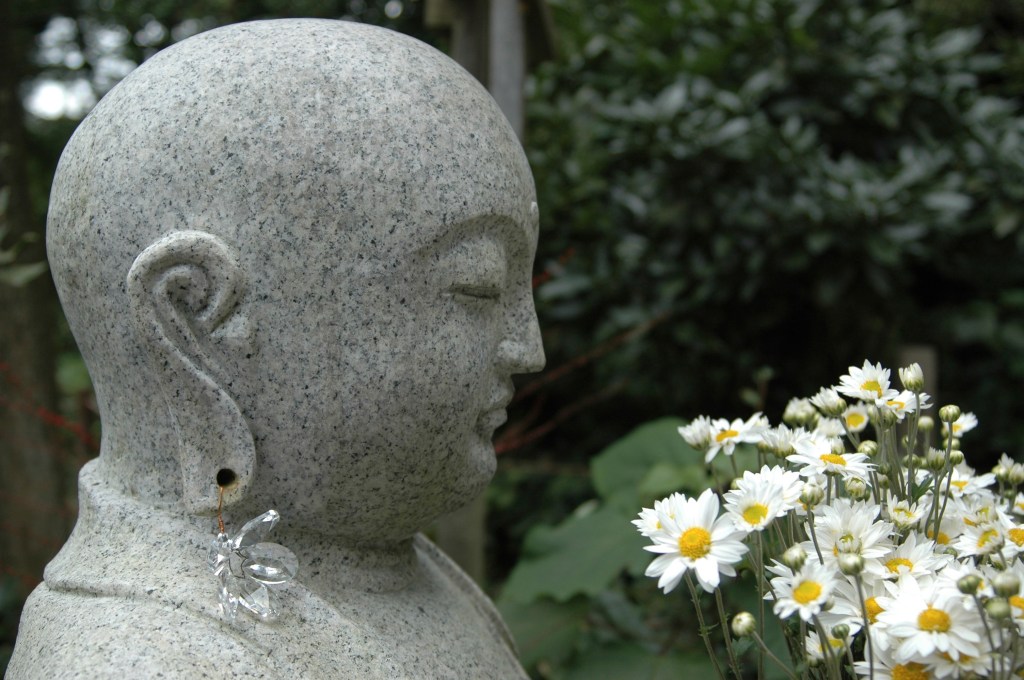
I’ve never really thought of myself as someone who has a method but now I realise that I do.
What do I mean by a method? Well, simply that there are common behaviours that I have in life. Behaviours that developed day after day over many years.
My method has three elements, or three verbs if you like. They generally occur in sequence but it’s a continuous loop, not a straight line with a beginning and an end.
Observe, reflect, respond.
That’s it. Not more complicated than that.
Observe is more than look, of course. We notice most when we use a combination of our senses….sight, hearing, touch, maybe scent and taste.
I was taught to observe at medical school. We learned to listen to patients stories, to look at their bodies, to listen to their heart, and lungs, feel for swellings and organs, and so on. So when I say observe I mean paying attention, noticing, using all the relevant senses.
After observation I like to reflect, taking some time to make sense of what I’ve observed. To understand.
Only after that do I want to act. Action might mean saying something, making a suggestion or, especially when I was a working doctor I would prescribe something. Sometimes however the best action was to wait….to take some more time to learn more.
Well, that was my method at work. Observe, reflect, respond – and then continue on around that loop – observe again, reflect again, respond differently.
I realise this method has become my lifestyle. I think it suits me. It’s feels right.
I took this photo many years ago in Edinburgh city centre. I suppose I was becoming aware of the proliferation of security cameras that was occurring back then. From the perspective of today, there were hardly any!
Do you security cameras make you feel safer? I think I’m in two minds about them. I’d like to believe that they might deter some criminality but I don’t know if that’s true. On the other hand, it’s a bit like having lived in places where nobody locked their front door…..that’s just the opposite of having to live in a gated community with security guards and CCTV (although I should be clear….I’ve never lived in a place like that). When you think of those two extremes which one of them feels like it might be a safer place to live?
I live in a small village in South West France. I live in a cul de sac in the village, so the only passing traffic is the occasional tractor making its way onto the vineyards. My elderly neighbour appears out of his garden gate whenever a different vehicle turns up. He’s like a one man neighbourhood watch!
The other thing I wonder when I see a CCTV camera is who is looking at the footage? Is it just recording so it can be reviewed if a crime is committed, or is someone sitting somewhere watching the live feed.
The thing that makes this particular image interesting for me is the placing of the camera just next to the stone carved head. It kind of seems like the stone head is looking through the camera, which, of course, is impossible, but that gets me thinking about all the non-human surveillance we are now subject to.
Whether it’s Facebook, or Amazon, or Google’s algorithms we are under constant surveillance by computers and software. And like the CCTV I expect most of that all goes on with no human “live” involvement, but as best I know it’s all being recorded and someone can analyse all that whenever they want.
None of that makes me feel safer or more comfortable. And now we are moving into a new era of health surveillance. Here in France we’ll need to produce the QR code which shows we’ve been vaccinated before we can get into cinemas, theatres, restaurants and so on, and when it comes to travel across borders you have to subject yourself to testing and give a lot of information about your travel plans….all, apparently, for “public health reasons”.
I think I can see a lot of potential benefit from the more connected world, and I can understand the good intentions behind a lot of the surveillance, but, surely it would help us all to become a bit more at ease if we felt that the data about us was available to us, and that anyone who wanted to use or analyse that data had to get our permission and be open about what they do with that data.
I know, I know, it’s a complex, but, let’s face it, uncomfortable subject, but it’s one we are going to have to tackle sooner rather than later.
There are two phrases which come to mind when I look at this photo.
“We are all in the same boat” and “everyone is paddling their own canoe”. I know, I know, this isn’t a photo of a canoe, but bear with me, this is the way my mind works.
The last time I looked at this photo, nearer to the beginning of the pandemic what I saw was the possibility of escape. I guess “running away to sea” was the phrase which popped up. Well, it turns out there’s really not been anywhere to run away to (or if there was they slammed their borders shut to stop anyone joining them).
I reckon that on multiple occasions over the course of this pandemic I’ve felt pretty baffled and unsure, just not really knowing what way it’s going to go next, and what’s the best thing to do. Maybe, in that respect, that’s still where I am. Because the new combination of mass vaccination plus exploding case numbers due to variants takes us, yet again, into “which uncharted waters” (to keep my maritime metaphor going!). In fact, yet again, it feels like the authorities are “up sh*t creek without a paddle)
But back to my first thoughts looking at this image again today.
We ARE all in the same boat. This virus has left no population untouched. Our interconnectedness and interdependence has never been more clear. In good ways we’ve seen really brilliant scientific collaboration in both understanding this disease and coming up with the best ways to treat the sick. In not so good ways we’ve seen how international travel has accelerated the spread and made it really hard to manage it within a single political boundary.
It’s also shone a bright light on many of the vulnerabilities and weaknesses of our global economic/social model. Those who have been hardest have been the elderly, the long term sick and the poor. It’s highlighted the precarious nature of employment, inequality and injustice. It’s shown us some of the frailties of the health care systems, of the care systems and of a vast range of support systems. It’s even highlighted our poor nutrition, our poor relationship with the rest of Nature and poor education.
In the midst of all this we’ve seen countless acts of compassion, kindness and generosity. Countless acts of courage and sacrifice.
But we’ve seen way too much greed and selfishness too.
Which brings me to the second thought of each of us “paddling our own canoe”. Because we’ve been faced yet again with issues of personal responsibility and autonomy. We’ve been challenged by restrictions and controls which seem to wrest all autonomy from us and place the power in the hands of unknown others.
There’s the two sided coin of authoritarianism and conspiracy theories with established authorities seeking to impose their idea of The One Truth and hound and silence any alternative voices. Authorities which act in secret and issue false statements which undermines trust. It’s a powerful, disturbing cocktail which shows deep fractures in our societies.
At one level I believe we are all responsible for own decisions and that difference and variety are healthy. At another level it’s clear that a pandemic is a community disorder which cannot be solved by everyone acting as if only their personal choices matter.
It’s tricky isn’t it? Maybe the best thing to do is to stay humble and critical while doing what seems best for each of us, all living together. Keep the compassion and the kindness flowing and stay flexible enough to adapt.
I guess even if we are all sailing our own boats, we’re sailing them across the same sea.
I took this photo a number of years during a trip to Italy. I’m often drawn to sculptures and this particular one is pretty unmissable I think you’ll agree. I’ve returned to look at this image many times and, particularly in the light of our new understanding of neurology and how the two cerebral hemispheres engage with the world differently, (thank you Iain McGilchrist) I find this a really powerful statement.
The first thing I think when I look at this is “Look at the size of that head!” It’s massive. See how small the people look in comparison. Every time I look at this it challenges me to consider how we over-represent the human head. How often do we think that “I” am what exists “in here” – in here being inside the skull we point to as we say that. But we know better now. We know that “I” is both an embodied concept – existing within a whole body – and an extended concept – existing within a network of ever-changing, co-influencing relationships with others and with the environment. You could say our more recent understandings have blown the head wide open and set the “I” free! Perhaps like this sculpture?
The second thing I think of that phrase “head over heart” which we use to set rational thinking and decision making against intuitive, feeling-based ways. In fact, we now know that the heart is more than a mere pump used to circulate blood around the body. There is a dense network of the specialised cells we call neurones around it, and the information processed in that network flows more from the heart to the head, than the other way. So we do actually make sense of our lives using our heart (physically and symbolically) as well as using our head. The fact this particular head is so over-sized reminds me of how we tend to give too much emphasis and attention to so called rational and cognitive ways of thinking, and not enough to our embodied, heart-focused, soulful, intuitive ways – which in many ways precede the work of the brain.
The third thing I think of is provoked by noticing that half the brain is missing in this sculpture – although we can’t see the cerebral cortex here, it seems that the right half is missing, even if the left half is still there behind the skull. That reminds me of the imbalance which is the basis of Iain McGilchrist’s thesis as described in such wonderful detail in his “The Master and the Emissary”. He argues that our left and right hemispheres have different world views and each half creates the kind of world it sees on a moment to moment, and historic basis. He claims that the right hemisphere is where all the information flows first (well, most of it does), that the right then hands off some of that information flow to the left, which processes it by analysing it, matching it to what we already know, categorising and labelling it. Then, it should hand the results back to the right, for it to set back into contexts and see it as a whole. As this sculpture suggests, things have gone wrong and we are using the left hemisphere way too much, and the right way too little.
There are many characteristics and features which seem to define what it is to be a human being. Language, storytelling, the use of symbols, pattern spotting, music, poetry, dance, rituals, problem solving abilities and creativity are amongst them.
But I think art has a very special place.
Deleuze described three ways of thinking – philosophy is our way of thinking concepts, science our way of describing functions and art as our way of dealing with “percepts and affects” – that is our sensations, what we perceive and what we feel.
The astonishing cave wall art found deep underground in several parts of France, and the intricate designs of the Picts and the Celts in Scotland are two of the more ancient examples I’m familiar with. But we find examples all around the world, going way, way back to the earliest traces of the human species.
There’s a creative drive in all of us, and we draw on it in very different ways……from day to day problem solving, to inventing, creating methods and technologies, to the creative expression of the varied art forms which exist.
Some of us are mainly drawn to music, others to dance, some to stories and writing, some to poems, others to the visual arts of drawing, painting, sculpture and photography. And, yes, I’ve left out several other alternatives from that list.
But whatever our preference and/or habit, I find that art attracts. We are drawn to it. We desire art. We desire and seek out the experience of art.
Art provides us with ways of engaging with, and understanding, the world which neither philosophy or science do. You know I’m a fan of “and not or” and I’m not seeking to establish a hierarchy here, but I have a feeling that we are slipping into a more utilitarian, materialistic and reduced way of living, and to restore a balance, to make life “more human” I think we need to give more time, energy, attention to art…..in education, in work and in leisure.
It’s messy and entangled. There is nothing, absolutely nothing, which exists on this planet in isolation. Everything is connected. Everything is embedded in multilayered environments and ecosystems. Everything has a history, a presence and a multitude of potential futures.
Yet we create whole systems of thought, of society and of structures as if this weren’t the case. We separate things out, disconnect and disembody them. We reduce the complex web of inter-related reality to sets and collections of interchangeable objects.
We reduce the subject to an object.
I find all that alienating, dehumanising and artificial.
Every encounter, every relationship, is transformative. You see a movement and your body and mind go into a state of alertness. You hear a song and your heart swells, your eyes moisten and your mind fills with memories. You read a story, or watch a movie, and your emotions flow, your physiology adapts, your thoughts and ideas set off in new directions.
It makes no sense to me to do anything other than accept that life is like this….entangled, complex and messy.
Having travelled in the south of France quite a lot over the years I have a number of photos of lavender fields. When I looked at this one yesterday I was struck by how the pretty much parallel rows of the one crop reminded me of the vineyards which shape the landscape around where I live now.
I was also struck by the sheer beauty of a field of lavender. I know it’s an image which has been used on calendars, postcards and posters for many years, but it still strikes me as beautiful.
However, a third thought popped up with this image today. I write a lot about diversity, difference and uniqueness. And whilst I think those are qualities which lie at the heart of an appreciation of reality, an image like this reminds me of how we like similarities too.
There’s a particular appeal coming from the impression that what I see here are rows and rows and rows of the same plant…..so many rows, and such long rows, that they fill the breadth and depth of the image. Now, of course, it’s not all the “same” plant…..every single plant remains unique, but they are so similar that their differences fade in significance. And that’s what life is like. That’s why we have this super power of being able to recognise patterns, categorise them and store them in our memories. The ability to see the features which individuals share allows us to see a group, a field, of a landscape, as a whole.
You know me by now…..”and not or”……..I absolutely believe we need to see the whole AND the particular. But I thought this beautiful image was a good reminder of the importance of seeing similarities, especially in the context of me writing so much about difference.
Thirteen years ago I noticed this big fat catalogue sticking out of a skinny letterbox in the door of this old house in a town in southern France.
I was so struck by the incongruity – an overload of “stuff” to buy which the letterbox was unable to swallow.
I’ve thought of this as a perfect image of “consumption”. That weird thing on which we seem to have chosen the entire economic system of the world. I thought of it again last weekend when the England football team played in the Euros and the news reported a sudden “growth” in the economy as millions of fans bought and drank gallons of beer, and ate pizzas and snacks.
Really? This is what defines a “healthy” economy? So it seems. How many politicians and economists have you heard complaining about the “shrinkage” of the economy due to the pandemic and how they look forward to “opening up” so that “consumers” will get out into the shops and pubs and “grow the economy” by consuming more!?
What a bizarre system. In a finite world the economic system is geared to consuming more and more of what’s left every year. Does that make sense? Is more always the same as better? Is growth of consumption the best kind of way to grow?
When I started learning Medicine I learned about tuberculosis. Back in the day that dread disease was known as “consumption”, and nobody thought that was a good thing.
Can’t we imagine a different kind of growth? One which is more like development and maturity, than about consuming? Can’t we think of healthy citizens as participants rather than as consumers? Isn’t a business which provides a good quality of living for a family a healthy one without needing to grow into a multinational concern?
There are economist now who are challenging the orthodoxy and who are searching for new solutions, new ways of living, which don’t put “consumption” and “growth” at the heart of their thinking.
At the very least, isn’t this a good time to pause and to wonder about just what we are consuming, and to distinguish between healthy and unhealthy “consumption”?
“Finding your niche”……..what does that really mean?
All living creatures are constantly changed by their encounters. Every interaction is a transformation. Both parties in the relationship are changed in the encounter. We humans alter the ecosystems and landscapes we live in through our actions, and, even, simply through our presence.
We tend to forget that in our mechanised, industrialised, dis-integrated civilisations and societies. The reduction of Nature to an object to be “mastered”, plundered and polluted ignores this basic truth – there is no separateness and we are changed by our encounters with the “other”.
So we co-create our life worlds, or our life spaces. Every one of us lives in our own niche. But niche is not an isolated space. Each niche is embedded in a complex, multi-layered, nested web of relationships and other niches.
There’s a sense in which “finding your niche” is about “fitting in”, or finding an activity in which you can excel. But that’s just a bit too reductionist for my liking.
For me, finding my niche involves becoming aware of influences – of how I am changed by those around me, by my daily experiences and encounters, and by the environments in which I live. That, and the ways in which what I do, say and think, sets off ripples and waves of change around the niches and webs in which I live.
Finding you niche turns out to start with awareness, with noticing, with becoming conscious…….not so much about separateness as about connection.
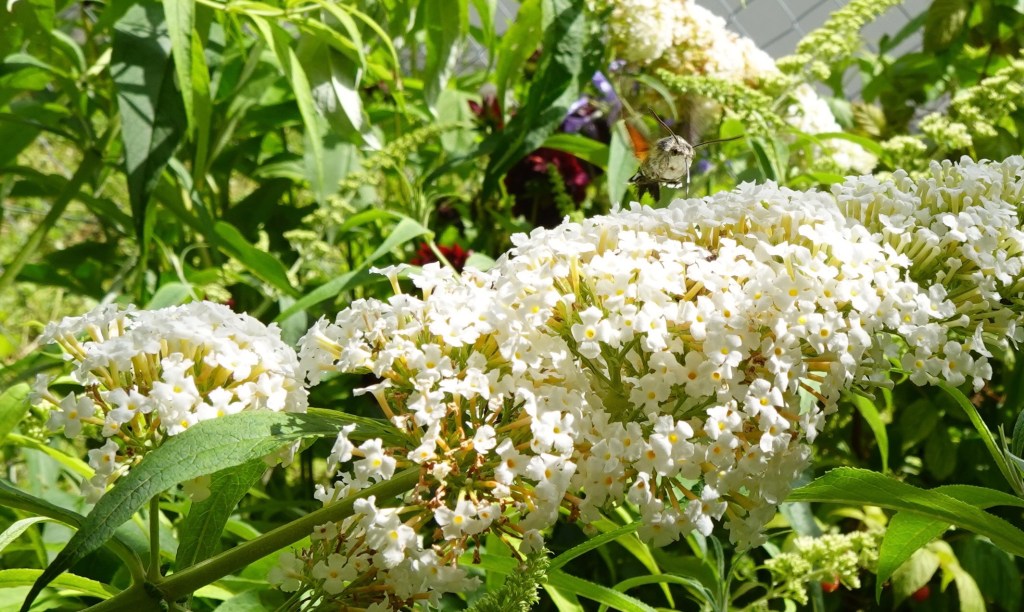
If you look carefully here you will see a hummingbird moth gathering nectar from these buddleia flowers. This little scene is an everyday one for me through the summer months, so it’s a good example of “l’émerveillement du quotidien” which I’ve written about many times on this blog. It’s that French phrase which I find hard to translate well into English, but it means something like “the marvel of the every day”. That’s my experience of life. There is something to be amazed by, something which stops me, and makes me wonder, something that delights me, every single day. In fact, usually, I have several such experiences, and every one of them makes my life richer.
These hummingbird moths are new to me since I emigrated from Scotland. I didn’t even know they existed till my first summer here. Now I recognise the deep thrum of their high speed wings before I see them. Like butterflies they seem to fly randomly, flitting from flower to flower, probing each one with a long thin proboscis. Can you see their incredible antennae? They are simply astonishing, beautiful creatures.
Isn’t it amazing how these bushes, commonly know as “butterfly bushes”, produce these long, tapering bunches of tiny flowers which give off a strong, delightful scent. I don’t know if it’s the scent or the colour which attracts all these pollinators but this mutually beneficial relationship between them makes it hard to imagine the one without the other.
I welcome constructive criticism and suggestions. I will not, however, tolerate abuse, rudeness or negativity, whether it is directed at me or other people. It has no place here. ANYONE making nasty comments will be banned.