Feeds:
Posts
Comments

Separate and whole

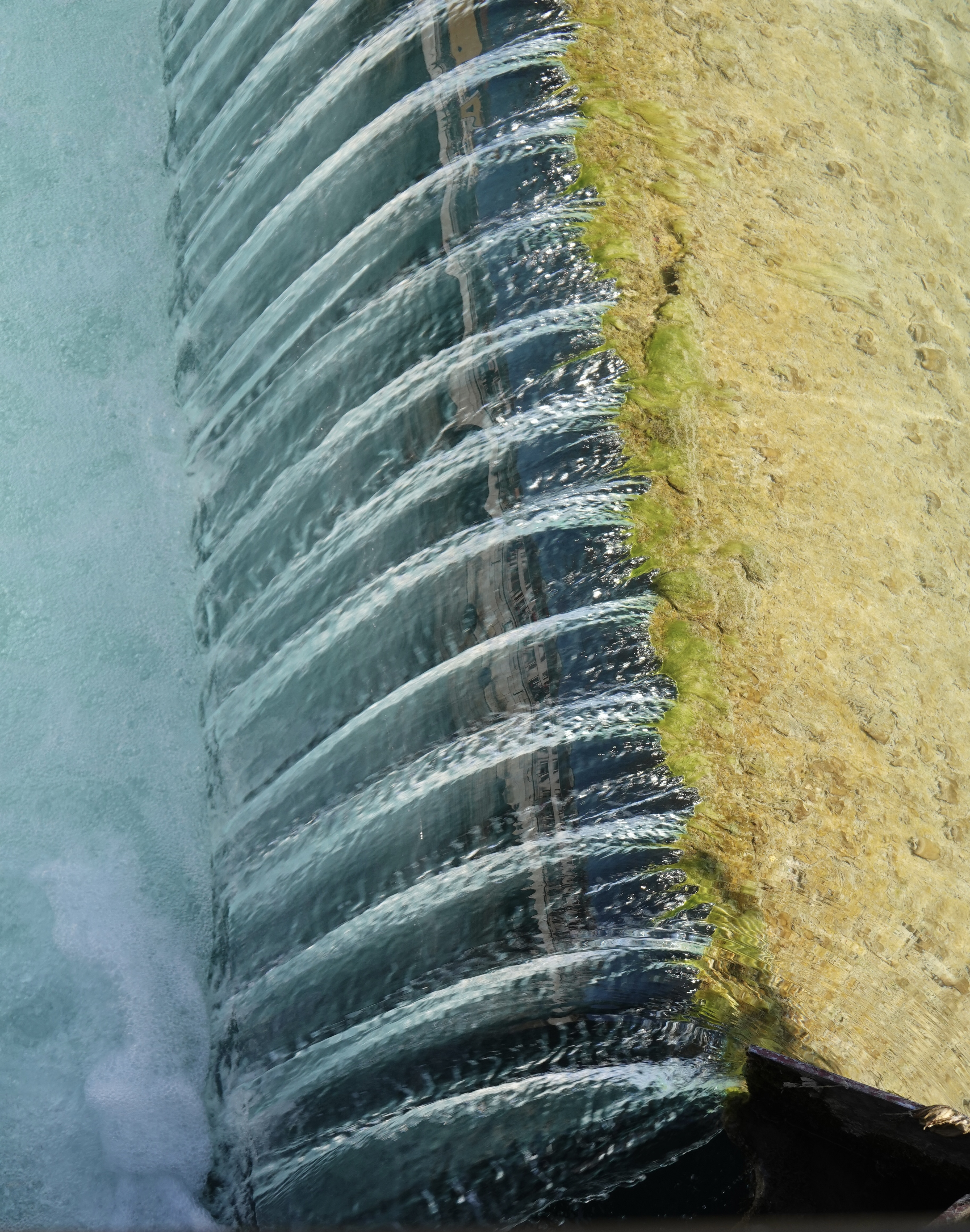
As the water flows over this weir, it seems to develop a distinct pattern of many parts. It’s almost as if there are suddenly dozens of almost parallel channels appearing as the water flows from right to left in this photo. Upstream the water seems to be of a whole. Downstream, after foaming and seething in a temporary chaos, it becomes whole again. But between the two phases of wholeness, and before the zone of chaos there is an area of organisation, where some of the water separates out enough from the surrounding water to appear almost like ropes, or pipes, or channels.

I look at this and I see how Life is. Life contains many paradoxes. It’s not “this or that”. All of Life is One, is Whole, and every moment produces distinct differences, so that every single path followed is unique. We are all separate, yet we are all of the same whole.

This separateness we live, this difference we experience, is temporary, and brief. Before we appear as individuals at birth, and until we breathe our last and slip away, there is no separateness. Isn’t that our challenge in life? To fully appreciate our uniqueness, our individuality, while never losing touch with the fact that we are a small, and transient, part of the whole. While never losing touch with the fact that we are intimately connected with every other uniqueness which is, which was, and which ever will be.

Life is flow. Life is change. Life is movement. Life is connection. And every life is unique.

Distinctions and nuances

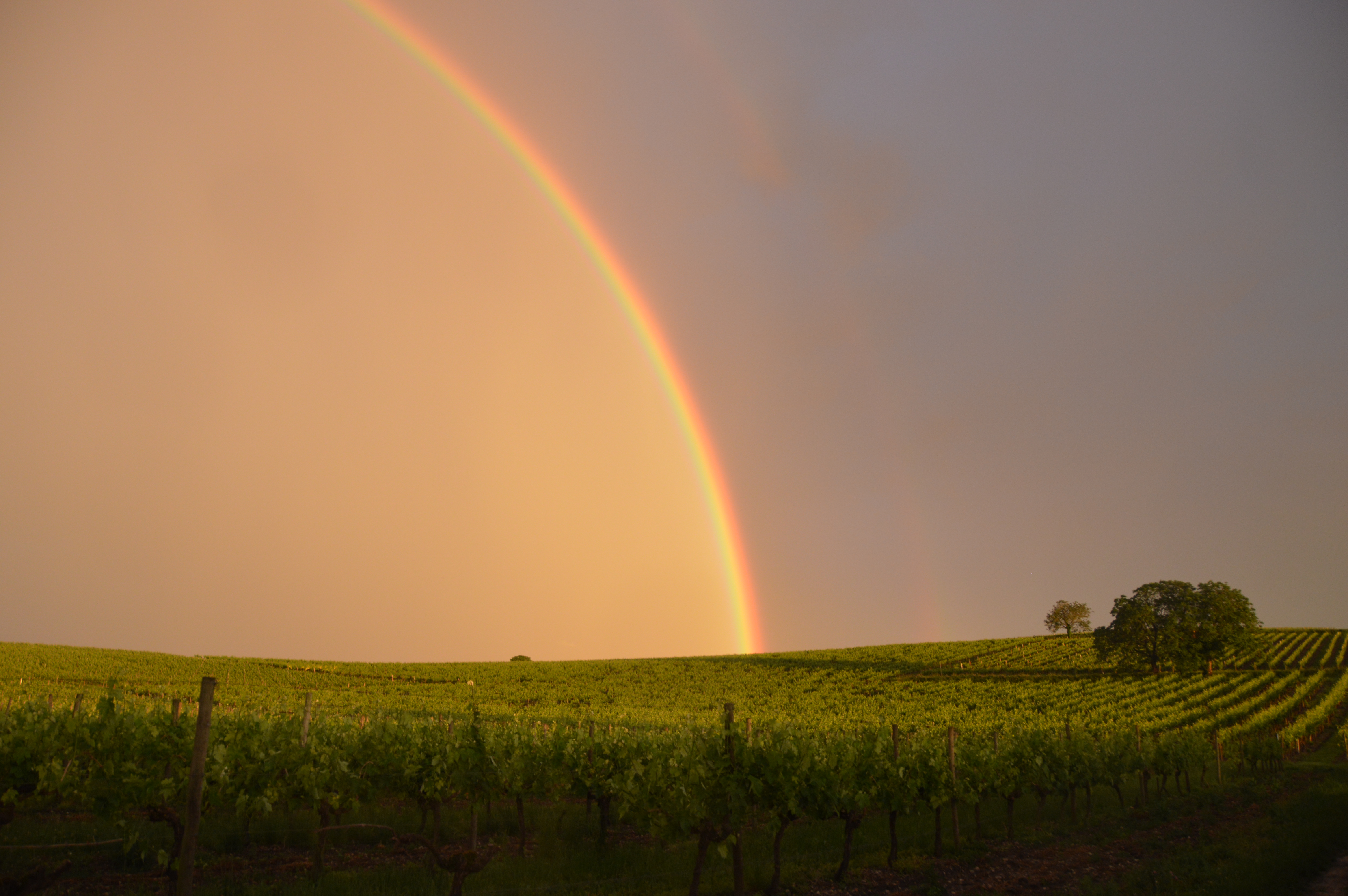
I read this yesterday (in a book by the Swiss author, Oliver Clerc) – if you take the seven colours of light in a rainbow (or in a prism) and blend them together, you get white.

But if you take the seven colours of the rainbow in paints and blend them together on a canvas, you get black.

Interesting, huh?

He says, the laws of the Spiritual realm (light) applied in the Material realm (paint), won’t necessarily produce the same outcome.

The context for this observation is one of his essays, where he explores one of the great paradoxes of reality – that in the Spiritual realm, All is One, but in our Material realm, we humans break up the flow of reality into separate sensations, elements and parts. Both are True. Our challenge is to hold both truths at the same time – to know that I am different from everyone else, but that I am also part of the same Unity as everyone, and everything, else.

By the way, in this essay, he also observes that with our sensory organs and our brains, we name seven colours as white light makes its way through a prism, and we name seven notes from all the sound we hear (to create a musical octave). We then learn how to discern and play with thousands of shades of colour, and thousands of musical notes. We need both – the distinct, “main” colours and notes, and the thousands of shades and nuances.

Webs of attraction

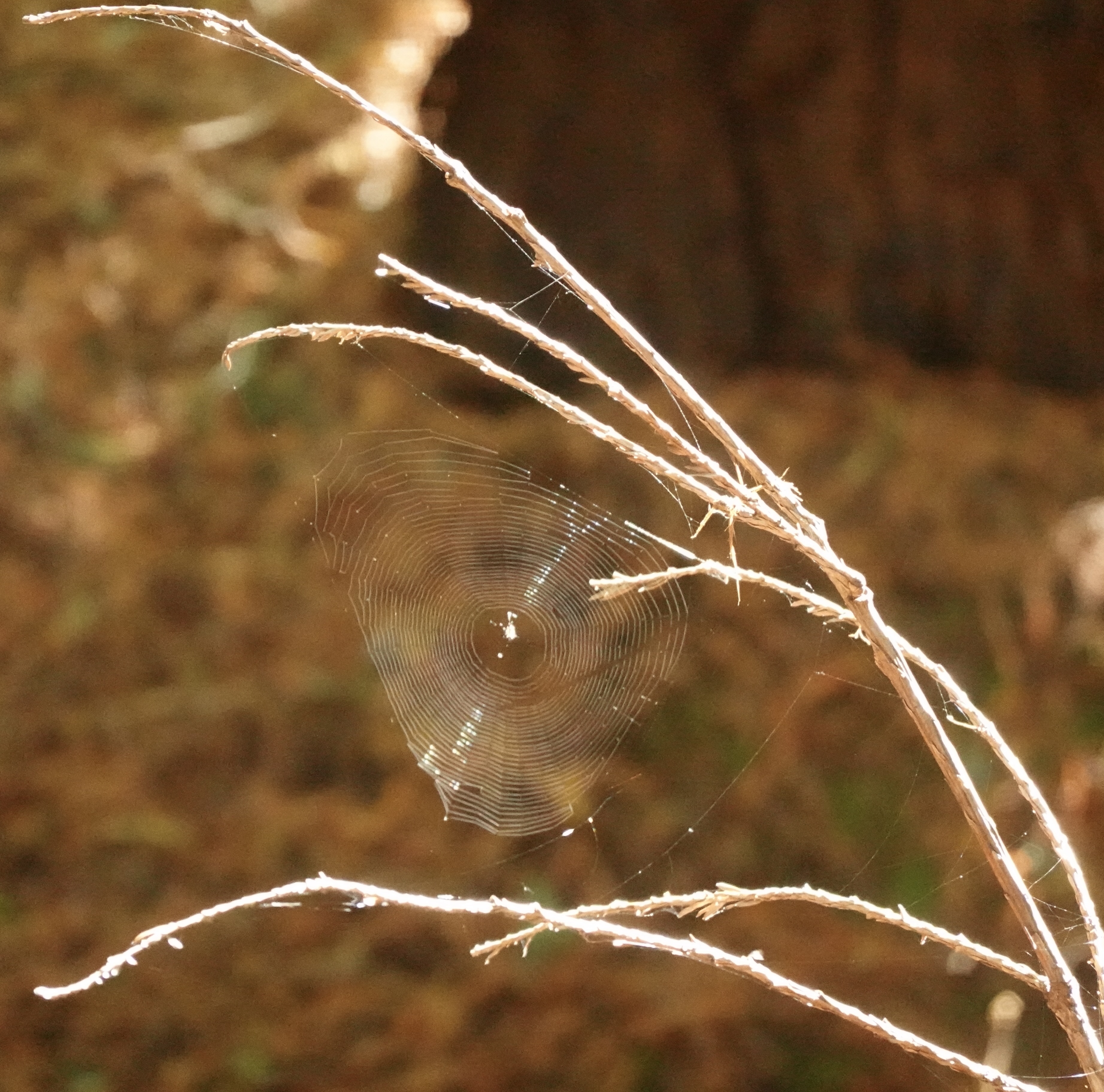
I’m irresistibly drawn to spider webs…..good job I’m not a fly!

They are frequently beautiful and frankly stunning. I never cease to be amazed by how a tiny creature can make something like this with only their own body. They have the knowledge, the skills and the resources to weave these webs. How did that come about? Isn’t it simply wonder-full?

What this photo inspires me to think about today is how I am “irresistibly drawn” to such creations. There is so much in our every day lives and surroundings which can capture our attention. In fact, don’t people talk now about an “attention economy”? Especially in social media with its dependence on advertising income at the core of its business model? They have to make “content” (I’m getting to hate that word!) which shocks, appalls, enrages, thrills or scares people, so they will stop, click the photo or the link and Kaching! more dollars to the companies involved. Meanwhile the people whose attention has been caught are left feeling shocked, appalled, enraged, thrilled or scared.

Is that how you want to be?

We can choose. We can choose where to direct our attention, and where to give our time and space. This web in the garden caught my attention, and created, for me, a moment of delight and wonder, leaving me curious, amazed and happy. I don’t click through on the most obvious “click baits” when I’m on social media, but I still get hooked in too much. It’s pretty pernicious. It’s the same with the “news cycle” of our mainstream media. How do you feel after watching today’s news programme? I feel more and more dissatisfied with what passes as journalism on mainstream media. When it isn’t superficial and repetitive, it seems too often to be full of conjecture and speculation rather than reports and analysis.

But we can choose.

Once we are aware of where our attention is going, and what’s being provoked, or evoked by whatever it is we are looking at, or listening to, we can take a more active, more conscious approach. That’s the basis of this entire blog – heroes not zombies – to move from being passive and reactive consumers, to creating the life stories we want to fashion. And here, in these posts, (if I’ve still got your attention, ha, ha), I hope you find inspiration, delight, joy, and wonder. That’s what I want to share with you.

Choose what you share, and become more aware of what you are paying attention to.

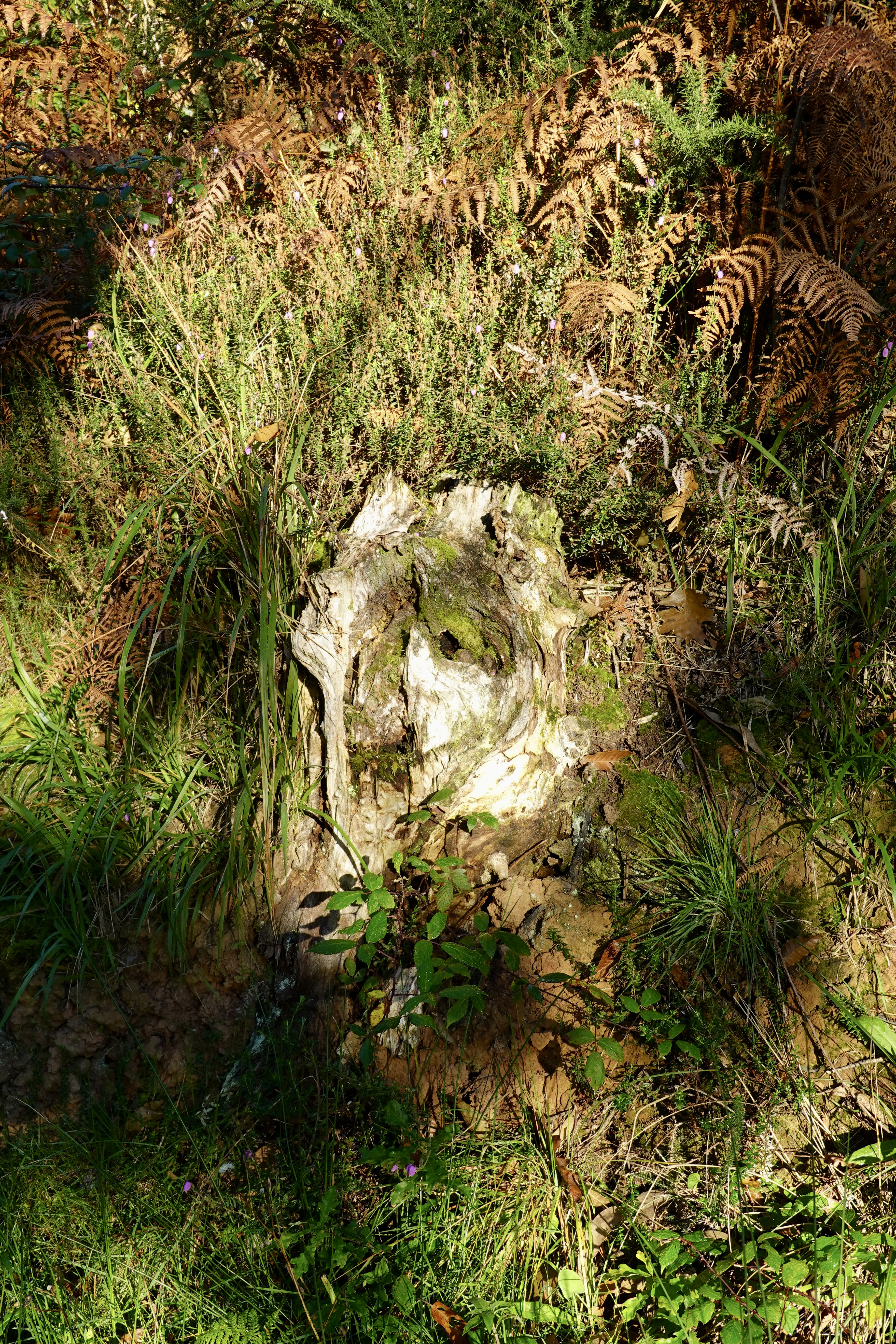
I took this photo earlier this year in a forest. What caught my eye was how the tree stump looked like a face, or the head of a wild animal.

Our brains have evolved a brilliant ability to notice patterns around us, and one of the patterns the brain is most attuned to is that of a face. We can see what looks like a face in a tree, a cliff, a rock, a bush….you name it. We also develop a great skill in recognising faces….even when we often completely forget the name of the person whose face we recognise. How many times are you watching a movie and you say “I recognise that actor. Who are they again?” And how often do you meet someone who you know you know, but because they are in a different context at this moment, you can’t for the life of you, remember their name? I used to find that a lot when I met nurses, or patients, who I only knew from the hospital, in the street, or in a shop. We recognise the face before we figure out who this person is.

But, back to the woods again……what patterns do you spot in a forest? Faces? Hearts? Something else? Whatever it is, I bet your experience is enhanced by your pattern recognition. It’s pleasing. It sparks wonder, delight and curiosity. We humans are great at creating layers of meaning over what we encounter in our every day. It makes life richer and deeper.

On reflection

One of the things I enjoy most about photography is taking the time to really look at the photos I’ve taken. I see things on review that I swear I didn’t see when I was actually there taking the photo. Or I see better something I had noticed, but didn’t take the time to look more closely while I was actually there. When either of those things happen it reminds me to slow down and pay attention in everyday life. I know some people feel that taking photos separates you from the moment, and maybe, in some ways, it does, but actually I find taking some photos, AND taking time to pay attention in the moment, AND reviewing the photos at home, (repeatedly), enhances the joy and pleasure I get out of life, and allows me to make more sense of the everyday.

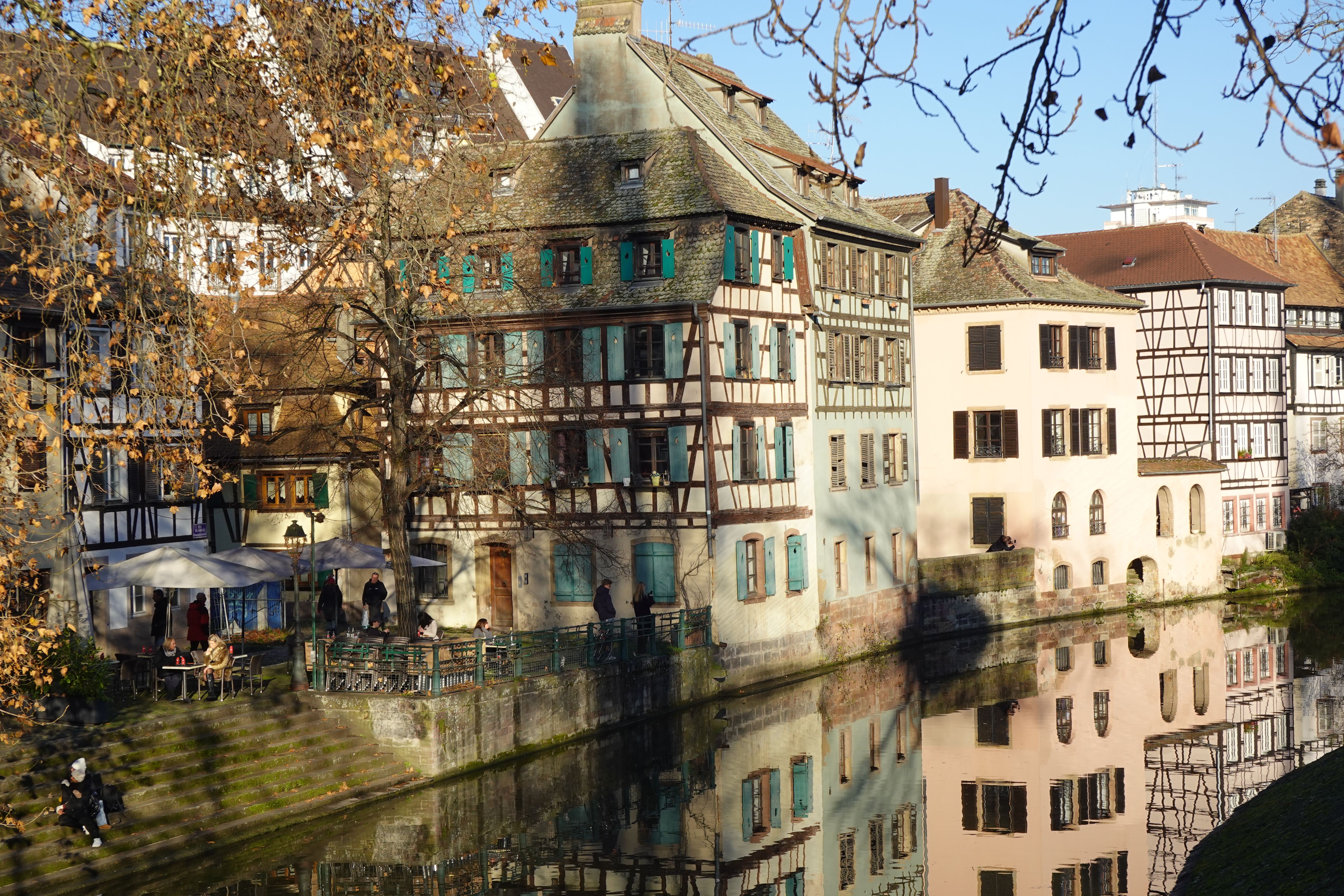
Here’s an example. I was in Strasbourg and noticed the beautiful reflections of the old buildings. Probably thousands of people have taken a photo like this, standing at the exact same spot as I was standing on this bridge. You can see that happening more and more as particular views and locations become “instagrammable”. However, just as in life, every photo is unique. I framed this particular shot, not just to capture the buildings and their reflections in the water but to include the couple sitting on the steps (bottom left of the image) – because I thought that made a more appealing composition.

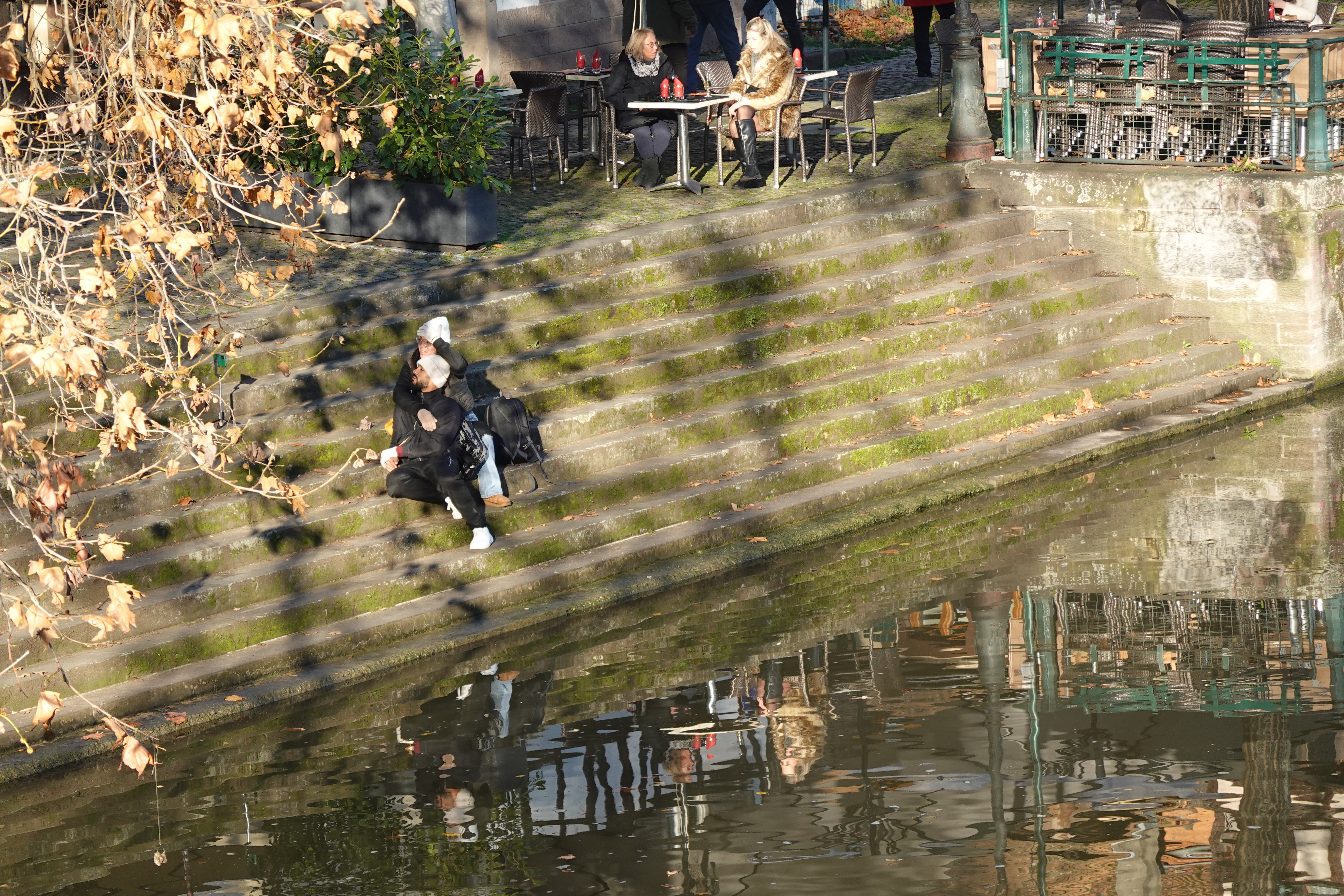
Having noticed them in the viewfinder, and taken the shot, I zoomed in to take a second photo, where the couple and their reflection in the water became the main subject. Here’s that second photo –

I think, at the time, my thought was, what a nice image of “reflection” this would be…..a reflection in the water, and a couple of people, well, reflecting (taking a moment).

But now that I’m revisiting these photos I’ve just seen something else. These people aren’t looking at the water, or the reflections. They are looking at something off screen to the left (there was a beautiful and very ancient tree growing at the end of the bridge. I think that’s maybe what they were looking at). Then I noticed something else. At first, I thought, oh, they’re sharing a pair of white gloves. Because it looks like they both have one gloved hand, and one ungloved hand. Now, sharing a pair of gloves is an interesting thing to do. I think I might have done that while we walked on a cold wintry day, with one hand gloved, and the other thrust deep into a jacket pocket….but, looking closer, I see that for each of them, the gloved hand is the left one. They are both wearing a left hand glove. Well, I’ve never seen anyone do that before. That sure makes me curious and stimulates my wonder and my imagination. What’s that about?

I do love it when a photo I’ve taken leads me off down very different paths of wonder the more closely I look at them.

I am convinced that taking photos, and reviewing them repeatedly, encourages me to reflect more….on the world, on other people, on my life, and on my every day experiences.

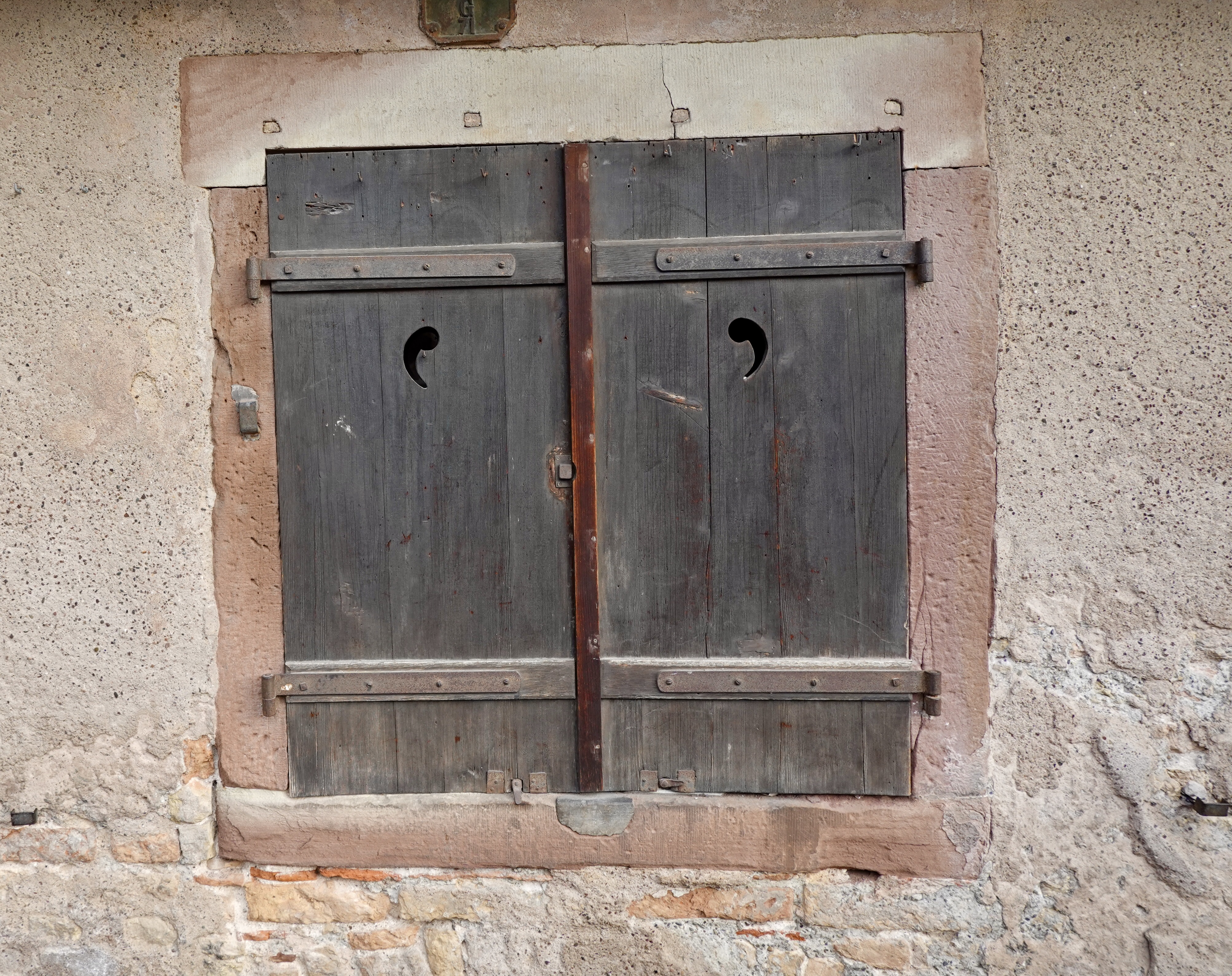
You could argue that these little “commas” cut out of the shutters covering this window are to let some light in. But if you wanted to let light into the room, you’d open the shutters, wouldn’t you? But maybe you just want some light in, not much. So why cut the holes into these carefully crafted shapes? Or maybe we need to think of this from the other side. Maybe these are holes to look out through….viewing points to see a bit of the world outside. But there again, why make them this shape? You know what? Maybe they aren’t carved for a utilitarian function. Maybe they are neither for letting in light, nor for facilitating observations of the street outside.

Maybe the creator just wanted to make something beautiful. Because they are beautiful, aren’t they? And without them, the shutters would look pretty, well, uninteresting. It’s the comma-shaped holes which have caught my attention, made me pause, take a photo, and return to it again to wonder……what are these all about? Who made them? Questions to which I’ll never find the answers. But, this much is sure…..they bring me a moment of delight and wonder…..”l’emerveillement du quotidien“.

I’ve looked at these shutters several times now, spent some time with them, reflecting, and wondering. But this morning, something else comes up – don’t they suggest a word? If you look at them, there is one on the left, a space, then another on the right, and if you saw them on a page like that, you’d assume that in that space there should be a word. Wouldn’t you? A word. Or a quotation.

So, here’s something to play with today…….what word, or what words, would write in this particular space?

Failing to grasp matter

I love a misty morning like this. I love how the mist blurs and obscures the landscape. Soon after getting home from taking this photo I read this, in Iain McGilchrist’s “The Matter with Things”

The atom has the curious property that while from a distance it has a blurry self-consistency, it does not become clearer, but more indistinct, as you zoom in, so that there is less and less to see, until it evades your grasp entirely.

The physicist, Carlo Rovelli, writes beautifully about this subject

A handful of elementary particles, which vibrate and fluctuate constantly between existence and non-existence and swarm in space even when it seems that there is nothing there, combine together to infinity like the letters of a cosmic alphabet to tell the immense history of galaxies, of the innumerable stars, of sunlight, of mountains, woods and fields of grain, of the smiling faces of the young at parties, and of the night sky studded with stars.

Can you imagine? Shift your perspective from a world filled with “solid” unchanging objects, to one of “elementary particles, which vibrate and fluctuate constantly between existence and non-existence” and how does the world look? As he writes elsewhere, the universe isn’t made of solid objects but of relationships and events. That’s quite a different way to perceive reality, don’t you think?

Writing this just now I find my mind calling up one of the books which changed my thinking about health care – Hans-Georg Gadamer’s “Enigma of Health”. In those essays he makes it clear that health isn’t an object we can measure, or a product we can make. Think of it this way. Chances are you are not particularly aware of your right thumb at this very moment, but trap it in a car door, and you become instantly extremely, excruciatingly aware of it! But once that injured thumb has healed, it fades into the background again. We doctors are taught a lot about pathology and the natural history of diseases. But “health”? It’s not even easy to define. We can become aware of the parts of our body which are diseased, but it’s pretty difficult to notice actual health…..that’s the enigma….as you heal, the diseased part becomes kind of invisible again.

Here’s a photo I took on the nearby Ile d’Oleron one day –

And here’s a passage from Carlo Rovelli, which goes well with this image –

The world is not a collection of things, it is a collection of events. The difference between things and events is that things persist in time, events have a limited duration. A stone is a prototypical ‘thing’: we can ask ourselves where it will be tomorrow. The world is made up of networks of kisses, not stones.

The universe isn’t as solid or fixed as we often assume. And I think that’s beautiful.

Calling all souls….

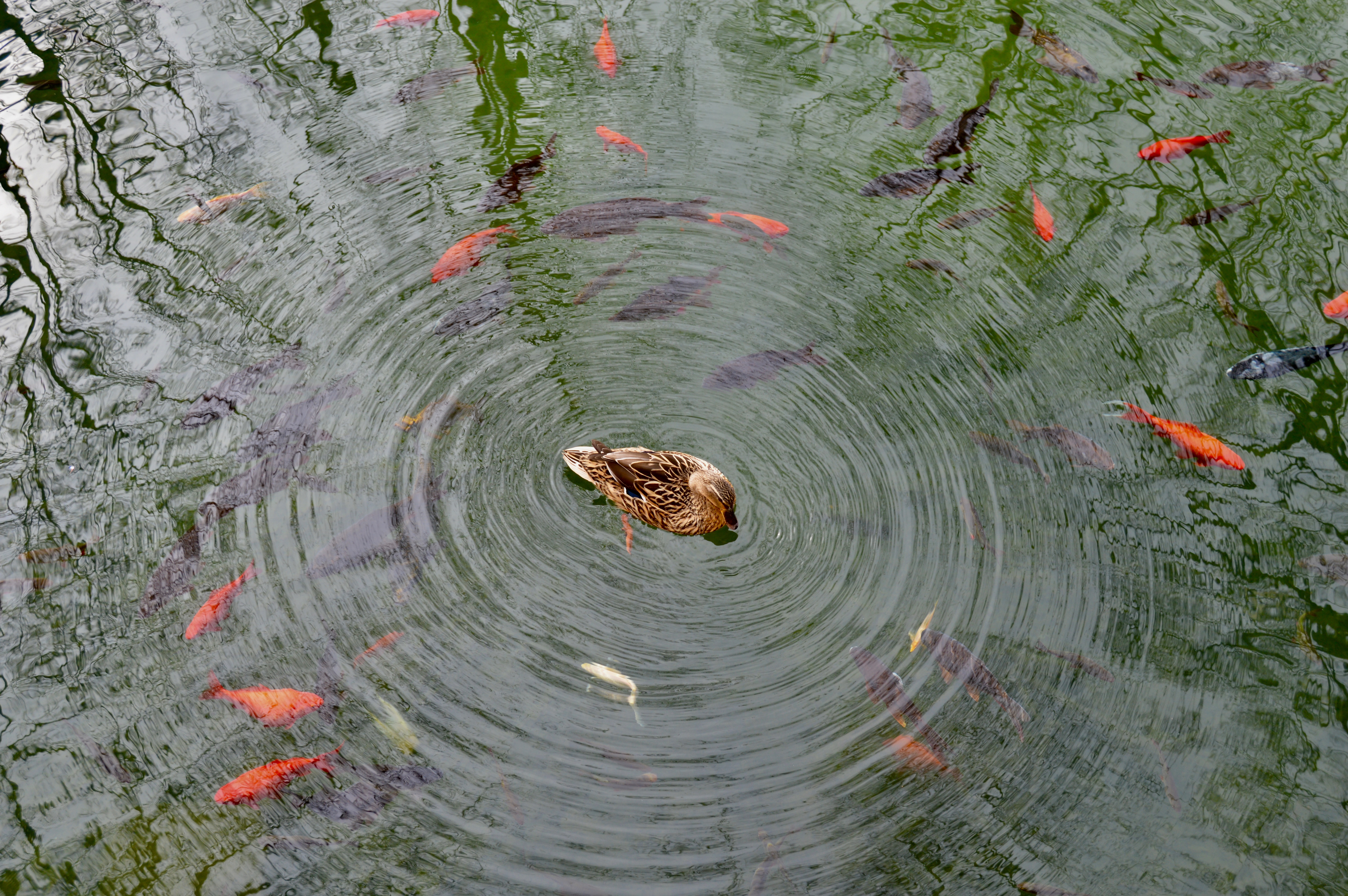
This is one of my favourite photos. It shows two things which always fascinate me. Firstly, the duck, which is apparently just sitting on the water is sending out ripples across the surface in the most beautiful pattern of concentric circles. Secondly, the fish appear to swimming around the duck, some even following the actual ripples.

This is a great example of how just by living we change the world around us and influence the lives of others.

D H Lawrence said –

As we live, we are transmitters of life.

When I’ve looked at this photo in the past, I’ve been struck by how we “influencers”, but, after reading this sentence by Lawrence, I think “transmitters” is a better word to use. Besides, “influencers” has become synonymous with marketers, and, in so doing, has lost some of its beauty for me.

We transmit life just by living. As I breathe, as I consume food and drink, as I digest, as move around this little planet, I change the air, the water, the soil, as I go. As I think, and feel, and imagine, and communicate, I change the lives of others. This blog, which really started just as a personal space to gather things that interest me, has, over the years, become a transmitter. I know that from the feedback I receive from people all over the world. That’s become an explicit part of my writing here. I want to share my life experiences. I want to share my photos, my words, in the hope that you, and maybe others you know, will be touched by them, inspired by them. I hope what I create here brings you some joy, evokes some wonder and reflection, and brightens your everyday. Because, creating these posts, does that for me!

We are transmitters of life, and each of us leads a unique, special, life. We are transmitters of life through our personal stories, none of us telling an identical story to another person. We are transmitters of life through our actions and our thoughts. Collectively, we humans shape and sculpt the Earth. We should stay conscious of that. It’ll help us make better choices.

Two worlds

I’ve been thinking about the value of Art recently, partly in relation to words I’m wary of.…like “utility”, and partly in relation to an article I read about culture and health.

Then, today, I remembered a scene from The Forsyte Saga, which I think the problem of communication between those who appreciate Art, and those who have a much more utilitarian mindset, is portrayed brilliantly by these two actors, Gina McKee, and Damian Lewis.

C.P. Snow famously described the “two cultures” of science and the humanities. However, I think the clash of world views can’t be neatly fitted into these two domains of learning. Rather, I think Iain McGilchrist’s explanation of the two types of focus which we use when we are using our left and right hemispheres, is a better one. It’s pretty clear that issues of utility and manipulation are in the domain of the left hemisphere, and that our appreciation of connections, and values, requires our use of the right hemisphere.

If you search my blog for “divided brain”, you’ll find some posts where I summarise some of his explanations. Alternatively, start here.

Culture and health

I read an article in the Guardian today entitled “Consuming arts and culture is good for health and wellbeing, research finds” It caught my eye – first because I thought consuming arts and culture ??!! I hate that. I don’t consume arts, I experience/enjoy/participate in…..not consume…. and what is culture anyway? Well, let’s leave that issue for another day. The next thought I had was “I don’t enjoy arts in order to improve my health or wellbeing, and this headline leads me to think these folk are about to try and justify arts on the basis of their utility. But, in fact, the article is even worse than the headline suggests. Here’s how it begins –

Most people are familiar with the buzz that attending a memorable play, film, concert or art exhibition can trigger. But now it is official: consuming culture is good for your health and wellbeing – and generates £8bn a year worth of improvements in people’s quality of life and higher productivity.

Seriously? I might have felt a “buzz” but, “now it is official” – “it generates £8bn a year of improvements in people’s quality of life and higher productivity”. Oh, thank goodness they’ve quantified that. Otherwise I’d have been stuck with my personal delusion that I was just enjoying something, or that it was adding meaning to my life!

Look, I understand what these people are doing, and, at one level, I commend them for it. They are trying to make an economic case for what isn’t measurable. We can’t measure paintings, poems or music. We can’t even really measure “health and wellbeing” (instead we invent questionnaires, the answers to which we allocate scores, then we say we are measuring the invisible – ok, another controversial view I can return to another day) They are claiming that, for example, going to a weekly drawing class at a museum is worth £1310 to each person from “going to see their GP less and feeling better about their lives”. Really? £1310? Not £1315? These apparently definite figures remind me of the old joke that 86.57% of statistics are made up……but, good on them for trying to make the case for arts funding to governments and policy makers who seem to understand only sums and measurements.

But, fundamentally, this makes me hugely uncomfortable. Can’t we make a case for the place of arts “and culture” in our lives without reducing them to arbitrary financial “values”, or so-called “measurements”. I don’t need any of those justifications to play music every day, to write, to read novels, to visit galleries and delight in their works, to feel the connections to their creators……

However, I read, just the other day, that more and more universities in the UK are closing down their Humanities courses, claiming that students don’t want them because they don’t see how they can lead to remunerative employment. Oh goodness, what has happened to our idea of education? What have we reduced that to? Is education only valuable if it lets you get a job managing a McDonalds outlet, or selling people “stuff”?

I hope reports like this one do stimulate debate about the Humanities. I hope they stimulate debate about what makes our lives valuable and meaningful. Meanwhile…..I’m going to continue taking photos, writing, sharing my creativity. I’m going to continue listening to music, reading novels, visiting museums and galleries – because those are some of the activities that bring me joy, that amaze me, that make me think, that help create meaning in my life. If all that contributes positively to my “health and wellbeing”, then so be it. But that’s not the reason I’ll keep filling my daily life with “arts and culture”.