Feeds:
Posts
Comments

Seeing

Stone cross

We seek out difference all the time. We look for the edges of things, for their boundaries, in order to see them clearly.
But nothing exists in a vacuum.
Every”thing” we see we have abstracted from its context. We focus on only some of what we see in order to see what we are focusing on.
I’ve read there are no foregrounds without backgrounds.

If it’s true that every”thing” is inextricably linked to its environment and is constantly changing or evolving, then we should be wary of this whole process of separating and labelling.

The beauty in the above image is, I think, in the interplay between the wall and the cross, each of which would be diminished by the removal of the other.

Cloisters

The way of the Spirit

Cloister

The way, the light

There is something special about cloisters. I love these open, covered, arched passageways around a garden. The light, the temperature, the silence….they slow life down and draw you deep into the present moment.

Poppy petals

In the A to Z of Becoming, O is for “open”.

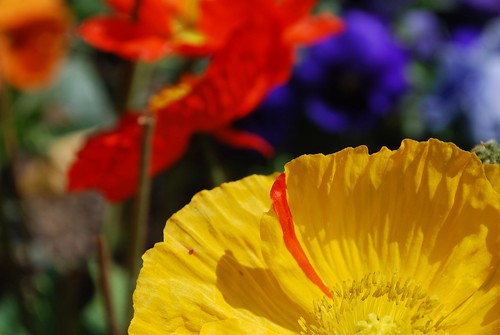
One of the most beautiful sights in Nature is the opening up of a flower (just like these poppies I photographed yesterday). So, in what ways can we “open” this week?

Open your mind. Many, many years ago I noticed graffiti on a wall in San Francisco, which said “Minds are like parachutes, they work best when they are open”. The General Semanticists say that “judgement stops thought”. When we “make up our minds” we often close them. I’m not saying you shouldn’t decide anything but it might be a good experiment now and again to keep an open mind, instead of coming down with certainty one way or another. We can also open our minds by opening ourselves up to new opportunities, new sights, new music, new tastes….in other words why not try something different this week, and see what it opens up for you?

Open your hands. Don’t grasp. Don’t cling. Can you let go? Accept? Just try this little experiment – make a fist with your hand, scrunch it up tightly. What feelings come with that gesture? Now, relax your fingers, and turn your hand palm upwards. What feelings arise now?

Open your heart. Approach people this week with an open heart, prepared to be kind, to be loving and accepting. What flows when you open your heart? (Another take on opening your heart to someone is to express your true feelings to them)

Let me tell you a strange story. I’m having a short holiday in Pézenas in the South of France. As the weekend approached I started to think about my Sunday blog post, the one about the A to Z of Becoming. This week it was to be “O for open” so I got to wondering about opening minds, opening hands and opening hearts. I wandered into the bookshop in Pézenas and browsed. The bookshop here is mainly a newsagent and stationers. They don’t have a lot of books, but there was a pile on a table. One caught my eye “L’Âme du monde” by Frédéric Lenoir. I’d never seen or heard of this book before but the “soul of the world” title caught my fancy. I picked it up and flicked it open to a random place, which turned out to be the start of a chapter. The chapter title? “Ouvre ton coeur” – “open your heart”.

I don’t know. You explain it!

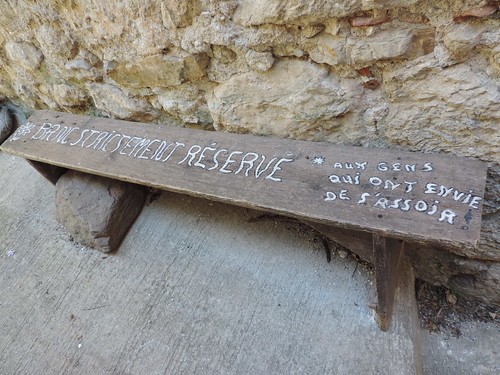
Strictly reserved

Translated, the message is “This bench is strictly reserved…..for people who really need to sit down”

I like it!

Door restore

This restored door in Pézenas reminded me of the story the ship whose planks were gradually replaced one by one until none of the original planks were left. Was it still the same ship?
And what about our ever changing bodies with new cells replacing old ones every day so that very few cells remain after a few years…..yet we are still ourselves. Aren’t we?

This miracle of perpetual change which allows a sense of continuity and consistency.

Pézenas

Relaxing in Pézenas for a few days. Tell me, look at this environment, don’t you think our physical environment, natural and built, influences the way we feel, the way we think, the way we are?

If you still aren’t sure, look at St-Guilhem-le-désert (one of the most beautiful villages in France).

St Guilhem-le-désert

Today I walked around these old streets, had lunch under the 150 year “King of the Platânes” in the main square, and felt, this is a sacred place, a place of beauty, of spirit, of wholeness.

I love the experience of “sacred places” – those places where you feel something extraordinary. Which places are sacred places for you?

Simple

I don’t know what this is but isn’t the simplicity of this just beautiful?

Lewis Hyde, in the excellent, “The Gift” writes about the origins of the word “dose”

The French etymologist Benveniste writes: ‘There is a … medical usage in which [the Greek word] dósis denotes the act of giving, whence develops the sense of the amount of medicine given, a “dose” … This sense passed by loan translation into German, where Gift, like Gr.-Lat. dósis, was used as a substitute for venēnum, “poison.”

How fascinating that it began as a gift, and how sad that it turned into poison!

Nourish.

Franschhoek

What about making this your verb of the week? What about asking yourself about your choices and your actions every day…..is this nourishing me? What, or who am I nourishing?

I imagine when you think of nourishing, first of all you think of food and feeding…..which makes me instantly think about two stories – the one from Native American tradition of the hungry wolves –

One evening an old Cherokee warrior told his grandson about a battle that goes on inside all people. He said, ‘My son, the battle is between two ‘wolves’ inside us all. One is Evil. It is anger, envy, jealousy, sorrow, regret, greed, arrogance, self-pity, guilt, resentment, inferiority, lies, false pride, superiority, and ego. The other is Good. It is joy, peace, love, hope, serenity, humility, kindness, benevolence, empathy, generosity, truth, compassion and faith.’ The grandson thought about it for a minute and then asked his grandfather: ‘Which wolf wins?’ The old Cherokee simply replied. The one you feed.’

and the one from Thich Nhat Hahn about watering seeds –

Your mind is like a piece of land planted with many different kinds of seeds: seeds of joy, peace, mindfulness, understanding, and love; seeds of craving, anger, fear, hate, and forgetfulness. These wholesome and unwholesome seeds are always there, sleeping in the soil of your mind. The quality of your life depends on the seeds you water. If you plant tomato seeds in your gardens, tomatoes will grow. Just so, if you water a seed of peace in your mind, peace will grow. When the seeds of happiness in you are watered, you will become happy. When the seed of anger in you is watered, you will become angry. The seeds that are watered frequently are those that will grow strong.

So, let’s think about nourishing the body, the mind and the spirit.

Main course

I’ve often been asked about dietary advice and my response is to say we are all different and what is good for one person at one time, might not be so good for another or at another time. I like Michael Pollan’s Food Rules – especially….”eat food”, “mainly plants”, “not too much”! But have a think when you eat this week, “is this nourishing for me?”

meditation

When if comes to the mind, are you aware of certain thoughts or feelings being more nourishing than others? When you worry, does that feeling nourishing? When you ruminate, does that feel nourishing? When you make goals, think positively, focus on the present, does that nourish you?

flourish

And when it comes to the spirit, I’d take a little while to explore what nourishes your soul – your soul as Thomas Moore describes it – think how we use the word “soul” – soul food, soul music, soul mate – what are those for you? What is your soul food, which music stirs your soul, who are your soul mates? Are there special places you can go to nourish your soul? How might you nourish your soul?

So, why not take a focus on nourishing this week? Nourish your body, nourish your mind, nourish your spirit, nourish those others who you encounter this week, nourish your world……

In the wonderful “The Republic of Tea” Mel says

The whole problem with Western civilisation is that ever since the Greeks we’ve been trying to squeeze the mind into the brain and it won’t fit.

Wonderful!

My first thought was Alva Nöe’s point in “Out of our Heads” – “Brains don’t have minds, people do”

Then I recalled Dan Seigel’s definition of mind as being an “embodied inter-relational process of regulation of energy and information flow” – which certainly doesn’t fit the mind into the brain!

Andy Clark talks about the “extended mind” in his “Supersizing the Mind” –

According to BRAINBOUND, the (nonneural) body is just the sensor and effector system of the brain, and the rest of the world is just the arena in which adaptive problems get posed and in which the brain-body system must sense and act.
Maximally opposed to BRAINBOUND is a view according to which thinking and cognizing may (at times) depend directly and noninstrumentally upon the ongoing work of the body and/or the extraorganismic environment. Call this model EXTENDED. According to EXTENDED, the actual local operations that realise certain forms of human cognizing include inextricable tangles of feedback, feed-forward, and feed-around loops; loops that promiscuously criss-cross the boundaries of brain, body and world. The local mechanisms of mind, if this is correct, are not all in the head. Cognition leaks out into body and world.

And then there was that recent map of body emotions which showed where we locate different emotions (certainly not just in our brains!)

But the mention of the brain-based focus of Western civilisation since the time of the Greeks producing such limits to our understanding, I couldn’t help thinking again of Iain McGilchrist and how I’m sure he’d say it’s not just that we’ve been trying to squeeze the mind into the brain, but that we’ve been tried to squeeze it into the left hemisphere!