Feeds:
Posts
Comments

Resilience

If control is a delusion, and it’s pursuit is ultimately futile, what would be a better strategy? Given the complexity of human, social and global life, accurate predictions are not feasible. The grander the scale of the prediction, the more likely it will turn out to be wrong.
However, at a personal level, we need some degree of predictability in life, some sense that not all of life is random or chaotic. Maybe a better strategy is to expect the typical but be prepared to cope with the atypical. You can apply this idea at any level – personal, political, economic, or environmental.
What we need in order to cope better with the unpredictability of reality is resilience.

But what is resilience?
Resilience involves a number of different factors and characteristics. Let’s examine some of them briefly, just to lay out a map for further exploration.
Take a look at these photos of bamboo.

bamboo

bamboo shadow leaves

Bamboo has two essential qualities which make it so resilient. Strength and flexibility.
At first glance, these can seem like two mutually opposite qualities. How can something be  both flexible and strong? How can something bend and resist? How can you change and not change?
Resilience involves many factors but let’s first examine these two apparently contradictory ones. Both are needed, and neither can be considered either superior to the other, or more essential than the other.

The ability change or adapt.
Flexibility is the ability to adapt to changing circumstances or environments. We may have to change our behaviour if we find ourselves in changed situations. If we can only behave in one particular way, then that lack of flexibility, that inability to change what we do, reduces our capacity to adapt, and therefore our resilience. We are less able to cope with change when we ourselves are unable to change.
Along with flexibility, we need spontaneity. An inability to be spontaneous will restrict our options, reduce our choices and our strategies for successful coping. Spontaneity involves not only a change in behaviour, but new behaviour. In biological and physical terms such new behaviour has been termed “emergence”. Emergence is the capacity of a system to exhibit previously unseen behaviours. This is a core creative process. Creativity is the ability to make, or see, things anew. It’s the ability to make changes, to make a difference. Creativity, of course, is highly dependent on imagination. Without imagination, how can we move to somewhere we’ve never been before? A change of behaviour is not, of course, always about brand new actions. It can be a change to a previously learned strategy, one which worked before in similar circumstances. In other words, the flexible aspect of resilience also involves the ability to learn, and that entails both memory and communication (after all one of our greatest strengths as a species is our ability to learn from others – our ability to communicate over space and time)
The other side of resilience is the ability to resist change. There’s something about the coherence and integrity of a system that requires strength, stamina and the determination to pursue a particular path. If I try to change to fit in with every change of everyone around me, I’ll begin to lose my sense of self. To be resilient I need energy, strength, the ability to persist in the face of adversity. I need the capacity to conserve my life, my health, the capacity to sustain and to persist to a significant degree.
So there’s the paradox at the heart of resilience – flexibility and sustainability. The ability to change and the ability to persist.
I think this is our agenda for the future at all levels. Changing our focus from control to resilience. We need a new politics, a new economics and a new way of living based on resilience, not illusory control.

One of the most amazing capabilities of the human mind is the imagination. However, this great ability brings certain difficulties, not least of which is being able to imagine our own mortality. It’s this existential fear which underlies most, if not all, other specific fears. Whilst very few people actually believe it’s possible to escape death, most of us find it difficult to face the reality of our own mortality. We seem to have no control over such significant events as our own birth or death. The apparent randomness and chaos of the universe has driven human beings to pursue ways of living which enable them to cope with all the daily uncertainties which arise. Over the course of several hundred years we have moved from strategies based on beliefs in supernatural forces which are in control of everything to ones based on beliefs that human beings can be in control of everything. In effect, we’ve seen the decline of religion’s power to give a sense of things being in control and a rise in the belief that science endows humans with such power.
In many cultures the supernatural forces in control of everything are not necessarily benevolent, and even when they are considered to be benevolent their actions are still not predictable. In attempts to assuage the feelings of fear and uncertainty rituals and sacrifices were created to try to influence the actions of the gods. Even with the emergence of monotheistic religions based on a belief in a loving Creator God, human beings were still not able to predict His actions. At best, a Christian, Jew or Muslim, finds peace of mind by letting go of the pursuit of predictability and certainty by trusting that God is benevolent and all will not only be well, but all that happens is, as God wishes, the best for us. Fundamentalists of all flavours, however, do not seem comfortable to leave Life and the World to God, but instead feel driven to impose strict behaviours and even thought patterns on believers and non-believers alike.
With the Renaissance and the developments of rationalism and the “scientific method”, human beings began to believe they could develop deep understandings of life and the universe. We began to use observations, logic and experiment to create “laws” based on highly predictable patterns. We have pursued this path relentlessly for the last 400 years. This shift in focus from the supernatural to the natural has, however, been focused on the same goal – the minimisation of uncertainty, and the parallel maximisation of feelings of control. Physicists still pursue the “theory of everything” in an attempt to use that understanding to control everything.
But control is still beyond our grasp. We are still mortal. None of us can know the exact span of our lives in advance and we find we can neither control ourselves nor others. We can neither predict nor determine the future, at any level – individual, communal or global. At an individual level we drive away the fear of chaos and unpredictability by settling into routines and rituals. One of my favourite novels of all time is “Rituals”, by Cees Nooteboom, (ISBN 1-86046-048-8), a story of a father and son who each have their powerful (and constraining) ways of imposing their personal power on their own lives through ritual, in the father’s case, through a strict set of time set routines which establish the value of punctuality as the highest of all his values, and in the son, through his fascination with Japanese pottery, and the tea ceremony. We all need routines and rhythms to our lives but when the need for control dominates these routines can become obsessions and compulsions, limiting our lives instead of stimulating growth.
At the communal level we seem to be moving fast towards George Orwell’s nightmare “1984” vision of increasing surveillance and attempts to control “unhealthy behaviours” whilst experiencing increasing levels of chronic disease and crime. A day or two after I started to write this post I read a review of Jim Jarmusch’s new movie “Limits of Control” where the author cited an essay by William Burroughs as the source of the movie’s title.  (see “how to make a zombie” )
In recent years governments have acted as if they have the power to control global phenomena when all they have is actually the power to make an impact. The consequences of each action, of each impact, turn out to be both unpredictable and uncontrollable. We see this in War (Iraq, Afghanistan etc); we see it in the economy (credit crunch, “boom and bust” cycles, the fall of the “Masters of the Universe”); we see it in climate change; we see it in rising levels of crime, drug abuse, and chronic disease.
Control is a delusion.
It was a delusion when human beings thought they could influence supernatural forces and it remains a delusion when human beings think they can control individual, social or global phenomena.
It’s frightening to be “out of control”. Yet, the relentless pursuit of more control just creates more and more anxiety as at our deepest levels we realise control continuously escapes our grasp. A greater risk from this control agenda is that we create ever more zombies, and lose our chance to become ever more human.
It’s time for a new direction. We have to replace the pursuit of control with something else. Something more real, and, therefore, something more to likely support human life, and to encourage development.
What might the new direction be?  A shift from increasing control to increasing resilience. Letting go of the pursuit of certainty and relishing the experience of the present, the wonder of life and the excitement of creation. Moving towards an agenda of adaptability and sustainability, of quality over quantity. Pursuing diversity instead of standardisation and valuing continual, dynamic experience over goals and outcomes.

Today I took a short trip on the train from Kyoto to Inari.
When you get off the train in Inari Station, turn left, then immediately up the first road on your right you’ll see the first two of 10,000 Torii gates winding up the hillside on which the shrine is built.

inari

Once you’ve climbed to the top of the hill you can look back to where you started and out over the whole of Kyoto.

See the same two gates in the distance?

inari and kyoto

That photo is taken with my zoom lens at full stretch. Look what happens as I pull it back up.

inari and kyoto

……and finally…..with minimum zoom…..(can you still see the gates?)

inari and kyoto

This shrine was originally dedicated to the God of rice, but is now more generally dedicated to prosperity. Each of the 10000 gates is donated by an individual or business hoping for prosperity. Foxes are believed to be the animals which guard the shrine and there are lots of stone ones to be seen (but I didn’t see any live ones).
The gates wind up and up the hillside. It’s quite a climb, especially on day like today when the temperature was 26C, but the gates are so close together that they form long shaded tunnels.

Fushimi Inari Shrine Torii Gates

The gates thread their way through the wooded hillside and near the top you can wander off through forest paths…

Fushimi Inari Shrine Torii Gates
Fushimi Inari Shrine
Fushimi Inari Shrine Torii Gates

I have never experienced anything quite like this. I’ve talked before about “emerveillement” and I strongly believe we need for re-enchantment in our overly materialist attitude to world. Places like this are known as sacred places. To walk in them, to sit in them, to breathe and listen and look around in them, it’s not hard to understand why. Magical.

Fushimi Inari Shrine

helleborus

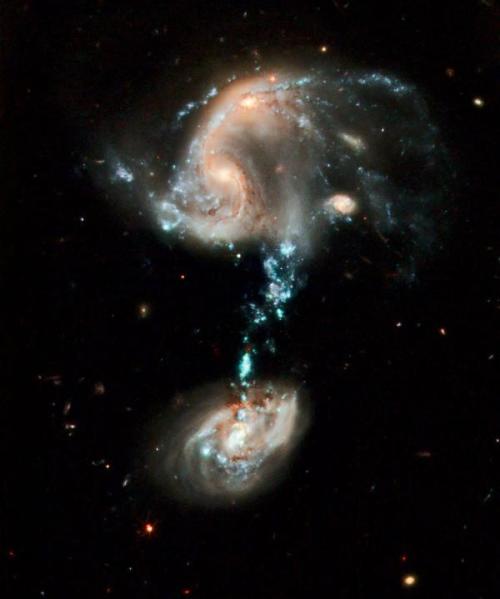
galaxy

This is not the usual sort of thing for me to post but I just came across this photo from the Hubble telescope and I’ve gone back to it again and again. It’s awe-inspiring. It’s amazing. It’s wonderful.

It’s a couple of galaxies interacting 200 million light years away from here. Between them is this “fountain” of new stars. The distance from the bottom of the lower galaxy to the top of the upper one is 100,000 light years!

Breath-taking

Carrying a camera

I’ve posted before about the value of carrying a camera everywhere. I’ve got two cameras (well, three if you count my mobile phone), a Nikon D70 which takes wonderful high quality photos, and a Nikon Coolpix S10. The D70 is BIG. It’s a conscious decision to take it with me, and, usually, I do that when I’m heading out on a photo trip. The little S10 with it’s amazing swivelling zoom lens is in my jacket pocket all the time (just have to remember to move it when I change my jacket!). I find even having the camera in my pocket makes me look at the world differently. I’ve hardly ever taken photos with my mobile phone (probably haven’t rated it as a “real” camera!) but this site by Chase Jarvis has just changed my mind about that!

Take a look for yourself – go to this link here. I find this totally inspirational! I’m amazed that he takes between one and a thousand photos daily with his iphone and I’m even more amazed by the quality of the photography.

I came across an excellent article about epilepsy recently. There’s a common belief that a seizure is a kind of chaos of the brain. In fact, it’s the opposite. A seizure is where the complex patterns of electrical activity in the brain break down and are replaced temporarily with a single big co-ordinated pattern.

A normal brain is governed by chaos; neurons fire unpredictably, following laws no computer, let alone neurologist, could hope to understand, even if they can recognize it on an EEG. It is what we call consciousness, perhaps the most mathematically complex phenomenon in the universe. The definition of a seizure is the absence of chaos, supplanted by a simple rhythmic pattern that carries almost no information.

I was especially struck by that last phrase – “a simple rhythmic pattern that carries almost no information”. We have a strong tendency to think it’s the ordered, clear patterns which convey information, and that when there is no clear pattern, that there’s no clear information. Interesting how it’s the opposite!

I then came across this interesting study of the zone between order and chaos. There’s a place between order and chaos which scientists describe as “edge of chaos” (otherwise known as “far from equilibrium”). It’s a difficult place to hold, easily tipping into some form of order, or some form of chaos, but it’s found everywhere in complex systems.

Self-organized criticality (where systems spontaneously organize themselves to operate at a critical point between order and randomness), can emerge from complex interactions in many different physical systems, including avalanches, forest fires, earthquakes, and heartbeat rhythms.

Well it turns out this is exactly how the brain performs best – and here’s why –

Due to these characteristics, self-organized criticality is intuitively attractive as a model for brain functions such as perception and action, because it would allow us to switch quickly between mental states in order to respond to changing environmental conditions

If you are too structured, too ordered, too stuck in your ways, it’s harder to adapt when things change.

Interesting……complexity means it’s hard to predict what will happen, but this fine balance between order and chaos turns out to not only Nature’s favourite, it’s a great survival strategy. I suspect one of our biggest challenges in the world now is to learn how to be more adaptable and not so reliant on rigid structures and patterns.

delicate plant ghosts

This tiny little plant is only about the size of my little finger. It’s so small, it would’ve been easy to miss it, but I’m glad I didn’t.

It inspires me for so many reasons.

I love the fact that what catches the attention is the spaces. They’re the first thing you notice. Almost as if when looking at a net you’d see the holes first, then the thread. And what was in those spaces? Some kind of seed I expect. This framework was most likely the structure that held the seeds in place, raised them up to the sky and waited till the wind blew and took them away to settle somewhere else. That got me thinking about seeds, and how many amazing ways plants have to spread their seeds around the world, how they’ll use the wind, insects, birds, really pretty much any way they can to hitch lifts, travel far and wide without any power to move in the seed itself. This set me thinking about the interconnectedness of everything, of how the world is a vast interconnected network, how really you can’t understand anything or anybody without knowing something of the world they live in and some of their vast web of connections, influences, links and bonds.

Then I got to thinking about how this little group of circles held up the past for inspection. Look, said the plant, here is where my sons and daughters were, and now they’ve all flown and I’ve only the spaces now in my life, where they used to be. And that’s just how it should be.

I had other thoughts too, but I’d be interested to hear if this little plant inspires any thoughts of your own!

delicate plant ghosts

What do you see?

tree monster

Here’s an interesting piece of research.

Psychologists decided to study how mood affected a sense of identity. The first thing they did was split the volunteer subjects into two groups – European and Asian. They claim that Europeans culturally value individuality and independence most highly, whilst Asians rate community and harmony most highly. I can see where that comes from but it’s one of those rather sweeping generalisations, isn’t it? However, let’s assume they actually checked out to see if their particular volunteers rated those characteristics in those ways.

They conducted two studies. In one, each group had to first list to Mozart (described as uplifting) and then Rachmaninov (described as mood lowering) [yet another BIG generalisation, huh? Again, let’s presume they had some way of checking that out on their subjects]. In the second, they had to hold a pen in their mouth, first between their teeth (forcing a smile), and second between their lips (forcing a frown)!

The groups were then tested in a variety of ways to see how strongly they expressed either individualistic or group values.

What they found was interesting – the mood elevated groups expressed more highly divergent values, and the mood lowered groups reverted much more to cultural stereotype, as if good moods lead to a freedom to explore a wider sense of self, and low moods did the opposite.

As is often the case with these reports, I particularly liked the conclusion –

They conclude that the findings also suggest that the “self” may not be as robust and static as we like to believe and that the self may be dynamic, constructed again and again from one’s situation, heritage and mood.

It’s just that……are there still people around who think the “self” is a static entity?

Isn’t it now widely understood that the sense of self is an act of continuous creation?