Feeds:
Posts
Comments

fairies

I love seeds. They fascinate me. Once you see which plant produces which seed then you can look at a seed and imagine how it might turn out if it finds fertile ground and grows to maturity. But if you look at a seed which comes from a plant you’ve never seen before, it is totally impossible to imagine the mature plant which lies as only a potential inside this seed.
Maybe it’s just the way my mind works, but I often think the same thing when I look at a baby. What potential lies in this little one? How will they be as a fully grown adult? It’s astonishing really.

Lotte Glob

Some ten years ago my daughter lived way up in the very north west corner of Scotland – just outside Durness. There was a local pottery run by a woman called Lotte Glob. Her work was really not like any other pottery I’d ever seen. As well as making cups and utility pottery (but quite exquisite and each piece totally unique), she gathered materials from the ground around where she lived, mixed them into works art and placed the art back into the landscape where she’d gathered the material. The idea completely caught my imagination. Over a few trips we collected a number of cups. I love how underneath each one is just two words “far north”.

Here are some of them –

lotte glob mugs
lotte glob mugs
lotte glob mugs

She has an exhibition currently and she’s published a beautiful book about her “floating stones” project.
I saw her exhibition at the Watermill Bookshop in Aberfeldy last weekend. It was stunning. Look at this simple tile for just one example –

lotte glob tile
lotte glob tile

I think one of the loveliest buildings in Edinburgh (inside AND out) is the National Portrait Gallery in Queen Street.

scottish portrait gallery

Until the 21st of September they have a special exhibition on show – the Vanity Fair Portraits 1913 – 2008.

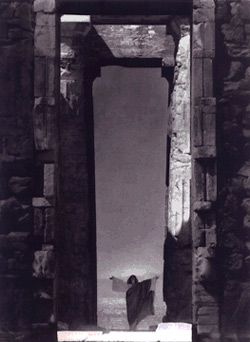
I can’t emphasise enough the difference between looking at an image on the web, or in a book, and actually seeing the original in a gallery. As I walked into this exhibition the first portait I saw was of Isadora Duncan.

isadora duncan

isadora duncan

Now, that photo doesn’t look much in this small form, does it? But in the original, large portrait, it is simply stunning. The exuberance of Isadora makes her seem as if she is filling the entire image, yet the smallness of her inbetween the huge pillars makes her seem tiny. Somehow, as you stand in front of this portrait, you can perceive both her greatness and her smallness at exactly the same moment. It’s unnerving, it’s amazing and it’s intensely moving. Well, that was the first portrait I stopped to look at and one after the other this fabulous collection totally captivated me.

One strong theme runs through many of these images – the uniqueness and the impressiveness of the subjects. Powerful, vibrant, unique human beings. I strongly recommend this exhibition. If you can’t get to Edinburgh look out for these portraits being shown near you.

Nigella sativa

nigella

Black cumin, or “love-in-a-mist”, or “nigella sativa”
Isn’t that a beautiful flower? I love both the double layer of petals and the spiral patterns. They give such a feeling of movement.

The BMJ this week reported an enormous increase in the amount of prescribed drugs being taken by people over 60 years old in England and Wales. In 1997, this group of the population were prescribed just over 22 items a year. 10 years on they are receiving just over 42 items a year. Overall, there has been a 50% increase in the average numbers of items prescribed per person. As you might expect, costs have shot up accordingly, doubling in the same decade – from £4.4billion in 1997 to £8.4billion in 2007. Statins in particular have gone up from under 5 million prescriptions in 1997 to 45 million last year.

Steve Field, chairman of the Royal College of General Practitioners, said that the increase in the number of prescriptions was probably due to a combination of a rising number of elderly people, more people with chronic conditions, and greater use of drugs used in preventive treatment.

The second report which caused me concern was a study by a Professor of Sociology who presented a paper at the American Sociological Association. He has demonstrated that the current licensing method which relies on trials of a drug against placebo, however,

Systematic reviews indicate that one in seven new drugs is superior to existing drugs, but two in every seven new drugs result in side effects serious enough for action by the U.S. Food and Drug Administration (FDA), including black box warnings, adverse reaction warnings, or even withdrawal of the drug.

So, he concludes, a new drug has twice as much chance of doing you harm than giving you greater benefit than the existing drugs.

Harms from prescribed medication are no small thing –

According to a 1999 report for the Institute of Medicine, adverse drug reactions (ADRs) are the fourth leading cause of death in the United States and more than two million serious reactions occur every year.

These two reports disturb me for two reasons. One is because they make me wonder just where medicine is going. Are we defining health as what people who take drugs experience? What’s normal any more? How successful are our societies where such large proportions of the population are having to swallow so many pills? This can’t be the best way to address the issue of Public or personal Health! Secondly, because of the extent to which the balance is tipping, not in favour of safer, more effective treatments, but, apparently in favour of more dangerous, and marginally (at best) more effective treatments.

Surely we need to think more seriously about how to maintain health and how to help people with chronic illnesses without reversion to drugs?

Because I deal with stories every day, I decided to learn more about the place of narrative in human experience, but coming from a medical perspective I couldn’t find much about narrative, even though there are emerging disciplines of “narrative-based medicine” and “narrative-based research”. Instead, I found the best thinking on storytelling lay in the world of the Humanities. In fact, Richard Kearney’s “On Stories” gave me more insights than any other single work.

It was interesting, therefore, to read this perspective, from Scientific American, which describes how researchers are beginning to study the use of narrative in order to gain insights into the workings of the mind. “Why does our brain seem to be wired to enjoy stories? And how do the emotional and cognitive effects of a narrative influence our beliefs and real-world decisions?”

The first problem scientists face, however, is defining a story! What exactly constitutes a story?

Exposition contrasts with narrative by being a simple, straightforward explanation, such as a list of facts or an encyclopedia entry. Another standard approach defines narrative as a series of causally linked events that unfold over time. A third definition hinges on the typical narrative’s subject matter: the interactions of intentional agents—characters with minds—who possess various motivations.

I loved the conclusion they reached –

However narrative is defined, people know it when they feel it. Whether fiction or nonfiction, a narrative engages its audience through psychological realism—recognizable emotions and believable interactions among characters. “Everyone has a natural detector for psychological realism,” says Raymond A. Mar, assistant professor of psychology at York University in Toronto. “We can tell when something rings false.”

In other words……you just know! How often this applies in life! How do you know when you are well? How do you know when your energy levels are good? Guess it’s the same when it comes to recognising a story. It’s a function of human intuition.

Do you become immersed in stories? Completely absorbed by them? Well, it turns out that if you have prior experience which is similar to that of the characters in the stories then you are more likely to become immersed in those stories. This is kind of obvious. It means that you are more likely to become absorbed by a story if you identify with the characters. One step beyond this conclusion is interesting though…..those who become more easily immersed in a wider range of stories have been shown to be those who have the greatest capacity to empathise. Interestingly, this can work the other way too…….you can increase somebody’s ability to empathise by teaching them literature! The ability to empathise is the ability to imagine what’s going on in someone else’s mind – scientists call this “theory of mind”. Theory of mind develops in children around the age of 5 and is a key part of the human ability to live in communities. So, storytelling also has the possibility of improving our skills in living together.

Other scientists have studied stories to see what they reveal about human motivations and goals –

As many as two thirds of the most respected stories in narrative traditions seem to be variations on three narrative patterns, or prototypes, according to Hogan. The two more common prototypes are romantic and heroic scenarios—the former focuses on the trials and travails of love, whereas the latter deals with power struggles. The third prototype, dubbed “sacrificial” by Hogan, focuses on agrarian plenty versus famine as well as on societal redemption. These themes appear over and over again as humans create narrative records of their most basic needs: food, reproduction and social status.

Are these the basic, common themes we find in stories? Do you agree that stories reveal the common human patterns of motivation and desire?

Let me finish this post with the final point made in this interesting article – the power of stories to influence us. This is well understood by advertisers and PR companies, but this point really struck me –

…..labeling information as “fact” increased critical analysis, whereas labeling information as “fiction” had the opposite effect. Studies such as these suggest people accept ideas more readily when their minds are in story mode as opposed to when they are in an analytical mind-set.

Now isn’t that interesting! Stories are more likely to convince people than “facts”!

Belief

All human beings try to make sense of their lives. We each have different ways of doing that and we use different frameworks of understanding to do that. (Owen Flanagan uses the nice concept of “spaces of meaning“)

With that in mind, take a look at this small bookshelf. I saw this in a little independent bookshop yesterday. It’s the section of the shop labelled “Religion” and “Esoteric”. Those are two interesting words to put next to each other to begin with……

The Religion shelf in the bookshop

Check out the book titles (if you can’t see them clearly click through to the flickr page where I uploaded a copy and click “all sizes” to see a larger copy of the photo). Along the top the shop has a New English Bible, books of psalms, the Q’ran, books on Tibetan Buddhism and Zen……this isn’t an unusual selection these days, even in a village bookshop in the Scottish Highlands.

What do you think about the books on the bottom shelf? There’s a book about the occult in London, a book about Celtic myths, one about Druids, and “Derren Brown’s Mind Tricks”!! That’s the one that struck me! Derren Brown, for those of you who don’t know, is a hypnotist and magician!

Ben Ledi dark sunset

I swear the sky I see from my window looks different EVERY day. I’ve posted photos of the sunset over Ben Ledi before but tonight, in the last hour, I looked out and saw this sight.

I have never seen anything quite like this. It’s amazing.

Funnily enough, I just finished reading a book by Pierre Hadot. The book is called “N’oublie pas de vivre” (Don’t forget to live). His key word is – emerveillement – which you could translate as “wonder”, “marvel” or “awe”. If you want to live, to really live, (as a hero, not a zombie, as I’d put it!), an attitude of “emerveillement” will do it. The more we wonder, the more amazing we find daily life, the more we feel the thrill of being alive.

East meets West

david hume and the geisha

This young woman was standing next to the statue of David Hume on the Royal Mile last weekend. She was one of a number of people who perform as “living statues”, standing very still for long periods as people gather, watch, photograph and maybe leave some money. It’s such a strange phenomenon, this kind of performance. What amazes people is their stillness. Isn’t that interesting? In the bustle and hurry and continuous doing of life passers-by are caught by these artists’ stillness, their not-moving. And what effect do they have on the crowds who rush by? Well, either only a passing glance, or they are caught. They stop and they stand and they watch, sucked into a moment of stillness. It’s quite something to see.

But it was the juxtaposition of this performer and the huge solidity of David Hume’s statue which especially caught my attention. Set me off thinking all kinds of things……..the relationship between contemplation and philosophy; between thinking and acting (who’s thinking and who’s acting here?); and, probably because this is the EIGHTH day of the EIGHTH month of the two thousand and EIGHTH year today and at EIGHT minutes past EIGHT tonight, the Beijing Olympics will commence, it got me thinking about the intermingling of East and West, of different traditions, different views, different cultures and how they influence each other.

This is a time of change. The old orders are creaking and shaking. As China engages with the rest of the world and the rest of the world engages with China we’re going to have a lot to learn about each other and, actually, right at this moment, I find it awe-inspiring and mind-boggling. I think many of our presumptions are going to be shaken to the core. (BBC2’s Culture Show special on China is an example)

It’s times like these when great opportunities arise to wake up from un-reflective, passive ways of life, (zombie life), to creative, radical, active ways of life (hero life).

buddleia
You know this plant? It’s a Buddleia. People who love butterflies plant it in their gardens because of its reputation for attracting butterflies.
Well, I’m sure it’s not the Buddleia hanging off North Bridge that attracts all the visitors to Edinburgh in August every year, but something does (and it’s not the sunshine…….)
royal mile
Although the rain doesn’t stop them enjoying the pleasures of al fresco drinking and dining…….
cafe on the royal mile

Thousands and thousands of people come to Edinburgh in August for “the festival”.

The Royal Mile becomes a vast pitching ground for the hundreds of theatre groups and performers trying to persuade visitors to come and see their show.
fringe posters
fringe contenders
It can all get a bit much, but if you need to escape from the crowds, Edinburgh has it’s emptier spaces to explore.
the crags

I suppose some of the things that repeatedly amaze me about Edinburgh at this time of year are the chances to really see and feel the rich diversity of life, the natural exhuberance of people and the overflowing expressions of creativity and passion. It’s worth having a day wandering around and just soaking it all up. But don’t forget your umbrella!