Feeds:
Posts
Comments

Archive for the ‘from the living room’ Category

two words

PRESENT

CREATIVITY

These two words, or concepts related to them, keep coming up for me. I read a LOT, and I have one of those minds that seems to be good at seeing connections, patterns, echoes, themes, and in all those ways these two words keep coming to mind. Whether I’m thinking about flourishing, about happiness, about health, about living a good life, about understanding what it is to be uniquely human, and most especially when I think how to be a hero not a zombie!

If you don’t want to be a zombie, you have to wake up and smell the coffee. Different thinkers and authors refer to this in different terms. Some talk about waking up from the sleeping state, others about living consciously, and yet others about living mindfully. What it amounts to is being present. Really being present. Not just being somewhere in your body while your head is in the past, worrying about the future or drifted off somewhere into the clouds. So it’s a deliberate act to be present.

I am very attracted to the ideas of the “slow movement“. If we take our time to fully savour the here and now we enrich our experience of living. Fast food, quickly prepared and gulped down with hardly time to even taste it is one kind of experience. Picking up fresh food in the local market, walking home with it, preparing it, cooking it, sitting down to savour it (whilst not doing anything else!) is quite another kind of experience.

Mindfulness is a very popular term currently (other traditions over many years have taught the same concept) The famous mindfulness meditation exercise of the single raisin is one simple way to understand experientially what it means to be present.

I often find myself sharing with patients the simple understanding that your mind can only be in one place at a time. If you are giving attention and focus to the past (remembering, ruminating, ruing?), or giving it to the future (planning, worrying, fearing?), then you aren’t giving it to the present (sensing, savouring, being?). So, if you are troubled with too much of the past or the future in your head, deliberately turning attention and focus to the present can change your inner experience instantly.

I find that having a sense of wonder, of seeking the extraordinary in the ordinary, drives my attention to the present.

What about creativity? Life, it seems to me, is constantly evolving, adapting, growing, developing. It’s a dynamic phenomenon which moves as a whole in the direction of ever greater complexity, diversity and uniqueness. In fact, that’s how I see the universe story – one of continuous and ongoing creation.

Creativity is also about expression. I believe every one of us has our unique and special contribution to make to the universe through living this life. We engage with and understand the world uniquely and we react and interact with it uniquely. Those interactions are creative. In biological terms we use the word “emergent” to describe phenomena and behaviours not seen before. That’s what we do. We are complex adaptive organisms in a process of continuous development, emerging, evolving (potentially) to higher consciousness.

Whether you create through art, through music, through building, through problem solving, through being with and sharing with others…..every day, you have countless opportunities to create, to make the world anew.

What does it mean to you to be present? And how can you be more present today?

What does it mean to you to be creative? And what will you create today?
 

Read Full Post »

There are many ways in which writing can help us to understand ourselves better, heal wounds and gain a deeper insight into our lives. Here are three ways you might like to explore.

A. Regular continuous writing

Julia Cameron, in The Artists Way, describes an exercise she calls “Morning pages”. Essentially it involves writing every morning until you’ve filled three pages of an A4 notebook. With one additional, and crucial, rule – you can’t stop. Not for a moment. Your pen or pencil shouldn’t leave the paper, and your hand should never pause. This is not a thinking exercise. You aren’t to work out what you are going to write, and if you find yourself writing “I don’t know what I’m writing and I can’t stop moving the pencil so I’d better keep going and…..” – well, that’s OK. It’s a stream of consciousness thing.

People do different things with this kind of exercise. Some swear it only works if you do it as the very first thing you do on waking, others just in the mornings, some at other times of day. See what works best for you. What I have found is that the greatest benefit comes from it if you don’t read what you’ve written. At least not for a pre-fixed period of time – a week, 30 days, a month, three months. Again, see what works best for you.

Try it. I’m pretty sure it’ll surprise you

B. Gratitude journal

There are many traditions which recommend creating and regularly using a gratitude journal. Quite simply, it involves having a special notebook and every night, before you go to bed, taking a few moments to reflect on the day and recall something, just one thing, for which you are grateful. It might relate to something you saw or heard, something you ate, a conversation you had, a moment of being held…..it’s up to you. Then just note it down. You can write it in as much detail as you like. I find this has at least two benefits. It gives you an opportunity to re-experience a positive emotion (and that’s good for your heart, and good for your health). And it means you head off to bed with your most recent experience being a positive one.

C. The story you live by

In the inspiring “the stories we live by”, by Dan P McAdams, he describes a template to help you write out the story of your life, in a way which will enable you to clarify your own main themes and influences. I like this approach. I like the idea of the story of the self, especially as stories take us from the past, into the present and forward to the possible futures. Here’s a very brief synopsis of Dan’s template. It starts with writing down your chapter headings for the story of your life, then moves down through the seven further points of focus and reflection. You might want to try the whole thing, or you might like to pick and mix. As ever, see what works for you……

1. Chapters – titles and brief contents

2. Eight key events –

  1. Peak experience
  2. Nadir experience
  3. Turning point – significant change in understanding of yourself
  4. Earliest memory
  5. An important childhood memory
  6. An important adolescent memory
  7. An important adult memory
  8. Other important memory

3. Four significant people

4. Any heroes

5. Future script

6. Two areas of life where you are experiencing stress, conflict or challenge

7. Personal ideology

8. Life theme

Read Full Post »

balloon


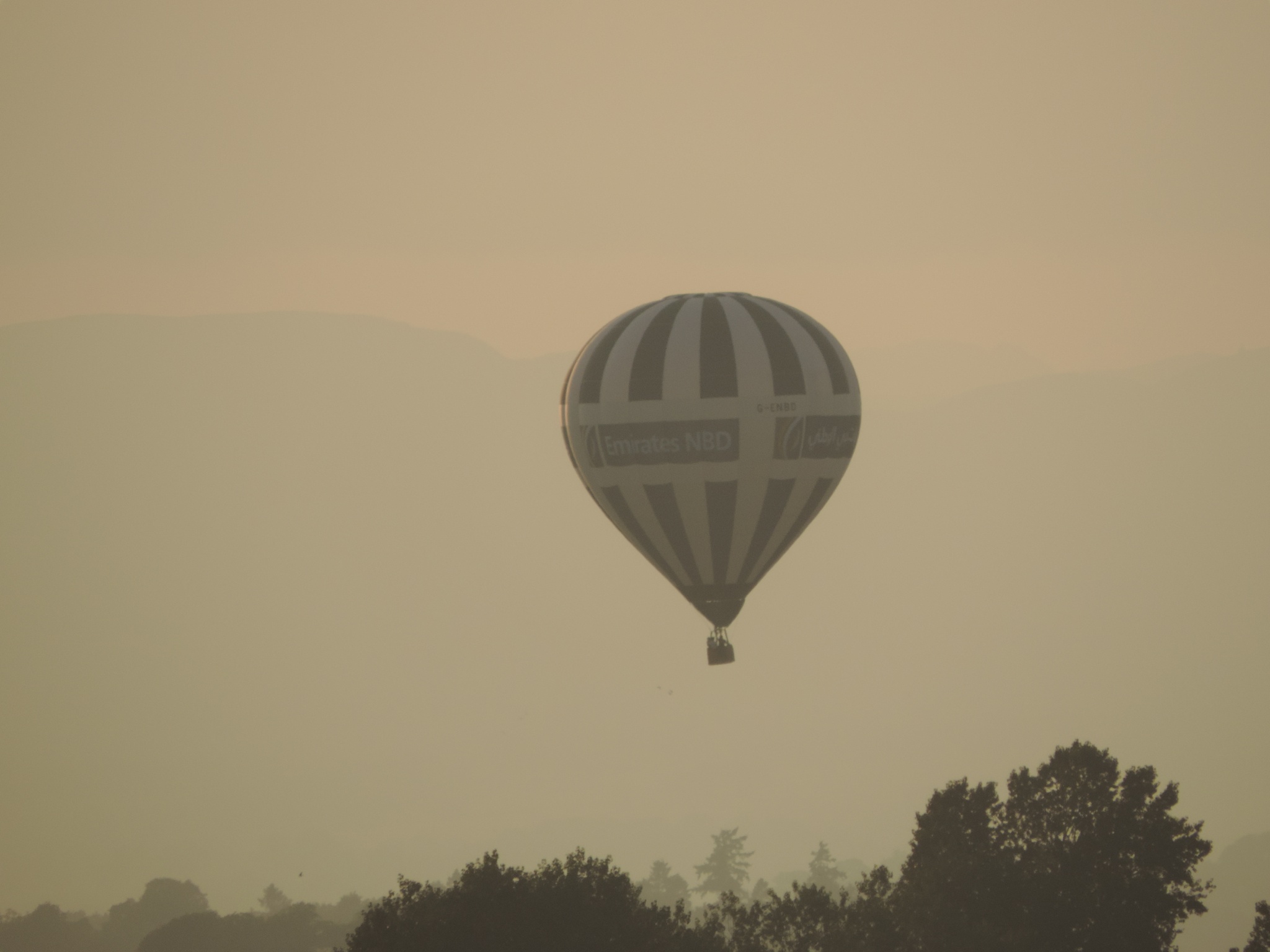
I like the concept of taking a view “from on high”, and as this montgolfier floated past my house yesterday it sparked my imagination and I wondered for a little while about how my life was looking from up above…….

I recommend doing that from time to time. We spend a lot of time down on the ground dealing with whatever lies immediately before us. That’s important. But there’s also a value in seeing what things look like overall at times, seeing the context of your life, the landscape in which you are living, the direction in which you are travelling.

Of course, just watching a hot air balloon gently, slowly, floating by, is also a beautiful experience. (This photo, by the way, is untouched, the sky was very hazy and strangely sepia-tinged. This is actually how it looked)

Read Full Post »

Antoinette Tuff

A man walks into an infant school with a gun and a lot of ammunition………

…..I felt like I’d read this story before. Not so far from where I live, in 1996, Thomas Hamilton walked into the Primary School in Dunblane…..you probably know the story. America, sadly, you have many of these stories……..

…..but this one didn’t continue the way the other ones did.

In this story, the man was met inside by Antoinette Tuff, the school bookkeeper. Over the course of the next hour or so, she talked to him calmly, hearing from him that he had no reason to live and hoped to die when the police arrived. She managed to call 911 and the recording of that call is easy to find on the web. At one point she was carrying out three conversations at once – with the gunman, with the local TV station he asked her to call, and with the 911 operator.

She empathised with his distress and pain and shared with him some of the difficulties she herself was going through, convinced him he didn’t need to shoot anyone, and he didn’t need to die.

She eventually talked him into putting aside his gun and lying on the floor in wait for the police to come and get him.

As she talked to him the children and the teachers were able to escape to safety. (Read more of the story here.)

During her conversation with the suicidal Hill, she opened up to him about the problems she had faced in her own life, explaining that she had a severely disabled son, and had recently separated from her husband of 33 years – but that she had picked herself up and started her own business. “I told him, we all have situations in our lives, [but] it was going to be okay. If I could recover, he could, too.” After about an hour, Hill had calmed down sufficiently that Ms Tuff began trying to persuade him to surrender, even suggesting that she walk outside with him to prevent his being shot by police. “[I] let him know that he could just give himself up,” she told WSB-TV. “I told him to put [the guns] on the table, empty his pockets. He had me actually get on the intercom and tell everybody he was sorry… “I give it all to God. I’m not the hero. I was terrified.”

This is an incredibly moving story. I can’t actually remember when I last felt so moved by a story in the daily newspaper. She showed compassion, she had hope, and she had faith. More than anything she saw Michael Hill as a human being and she talked to him with kindness, gentleness and love.

As Hill lay on the floor of the office and prepared to surrender, Ms Tuff can be heard on the 911 recording, telling him: “I just want you to know that I love you and I’m proud of you.” It was then that he finally told her his name.

You know when we read all these terrible stories of cruelty and horror every day, it comes as even more wonderful to come across a story like this, where we get to hear about the wonderful potential which exists in human beings too – the potential to connect, and the power of compassion.

You really are a hero, Antoinette Tuff.

Read Full Post »

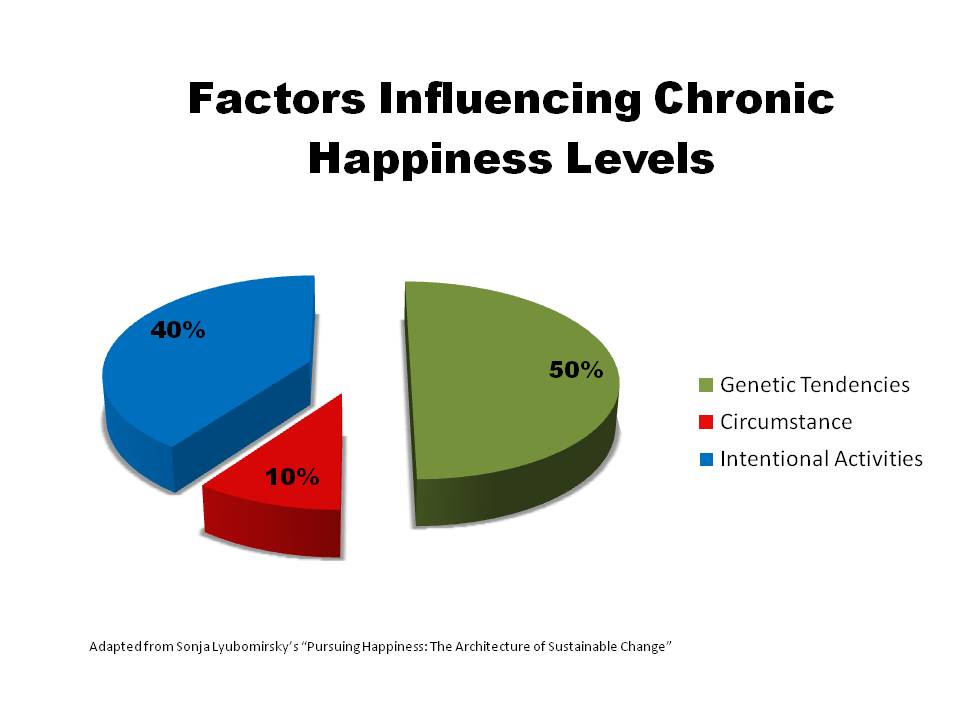
I came across some interesting research into the factors affecting long term happiness. Positive psychology researcher, Sonja Lyubomirsky found that your long term happiness is partly determined by your genes, partly by external circumstances and partly from your disposition/choices. It breaks down something like this –

IMG_0446

Whatever you think about the proportions, this got me thinking more widely about not just happiness, but health.

It strikes me there are three contributing influences – the given, the random and the chosen.

The given includes not only genetic factors, not just the DNA inside you, but also the circumstances of your birth. A child born in a Mumbai slum doesn’t just have different genetic influences from one born my home town of Stirling, Scotland. There are the physical, economic, cultural, familial environments into which they are born. Let’s assume the child neither chooses their genes, nor the circumstances of their birth. (I know not everyone sees the world that way) This is the given.

The random is whatever happens by chance. If a drunk driver loses control of his car and knocks you down as you walk along the pavement, that’s bad luck. If you happen to be on a train which derails, to be where a tornado hits, get caught in a tsunami…….unpredictable events – the random.

The chosen – we are always able to choose how we respond, to choose what to say or do in any given circumstance. As Viktor Frankl found, what matters is what stand we take in the face of events. See William Glasser’s “choice theory” for more on this.

I don’t know if the proportions are always the same, 50/10/40, but that’s not really the point. The thing is choices are what we can do something about. In fact, it’s not as separate as this description seems so far. We now know that we aren’t just our genes using us to replicate themselves. Epigenetics shows that genes can be switched on or off by external factors. We can influence whether or not certain genes are expressed. Similarly we can influence our luck. Watch the movie, “The Cooler”, with William H Macy for a really entertaining exploration of that!

Then I thought, it’s a bit like a game of cards. You have the hand you are dealt (the given), luck (what other cards other players are dealt and how they play them), and then you choose what to play when – something you can do well, or badly, depending on your skill level.

And that brought back to mind the phrase, “its the hand you are dealt” – which is usually a statement of something pretty limiting. People tend to say that when they think that whatever has happened is completely outwith the person’s control, when it’s all down to Fate, or to genes or whatever….but I think we can reframe this card game analogy much more positively.

We take the hand we are dealt, use our skills to play the game well, and make our best choices in the face of lucky (or unlucky) breaks!

We have the given; stuff happens; and we can usually make choices, develop strengths and skills.

What choices are you making today? What strengths do you have which you can develop?

Read Full Post »

earthrise orange

I love the Earthrise every evening at this time of year…..can’t you feel the Earth turning as the horizon rises, turning away from the Sun for another night?

Read Full Post »

seeds


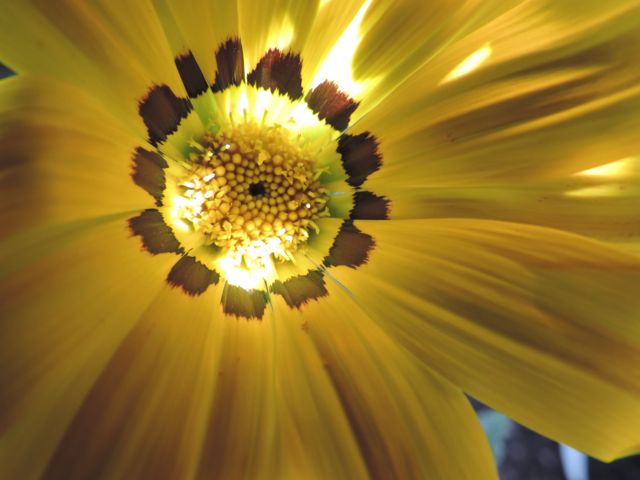
Look at this wonderful cluster of seeds with the sun shining through…..simply bursting with potential…..this is me, today. This is you, today…..

simply bursting with potential

Which seeds will you water?

Reminds me of Thich Nhat Hahn’s teaching on watering the seeds…..

If you live in a couple, if you live in a family, if you live with another person or several persons, you may ask them to be careful. You may ask them to be aware of the seeds you have in your store consciousness. “Darling, I know that I have these negative seeds in me. And every time these seeds manifest, I make myself suffer and I make you suffer, also. So, please, if you love me, if you care for me, be careful not to water these seeds in me.” Among lovers, there should be such an agreement. That is the practice. “Darling, if you really love me, water the positive seeds in me, because I do have the seeds of understanding, of compassion, of forgiveness, of joy in me. Even if they are still small, if you know how to touch them in me every day, I become a much happier person and when I am happy, you don’t have to suffer as much.”


Read Full Post »

The Heartmath technique involves recreating a positive emotion – not just remembering a positive event, but actually feeling the feeling again.

When I found this project from “soul pancake” it struck me that they were making little “heart math” moments in the street. Watch the video. It’s delightful, and I’m pretty sure it will make you smile……

……and remember, to flourish, you should try to have a 5:1 ratio of positive to negative feelings/experiences each day.

Read Full Post »

I came across this the other day –

The Atheist Credo

I believe in one method

of data, hypothesis, and experiment

which was conceived by ancient Greek thinkers,

born in the Age of Enlightenment,

suffered under superstition

is struggling under religion

is bound to make people’s lives better

and will one day bring about a perfect world.

I found it on the blog of a neuroscientist called Kathleen Taylor, having read about her in a French magazine article.

My first reaction was what?!

“data, hypothesis, and experiment” ………. “will one day bring about a perfect world”

Really?

It’s niggled away at me since. Here’s my problem. Well, two problems actually. I’ll start with the last one first. What’s a perfect world? I wonder what the author imagines a “perfect world” would look like?

Do you have an idea what a perfect world would be like?

Do you have an idea of how to bring that about?

But before we get to that closing sentence, its the earlier statement that really worries me. Right from the outset.

“I believe in one method”

OK this “one” anything always worries me. It worried me when Mrs Thatcher said “there is no alternative” (“TINA”). It worried me because it made me think of totalitarian regimes, from Stalin to who knows who else? It made me think of fundamentalists – theists, as well as atheists. Nature loves diversity. The “one method” stance strikes me as being about power over others.

It brought back to mind Deleuze and his “three ways of thinking” – science is thinking about function, philosophy is thinking about concepts and art is thinking about percepts and affects. (I know I’m way over-simplifying what he said here, but that’s the gist of it as far as I’m aware). And that quickly led me onto to that second line  – “data, hypothesis and experiment” – she means, of course, “the scientific method” – as interpreted by modern day materialists. And again, I find myself thinking “Really? Is she having a laugh? Is this tongue in cheek?” …… maybe it is. But I suspect there are people who would resonate with this all the same.

So what about music, and painting, and poetry, and novels, and the theatre, and love, and laughter, and passion, and relationships? We can make those perfect through this one method too? This one method is enough to create a perfect world full of love, laughter and flourishing?

What do you think?


Read Full Post »

DSCN0031


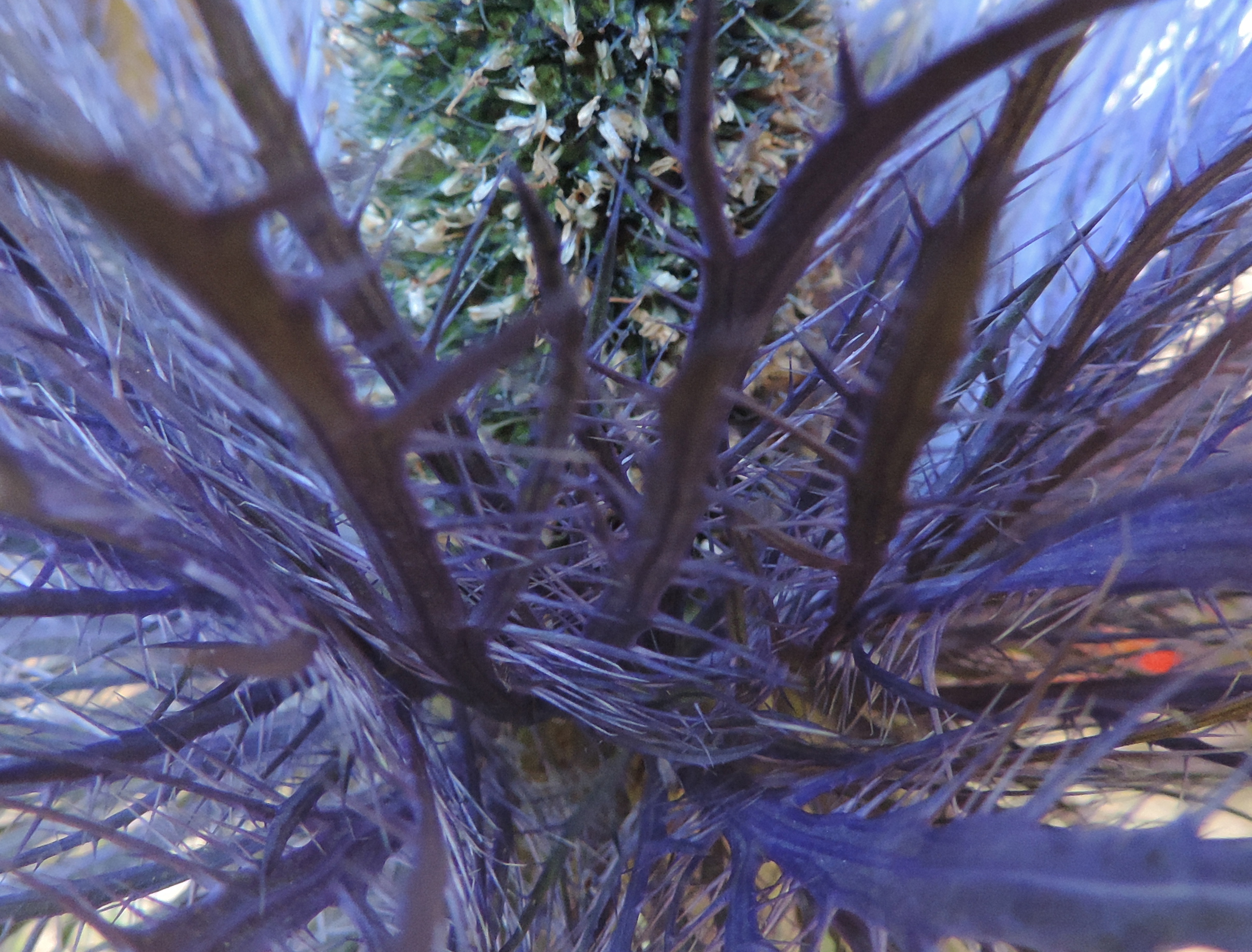
When you look closely at a spectacular flower, like this Eryngium, you can really immerse yourself in the present moment.

This is a kind of meditation for me…..an exercise in being fully present, in flowing into that amazement and wonder of the everyday reality, and of savouring it fully.

The colours and shapes bring me such aesthetic pleasure.

The astonishing delicate complexity fills me with awe and wonder.

Life is living these moments.

Read Full Post »

« Newer Posts - Older Posts »