Feeds:
Posts
Comments

Archive for the ‘from the living room’ Category

We are a pattern-spotting, and pattern-creating species. This is a brilliant quality to possess. It allows us to make sense of very complex systems, to engage with Life and phenomena holistically and to see (or create) the meaning behind our daily perceptions and experiences.

eye of the tree

Margaret Wheatley, in her Leadership and the New Science, says

Wholeness is revealed only as shapes, not facts. Systems reveal themselves as patterns, not as isolated incidents or data points.

Further, she says,

It is the nature of life to organise into patterns

morse moss


What patterns do you see today?

What patterns touch you, capture your attention, or help you make sense of things?

Every consultation I do, I sit with a patient and we have a conversation. It’s best if I do most of the listening, and stimulate the odd reflection when I begin to discern patterns. At the simplest of levels I was taught diagnosis at Medical School. I still think we make the best diagnoses by quickly spotting the patterns – the connections and inter-connections between the elements of a story, the symptoms expressed, the signs and changes manifested, and recognising the pattern which holds this all together.

At the deepest level there are a multiple of patterns in every person’s life, each interacting and interweaving to create ever more beautiful and amazing spiralling narratives. This is how we get to know each other. This is how we get to know ourselves.

Let’s make some new patterns together……how about it?


zen garden

Read Full Post »

sometimes the easiest way to connect to Nature’s rhythms is just to look out of the window……

DSC_0622

Read Full Post »

Margaret Wheatley works in the area of leadership and organisational change from the perspective of what we can learn from living reality. She has the complex adaptive systems concept at the core of her work. I recently stumbled across her writings, particularly her four “principles of living systems”. Here they are –

  1. Participation is not a choice
  2. Life always reacts to directives, it never obeys them
  3. We do not see “reality”. We each create our own interpretation of what is real
  4. To create better health in a living system, connect it more to itself

The first principle relates to the reality that everyone, every thing, every aspect of our world, our universe, exists inextricably embedded in the contexts of its existence. A living organism is an “open system”, with information and energy constantly flowing into and out of it. A living system is dynamic and perpetually changing and “co-evolving” with the other elements of the ecosystem in which it lives. You can’t change a part of a person without producing changes in the rest of that person, and you can’t change a person without setting off a cascade of unpredictable changes in the world in which that person lives (and vice versa – you can’t change something in someone’s world without setting off changes in that person). Participation is not a choice, it’s an inevitability.

The second principle is the core of adaptation. Every individual is unique and cannot be controlled like a robot or a machine. You can force people to behave a certain way for a period of time, but ultimately all the organisations and political systems based on force collapse. You can’t force the sun to shine, the wind to blow, the rain to fall, or Life to obey your commands.

The third principle is something we often forget. Iain McGilchrist, in The Master and His Emissary, highlights how the left cerebral hemisphere is particularly well developed to “re-create” reality. It creates “re-presentations” of the raw information and energy which flows into the person. These representations allow us to make sense of the world and to literally to grasp things better. It’s a fantastic development and is probably at the core of our industrial and technological development as a species. We also know now that the part of the brain just behind the forehead, the mid-prefrontal cortex, has many, many functions, but amongst them is a map-making facility. It’s crucially involved in creating, what Dan Siegel calls, “a me map, a you map and a we map”. We never know any of this reality directly. Rather we constantly create our perceptions and our understandings, influencing those creations with our memories, our hopes, our beliefs, our values and our desires.

The final principle is Margaret Wheatley’s way of talking about integration. When a system is well integrated there are healthy, mutually beneficial relationships between all the connected parts. That produces coherence and harmony. It’s the basis of health.

When I first created this blog, I wrote a permanent page on “ACE” – “Adaptation, Creativity and Engagement“. It was really interesting for me, therefore, to discover this quote from Margaret Wheatley (which I believe, essentially highlights the same characteristics)

Over many years of work all over the world, I’ve learned that if we organize in the same way that the rest of life does, we develop the skills we need: we become resilient, adaptive, aware, and creative. We enjoy working together. And life’s processes work everywhere, no matter the culture, group, or person, because these are basic dynamics shared by all living beings


Read Full Post »

This week I sat next to a student on the train. She was revising her notes on “clinical research”. I was struck by her list of keypoints under the heading “the scientific method”

  • Observation
  • Description
  • Explanation
  • Prediction
  • Control

I have a life long interest in science, but for me, science is just one form of enquiry. I’m actually an insatiably curious person. I love learning. I’m constantly reading. I read on the train, I read in cafes, at home, at work, everywhere. Having a kindle reader on my iphone and my ipad has made it even easier to weave reading into my day. I have thousands of books in my own library. I have google searches set up, rss feeds delivered to my MrReader app, Flipboard and Zite apps on my ipad…..I’m a reader!

But I’m also a photographer and a writer, as you can see if you browse through this blog. And I’m a thinker. I love to learn, to reflect, to understand. I love that every work day I get to spend time with people and try to understand them.

I observe, I describe and I explain.

But predict? I’m not so keen on that one. I find life so complex and every human being so unique, that I find it impossible to predict the future. In broad brush terms, or in generalisations, or statistical probabilities I can have a bash, but I know that for this person, right here, right now, I can’t predict how things will go.

And control?

Control?

No thank you. Way too much compliance and control going on in our society for my liking and it doesn’t seem to be improving much. I’m a lot more keen on values than I am on control.

Is science about control? I thought it was about discovery and wonder. I thought it was about learning with every new insight that we have more to learn.

I was very impressed the first time I read Deleuze and Guattari who described three ways of thinking

Art – which is thinking about percepts and affects

Philosophy – thinking about concepts

Science – thinking about function

I like that. Science for me is about discovering patterns, and getting some insights into how something works. That’s what I loved about my undergraduate medical degree – discovering the anatomy, physiology, biology of how the body works. It’s been years and years of daily medical practice, of reading, of reflecting and of thinking, which has brought me to my present place of understanding how a person works. And I sure haven’t got all THAT figured out!

There’s something that jars with me about science directed towards control. But maybe that’s because I don’t like to be controlled!


Read Full Post »

Each of us lives out a story, a dynamic narrative whose only consistency is that we somehow show up in each of the scenes. While the plots line may be unknown to us, there is one. Creating a Life. James Hollis

We know ourselves and others through the stories we tell. We create meaning and gain an understanding of the events and experiences of our lives by creating a narrative. And isn’t that quote so true? Doesn’t it sometimes seem as if the only constant in our life story is that we show up in each of the scenes. All of life, the world we live in and experience, is woven into these stories, which always, in some way, contain ourselves.

But what about this idea of a plot? Because doesn’t it happen to all of us that from time to time we lost the plot? In fact, don’t many people never seem to have a grasp of the plot? Well, an interesting factor in the creation of the plot comes from thinking about Fate.

What is fate?

The narrower the frame of consciousness, the greater the personal chronicle plays out as fate…what is denied inwardly, will come to us as Fate. Creating a Life. James Hollis

Of course, we have the hand we are dealt too, as part of Fate. Sir Harry Burns, the Chief Medical Officer of Scotland, in discussing the problems of ill health in Scotland points the discovery that a grandfather’s experience can alter his genes and so pass on influences that way through his children and even their children too. We can’t understand a person, or their plot, without seeing who they are within more than their own personal lifetime. We have to consider their genetic, familial, cultural and societal contexts and influences, most of which may shape the unconscious more than they shape the conscious. Living a zombie life, on automatic pilot, will be experienced as a life dominated by Fate, but waking up, becoming conscious, examining our own lives, gives us the chance to become the heroes of our own personal stories.

Plot is partly unearthed, and partly created.

Read Full Post »

As Howard Bloom points out in The Global Brain, there are a couple of opposite but essential drivers at the heart of complex systems – conformity enforcers and diversity generators.

We need both. But we need both to work together in an integrated way. If there’s too much of either growth, development and evolution is impeded.

Diversity generators don’t just tolerate difference but give highest value to uniqueness. Conformity enforcers, on the other hand, operate by eliminating difference, setting standards and rules and making sure the whole system is compliant.

In health care, it seems to me, we have an excess of conformity enforcement. The “evidence based” enforcers seek to “eliminate variation” by developing flow chart style protocols where every single patient is entered into the same pathway and is treated according to the same, limited range of interventions. There is a belief that the raw material of patients can be entered into the same machine and will come out the other end with the same product or “outcome”.

But life isn’t like that. Every single human being is unique. There isn’t a single health care intervention in the world which produces the same outcome for every patient who receives it. There’s something essentially dehumanising about the enforcement of conformity on the rich diversity of individuals.

I’m a champion for diversity and tolerance. I think it’s richer than uniformity and conformity. I don’t deny that we need some level of conformity (without it we’d have disintegration and chaos), but I think we’ve gone too far. Not just in health care but in many, many areas of modern society – education, politics, economics…….

Where do you put your energies? Are you throwing your weight behind diversity generation or conformity enforcement?


Read Full Post »

The self is relatedness. The self doesn’t exist without relationship. The self appears in your deeds, and deeds always mean relationship.

James Hollis wrote that. It stopped me. You find there are books like that, don’t you? Books which you can’t read all the way through without stopping. I don’t mean the stopping for tea, or to answer the phone. I mean that stopping in the middle of the page, or anywhere in the page actually, because what you just read provokes such a mental reaction. This was one of the many places where I stopped when reading Creating a Life by James Hollis.
My first thought was, “how true”. I see connections everywhere, and I see the constancy of change. In fact, that is so important to me that I put the phrase, “becoming not being….” as the sub-head of this blog.
We are constantly becoming, ever interacting, exchanging, adapting and changing.
So, it’s true. The self doesn’t exist without relationship. I’ve thought many times that you could never know a person by observing them, through a one way glass,in an empty room. You have to see how a person interacts, with you, or with others, to have any sense of who they are.
Reminds me too, of “Ubuntu” – “I am because you are”
But then it seemed to me he’d gone too far when he added “deeds always mean relationship”.
Surely there must be deeds we commit alone?
But hold on, am I narrowing the definition of relationship too far here? Am I assuming a relationship is between two PEOPLE?
What about how I relate to Nature, to the built environment, to music and images and art? To this very book I am reading in fact!
It’s true what he says – the self really does appear in our actions, our reactions, and our interactions. It’s not a phenomenon which emerges in total isolation (even our memories and our imaginings are the creation of relationships aren’t they?)
So here’s something to consider today – what sense of self do I notice emerging from my deeds? my choices? my interactions?

Read Full Post »

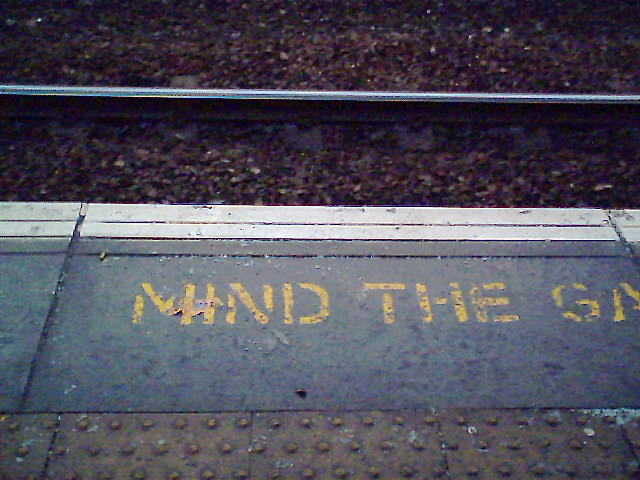
mindthegap.jpg


I come across this issue all the time – there is a gap between reality and fantasy, and that’s where suffering occurs.

By fantasy, I really mean imagination, but that includes hopes, dreams, and idealised wishes for how things could be. It includes memories too, because I don’t believe memories are like objects tucked into some cerebral drawer – we recreate them, imagine them anew, every time we bring them into the present.

Some terrible things happen to people. Things that will never go away. And those things keep jumping into the present. We wish those memories weren’t there. We wish those things had never happened, those words had never been said, those choices had never been made. But they did and they were. And in that gap, in that space or difference between how we wish things had been and how they actually were, there’s where suffering lies – hurt, pain, anger, sadness, regret…..

Some people imagine how things might turn out, and those imaginings might either be terrible and they live them now in the fears and paralysing anxieties which emerge in the space between the awful future and the actual present. Or they imagine how things would be so much better than they are and in that gap they find frustration, dissatisfaction and discontent.

What do we can we do with this gap? Can we narrow it a bit, even if we can’t make it go away?

Partly. But, wait a minute. Should our first thought be “let’s get rid of this suffering”? Because if it is, we might reach for the painkillers and the sedatives, or hit the escape routes, before we understand what this pain is about. Might it not be better to see if we can see what the roots of this pain are? Where is it coming from? Why is it here? What sense do I make of it? We are meaning seeking creatures and we want to make sense of lives. What sense do we make of this particular suffering? What it is telling us?

Sometimes, when we understand the suffering better, we understand that something needs to change, that we need to make different choices. And sometimes when we understand it better, we realise that right now, right here, in the present moment, we are actually ok. Better than that, we discover that the everyday, so called ordinary world, right here, right now, is extraordinary and amazing, and that our suffering is fear or anxiety about what might be, overwhelming the present moment and hiding from us the fact that life, here and now, is not just welcome, but something to be grateful for.

There’s another role for suffering of course – creative energy. In the gap between how things are and how we imagine they could be, dissatisfaction or discontent can drive creative solutions, generate new ways of thinking or inspirational art. (I’m not saying you have to suffer to create great art – I’m just saying that sometimes great artists turn their alchemical skills to their suffering and their struggles and create gold)

Anyway, however you handle it, whatever choices you make, next time you feel you are suffering…..Mind the Gap – and reflect on why it’s there. Then you might be able to make a different choice.

Read Full Post »

There’s a chapter in James Hollis, the Jungian analyst’s book, Creating a Life, entitled, “Attending the Soul”. This particular chapter is about the practice of psychiatry and he completely nails an important point.

If we consider health, acute and chronic illness, to be a spectrum of experience, then we need to do more than control or manage disease in order to be healthy.

Here’s how James Hollis puts it….

In seeking scientific verification of success, many of these practitioners [psychiatrists] have narrowed the definitions of pathology to behavioural patterns, faulty cognitions and flawed chemistry. While it is certainly true that we are behaviours, and behaviours may be corrected, and we are cognitions which may be challenged by other cognitions, and we are chemical processes which may be compensated by other chemical processes, none of these modalities – behaviourism, cognitive restructuring and psychopharmacology – should be confused with psychotherapy.

He goes on to say that psychotherapy seeks to address the whole person, even the meaning of the person, the meaning of their suffering or even the meaning of their life.

This same point applies across the whole of Medicine. Illness may include physical pathologies which can, and may, be addressed with drugs or surgery, or it may include adaptive, or protective symptoms and behaviours which can be changed. However, if we are interested in healing, in facilitating the experience of wellbeing, resilience, and health, then we face the fact that a whole human being is more than the sum of his or her parts.

Here’s how he concludes his chapter…

To stop at behavioural change, as important as it is, or cognitive restructuring, liberating as it may be, and pharmacology, necessary as it sometimes becomes, betokens a failure of nerve and sells the soul very short indeed.


Read Full Post »

For many years when I’ve taught about the different ways in which we develop an identity I’ve described a line with two poles.

At one end is “I”, the unique, separate, different “me”. We have a whole body system, the immune system, developed to be constantly on the alert for what is not “I”, whether it be a virus, another person’s genetic material, or a chemical substance from “outside”. The immune system is primed to quickly recognise any such foreign material and isolate or remove it.

At the other end is “we”, the connected self, the “me” which is part of “we”, whether that be in relationship with another single person, or with a group.

We all need to know that we are unique, that we are different and separate from others. What can come with that however, is a sense of disconnection, or loneliness. Just as importantly we need to know that we are connected, that we belong, that we “fit in” and that we love and are loved. What can come with that can be a loss of personal identity, a feeling of just being a number within the group.

I pointed out that this line with its two poles didn’t have a point somewhere along it where everything was balanced. It doesn’t work like that. We move continuously along the line, back and forth, changing our focus, our awareness and our sense of self, but never wholly living at only one of those poles.

Then last year, I read two books which mentioned concepts which fitted right in to this simple diagram. Thomas Berry’s The Great Work, where he beautifully describes the twin polar opposites of “wildness and discipline“.

When first the solar system gathered itself together with the sun as the center surrounded by the nine fragments of matter shaped into planets, the planets that we observe in the sky each night, these were all composed of the same matter; yet Mars turned into rock so firm that nothing fluid can exist there, and Jupiter remained a fiery mass of gases so fluid that nothing firm can exist there. Only the Earth became a living planet filled with those innumerable forms of geological structure and biological expression that we observe throughout the natural world……….The excess of discipline suppressed the wildness of Mars. The excess of wildness overcame the discipline of Jupiter. Their creativity was lost by an excess of one over the other.

The greater the wildness, the greater the emphasis on “I”, on separateness. The greater the discipline, the greater the emphasis on “we”, on the bonds, the connections.

And Howard Bloom’s The Global Mind, where he picks out five characteristics of complex adaptive systems and highlights the first two as “diversity generators” and “conformity enforcers”. Diversity generators increase the wildness and the sense of “I”, whilst the conformity enforcers increase the discipline and the sense of belonging.

I now have two lists with a line connecting them, and it still didn’t look right. It wasn’t a simple spectrum for example, and it wasn’t a line where there was some balanced point half way along where we “should” be. So, I turned the horizontal line into a vertical line running between the two lists, and then I bent the line into an “S” shape. Drawing a circle right around the whole image turned it into a yin yang symbol and I thought, “Yes, that’s it” – that’s the heart of the universe.

yin yang

Read Full Post »

« Newer Posts - Older Posts »