Feeds:
Posts
Comments

Archive for the ‘from the living room’ Category

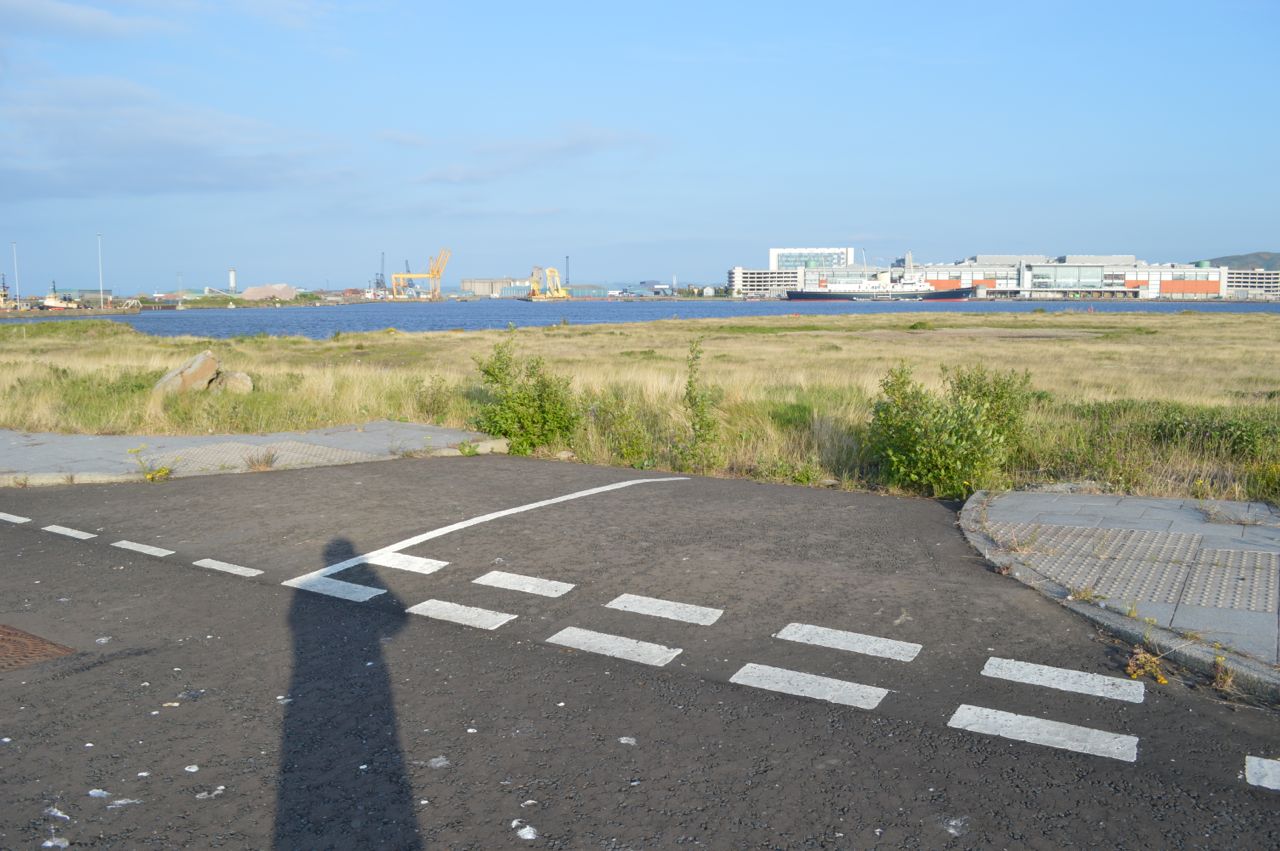
the road


A few years ago they started to develop Leith harbour. They built blocks of flats, terraces of houses, laid roads……then, CRASH, it all stopped. I can understand how these projects hit the buffers, but this little false start of a road with its pointless, well-painted junction leaves me wondering.

Why would you tarmac the roads before laying the foundations for the buildings? But, really, why would you PAINT THE WHITE LINES on a road which, after three paces, ends in shrub and grass? Complete with the double dashed “give way” rule? Give way when you’re coming from where?

What do you think of this road less travelled? This road to nowhere? This abandoned little bit of hope and planning?

What do you think of bothering to mark the rules of the road so long before anyone can ever be subject to those rules?

I’m not sure what I think about all this, but I do know this image is disturbing to me. It keeps popping back into my head and asking me questions. It’s an image without answers.

Read Full Post »

Oh when should we start?

Start living differently, if we reckon we’re not living the way we want to live? Eat differently, if we reckon we want to change our diet?

Start a project? Pursue a dream? Make a different choice?

I’m sure most advice is to start today. But then today passes and becomes yesterday and we haven’t started yet, so now what? The advice remains the same – start today.

I understand the wisdom of that advice…..I just have difficulties following it! If you do too, maybe this little excerpt will bring a smile to your face, the way it did to mine yesterday –

…Luigi Cornaro (1467-1566), a Venetian nobleman, published four editions of a work on “The Temperate Life.” He had been subject to digestive disturbances and gout for fifteen years, when at forty he took to dieting and hygienic living. Until within a few years of his death at ninety-eight he was able to write for seven or eight hours a day, conversed with his friends, attended concerts, etc. His first book was written when he was eighty-three, the others when he was eighty-six, ninety-one and ninety-five. The later ones contain apologies for the juvenile crudities of the earlier compositions!

A couple of interesting things about that story, huh? He had his illnesses for 15 years before he decided to live a healthier life. Having decided, aged 40, he went on to live another 58 years. We aren’t told whether or not his diseases went away, but we are told that for most of that time he was able to be creative, to be socially active and to enjoy music and attend events. That’s the important part isn’t it? What kind of life did he live? A fully engaged, creative life.

He published four books between the ages of 83 and 99, and his FIRST book was when he was 83, but how long had he been writing for 7 or 8 hours a day? Since he was 40?

Finally, don’t you love the humility of this man, and his understanding of the developmental nature of knowledge? In his final books, he apologies for the “juvenile crudities” of his earlier writing (the book he wrote when he was a mere 83!)

I guess one of the main lessons I take from this is that there is no “right time” to start, but the important thing is to start!


Read Full Post »

As I was walking to work this morning, I was suddenly struck by a beautiful scent. I stopped, looked up and saw this honeysuckle.

Honeysuckle

Oh I wish there was a tag to insert scent into a post!

Which scent stopped you in your tracks recently?

Read Full Post »

One of the characteristics of health is resilience. But what is resilience?

One definition is –

Resilience is the capacity of a system to absorb disturbance and reorganise while undergoing change so as to still retain essentially the same function, structure, identity, and feedbacks.

I like this definition. It captures the essential elements of reorganisation and change whilst retaining integrity and coherence. In other words, when something disturbing happens (and in health terms that can be anything which is a biological stressor – infectious organisms, chemicals, drugs, injuries or operations, or psycho-social stresses ie significant life events) then the system, or the organism, makes an adaptive response. The response has two aspects – defence, which tries to maintain the internal status quo, and reorganisation, which produces change within. Both are necessary, and whilst they can seem like opposites, both functions are required.

When someone is resilient they are less likely to be infected when a bug is doing the rounds, less likely to be overwhelmed or blown off track by major life events, AND they are more likely to recover and repair when damaged, but, more than that, are more likely to change, develop and grow.

As Prigogine demonstrated with his concept of “dissipative structures”, living forms develop and grow by falling apart. Reorganisation involves elements of breaking down, or dis-organising what is already there, and of putting things back together but in a new way.

How do we maximise resilience?

I read a paper recently which considered the phenomenon of resilience in relation to “fragile states” and the author highlighted two ways to maximise resilience.

Firstly, to develop “resilience-sensitive” policies (or actions), and, secondly, to create the conditions which support resilience. I think both of these ideas are useful in thinking about resilience in health care.

Our treatments should be “resilience-sensitive” ie if a drug, or an operation, or whatever other treatment is used impairs resilience it is less likely to be effective than one which at worst is neutral, but at best, is stimulative or supportive of resilience. How often do we think of this aspect in health care?

Secondly, how do we create the conditions to foster resilience? That’s a question that crosses the boundaries from the personal to the social and political. There are environmental, societal and economic aspects to that question. Is a polluted environment going to be conducive of resilience? What about an unsafe community? And what about the increasing inequality in income distribution? At a personal level, what about emotional intelligence? What about food? What about exercise? What about Nature?

What do you think?

What could you do to foster and maximise your resilience?

Read Full Post »

Three kinds of antis

The aggressive anti

The aggressive anti is either verbally, or physically, aggressive. They attack the people they are against, either directly, when the attacks occur between known individuals, or indirectly, when they attack anyone they consider representative of those they are against – them, not us. Those who commit hate crimes, terrorists, bigots, religious fundamentalists or militant atheists. They troll, they mob, they bully and they attack.

The political anti

In democratic societies politicians frequently define themselves by saying what and who they are against (the opposition). “We will fight….” Well, what and who are they going to fight? The other guys….whoever they are, and whatever they say.

The medical anti

Fight this disease, fight that disease, eliminate this, eliminate that, control this, control that……The drugs our doctors use are usually anti-something….antibiotics, antihypertensives, anti-inflammatories, antidepressants, antispasmodics…..They control or suppress disease or disorder, but they do not directly stimulate, support or maintain health. They are aimed at disease, not aimed at resilience, vitality, adaptability or wellness.

OK, if you want to be an anti, my question for you is what are you FOR?

I’d like to know, all you fight this, fight that people, what would you promote, what do you believe in, how would you like to make the world a better place by the positives you have to offer. What solutions do you propose to which problems? What is your vision of a wonderful world? Persuade me. Share your great ideas for how we can ALL have better lives. Enthuse me with your passion for what you are FOR, not what you are against.

Can you do that?

Read Full Post »

overhead on the train on my morning commute (two businessmen chatting)

“I saw the first butterfly in the garden yesterday”

“And two bumble bees”

“I saw a bee too, but no butterflies yet”


Don’t know, but its not the kind of conversation you usually hear on the Glasgow train. Warmed my heart a bit though…..

Read Full Post »

I was really struck by an article in The Observer the other day. Dr Sam Parnia, a doctor specialising in resuscitation techniques, has studied the experiences of patients who die and are later brought back to life.

Pardon? Yes, people whose heart stops (a cardiac arrest) and whose brains stop working due to oxygen lack, but who are successfully resuscitated and fully recover. Not only does the person return but he has found that about half of them report very similar death experiences (people refer to these experiences as NDEs – “near death experiences” – but he says they are, in fact, ADEs – “actual death experiences”). These two phenomena raise interesting questions – where does the “person” go while they are dead? And how does this “person” observe and remember observations which they make while they are dead?

This particular paragraph really gripped me –

All I can say is what I have observed from my work. It seems that when consciousness shuts down in death, psyche, or soul – by which I don’t mean ghosts, I mean your individual self – persists for a least those hours before you are resuscitated. From which we might justifiably begin to conclude that the brain is acting as an intermediary to manifest your idea of soul or self but it may not be the source or originator of it… I think that the evidence is beginning to suggest that we should keep open our minds to the possibility that memory, while obviously a scientific entity of some kind – I’m not saying it is magic or anything like that – is not neuronal

Now, I’m very familiar with the idea that whilst there are neuronal correlates of mental activity, we cannot say that its the neurones which produce the thoughts, feelings, and indeed consciousness which we all experience. But what a way to put it!

That the mind uses the brain to express itself.

I had to get the book. (The Lazarus Effect. Dr Sam Parnia. ISBN 978-1-84604-307-9)

I raced through it. In the book, Dr Parnia describes his work in resuscitation and reports on his AWARE study into the reported experiences of those who return. The heart of the book, for me, is Chapter 6, “What it’s like to die”, which describes many of these reports in detail. I’ve read this kind of thing before but I had never, ever read reports from children as young as 3 years old. Those stories stunned and moved me. They are amazing. And the story told by the Consultant of his first experience of a patient’s cardiac arrest where he tells how once recovered the patient told him in detail not only what the doctor had done in the room whilst the patient was unconscious, but even what the doctor had thought, but hadn’t verbalised…….

Dr Parnia goes through the possible scientific explanations for these reports and shows how none of them actually credibly explain them. He believes we will uncover a scientific explanation one day, but not until we start to accept these phenomena as real.

Here are a couple of sentences which really struck me

Reality is not neurologically determined, then, but rather it is largely socially determined.

and

The bottom line is that no brain-based chemical change can define whether a sensation or feeling is real or not

I don’t see things exactly as he does – for example, he uses a machine model to explain how the body works – it isn’t a machine, its a complex adaptive system – and the crucial difference is that only complex adaptive systems demonstrate both emergence and self-organisation – ie the whole cannot be explained by the parts. And he says “the goal of Medicine is cure” – well, I wish! But in fact, what does Medicine these days cure? Rather, Medicine manages disease – there are no cures for asthma, multiple sclerosis, Parkinsons Disease, etc etc etc

However, these are not the key points of the book.

Let me just finish with a reference to Chapter 5, “The Orphan” where he says

Asthma has a home in pulmonary medicine. Cancer is in the domain of oncology. Parkinson’s belongs to the neurologist. But cardiac arrest is an orphan by virtue of the fact that it cuts across many specialities because it is death, and death happens in all specialities of medicine but is parented by no-one.

See, this is what I find so wrong about health care – we divide health care into specialities which focus on parts and diseases – not only does death then become an orphan, but so does health.


Read Full Post »
darkening the light

In Goethe’s Theory of Colour he says that the primal phenomenon of colour is the lightening of dark to give violet and blue and the darkening of light to give yellow and red.

Read Full Post »

OK, here’s something I did yesterday and it resulted in such a GREAT day I thought I’d share the idea and see if you, too, might like to try it.

Here’s the challenge –

Travel no more than 30 minutes from where you live to somewhere you have never been before, walk around, explore, take some photos, or make some notes, then come home and reflect on it.

You can travel any way you like – walking, cycling, driving a car, public transport. Doesn’t matter if you live in a city, a town or in the country. The key to this is to explore somewhere NEW.

Here’s my personal story from yesterday. I was born and brought up in Stirling, went off to study and work as a doctor in other places for about half my life, then came back to live in Stirling again. So I’ve lived in this town for about half my life. Yesterday we decided to take a trip and do something we’d never done before. April first turned out to be the first day of the season for the ferry boat to cross the Lake of Menteith to Inchmahome Island and that was somewhere we’d never been. The Lake of Menteith is a 3o minute car drive from my house so off we went. Here’s some of what we saw –

The Lake of Menteith –
Lake of Menteith

The ferry –

Lake of Menteith ferry

The priory –

Inchmahome Priory

Inchmahome Priory

Inchmahome Priory

Men fishing –

fishermen Lake of Menteith

We also witnessed the spectacle of swans taking off, flying and landing, and seeing (and hearing!) some nesting Canada Geese (having totally by chance watched Fly Away Home yesterday on TV – strange universe we live in….how do those things happen?)

How many times yesterday did I say “How come we’ve lived in Stirling half our lives and we’ve never been HERE before?” ? Lost count.

So, here’s the idea. Find somewhere within the half hour radius of where you live, somewhere you’ve never been before, and go explore. If you like, come back here and tell me about it – create a flickr set, write a post on your blog, tweet about it, or post it on your Facebook page.

Why?

Because Life is brand new every day, and if you deliberately set out to explore this new day, you’ll experience the thrill of that directly.

See what it does for you to see life as wanting to surprise you, to share novelty with you, to fully engage you in this present moment. See how it feels to share what you experience.

Read Full Post »

diversity in the autumn garden

It’s common for us to experience loss, break down, destruction and disintegration.
In the middle of it, it can become hard to see the wood for the trees, and it can feel like this falling apart is not just inevitable but permanent.

As the leaves fall from the trees in the autumn, the bare branches of the winter woodland give the appearance of life being over for those trees.

Human beings know they don’t live forever, and although some have a belief in reincarnation, or lives of different forms from this life, nobody expects they are not going to experience loss, degeneration and death.

If the course of Life could be summarised as destruction and decline, then what kind of Life would that be? Is that really what we believe? That the direction of Life, the direction of the Universe even, is towards destruction and disintegration? Having begun with a Big Bang, are we heading for the final whimper (as T S Eliot wrote?)

But look again at the photo above. What do you see? Death and destruction? Loss and endings? Life and growth? Change and diversity?

The old mechanical, materialist view of the world teaches the idea that we try hard to resist destruction. “Entropy” is the term used to describe the inevitable run down of a system. But this view is more relevant to machines (which are “closed” systems), than it is to Nature (which is full of interconnected “open” systems).

Prigogine coined the term “dissipative structures” to better describe the reality of Nature and living organisms. He found that complex adaptive systems used dissipation to renew themselves, and in this renewal they grew, developed and adapted to changes in their environment. Indeed, Varela and others coined the term “autopoiesis” (self-making capacity) to describe the essential characteristic of a living system.

All living systems, ourselves included, are continuously breaking down existing structures and elements in order to create ourselves anew – in order to not just adapt, but to flourish. Not a single cell in our bodies lives as long as we live. In fact cells live between a few days and few months on average. It’s not the material, or the “stuff” of which we are made which makes us who we are. In that sense, we are much more like a river than we are like a machine.

I find this idea thrilling. Partly because I work every day with people who are experiencing loss and breakdown, people whose lives are falling apart. When a loved one dies, when your relationship or your job ends, when disease appears suddenly, or slowly in your life, it can all become quite overwhelming and it can be hard to see how any good can come of this experience. But here’s the key point, such continual change, such cycles of breaking down and destruction are not just inevitable but they are a necessary part of growth and renewal. These special times are times of renewal.

Spring time (not quite managing to appear yet here in the UK) is a good time to reflect on this. I’ve mentioned before how the Japanese celebrate transience through the cherry blossom festivals.

Renewal occurs through adaptation. As our lives change, if we take the time to become more aware, and we learn not to cling to current forms, we can see that in the midst of dissipation we discover the vast potential for creativity and growth. Just think of the universe story for a moment. Is it one of era after era of decline and destruction? No. It’s one of ever increasing diversity and complexity. It’s a story of cycles of joining together, breaking apart and forming new connections. It’s a story reflected in every single living being. Here’s the miraculous truth. The universe is not a closed machine heading day by day towards destruction. It’s a vast interconnected web of open systems producing the most elaborate, most complex and most amazing phenomena day after day after day.

snowdrops closeup

Read Full Post »

« Newer Posts - Older Posts »