Feeds:
Posts
Comments

Home and food

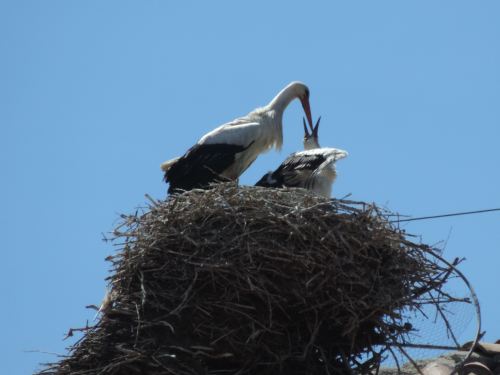
A few years ago I visited Segovia in Spain and saw all the storks which live there for part of each year. Here’s one feeding a chick….mind you that chick is looking pretty big already! The storks’ nests are huge and look pretty chaotic really. They’re built on roofs, on the tops of towers and tall trees.
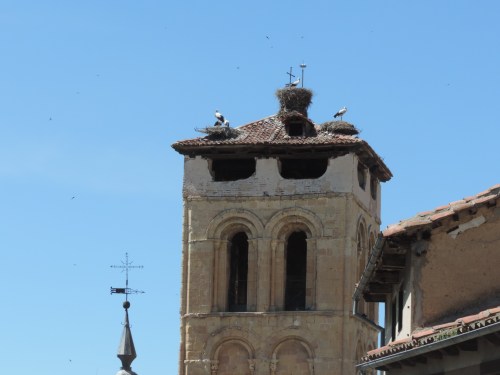
If you look carefully you’ll see that each nest is constructed on a kind of wire basket. Now, I don’t know who makes the wire baskets or puts them there but I’m pretty sure it isn’t the storks! So, there’s no doubt the people of Segovia welcome these birds and help them create their homes here. Not all storks are migratory but I think these ones are. Their nests are used for many years, with each season’s storks adding to the material. In amongst a copse of trees I came across there were quite a number of large twigs and branches scattered on the ground, but I don’t know if they fell off during construction, were thrown out by some of the birds, or just fell down because the nest grew too big.

Looking at these photos again I’m reminded of some of the basic needs and drives we share with all living creatures – the need for a home and the need for food. I know there’s a lot more to human beings than that, but we are all motivated to get both food and a home….neither is optional.

Ah, you might say, but some people are nomadic. That’s true, but nomads have “homes” too, they just take them with them, or build new ones wherever they settle for a bit.

We humans are apparently the most highly developed species on the planet. Don’t you think we could manage to provide both home and food to every single human being? Is that beyond us? Or do we have the means, but not the motivation?

When I consider this pandemic I’m struck by the importance of both home and food. If we had better housing, less densely occupied and less densely clustered together, don’t you think it would be harder for an epidemic to become a pandemic? In France, it’s been striking that most of the infections have been in cities with populations greater than 100,000 people – mainly the cities of the “Grand Est” – Paris, Lyon, Marseilles. Incidentally I read a study recently which surveyed populations for life satisfaction and the highest rates were in those who lived in cities or towns of less than 100,000 people.

The second striking feature has been about food – on the one hand, the difficulties faced by many families in getting enough food, because so many people live in precarious conditions, with hardly enough money to get to the end of each normal month. When a crisis comes along, they are hit the hardest. Another aspect of food is the contribution of obesity to the incidence of severe COVID-19 disease. Obesity is a true pandemic, and unless it is tackled by addressing poverty, well-being, inequality and the industrialised agriculture and food production systems of our societies I don’t know how it’s going to be resolved – certainly not by fat-shaming and hectoring people to eat less and move more!

Is it beyond our abilities and/or our will to create more robust, healthier, happier societies by at least dealing with these two key needs…..the need for decent homes and the need for nutritious food?

Oh, and just so you don’t forget what this is all about……
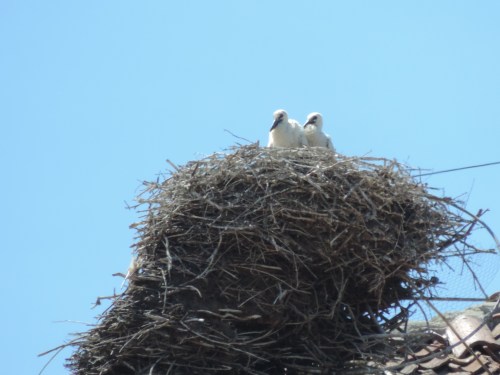
Let’s do this for the babies, the children, the chicks!
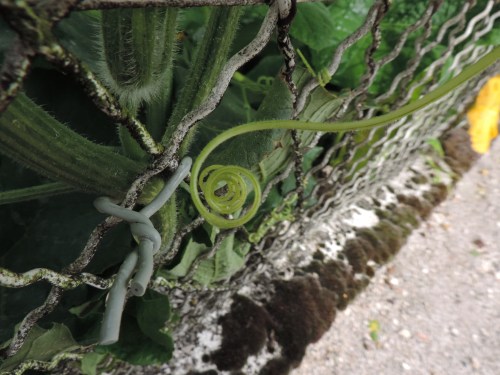
Yesterday I shared a post about two forms of growth….unfurling (unfolding, opening, flourishing or blossoming) and connecting (reaching out to make bonds, relationships and links).

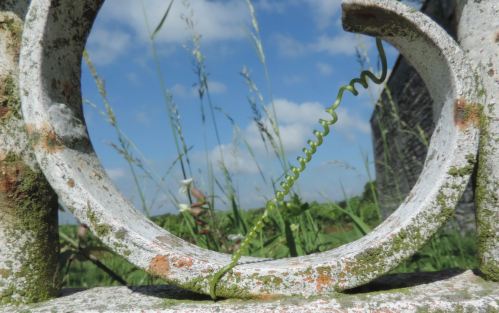
Today I came across a couple of photos from my garden which show both of these processes occurring at the same time. In this first photo you can see how the tendril or creeper which is reaching out is doing so in a kind of spiralling or un-spiralling way. It doesn’t consider that a straight line is the shortest distance between any two points! Perhaps there is something to learn from this – a sort of melange of meandering and spiralling around.

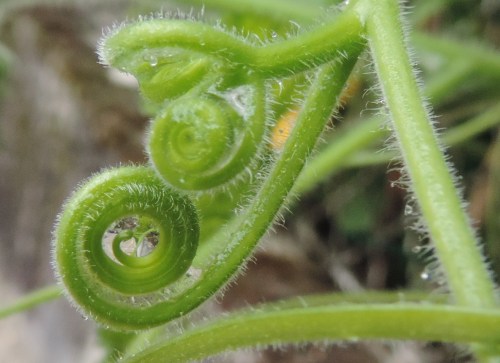
But what really struck me was this photo because I took a close up of these beautiful spirals and because I was focussing on the near distance the background has gone nicely blurred (something photographers call Bokeh I believe!) – but, wait! Look more closely! Look at the centre of the spiral which is in the bottom left corner of this image!

Through that spiral the distance suddenly becomes clear as crystal.

I don’t know what you think, but that reminded me of my favourite “And not or” theme – when you take BOTH of these processes of growth together suddenly you can see the world more clearly!

If you’re interested to read more about “And not or” check out my book.

Two forms of growth

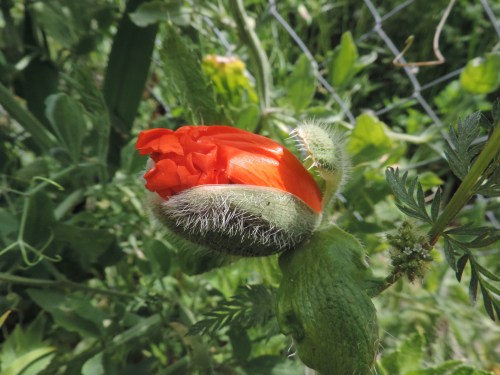
Both of these images are beautiful and I think that in each of them we see a way of growing.

The image on the left is an unfurling. It’s an opening up, a revealing, a bursting out. The outer surface splits apart to allow the inner flower to come into the world. Buds are a powerful example of growth. We see them everywhere in the Spring. They start as small swellings, then their appearance becomes more complex as they grow, then they open up. This opening up, this “flourishing”, is one of the main ways of growing in the world. It’s a blooming, a blossoming. Beautiful. Isn’t this what we hope for in ourselves and our loved ones? That we are able to realise our potentials, that we are able to unfold and reveal our uniqueness, that we develop, grow and mature in a way which we could only call “blossoming”?

The image on the left is a connecting. This is a reaching out, a stretching out, a spiralling upwards, downwards, along until we find something else to catch on to, then investing power and energy is creating a strong, resilient bond. This is a second, equally important, way of growing. We grow by making connections, forming bonds, developing strong, resilient relationships. We grow by finding and connecting to “the other”…..to other beings, other parts of our environment, other parts of ourselves even.

So, in these two images I see two of the most fundamentally important ways of growing and developing – unfurling and connecting.

A world reclaimed

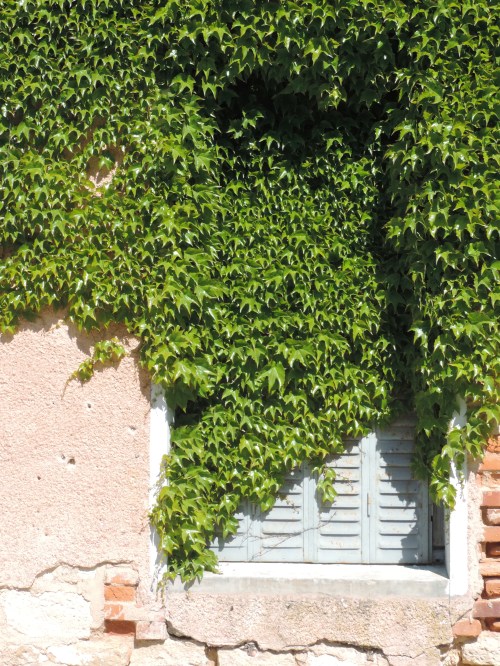
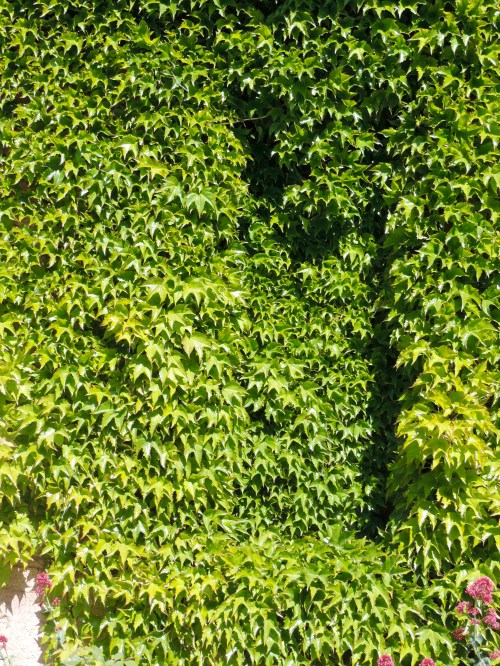
In the chateau down in Blaye there are some abandoned buildings. Look what happens when a man-made structure is left unattended. Nature begins to reclaim the territory. In the photo on the left you can see the advance of the ivy over the window, and in the one on the right you can still make out where the window is, you just can’t see it any more.

During the lockdown and even during this time of eased restrictions, it is clear that human beings have to a certain degree retreated and the rest of Nature has been left to reclaim the world. Many people have commented on the amount of birdsong they can hear now, and that’s not all down to there being less traffic. Some of it seems to be there are more birds in and around our gardens and streets now.

This summer has seen a sudden surge in wasp numbers in this part of the world and one of the explanations given for that is also the temporary retreat of human beings into their houses and gardens. It seems there has been less vigilance on the part of park and grounds authorities so wasps’ nests have been left unattended and allowed the wasp populations to proliferate.

I think each of these examples reveals how intricately interconnected we all are on this planet…..and by “we” I don’t just mean “we humans”, I mean “we living organisms”……humans and other animals, birds, insects, and plants too.

The down cycle

I’m pretty keen on creativity. I have an eye for what’s new. In fact, I’ve been pretty impressed with the old philosophy which says to treat every day as if it’s the first time you’ll have experienced it. Because it is. Each patient who came into my consulting room was coming in to tell me a new experience, a new story. Even if I already knew them quite well they’ll still come and tell me something I hadn’t heard them say before. Everyone had the capacity to surprise me.

I love the Spring time of the year because I love to see the new seeds pushing up the first green shoots, love to see the buds beginning to form and unfurl, love to see the first sight of the migratory birds returning from their winter travels.

But Autumn is sort of opposite to that. It’s a time of a certain paradox – a time of fruition and therefore harvest, but also a time when the world begins to wind down, go to sleep, or even die off. It’s a time you might call the “down cycle”. I love that too. I love to see the leaves turn yellow, red, brown, golden. I enjoy sweeping up the leaves that fall from the mulberry tree.

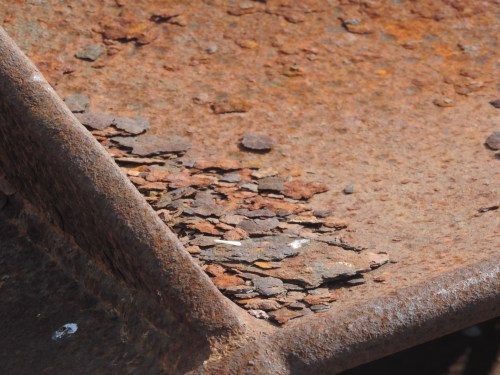
This photo reminds me of the down cycle. Here’s a piece of iron. Some large, once strong panel or plate which someone created. But it’s been cast aside for a long time, and Nature has begun to break it down. The once smooth and shiny surface is breaking up into these little chips and flakes. The chips and flakes will, finally, turn to dust.

Does that seem like a loss?

I suppose viewed from one perspective it is. But Nature has down phases as well as resting phases, waking, growing phases, and maturing phases too. Could anything exist if any of these phases didn’t exist?

I think we need to remember that sometimes, and not get too upset and anxious about change. Nothing stays the same. And because nothing stays the same we are able to start each day as if we had never lived it before….because we haven’t. Imagine! How much there will be to discover today. How many new experiences and sensations you will have. How many new thoughts and feelings you will experience.

Life is dynamic. As Carlo Rovelli, the physicist says

A stone is a prototypical “thing”: we can ask ourselves where it will be tomorrow. Conversely, a kiss is an “event.” It makes no sense to ask where the kiss will be tomorrow. The world is made up of networks of kisses, not of stones.

I think an awareness of the phases and cycles of life reminds us of that. There’s beauty in every phase.

Nostalgia for normal

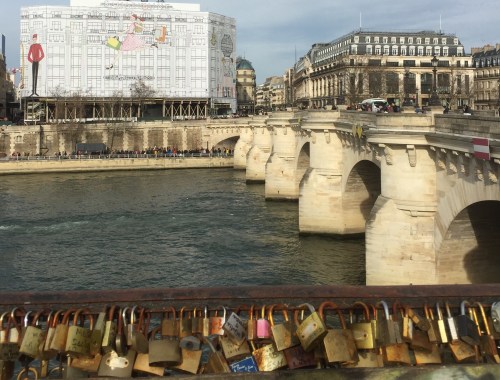
I came across this old photo the other day. I took it in Paris. In the foreground you can see some of the famous love locks. I’m not sure where this habit began but you can find it all over the world now. In this case these ones are along one of the banks of the Seine. On the opposite bank, the first thing you probably notice is the huge “Printemps” department store with its facade covered with scaffolding for building works. Rather than just cover the scaffolding with boring, bland material, they’ve made it look like a giant mural depicting a happy, carefree shopper swinging her bags of purchases as she almost flies over the ground. Right in front of the shop, but down a level on a promenade, you can see a gathering of people. Maybe if you zoom in you’ll make out that there are some musicians in this little crowd, because that’s what was going on. There was a jazz band playing by the side of the river. A kind of large busking event. They attracted people to gather around them and listen to the upbeat delightful music, but you can see a fair number of people also stopped on the bridge up above them to look and to listen.

Last night I watched a movie. A British rom-com called “Finding Your Feet“. I enjoyed it and had some real laugh out loud moments. For example, the character played by Joanna Lumley saying she had been married five times and the last time the marriage had ended “due to religious differences” – “He thought he was God and I disagreed”. But there are sad themes of loss and dying in the movie too. In one scene most of the cast go off to Rome to take part in a dance performance, and as they spend a day and an evening enjoying Rome together I was suddenly struck with a feeling of loss myself.

I realised I had the same feeling when I looked at this photo here. It’s a sort of nostalgia for what we used to call normal. There they are, all kinds of people, out in the city, no need for masks, no need for “social distancing”, as carefree as the character painted on the Printemps mural.

I have a longing for that normality again. I guess a lot of us are feeling pretty fed up with this pandemic by now. I guess many of us aren’t feeling that comfortable with all the measures introduced to “protect us” by making us wary of others, and constantly reminding us that we might catch this virus, get ill, and even die. It’s not getting much easier, is it?

So what are our options?

Mine is a mixture of acceptance and adaptation. The virus is present. It’s highly unlikely that I will catch it, and, apart from my age, I’m not in any of the groups likely to suffer the infection most severely. In fact, most people won’t catch it, and most of those who do won’t suffer much. But some will. Enough to overwhelm hospitals and carers….potentially. So, at the very least from a position of care and solidarity I need to change some of my habits. So I choose to go along with the increased physical distancing, the wearing of a mask to reduce the chance of spreading the virus, and to let go off some of the things which had become a normal part of my life – travel, day trips to cities, visits to museums and galleries, lunch in a seaside town during the holiday season. I’m sure you’ll have your own list.

So, I have this nostalgia for “normal” and I hope “normal”, at least as an experience will return soon.

Meanwhile I’m drawing my focus in to the everyday wonders of life here and now. Enjoying the glimpses of the “Little Owl”s, or the “Barn Owl” which flew over my head the other night in the dark. Gazing at the sparkling night sky wondering what I’m looking at. Sunset bathing…..basking in the glorious colours of the clouds as the last minutes of the day turn the world pink, and rose, and violet. Losing myself in wonder at the drunken stumbling movements of bees gathering nectar deep in the big yellow pumpkin flowers. I could go on.

I’ve started the practice of “morning pages” again (if you don’t know this practice, google it. Or check out this older post of mine). I’m writing these daily posts, compiling and editing photos and texts for my next book (remember to check out my last one – “And not Or“) I’m reading as avidly as I’ve ever read, and pretty much each day feels like a good one.

What are you doing?

Breaking traditions

One thing this pandemic has done is it has broken a lot of habits and traditions. Perhaps one of the biggest of these is working from an office.

I wonder how many people have been working from home now instead of from an office, and I wonder how many of you, at this stage, have decided that, actually you prefer it this way.

There are, of course, pros and cons. When you break down the boundaries between work and the rest of your life there’s more of a danger of work seeping into other areas of your life, than there is of other areas of your life seeping into your work!

There’s a freedom, a flexibility and a release from long commutes. But there’s a change of human contact from face to face, to screen to screen, and, for many people that feels like something lost rather than gained.

I wonder what this experience will do to the future of work. I don’t mean just the shrinking of certain forms of work and the complete loss of others, but of the way work continues for those whose jobs remain secure.

2020 is turning out to be a sort of “bardo” – a gap, a pause, a space – it’s got an in-between quality to it. In the future people will talk about life “BP” and “AP” – Before the Pandemic and After the Pandemic. Two things these in-between times give us is the opportunity to do things differently AND the opportunity to reflect, reassess and revalue.

How’s that going for you?

Has your life changed now in ways which will make your “AP” years significantly different from your “BP” ones?

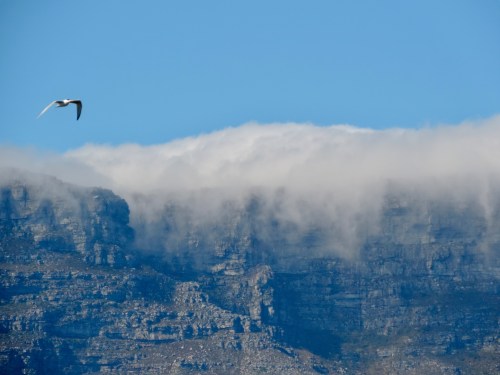
I took this photo in Capetown many years ago. It wasn’t my intention to take a photo of a seagull, but, somehow the bird’s presence adds to the image, rather than taking anything anyway.

What I was wanting to photograph was this very common phenomenon which the locals refer to as “The table cloth”. It’s when white clouds form on top of Table Mountain and steadily spill over the edge to tumble down the cliff face.

They don’t tumble that far before disappearing. It’s mesmerising. I watched it for ages. It seemed like there was an endless supply of white cloud on the mountain top. No matter how much spilled over, there never seemed any less on top. It’s a constantly moving phenomenon. The cloud tumbling over the edge is continuous. At the very top it looks like a waterfall, but, as you can see, it’s a waterfall which completely disappears within the first few metres of its descent.

Where does it go?

As you stand and look at it, you are watching the visible become invisible. Right before your very eyes.

Isn’t it amazing that all that water which creates the white cloud is already present in the air, but invisibly so, and it all just vanishes back into its natural invisibility as you watch it.

I know I often think of the relationship between a wave and the ocean when I think of our individual existences…..how we emerge from the ocean, the way an identifiable wave emerges, without ever leaving the environment in which it exists.

This “table cloth” phenomenon is like another example. The water exists in the air, then it coalesces to from clouds like these, before slipping back into the invisibility of the air.

Each of us, in our short, transient lives, is fashioned out of all that exists, appearing briefly in our distinct, unique form, before slipping back into the continuity of Existence.

As the physicist, Carlo Rovelli, wrote…

A handful of elementary particles which vibrate and fluctuate constantly between existence and non-existence and swarm in space even when it seems that there is nothing there combine together to infinity like the letters of a cosmic alphabet to tell the immense history of galaxies of the innumerable stars of sunlight of mountains woods and fields of grain of the smiling faces of the young at parties and of the night sky studded with stars.

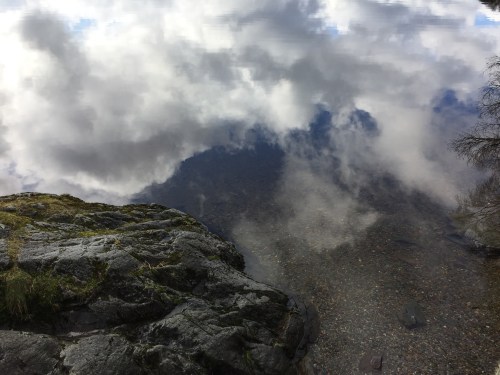
When you look at this photo I think it seems to be a mountain with clouds and sky just above it. But you immediately recognise that’s not quite right.

So then you see this and you think it’s trees with the sky above….maybe one of those forest pictures where the photographer directs the camera straight up to the sky and catches the topmost branches of several trees. But that’s not quite right.

In the first photo, the apparent mountain in the foreground is an odd shape. Mountains just don’t look like that, then, in the second photo, what’s that rock doing balanced on top of the trees?

The thing is, these are both photos of reflections on the still water of a loch. Once you know that, the whole image makes sense.

This inspires a train of thought in my mind…..about how we perceive and make sense of reality. It’s a complicated business but it involves context. It helps to know where you are when you are looking around and what you can see in the immediate environment. There is nobody standing at the edge of this loch wondering what they are looking at. They know where they are and how they got there.

We make sense of reality by spotting patterns, but we need to learn the patterns before we can spot them. A bit chicken and egg-ish isn’t it? In normal life these two aspects of the same thing are iterative…..we are constantly learning and spotting patterns, the more we learn, the more we spot, and the more we spot, the more we learn.

Medical Practice is like that. Doctors learn pathology and the natural history of diseases. In other words, they the patterns of illness. The better a doctor knows the patterns, the more easily they’ll be spotted – or diagnosed. And the more diagnoses a doctor makes, the better the knowledge of patterns. We call it experience. I always felt that a good diagnosis was crucial in good health care. If the diagnosis was wrong, the chances are the treatment would be wrong.

In my first Paediatric job, my mentor told me on the first day that his goal for my six months with him was to teach me how to recognise a sick child. When he said that I thought it was a pretty bizarre thing to say. I mean, wasn’t it obvious when a child was sick? Wasn’t the goal to diagnose ie name the sickness? Well, of course, he was right. I was wrong. What he wanted to teach me was that very first important step…..how to recognise, in an instant, that this child was ill and needed immediate attention. Working out exactly what the disease was and how to treat it came a close second, but if you didn’t recognise that the child was sick, all was lost. It turned out that learning was by experience, encountering sick children and healthy children of all ages, to become familiar with what was normal behaviour and demeanour at different developmental stages. That teaching was crucial for my practice as a GP. It let me walk into someone’s house and know instantly that this child needed close attention and help.

The clues, and the signs, were in the contexts, the environments and the relationships. Yes, some were in bodily or facial “signs”, but mostly they were in behaviours and responses.

I suppose it’s that kind of experience and learning which made me suspicious of reductionism and generalisations. Every individual is unique and can only be understood within their contexts, their environments and their relationships.

Diagnose, like pattern spotting, is like joining up the dots. It’s got a lot to do with connections and behaviours. It’s not all about “data” and “measurements”. Especially when considering the real, actual, unique individual here and now.

Social distancing

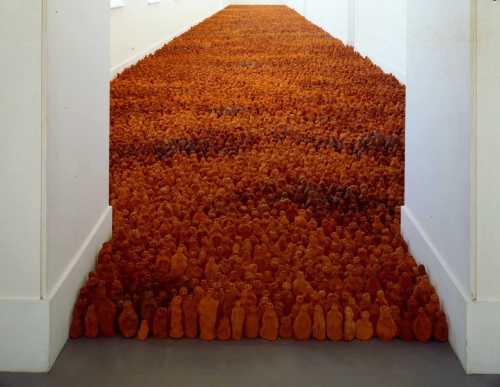
One of my most favourite sculptors is Antony Gormley, he who made “The Angel of the North” which stands beside the M1 in the North of England. His “The Field”, which I saw in Inverleith House in the Edinburgh Botanic Gardens years and years ago left an indelible mark on me. I recalled it in my mind time and time again as I wrestled with the paradox of what makes every patient unique and what they share with others.

But I was thinking again of his work the other day and I remember “Capacitor” which is what you see in this photo at the beginning of this post. This was one of the works he created from an outline shape of his body. In this case he made it with dozens of metal rods.

Maybe this came to mind because for the first time since I moved here almost six years ago I came across a hedgehog in the garden after dark, as I was out closing the shutters for the night.

I have such a clear memory of being in the same room as “Capacitor”….how awkward and dangerous it felt to be anywhere near this work. Like it could take your eye out, or pierce your body if you got too close.

So, you can see why that’s come back to me now. When I’m out and about now I sometimes think everyone has got on a suit that makes them look like “Capacitor”. Except all the spikes are invisible. Has this become the famous “new normal”? All of us increasing our stand-offishness (is that a word?). All of giving each other “a wide berth”. Everyone now regarded as a potential threat.

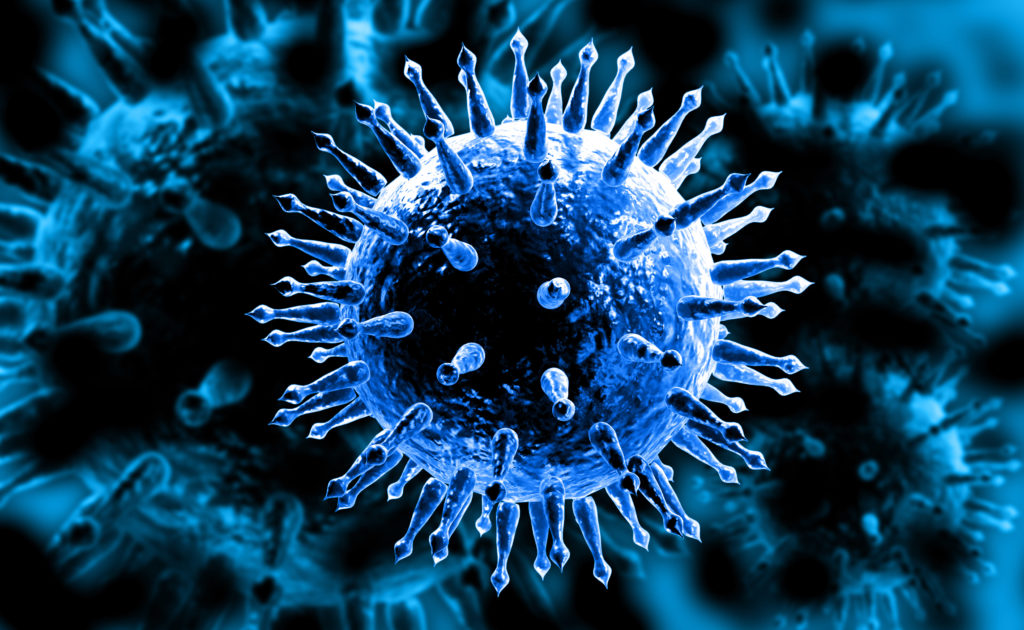
Then it struck me…have you seen the images of the coronavirus?

It’s a ball of spikes!

Yikes! It’s turning us all into images of itself!!