Plants send out creepers and tendrils which twist and turn and spiral on their way are always fascinating. For the last five years I’ve been composting grass cuttings and “garden waste” then spreading it on the veggie patch. It’s turned a stony, hard, bare piece of ground into something of a mini-jungle once each year’s vegetables start to grow. This year there must have been some viable pumpkin seeds in the compost because a couple of pumpkin plants started to grow in places where I definitely hadn’t planted them. Once they started to grow they took off, spreading all around the entire patch, weaving between other plants, sending spiralling tendrils out to grasp onto to anything it could touch, reaching each of the two boundary walls (the veggie patch is in a corner), climbing those walls, the fences above them and by now developing over half a dozen huge pumpkins. Every morning you could see how much further the plant had managed to grow since the previous morning. It’s astonishing.
This photo isn’t of a pumpkin plant. There are many, many varieties of plant which have this ability to send out these incredible tendrils. They reach out, touch and catch on. They connect, they bind, they tie together. Look at the size of these ones! You can sense how strong they are.
I was thinking this morning about how pretty much every single atom on the Earth has been here since the planet was formed. They arrived here from distant stars. I was contemplating how the Earth doesn’t make new copper atoms, gold atoms and so on. But what Nature does is create what’s unique and new every single day. She does that by making connections, reaching out, touching, drawing together, blending and binding. In other words, the world is full of newness every day….not new elements but new forms. Nature is like the most inventive creative artist you could imagine, fashioning brand new, individual, unique, forms every single day.
Making connections. Making new connections. That’s the essence of creation.
The wonders of the everyday. Or “L’émerveillement du quotidien”. It’s normal for me to find myself wondering about something I’ve just seen or heard.
I suppose for most of my working life my days were filled with patients. I never tired of that. I never got bored of that. Every day each patient would present to me a unique a story, a new, and singular problem, puzzle or conundrum to unravel. Each patient would be asking me to help them make sense of what they were experiencing and to support their abilities to heal, to cope, to adapt. Maybe they didn’t quite use that language but that’s always what I heard.
Before I became a doctor, way before, right back as early as I can remember I was driven by curiosity. I wanted to learn, discover and explore. It strikes me now that it isn’t a long way from curiosity to wonder.
People have always amazed me. They still do. Life has always amazed me. This Earth, this planet, the solar system, this universe which we all live in have always amazed me, filling me with an infinite supply of curiosity.
But there’s something else.
Beauty.
Look at this photo of a glorious, immersive sunset, where every single element of the sky and the Earth changes colour. Look at the palette! It is just breathtakingly gorgeous.
I see beauty everywhere. Which isn’t to say I find everything I see beautiful, I don’t. But there is “so much beauty in this world” (do you know what movie that comes from? Here’s the answer).
I am a very visual person. I think visually. I sketch and diagram as I think. I love photography and I think I “have an eye for it”. I see what I find amazing, curious or beautiful and I try to take a photo or two. Then I return to those images again and again, year after year, and I find that, like with this one, the delight, the pleasure, the amazement in beauty like this never fades.
Of course there are other senses and I don’t just experience beauty visually. I love music. I collected “records” long before people starting calling them “vinyl”. I still have them. I still play them. I spent hours and hours ripping CDs onto iTunes and I don’t even know where those libraries are any more! But I stream music now. Every day. Several times a day. I used to discover new music on the radio. I took the back off an old radio when I was a teenager, attached two wires to the speaker using clips, and fed the audio directly into a cassette recorder. I still have some of those recordings…..studio sessions on John Peel’s programme on Radio 1.
I’ve long had a love for movies. I love them for their stories and for their beauty, oh, and I often love them for their music. I compiled short clips of about a hundred movies to teach doctors and other health care workers about our unique human strategies for coping and adapting. I could have taught those strategies without movies but the beauty, wonder and emotional engagement which came with the movies made them much easier to learn and to remember. I probably have a whole vocabulary of coping and adapting based on movie characters, scenes and plots.
There is beauty all around us. I delight in images. I delight in music. I delight in movies.
Where do you find beauty? Where did you find beauty today?
I know there’s a colour called “sea green” but I must say that most times I look at the sea, I don’t think “Look how green the sea is!” But on this particular day, I did. In fact, the singular most striking feature of the sea in this photo is how green it is. Growing up in Scotland I’m used to seeing the land as green….the hills, glens, fields and forests. There is a lot of green in Scotland. I associate those greens with Nature, and with Life.
When I think of a calm, soothing landscape, I usually envisage one which is green, but this green seascape isn’t calming at all. The fact that the wind is whipping up the waves and causing them break far from shore tells me this is a day of a more “active” form of weather…..not a day of peace and ease. And there’s something else in this scene which makes it a bit disturbing….the lighthouse.
The lighthouse? Why should that be disturbing? Well, what’s a lighthouse for? For warning people sailing in this area. Why this area? Because there are dangerous rocks, and/or dangerous tides here. If you’re not careful around here then you could run aground, and even lose your life.
Noticing the lighthouse and realising that I was feeling unsettled as I looked at this image reminded me that we are constantly bombarded with warnings these days – “yellow weather warnings” (what is yellow weather by the way?), “red weather warnings”, “danger to life”, “virus warnings”, “health warnings”, “safety warnings”…….there’s no end to it.
What do all these warnings do? Keep us safe? Maybe. But one thing they certainly do is trigger our inner warning systems. There’s a part of the brain which is called the “amygdala” which has a key role in our alert system. It sets off the famous “Fight or flight” response, flooding our bodies with adrenaline, speeding our hearts and our breathing, tensing our muscles, tightening our stomachs, preparing us to take action. What kind of action? Survival actions.
This essential survival system comes with a problem however….when it’s constantly triggered it sets a higher level of body defence…..that’s the inflammatory system…..and a chronically alerted, activated inflammatory system is at the basis of most chronic disease – from heart disease, to any form of “-itis”, to autoimmune diseases and chronic psychological problem states like chronic anxiety, phobias and depression.
So, I think it’s important to be able to do something about that, and here’s a simple, but helpful exercise – take three very deep breaths, slowly one after the other, completely filling your lungs, then gradually letting all the air out bit by bit. Repeating that big, deep breath three times.
That’s it.
Sure, there are loads more things you can do, but, believe me, this is a good start! Firstly by consciously choosing to do these three breaths you’re taking your attention away from the alarm state. Secondly, this form of breathing changes the chemical balance in your body, changing the oxygen/carbon dioxide ratio in a way which triggers cascades of anti-inflammatory change in your whole system. Thirdly, it triggers the vagus nerve, slowing the heart and pretty much literally steadying your nerves. Finally, this all breaks the loops, helping your break out of stuck hyper-activated circuits….a kind of “re-set” if you like.
If you want to extend these benefits and deepen them, the next thing to do is call to mind a calming, safe, relaxing scene…..preferably one you once experienced. Re-create that event, or that circumstance for a few moments and the emotions which arise with it will begin to dilute the alarm state and deepen the benefits of the three breaths.
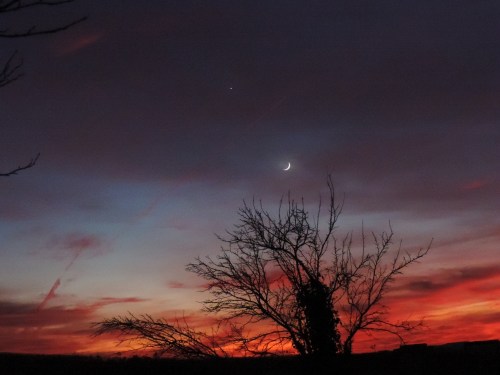
You might want some help with this. I find a sunset helps. Here’s one taken from garden on a night where the crescent moon sat above the plum tree and the planet Venus hung in the depending night sky just above the moon.
You might well have a photo of your own somewhere on your phone…..a peaceful, pleasing, calming scene, which you, yourself witnessed. If you do, mark it as a favourite and keep it handy. It could be just what you need.
Emanuele Coccia, the Italian philosopher who brings a new and refreshing perspective to the life by considering plant life says that what plants do so well is capture “extraterrestrial light” and turn it into energy and forms.
Two things struck me when I first heard him say that – “extraterrestrial light”? What’s that? Well it’s the light which comes from outside of the Earth isn’t it? Natural light. The light of the Sun, and the light of stars. The light of the moon is reflected light, so is just another dimension of the light of the Sun.
Without this “extraterrestrial light” from the Sun there would be no Life on Earth. Plants are THE way of transforming light into energy. We get all the energy we need by consuming other life forms at different stages on the food chain, but all of what we eat has plant life at its core. We fundamentally consume the light of the Sun through plants. Maybe through some animals we eat, but they do didn’t capture the energy directly from the Sun. All animals get all the energy they need AFTER the plants have captured it from the Sun.
The second thing which came to mind was Richard Feynman’s observation that trees make themselves “out of thin air“. That startling observation was based on the fact that trees capture carbon dioxide from the air, turn it into carbon based structures and emit oxygen as a “by product”. They also capture all the energy they need directly from the Sun using photosynthesis (a trick no animal ever managed to acquire!)
Then a third thing came to mind….the fact that we are all made from the atoms created in the stars. All the natural elements we find on Earth didn’t originate here. They originated in the great furnaces and explosions of distant stars millennia ago.
All of Life pursues this “extraterrestrial light” – all the plants, all the animals, all living creatures get the energy they need either directly from the Sun or indirectly through the consumption of other creatures which have already captured the sunlight.
Isn’t that a startling thought? That we are ALL light-seekers! All of us surviving and growing by finding and consuming the “extraterrestrial light”.
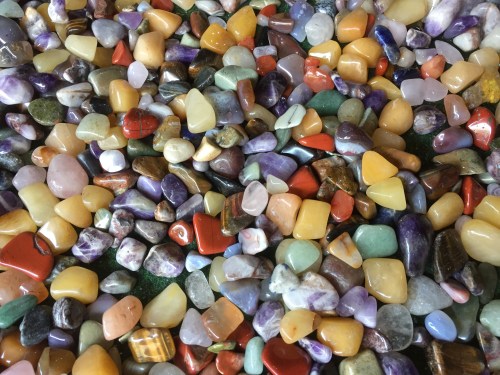
This is a photo of a small part of something called a “Scratch Patch”. It’s an area about the size of a large room. The floor is covered with polished stones. You pay for a container/jar and can then spend as long as you like filling it with the particular stones which attract you most.
I shared a photo of a pumpkin stall at a farmers’ market the other day to demonstrate the beauty of diversity but then I came across this photo which shows exactly the same thing in the mineral world.
We have a bit of an ambivalent attitude towards stones I think. Maybe because they are inanimate we don’t often value them as much as we do plants or animals, but on the other hand, “precious” stones are considered to be amongst the most valuable objects in the world.
At a simple level many of delight in spotting and picking up a few “interesting” stones when we are out walking – whether it’s through the vineyards, or along a beach. You probably have some favourite stones of your own. Maybe in your pocket, at the bottom of a bag, or on a shelf somewhere in your house.
We must know, instinctively, that stones are not all the same. Otherwise how would we notice some but not others? Why would we choose to pick up and keep certain ones?
I think the attraction of uniqueness runs right through everything in this universe. We humans, each of us unique in our own right, are delighted by uniqueness, whether we find it in our gardens, the paths we walk along, the flowers and trees which grow around us…….
I have often said that what I looked forward to most on a Monday morning was the first clinic of the week. Every single week I knew I’d meet unique patients. Every single day I knew I’d hear unique stories which I’d never heard before. Every single consultation was unique, never to be repeated.
For me, good Medicine couldn’t be reduced to protocols, guidelines and algorithms because every single human life is a unique one. Every single human being is “extraordinary”, not reducible to a class, a type, or a disease. Every encounter occurs only once.
I think of it when I look at this photo I took in Capetown several years ago. The trees which had been planted along the promenade were blown by the winds every day which made them grow the way you can see in these photos above.
That would be a good example of going with the flow…..rather than being blown over and broken the trees bent to the wind and grew WITH it rather than against it.
But then see what happens when someone turns up to park their car on a sunny day? They find the perfect spot to keep the car cool and shaded!
Here’s where I’m for “efficiency” – in machines and in situations where you can accurately predict the outcomes.
Here’s where I’m against “efficiency” – in human situations. Human beings, all other living creatures, Nature and the environment are all complex, open systems. You cannot predict the outcomes with accuracy and certainty from any starting point. For three reasons – change is constant (nothing stays the same), everything is connected so subject to unpredicted influences, and the phenomenon of “emergence” where a complex system develops new characteristics and behaviours which couldn’t have been predicted from its prior state.
Everywhere you look in Nature you find something called “redundancy” – natural systems have more checks and balances, more options in play, than logic would lead you to believe was either necessary or “efficient”. This is the key to their robustness.
As Professor Margaret Heffernan, author of “Uncharted”, points out, aircraft are built with more control systems than they “need”. They have more engines than they “need”. It’s these backups, alternatives and “redundancies” which make a plane robust. She clarifies the difference between “resilience” which is the ability to recover, and “robustness” which is the ability to avoid failure in the first place.
Austerity economics plus managerial philosophies of “efficiency” plus neoliberal politics created the perfect conditions for the pandemic to be a disaster. In many, many countries the health care services had been cut to the bone. They weren’t robust. In many countries social care services had been cut to the bone. They weren’t robust either. In many countries industry, employment conditions, education…..you name it, had all been pared back, trimmed down, downsized, made “more efficient” by under-resourcing them, failing to replace staff who left, and, in fact, doing the exact opposite of developing and strengthening any of them.
How do we cope better with the next pandemic?
Well a good place to start would be to set our sights on “robustness” instead of “efficiency”. After all, in human beings and in all of Nature, the future cannot be predicted, the exact outcomes cannot be known. We are not machines.
Ok, you’re asking, what’s all that got to do with a table of pumpkins at a market? Well, that photo is from a fabulous Saturday morning farmers market in Capetown, and I love this display of diversity and abundance. I love how DIFFERENT they all are! No standardisation by size, shape of colour. Nature is like that. Diversity, abundance and redundancy are key features of healthy natural systems.
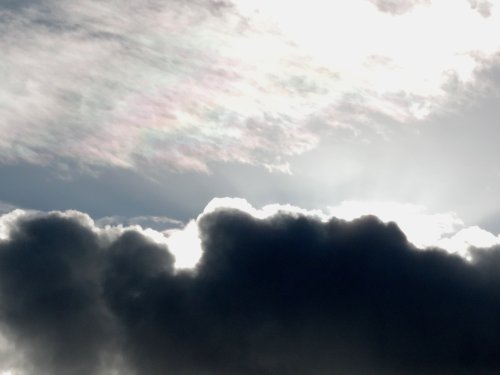
I see two symbols of hope in this one image – a cloud with a silver lining, and the beginnings of a rainbow (or, if you prefer, the emergence of colour out of monochrome)
We human beings need hope. I’m not sure if it’s possible to live without it. That might sound dramatic but I expect you’ve heard tales of seriously ill people “turning their face to the wall”, and dying. Or, maybe the opposite, maybe you’ve heard those who recover from serious illness described as “fighters”, which doesn’t mean they have defeated an enemy, it means they have dug deep, found wells of hope and belief, and have healed.
Whenever I saw a patient with a serious disease I knew there were roughly three possible future paths – improvement, deterioration and something inbetween (a kind of continuation of the present). You can see that with common, acute infections, such as a cold or flu, and you can see it with this COVID-19 virus too. Some people make a complete recovery, some go downhill quickly and die, others recover well enough to leave hospital but continue to have disabling symptoms (people are calling them “long haulers”).
Perhaps one of the silver linings from this latter group is the growing recognition in Medicine that some viral infections can produce seriously disabling chronic states. Sadly, in my own work, I saw patients with diagnoses from “Post Viral Syndrome”, to “ME”, to “Chronic Fatigue Syndrome” who had been dismissed and/or not believed by other doctors. These patients were hit by a double whammy – illness and disbelief. That was always hard. I hope this pandemic might have changed the mindsets of some physicians who have dismissed such chronic states as “psychological”, “depression”, or “fraud”.
But to return to the issue of hope. What makes the difference? What influences which of these three paths lie ahead for you when you get sick? The improvement path, the decline path, or the chronic illness path? The truth is we don’t know. But I sure hope there are people invested in research projects to try to shed a light on this issue. The other truth is that nobody can accurately predict which of these paths lie ahead for any single patient.
Yes, of course, we can use statistics and probabilities, but when it comes to an individual, those generalities don’t determine the outcomes. I’d be explicit about that with patients, and I’d say, the truth is that for this individual, their path may well be the improvement path, so why not take on board that truth? Taking that on board is a kind of hope.
A little further down the road things might look very different. Someone who was getting better might decline. Someone who looked as if they had no chance might make a stunning, and unexpected recovery….and so on. But as the story proceeded, so did the three options. At every point, every day, those three paths lie ahead – improvement, decline or staying much the same. Is it ever helpful, then, to give up hope? If we hope, then don’t we try our best? Don’t we put in our greatest efforts? If we don’t hope, the danger is that we give up.
Because, here’s the other piece – the self-fulfilling prophecy. How often does it seem that what we anticipate, what we expect, comes to pass? Is it possible that hope can contribute to improvement and that despair and hopelessness can contribute to decline?
What do you think?
I think we human beings need hope. And I think hope contributes towards improvements. And even when things don’t improve, we can always change what we are hoping for. Changing what we hope for keeps us realistic, but being realistic doesn’t mean we have to give up all hope.
This sign is on the wall of a buddhist temple smack in the middle of Kyoto city.
Just take a moment and contemplate it.
Ever since the moment I saw this phrase and it stopped me on the pavement outside this temple, I often think of it, and the more we learn about Life on Earth, the more true this statement seems to me.
As best we know, planet Earth was formed from atoms which were created in the great furnaces and explosions of distant stars. Every single one of us has been created from those atoms. Nature doesn’t create new atoms, it recycles and rearranges the existing ones. So the atoms which can be found in your body were once found in other bodies, other species, other members of other kingdoms on this Earth.
Our bodies are Star Bodies. We are the children of the Stars.
Emanuele Coccia, the Italian philosopher challenges us to think about the Plant Kingdom differently. He has a new book out, “Métamorphoses” (I’ve got it in French…..you’ll need to wait for an English translation if you don’t speak Italian or French). One of the central themes of this book is that we are One….that there is only One Life which never ceases to change forms whilst never changing its substance. In other words, there are only the atoms which made up the substance of the Earth at its creation, but Life turns these atoms, continuously into new forms – new species, new individuals within each species. The process of evolution is a kind of sculpting, produced by the vast complex web of all that exists, to create ever more adapted forms of Life.
We are each like the individual waves on one great ocean of water, every one of us unique and transitory, emerging for brief periods of time before dissolving back into the vast sea.
It’s Life which fashions each of us, and each of us, in turn, interacts with, metabolises and changes the other forms of Life. So, as Emanuele Coccia says, once we understand the one-ness of everything, all ownership and frontiers lose their significance.
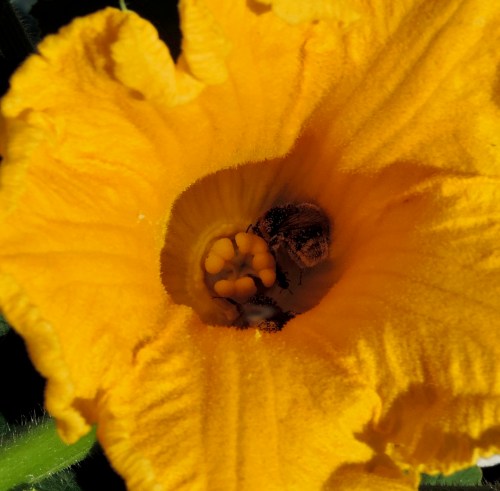
The other day the bees were going crazy for the pumpkin flowers. Each flower had two or three bees tumbling around in its depths, covering themselves with yellow pollen, and staggering as if they were drunk.
It was an amazing sight. Every single flower was filled with powdered bees. It was hard to photograph, but, I think you’ll agree, persistence paid off.
Strangely, (well, I never really understand how the universe does this), I had just read an interview in “Le Monde” with the Italian philosopher, Emanuele Coccia. He has a new book out, “Métamorphoses”, where he lays out his insights about the unity of Life, and the prime importance of plants. I read his earlier work, “La vie des plantes” some time ago and was hugely inspired by it – he gave me a whole new perspective on the world, teaching me to consider life from the perspective of the plant kingdom. In his interview he said a few things which came flooding back into my mind as I photographed these bees.
I’ll paraphrase what he said because the original is in French…..
Flowers contain the sexual organs of the plants but in order to reproduce they need the intervention of third parties – primarily insects or the atmosphere. So, what we learn from this observation is that flowers involve agents from other kingdoms in their individual sexual acts. This means that plants place their genetic and biological destiny into the hands of other species.
That’s quite a thought by itself, but he then goes on to ask “How do the insects choose which flower to pollinate?” The answer is, not by rational thought and logic, but by TASTE and AESTHETICS. So the evolution of plants is based on the tastes of other species.
Isn’t that a stunning idea? Or, rather, observation?
He has much more to say, but this is the part which I thought was most relevant to my experience of witnessing the crazy desire of the bees and the massive spread of pollen which was the result.
Life based on desire and taste……well, what do you know?
I welcome constructive criticism and suggestions. I will not, however, tolerate abuse, rudeness or negativity, whether it is directed at me or other people. It has no place here. ANYONE making nasty comments will be banned.