Feeds:
Posts
Comments

The healing isle

healingisle


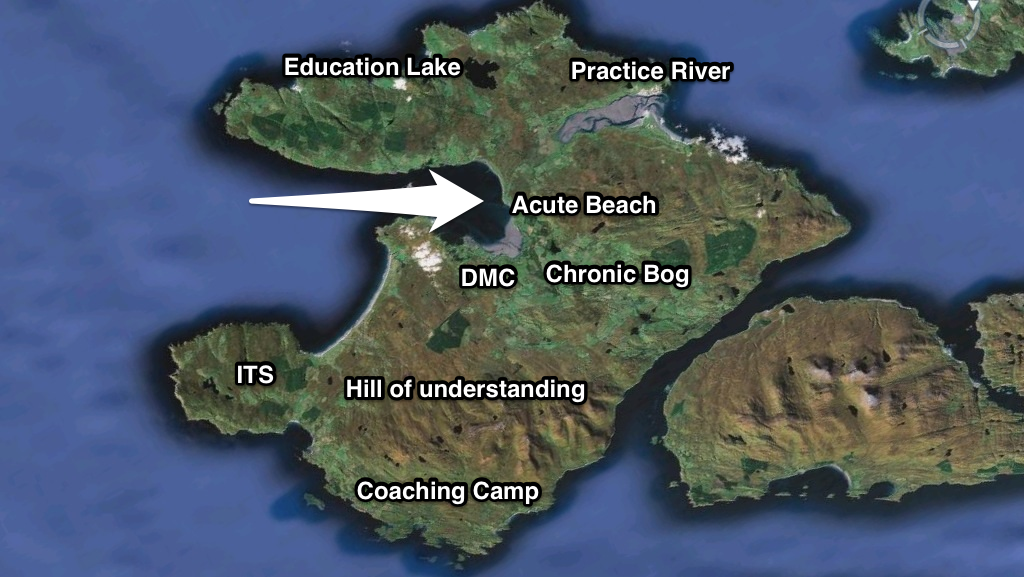
So you’re sailing along, getting on with your life, when suddenly a storm hits, and you are blown onto the “Acute Beach”. Now you are ill, or injured. If you’re lucky you’ll find your way to the “DMC” (Disease Management Centre – that’s probably a hospital, clinic or doctor’s office) where the broken bit will get fixed and you’re back down on the beach, into your own canoe, and paddling off into the rest of your life again.

Except, often, that’s not what happens. It turns out there isn’t a simple part to be replaced or fixed, and before you know it you’re mired in the “Chronic Bog”, only to spend the next few weeks, months, or years trudging back and forward between the DMC and the Bog. Doesn’t feel so good, and it doesn’t get you back into the flow of life again either.

So, what next?

Maybe you meet an “integrative medicine” specialist and they take you on a journey, up the “Hill of Understanding” where you get a good overview, check out the lay of the land, and see more clearly just how you got here in the first place. That feels better. It’s good to be understood. It’s good to be able to put all the pieces together, see the connections, and work out just what needs to happen to get healthy again.

Maybe some time down at the “ITS” is going to be needed (“Integrative Therapy Spa”) – where health-making therapies stimulate and support your recovery, and give you a helping hand to start to heal.

After that, your health coach can help get you some time down at “Education Lake” where you can learn about health and healing, find out what the connections are between the mind and the body and learn what you need to know to get well.

You might also benefit from some time on the “Practice River” learning some new skills, like “mindfulness meditation”, stretching and moving exercises, ways of dealing with stress and so on.

Luckily for you that “integrative medicine specialist” is with you all the way, and you follow the path back down to the sea, and onto your boat to sail off and live the rest of your life.

Wouldn’t that be a good idea?

Le sens de la vie

I read a fabulous book whilst on holiday in France recently – “Ni hasard, ni nécessité” by Marc Halévy. I’ll probably write a few posts inspired by it. Here’s the first –

Marc Halévy refers to the three meanings of the word “sens” in the French language.

The first is sensation, or senses – what we experience subjectively. This is such a great way to be present – to pay attention to, to become aware of, or mindful of, the sensations you are experiencing in the here and now. What colours, what light and patterns can you see? What sounds do you hear? What scents can you smell? What tastes linger on your tongue? What does your body sense?

The second is meaning – “what sense do you make of……..?” We are meaning seeking creatures. We are always wondering why, and what does this mean? Why me? Why this happening now in my life?

The third is direction – “where am I going?” “where will this lead?” “what’s the point, or purpose or direction of my life?” We like to be able to see an overarching narrative in our lives. We like to see how we’ve got to where we’ve got to and where that might lead if we carry on down this road.

I love this unpacking of that one word “sens” – the sensations, the meaning and the direction of my life.

In fact, sticking with French for a moment, it’s not far from “le sens” to “l’essentiel” – as Saint Exupéry said “l’essentiel est invisible pour les yeux”

What is most important to us, what is essential in fact, is what is invisible – and the sensations, the meaning and the direction in our lives are all invisible. They aren’t material. They can’t be measured. But they create “le sens de la vie”.

The power to predict

The power to predict

Here are two chestnuts in my hand.
Who can predict what will happen to them? Who can say what their future will be?
Will they become chestnut trees?
If so, where? And how big will they grow, and how long will they live?
Will they get pickled and become champion conkers in a playground game somewhere? Which one will become the champion?
Will they feed a squirrel and help it through the winter? Or some other creature in need of nourishment? Could these particular chestnuts make the difference between life and death for one little animal?

I’m sure, the more you use your imagination, and the more you consider the current and potential connections between these chestnuts and the rest of Life on our planet, you can come up with an almost infinite number of possible biographies for them.

So how easy is it to predict?

In this complex, multiply interconnected, frankly astonishing world, isn’t prediction impossible? Instead we default to guesses, hunches and statistics. None of which actually allow us to predict the details.

In the light of that, I find it amazing that we listen to “experts” who claim the power of prediction – whether they are economists, politicians, scientists or doctors.

The power to predict reality is an illusion. And here’s why……the universe is an emergent process. Life is an emergent process. It’s not a machine with the endpoint already established.

We are all becoming not being………

Circular rainbow

Took this through the window of the plane. Don’t think I’ve ever seen a circular rainbow before.

Making waves making rainbows

As the ferry shuttled between Pointe Rouge and the Vieux Port the bow would break through the surface of the water throwing up plumes of foam. Flickering in and out of that foam you could see little rainbows appearing.

rainbow dolphin

This kind of rainbow, I have seen before. It’s a fountain rainbow. You don’t see them so often but they can be quite mesmerising when they do appear.

Finding rainbows everywhere feels like being surrounded by hope and by beauty.

Meeting of the lizard minds

Well, these little guys got me thinking. They just sat there doing this motionless three way meeting thing in the sun.
I thought look at the three lizard minds meeting!
And of course that set me off on thinking about the three brains we each have, and how only one of them is a lizard mind! You know that model?
You can think of the human brain as having three distinct waves of evolution, each with its own main area of responsibility and each, intricately connected to the other two. We use all three all the time.
The oldest one is what people call the lizard brain. It’s the brain stem. The deepest and, in evolutionary terms, the oldest part of the brain. It’s the part at the top of the spinal cord and its all about survival. The autonomic nervous system spins out from here (its the accelerator and the brake system which produces, respectively, the fight or flight, and the rest and digest, responses to immediate threats. In fact those are the brain stem’s main duties – to control the heart rate, the breathing rate, the release of sugars and energy and so on. It’s our survival centre. It’s also involved in the production of emotions through its links to the second brain, the limbic system. Some people call the limbic system the mammalian brain, because mammals have it. It has a number of main tasks, primarily associated with memory processing, attraction, and the production of emotions. The big bit on the top, the cerebral cortex, split into left and right hemispheres, is the youngest part in evolutionary terms. It’s a great co-ordinator, analyser, synthesiser, map maker and thinker. This is the bit where we seem to get conscious thought from.
Ok, that’s a VERY simplified account, but I wanted to whet your appetite and hopefully make you curious to become more aware of what’s going on inside your head. We can learn to become more aware of these different areas and their processes and through their intimate two way massive links between each other, and between the brain and the body, we can begin to understand why it makes no sense to create a false model which posits that we can think of the brain and the body as separate. We can’t separate them. What goes on in one part affects all the other parts.
And how do we begin to claim we understand illness when we don’t understand yet what good mental and physical health is (I didn’t even like writing that last phrase because I just don’t think you can divide things between “mental” and “physical” that way)
The other thing I thought, in my meeting of the lizard brains rumination, was thank goodness we don’t have three lizard brains in our heads! Thank goodness, that instead, we have something much more complex, much more evolved, which allows us to experience the world in such unique and intricate ways. I do love uncovering some of the patterns in there by listening to people’s stories and seeing them in the contexts of their lives.
It’s an amazing world. Full of incredible creatures, all so inextricably connected in so many ways……I think we are only just beginning to realise that.

Slow

my new motto

I saw this on the wall of a little village house down at the end of a long track to the East of Marseille. I love it. I’m going to adopt it as my motto.
Roughly translated it means, “slowly, gently in the morning, not too fast in the evening”
I’m a great fan of the slow movement – the idea that we should take our time to be present, to savour the details of our lived experience, and to be fully open to the wonder of the every day.
I think this saying captures all that for me.

water colours

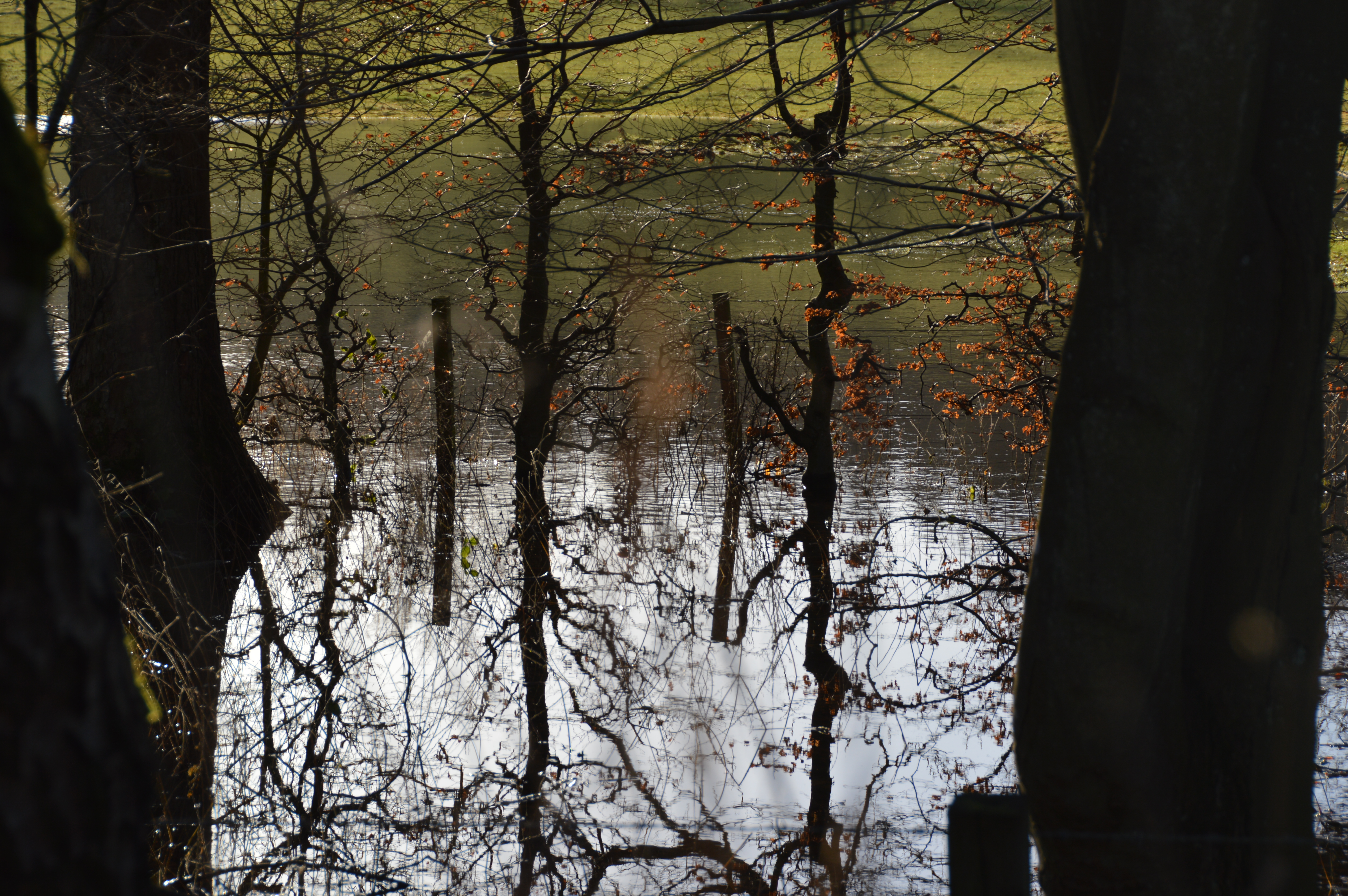
I have a fascination with water and its wonderful to see how either direct or reflected light creates real natural works of art.

sunwater vieuxportwater mairiewater batobuswater

Deeply orange

20130904-191758.jpg

two words

PRESENT

CREATIVITY

These two words, or concepts related to them, keep coming up for me. I read a LOT, and I have one of those minds that seems to be good at seeing connections, patterns, echoes, themes, and in all those ways these two words keep coming to mind. Whether I’m thinking about flourishing, about happiness, about health, about living a good life, about understanding what it is to be uniquely human, and most especially when I think how to be a hero not a zombie!

If you don’t want to be a zombie, you have to wake up and smell the coffee. Different thinkers and authors refer to this in different terms. Some talk about waking up from the sleeping state, others about living consciously, and yet others about living mindfully. What it amounts to is being present. Really being present. Not just being somewhere in your body while your head is in the past, worrying about the future or drifted off somewhere into the clouds. So it’s a deliberate act to be present.

I am very attracted to the ideas of the “slow movement“. If we take our time to fully savour the here and now we enrich our experience of living. Fast food, quickly prepared and gulped down with hardly time to even taste it is one kind of experience. Picking up fresh food in the local market, walking home with it, preparing it, cooking it, sitting down to savour it (whilst not doing anything else!) is quite another kind of experience.

Mindfulness is a very popular term currently (other traditions over many years have taught the same concept) The famous mindfulness meditation exercise of the single raisin is one simple way to understand experientially what it means to be present.

I often find myself sharing with patients the simple understanding that your mind can only be in one place at a time. If you are giving attention and focus to the past (remembering, ruminating, ruing?), or giving it to the future (planning, worrying, fearing?), then you aren’t giving it to the present (sensing, savouring, being?). So, if you are troubled with too much of the past or the future in your head, deliberately turning attention and focus to the present can change your inner experience instantly.

I find that having a sense of wonder, of seeking the extraordinary in the ordinary, drives my attention to the present.

What about creativity? Life, it seems to me, is constantly evolving, adapting, growing, developing. It’s a dynamic phenomenon which moves as a whole in the direction of ever greater complexity, diversity and uniqueness. In fact, that’s how I see the universe story – one of continuous and ongoing creation.

Creativity is also about expression. I believe every one of us has our unique and special contribution to make to the universe through living this life. We engage with and understand the world uniquely and we react and interact with it uniquely. Those interactions are creative. In biological terms we use the word “emergent” to describe phenomena and behaviours not seen before. That’s what we do. We are complex adaptive organisms in a process of continuous development, emerging, evolving (potentially) to higher consciousness.

Whether you create through art, through music, through building, through problem solving, through being with and sharing with others…..every day, you have countless opportunities to create, to make the world anew.

What does it mean to you to be present? And how can you be more present today?

What does it mean to you to be creative? And what will you create today?


writing your life

There are many ways in which writing can help us to understand ourselves better, heal wounds and gain a deeper insight into our lives. Here are three ways you might like to explore.

A. Regular continuous writing

Julia Cameron, in The Artists Way, describes an exercise she calls “Morning pages”. Essentially it involves writing every morning until you’ve filled three pages of an A4 notebook. With one additional, and crucial, rule – you can’t stop. Not for a moment. Your pen or pencil shouldn’t leave the paper, and your hand should never pause. This is not a thinking exercise. You aren’t to work out what you are going to write, and if you find yourself writing “I don’t know what I’m writing and I can’t stop moving the pencil so I’d better keep going and…..” – well, that’s OK. It’s a stream of consciousness thing.

People do different things with this kind of exercise. Some swear it only works if you do it as the very first thing you do on waking, others just in the mornings, some at other times of day. See what works best for you. What I have found is that the greatest benefit comes from it if you don’t read what you’ve written. At least not for a pre-fixed period of time – a week, 30 days, a month, three months. Again, see what works best for you.

Try it. I’m pretty sure it’ll surprise you

B. Gratitude journal

There are many traditions which recommend creating and regularly using a gratitude journal. Quite simply, it involves having a special notebook and every night, before you go to bed, taking a few moments to reflect on the day and recall something, just one thing, for which you are grateful. It might relate to something you saw or heard, something you ate, a conversation you had, a moment of being held…..it’s up to you. Then just note it down. You can write it in as much detail as you like. I find this has at least two benefits. It gives you an opportunity to re-experience a positive emotion (and that’s good for your heart, and good for your health). And it means you head off to bed with your most recent experience being a positive one.

C. The story you live by

In the inspiring “the stories we live by”, by Dan P McAdams, he describes a template to help you write out the story of your life, in a way which will enable you to clarify your own main themes and influences. I like this approach. I like the idea of the story of the self, especially as stories take us from the past, into the present and forward to the possible futures. Here’s a very brief synopsis of Dan’s template. It starts with writing down your chapter headings for the story of your life, then moves down through the seven further points of focus and reflection. You might want to try the whole thing, or you might like to pick and mix. As ever, see what works for you……

1. Chapters – titles and brief contents

2. Eight key events –

  1. Peak experience
  2. Nadir experience
  3. Turning point – significant change in understanding of yourself
  4. Earliest memory
  5. An important childhood memory
  6. An important adolescent memory
  7. An important adult memory
  8. Other important memory

3. Four significant people

4. Any heroes

5. Future script

6. Two areas of life where you are experiencing stress, conflict or challenge

7. Personal ideology

8. Life theme