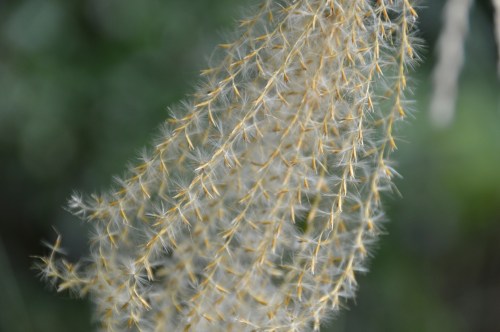
When you see a seed head like this, holding an abundant supply of seeds, all waiting for the next breeze to come and whisk them away, spreading them far and wide, you can’t help but have some sense of awe.
Isn’t it incredible to see this? Look at the structure and look at the sheer magnificent abundance.
When I come across this I do think of how abundance is the key characteristic of the universe – not scarcity. Changing the mindset from a scarcity one to one of abundance changes the way we engage with life. It helps us to move from insecurity to security, to embrace change, and to quieten down our fears and anxieties.
But looking at an abundance of seeds like this brings something else to mind for me – potential.
I mean, just look at the potential held in this one stem of seeds. Every single one of these seeds could be the beginning a new plant. Some of them might fall locally and start to grow where they fall, whilst others might be carried far in the wind landing in micro-environments, very different from the one where they were born. This dispersal vastly increases the chances that the plant will successfully propagate its offspring by sending them far and wide and giving them a huge range of opportunities for growth.
I think of an image like this whenever I consider any single person, because within all of us there are vast, you could say infinite, potentials. Most of them, we will never realise in one lifetime. What an astonishing gift! What an incredible scope!
Couple this vast potential with an abundance mind set, and the world opens up to us. We have so many different ways to become the unique selves that only we can become.
Are you familiar with the concept of the “wood wide web”? It’s a term which has been coined to describe the vast, intricate, integrated network of communication channels which spread through every forest. The trees don’t just communicate with each other by sending out chemicals from their leaves through the air to other trees, or to repel noxious insects, nor do they just send molecules and messages to each other through directly from root to root, but their root systems are deeply embedded in vast webs of fungi and “micro” fungi (that’s tiny fungi!!). We’ve discovered that the incredible interactions between trees and fungi can share information and materials right throughout the entire forest…..to the extent that you can really think of the forest as one enormous organism. Well, similar pathways and mechanisms have now been described in flowers. It seems that flowering plants, too, communicate, not just by colour and scent, but through similarly entwined symbiotic relationships with micro-organisms and fungi. Guess what? We communicate in a vast variety of diverse ways too. Sure, we use language, but we also use facial expressions, body movements and positions, as well as scent, colour and touch. But more than that, our beating hearts send out electromagnetic signals around our bodies…a sort of energy net which can interact with the nets of others close to us. We also communicate by sharing micro-organisms and molecules all of which are too small to see without a microscope. In fact, just like trees and flowering plants, our hyper-connected existence really means we are so inter-related and so inter-dependent, that we just can’t help communicating with, and influencing, others every moment of every day. It’s partly because of that, that I decided to start writing these daily posts during the pandemic. It seemed to me that there is a lot of negativity around, a lot of “bad energies”, a lot of fear, anger and hurt. And all of that spreads around our “world wide web” of hyper-connected humanity, and, yes, even the rest of the hyper-connected, natural world. As best I can see, we are creating the kind of world we both imagine and experience, because these connections act as vast feedback loops and accelerators, spreading and magnifying the information which we send out. So, here I am, every day, sharing with you an image which I hope will enable you to have a mindful moment, a few minutes to pause, and reflect, and to stir within your soul, some wonder, some joy, some delight, and to magnify the love that exists in your heart. Because, hey, wouldn’t it be great if wonder, joy, delight and love spread around our planet? Wouldn’t it be great if they accelerated and increased as they spread? Well, that’s my hope. And I hope you’ll do the same, sending out and spreading your own wonders, joys, delights and love around your family, friends, colleagues, and, yes, even strangers.
There are a few stories circulating which I find really disturbing. Stories of EU citizens being detained at the UK Border when attempting to visit the UK for a holiday or to visit family or friends….detained then being refused entry and sent back home because the Border Guards didn’t believe what they were being told about the visitor’s intention. There are so many such stories now that some EU citizens are saying they’ll never try to visit Britain again. The Home Office response is to say that the vote for Brexit was one to make it more difficult for EU citizens to enter into Britain so they are are just doing what “the people” voted for. I’m not sure even the minority of UK voters who voted for Brexit really wanted stop young people from Europe visiting family and friends in the UK.
What especially bothers me about these stories is that they fit with the harsh rhetoric used against asylum seekers and immigrants. I think it was Theresa May who started the “harsh environment” policy which has been developed into this present form. “Harsh environment” – make life difficult for certain people – what a starting point! What a sad, hardening of hearts
Another group of stories which are disturbing me is about the daily abuse and threats directed at doctors, nurses, health care staff, and paramedics. The British Medical Association say a majority of their members receive abuse or threats daily, and England is currently considering fitting body cameras to all paramedics to try to protect them from abuse and violence, or to catch the perpetrators of such actions.
In my four decades as a doctor, half of them as a GP, I don’t remember a single episode of abuse or threat directed at me, at any of my colleagues, or at our staff. What a tragedy!
Isn’t that also part of a de-humanisation, or de-personalisation of care? A hardening of hearts? The entire health care system has been reformed along lines consistent with managerialism – it’s now the language of consumers, customers and clients, of targets, financial “efficiencies” and of tasks – the language of people has got a bit lost. Yet health care is surely based on the doctor-patient relationship – where the people involved – the doctors and the patients – should be paramount, not the protocols, the processes and the financial constraints.
I could go on…..we see a harsh language and deliberate cruelties inflicted on the most vulnerable who need State help. The Ken Loach film, I, Daniel Black, described very well the sad, and unnecessarily mean ways in which the poor and the sick are treated in society. Harsh environment seems to have spread to the treatment of the poor as well.
I can’t help thinking this is a loss. A loss of quality of life and loss of decency, kindness and justice.
Maybe its the result of the wrong “-isms”? Of the financial and economic wrongs wrought by “capitalism”, of the wrong-headed priorities set by financial-ism, and the dehumanising nature of materialism and managerialism. Maybe you could add a few -isms that you think are contributing to this?
I guess what I’d like to see is a rise in “people-ism” – in actions, policies, strategies and behaviours which put people first – people before profits, and before processes.
I’d like to see some softening of hearts as we allow ourselves to be curious about everyone, and to find out just how inter-related and inter-dependent we all are on this little planet Earth.
I’d like to see more priority given to open handed-ness, to open hearted-ness and to kindness.
That’s a trick question really, because if it doesn’t, I have a hunch that you’re not looking!
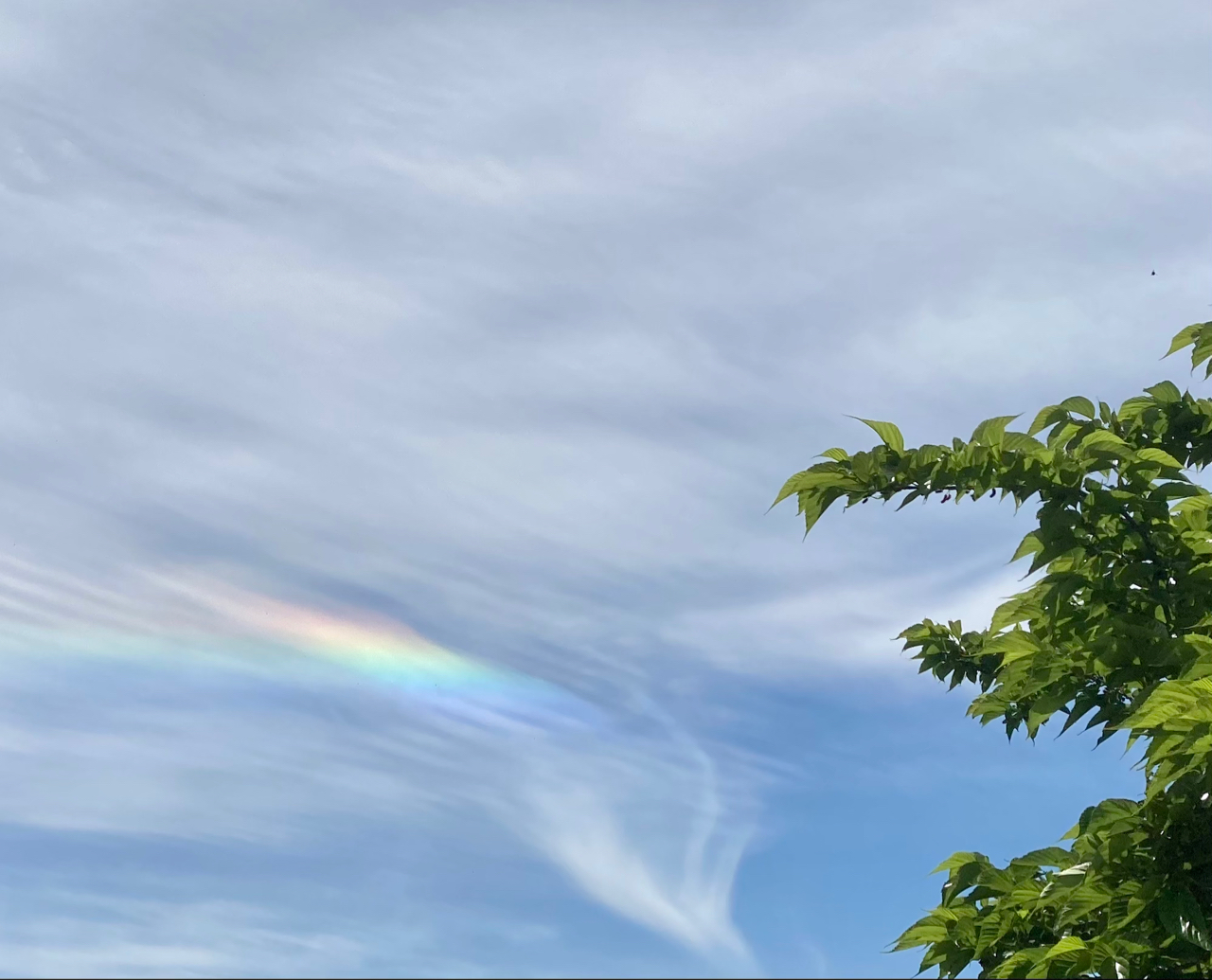
The sky often surprises me. Sometimes it catches my attention because it is blue from horizon to horizon, or it is covered in fast moving, rapidly shape-shifting clouds, or because it catches fire and turns crimson as the sun sets. But other times it’s because something appears which I’ve never seen before.
This sort of rainbow is one of those. Two of them appeared at the same time, but in different parts of the sky, a couple of days ago. I guess it’s not really a rainbow because it isn’t a bow and it wasn’t raining! Perhaps it is more like what you would see if light is passed through a prism.
Given the age I am, it might not surprise you that when I think of light passing through prisms I think of the cover of Pink Floyd’s album, “Dark Side of the Moon” (google it, if you don’t know it)
I have a fascination for kaleidoscopes and one day I was in Kyoto and it started to rain quite heavily. We noticed that the building we were passing was called “The Museum of Kaleidoscopes” so we dashed in to get out of the rain. When we signed the visitors book and put our country of origin as “Scotland” the staff all gathered around and excitedly welcomed us. It turns out that the inventor of the kaleidoscope was a Scotsman, Sir David Brewster. Ha! Who knew? Not us! Well, I’ve never seen so many different types of kaleidoscope in my life, and if you ever visit Kyoto, I recommend a visit to that museum. I bought a couple of different types while I was there and I still enjoy looking through them, watching the patterns change before my eyes.
Well, those are some of the thoughts which came up for me as I looked at this colourful, but pretty subtle, display in the sky.
As I look at the image again now it seems that the colours are pouring out of a spout-shaped cloud – and one of my friends said it looked like a rainbow genie escaping from a bottle!
Ooh, I love that! So, have a look at this rainbow genie and make a wish. Let’s see this as a good omen, a symbol of hope, a sign of better days ahead.
Wow! Just look at this poppy which has opened up in the garden a couple of days ago. I went in close to take this photo because I think when you look really closely you see an astonishing creation.
This is like a work of art. In fact, who would have imagined something like this if they hadn’t seen a flower before? I was thinking, what if an alien landed on Planet Earth and encountered this poppy, wouldn’t they be utterly amazed?
Actually, I’m not an alien here on Planet Earth but I am totally amazed by this. Look at the details! As well as the gorgeous red petals, right in the centre we can see this rich, dark array of structures which make up the reproductive system of this flower. The thirteen stripes on the seedhead – what are they? And why are there thirteen? Don’t you think thirteen is a strange number?
Honestly, I think you can lose yourself in contemplation of a glorious flower like this. On single plant, one single blossom, totally captivating.
And it won’t be here for long. Within a few days, all the petals will fall to the ground, ultimately only leaving the seedhead behind. I think it’s amazing. I’m transfixed! In fact, a simple, astonishing, utterly beautiful, intricately complex flower like this, can make me lose my sense of boundaries and separateness. I can experience transcendence in moments spent with a flower like this.
I guess we humans have been, and continue to be, pretty blasé and unthinking about the plant kingdom. But without it, none of us would be here. It’s the plants which capture and transform the Sun’s energy. We can’t do that. We eat the plants, or eat the animals which eat the plants, so existing a bit further along that chain of energy transformation to get what we need to survive and thrive.
It’s not just that there is an emerging consensus that plant-based diets are best for us in terms of health, they are best for us in terms of the planet too. I’m not vegan. I’m not even vegetarian. But I don’t eat meat every day, and in all the studies I’ve read over the years, time and time again, the conclusions seem to be, if you want a healthy life, and if you want a long life, you could do worse than to limit your meat consumption and move towards a plant-based diet.
There are many many studies now which also show us the benefits to our immune systems, to our inflammatory systems, and to our mental health, of spending time in, and connecting with, the natural world. Primarily, that’s the plant world of trees and flowers. So, it’s not just about seeing plants as a source of nutrition. Engagement with the plant kingdom is good for us every day – noticing, stopping, gazing, contemplating, wondering about, and, especially caring about, flowers, plants, trees is one of the best ways I know to increase the quality of everyday life, and to set yourself up to live as healthily as possible.
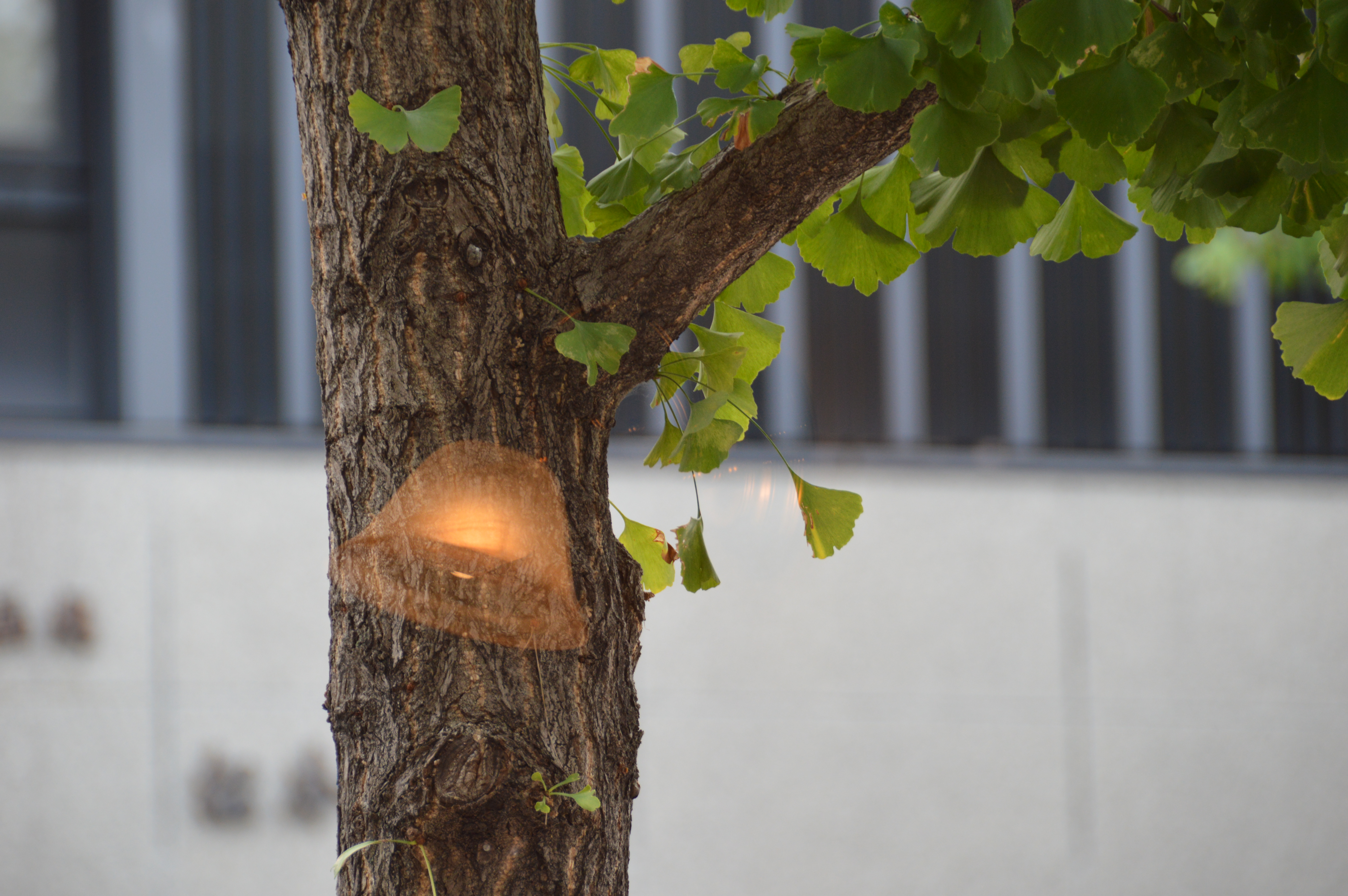
I was sitting in a cafe in Kyoto, looked out of the window and noticed that the reflection of one of the lamps was sitting right in front of one of the trees outside, so I took this photo.
Right from the start this has seemed a metaphorical photo to me.
I know the light is not “in” the tree but the image seems to capture that idea.
Every time I look at it I start to muse about “the light within” which is in us all. Sometimes I think of that light as being a manifestation of Life, of the presence and flow of the life force. It’s a strange thing, that life force. In fact, it’s not really a “thing” at all. It can’t be directly observed. It can’t be measured. But it’s a concept or phenomenon that few would deny.
I’ve seen people die right in front of me. I’ve seen some go suddenly, and others fade away over longer times. I’ve had to examine the newly dead to confirm that they are indeed dead, and to issue the “death certificate”. But death has always been a mystery to me. I don’t fully grasp it. I know about the shutting down of body systems and of organs ceasing to function. I know about “brain death” and I know that heart can just stop beating. But there is a distinct boundary between life and death. One moment someone is alive, and a few minutes later they are dead. It can be pretty straightforward to know which of the two states they are in. But I get caught up in a sort of Zeno’s paradox as I try to discern exactly the moment someone has moved from life into death. There is no “off and on” switch, yet sometimes it seems instantaneous. Organs fail, but more often than not, they do so over a period of time…..years, months, weeks, days, or even minutes. But our bodies are not machines and life doesn’t disappear the way a machine switches off, or a computer hangs.
So, many times I’ve wondered what brings about this “presence of life” which seems to shine like a bright light, and which goes out? Where does it go? If it isn’t even an “it”, does the question even make sense?
When I studied homeopathy I learned that Dr Hahnemann described something we call “the vital force”. He lived in days before we knew what we know now, and the objectification of “the vital force” into a material reality which nobody ever managed to find, directly observe or measure, led to the dismissal of the concept. But it still seems to me that there is indeed a “vital” phenomenon, a living “presence” or “flow” which we only find in those who are still alive.
Is this light within a sort of energy? There’s another hard word to pin down – energy. We can identify certain clear energies in physics, and even measure them. But the energies we humans experience are harder to define.
Not to know, but to define.
What do I mean by that? Well, imagine a scale from 0 to 10, where 0 represents the lowest energy you can imagine experiencing, and 10 represents the greatest amount of energy you can imagine experiencing. Tell me, right now, what number would you apply to represent your current energy level?
You managed to do that didn’t you? I have never met someone who couldn’t come up with a definite number when asked to do this.
But here’s my question, whether you said “5” or “8” or “2” or whatever you said, how did you do that?
You didn’t measure anything. You didn’t check your blood pressure, your oxygen saturation levels, or you blood sugar level did you? In fact you neither selected out a single organ or system of your body to assess, nor did you use any kind of measuring equipment at all, but you did it. You holistically, intuitively, know what your current energy state is. Nobody else can do that for you.
Let’s expand that idea and apply the scale now to “mental energy”. What number would you give for that currently? Is it the same number, or a different from the previous one? What is mental energy? Where might you find it? How could someone else measure it for you?
Challenging, huh? But, at another level, not challenging at all…..in fact, it’s utterly straightforward and easy to do. In fact, sometimes we can even pick up the energy level of someone else, can’t we? We can know that someone is “not on form”, is in a state of “low energy”. How do we do that? Not by using any measuring equipment either.
So sometimes this “light within” seems like the presence or the flow of Life to me, and sometimes it seems like an energy.
But I think there’s a third path to consider. Something to do with brightness. I don’t mean intelligence. I mean brightness – alertness, awareness, presence. You know that old saying that “the lights were on but there was nobody in”?
There’s a light in your eyes tells me somebody’s in
And you won’t come, the cowboy with me.
…..sang Kirsty Maccoll
So, this light apparently shining from the middle of this tree sets me off on all this routes – the life force, subjective energy and presence.
All subjects which I have dealt with almost daily, all subjects of which I am very, very familiar, and all subjects which I still don’t fully understand!
One of the biggest changes wrought by the pandemic was the mass shift of work away from big offices in city centres out to peoples’ own homes. I heard many and varied stories about that and I’m sure you’re hearing them too. For some people it’s been a whole series of revelations. Freed up from long uncomfortable commutes every day they’ve been able to enjoy more time with family and friends than was their norm. For others working from home has become something of a scourge with no boundaries….work has invaded their homes, blurring both start and finish times, and increasing the extent to which their work is monitored by managers. Some are discovering the delights of local shops, cafes and parks. Whilst others are missing the camaraderie of their work colleagues.
For some this is a moment of pause. A time to stand back and reassess their lives and their values. In France there has been an explosion of interest in city dwellers seeking to relocate to smaller towns near the city – places where they can find and afford a house with a garden, instead of an apartment with no outside space, and where they can establish a mix of “tele-travail” and commuting.
New patterns of work have appeared, where some of the week is spent on home working while some is spent in offices, so the towns which are less than a hour away from the main cities have become the most sought after.
The small businesses around office blocks and travel hubs, such as train and bus stations, have suffered enormously. I can remember wandering through the streets of London on a Sunday morning and finding every single cafe was closed. I’ve had the same experience in Tokyo. The office zones emptied of their workers just closed down for the day – no commuters, no customers – well, I imagine that’s extended well beyond Sundays now.
How much of this is the beginning of change which will last? Only time will tell.
What’s your own experience? Has your working life (and family life) changed a lot because of this closing down of office work? Has it led you to reconsider your values and your life path?
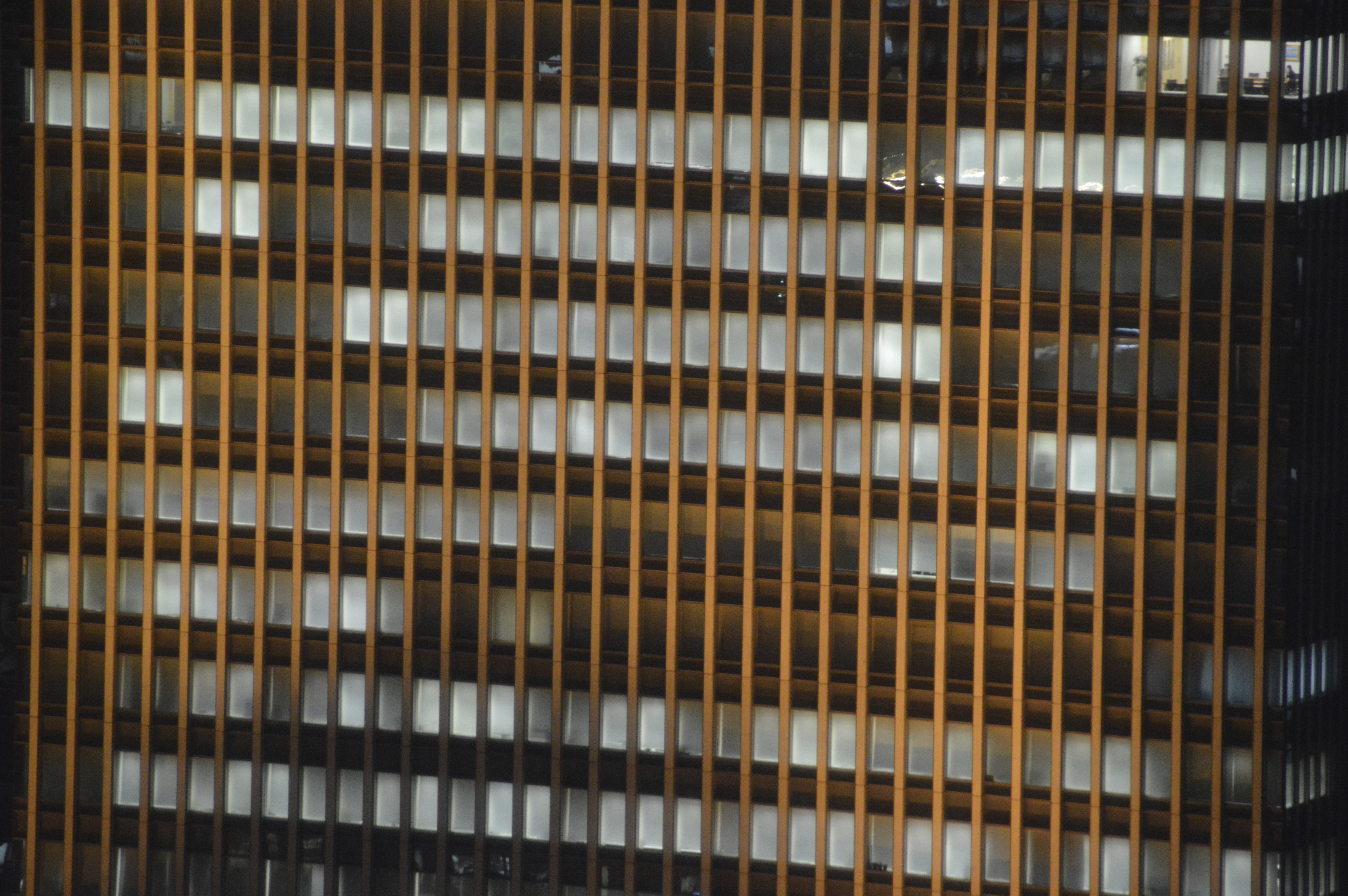
By the way, I took this photo from the airport bus as it made its way into the centre of Tokyo from Narita one night. That’s why the picture is quite dark and why most of the windows have the blinds down. Every time I look at it, the first thing I think of is a cage. Or a prison. But I guess I’ve never been a fan of massive offices! The other thing I’ve just noticed is that there is only one single human being visible in this photo. Can you see them? Isn’t that an interesting observation? I wonder what will happen to the occupancy rates of offices as societies and cities begin to open up again?
What are some of the core characteristics of being human?
Well, this photo reminds me of two of them.
Observe and create.
We are great at observing. When we slow down, take our time, and really pay attention, then we notice details, see connections, discern patterns, understand underlying themes and aspects of reality. I think this is one of our key powers. Yet, too often, we are too busy, or too distracted and life passes us by.
This is maybe one of the best ways I know to improve the quality of every day life – observe – just notice – just pay attention – just become aware. When we interact with whatever we pay attention to, we develop a deeper understanding – a deeper understanding of what we are observing, of reality, and of ourselves.
We have tremendous powers of observation, which entwine perception with analysis, re-cognition and imagination. Observation can spark insights, connect us to meaning, purpose and sense, and so enrich the every day.
We just have to slow down, set our intention, and raise our awareness. And like all strengths and abilities the more we practice those the easier they come to us.
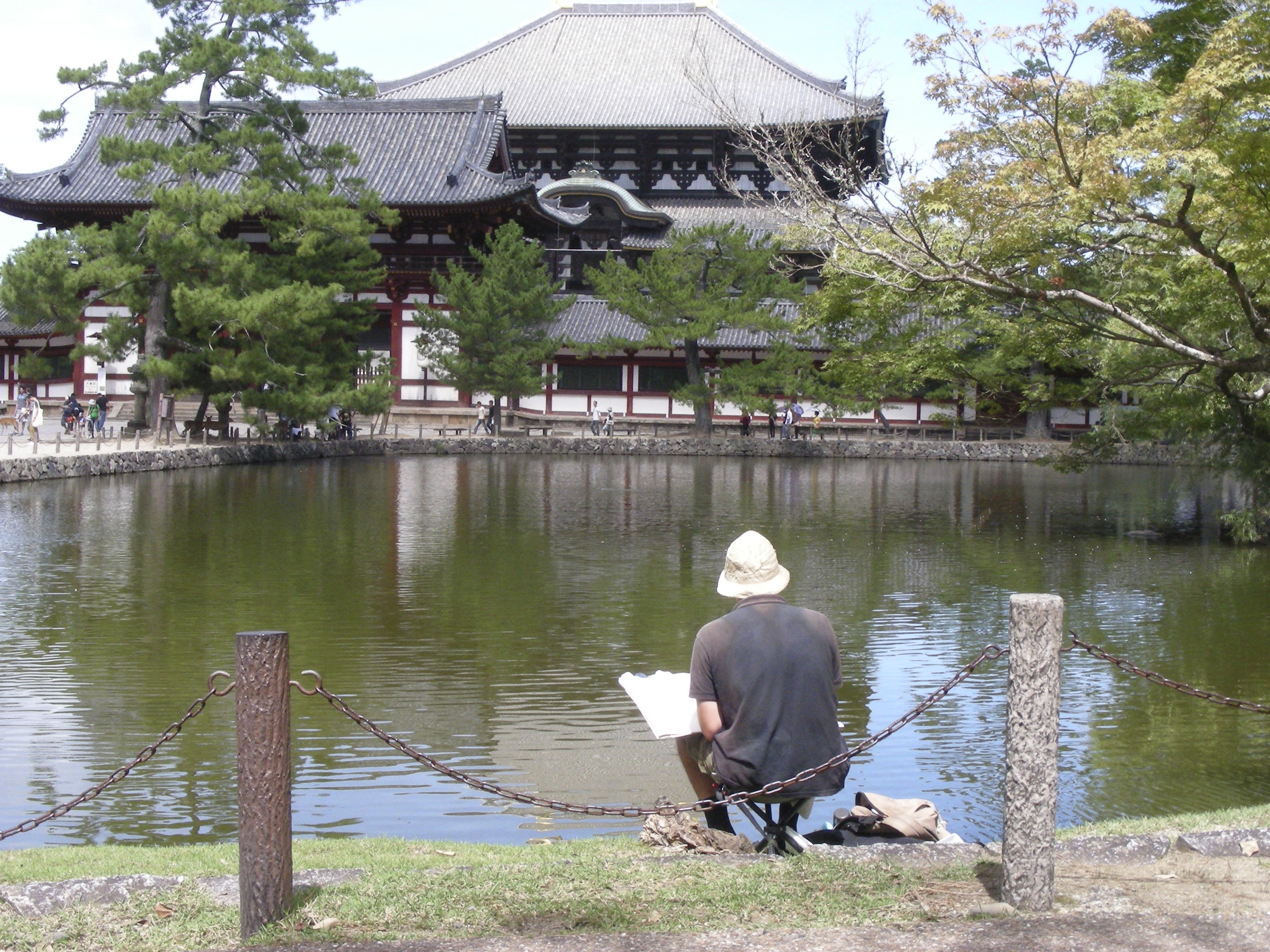
This man is sitting on his traveling chair with paper on his knees, and he is drawing, or painting (I can’t quite remember which). In other words, he is doing more than observing. He’s creating. We are creators. We create all the time. We bring memories and imaginings together to express ourselves, to solve problems, to invent, to make art. We humans have painted on cave walls, constructed great stone circles, and buildings, developed tools and shared our knowledge and skills with each other right from the beginning of our lives on Earth.
I know sometimes we think of creativity as being the reserve of great artists, musicians, poets and so on, but it’s more than that. It’s something we all posses and something we all use every day….whether that’s in cooking, caring, dressing ourselves, nurturing and nourishing, communicating and connecting, or in our ways of thinking. We engage with the world creatively. We make each day, each experience, each moment our own. That takes creativity.
So, here’s a good place to start if you want to increase the quality of your every day life – observe and create.
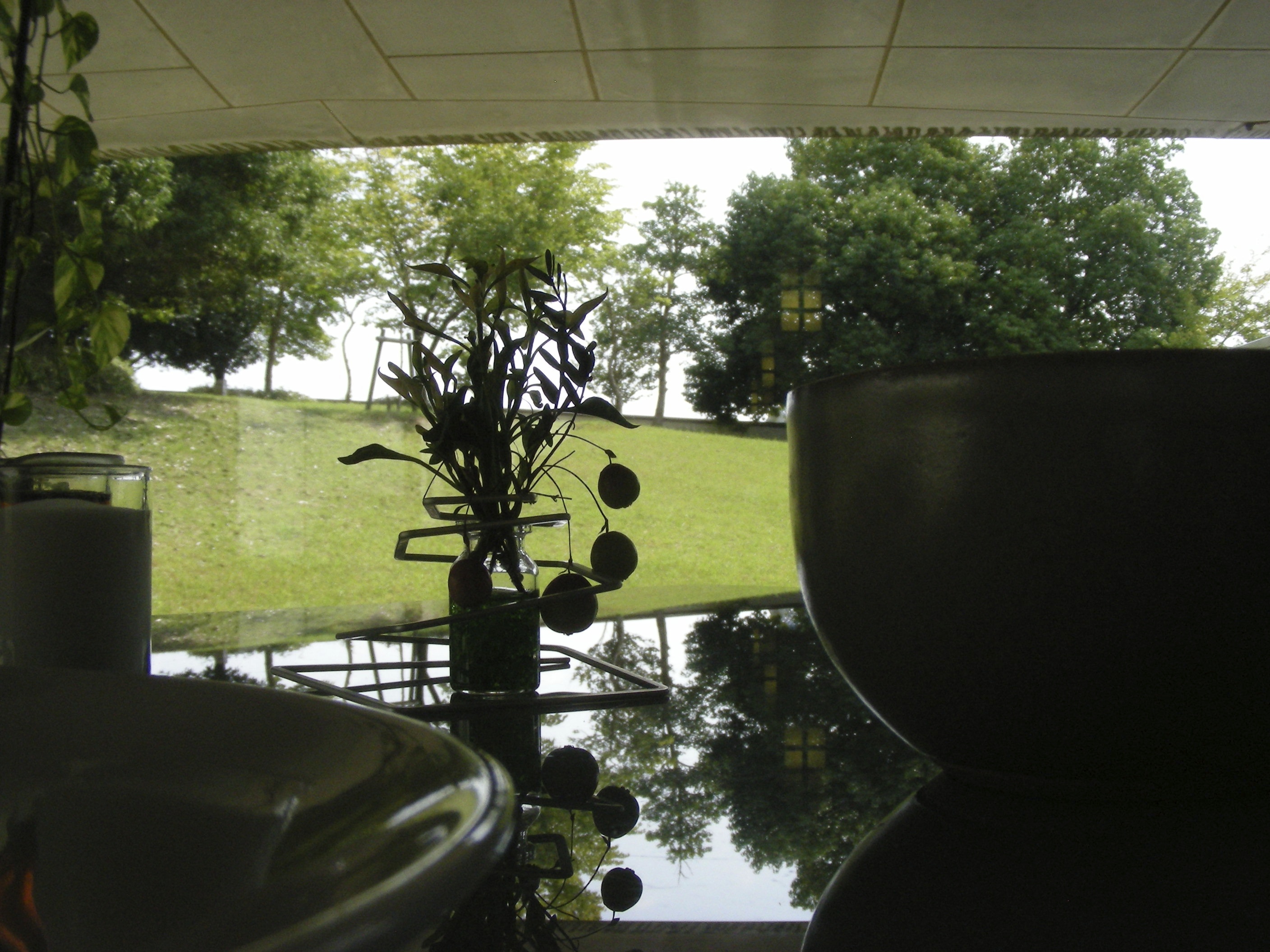
I took this photo in a tea house when visiting Japan a number of years ago. That tea house was one of the most peaceful places I’ve ever been, and I think part of what made it feel such a positive, healing place, was that they slid back the paper screens over the windows to reveal a terrace with an awning, and then all you could see were trees, bushes, and grass.
I was very fortunate to spend almost half my career working in Glasgow Homeopathic Hospital, which became the NHS Centre for Integrative Care once it moved into new, purpose built premises. Although the location of the new build was at the back of a major hospital site, just next to the railway station, the architect designed the L-shaped building around a garden. All the patient care rooms and spaces faced into the enclosed garden, which could be accessed by stepping out onto decking once you’d slid aside the French windows. Everybody commented on it. Patients and staff. We all felt the peace, the calm, the comfort, and the security which seemed to come from such closeness to green nature.
There’s pretty famous research into that phenomenon in the world of architecture. We know that patients recover more quickly, with less complications and less need for painkillers post-op if their hospital room has a view of green nature (as opposed to having no window, or a view of a wall).
We know, too that there are social as well as health benefits from the “greening” of cities.
But the other thing which occurred to me when I was remembering my trip to the tea room, was that those moments of peace which we all need, don’t have to involve learning any special techniques. There’s no doubt that various forms of meditation, and of cognitive behavioural exercises can be helpful, but there’s something powerful, even necessary, about just taking a pause.
Maybe not even just pausing by sitting and looking, which I’ve recommended before, but sitting with a cup of tea, or coffee, or some other favourite beverage, sipping, gazing, and contemplating freely.
I think it add to the quality of life. It’s a way of slowing down.
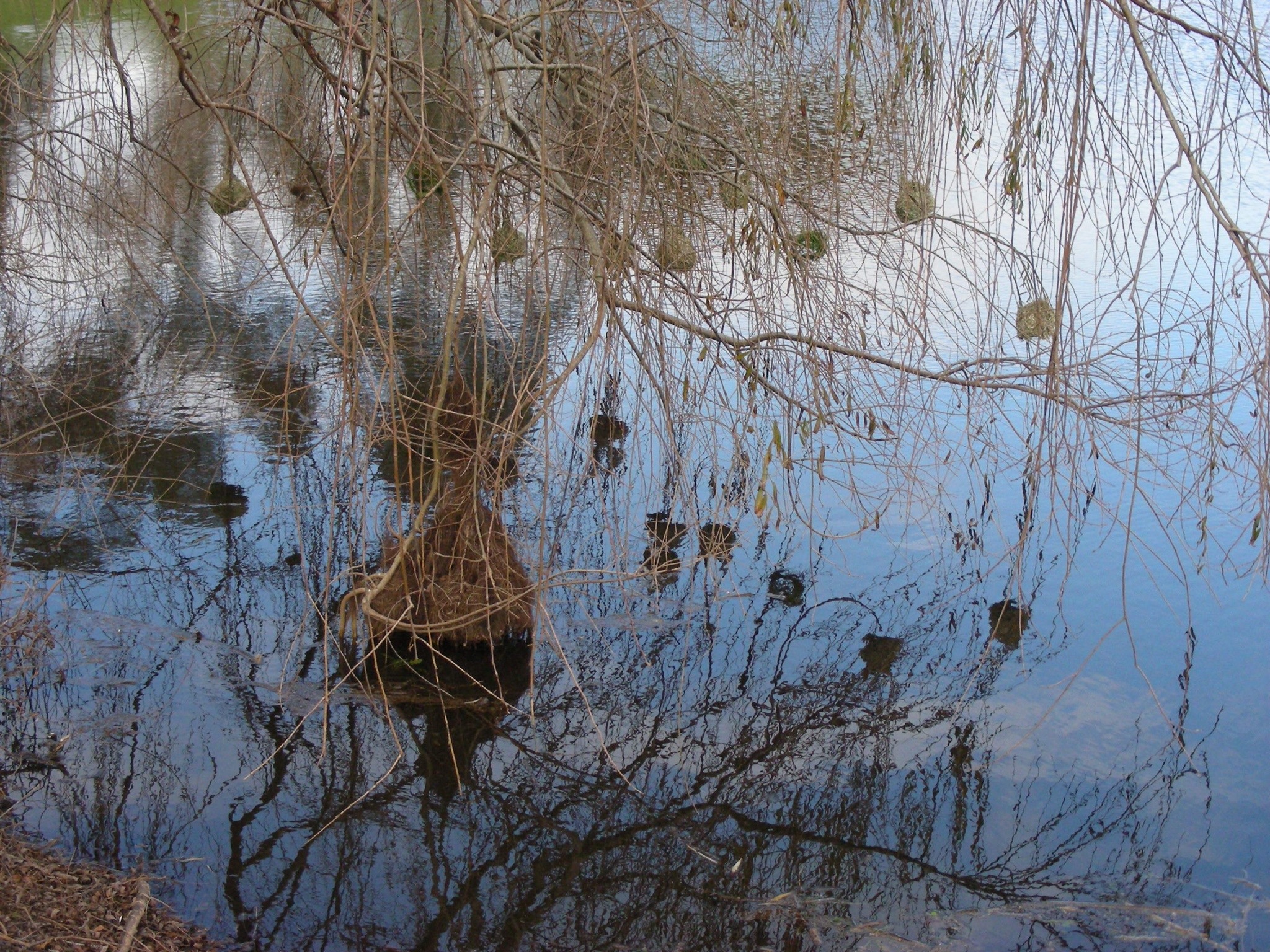
A few years ago, during a visit to friends in South Africa I saw these nests hanging from this tree. They are weaver birds. The nests they build hang like balls from the branches, and the entrances are at the bottom. How strange is that? You’d think that even if they didn’t make open nests like most birds, that they’d have an entrance in one of the side walls, a bit like the nesting boxes you can buy and fix to a post or tree in your garden, but no, these birds build this unique design of a nest with the entrance at the bottom. How they don’t all fall out remains a bit of a mystery to me, but I’m sure some ornithologist could explain it to me.
However, it wasn’t just the unique design of the nest which struck me, it was how many there were all hanging together in the one tree. I’ve found several birds nests in the garden here over the years. The great vine which used to cover the high stone wall (which has since collapsed, taking the vine with it) used to be a bit of a community hub for nests. But the mulberry tree and the buddleia bushes have only ever had single nests in them. There is a noisy flock of sparrows living in a mass of wild creepers and ivy on the wall of an old barn just along the lane a bit, but I haven’t managed to actually see their nests. However, I bet they are in there.
So, I’ve seen different densities of communities of nests and that got me wondering about the whole concept of community.
What communities do we humans live in?
I live in a pretty small village in rural South West France. I used to live in a moderately sized town in Central Scotland, and before that I lived in the great city of Edinburgh. Each of those environments enabled both different lifestyles and the opportunities to belong to very different communities.
This pandemic with all the restrictions in movement, and the months of confinement to our own homes has highlighted a couple of important things about communities, and I was thinking about them when I looked at this photo this morning.
One is that we can think of communities as the active, live, web of relationships in our lives. Whether we’ve been connecting over zoom, messenger apps, email, telephone or by letter, we’ve been more connected recently to our communities of relationships than ever before.
When we live in one place and work in another, our time, attention and energies are divided between different communities by geography. My daily commute on the train between home and work used to take over an hour and I used that time as a sort of personal time between the home/family community and the work one. Maybe there was even a kind of commuter community on the train. Certainly over the years I became familiar with a particular number of fellow travellers, but I didn’t really interact with them, so I probably can’t call them a community.
But that leads me to the second insight which the pandemic has made clear. We all share this one small planet. The virus knows no boundaries, no borders. The decisions taken in one country affect millions of people living in other countries. Scientists around the world began to co-operate more intensely and more openly than perhaps ever before. The scientific community, you could say, helped the scientists to discover new ideas, to learn lessons from each other and to problem solve together at speeds never seen before.
The truth is, that just as the “self” is in fact multiple, so in the “community”. We exist within a multilayered hyper-connected web of communities….plural. Maybe that realisation is a reasonable source of hope for the future. Because if we all retreat into separate, closed communities, we humans, are going to fail. The pandemic could be the least of our problems. If we don’t work together to deal with diversity loss, climate change and pollution, then we aren’t going to survive as any kind of community at all.
Well, in fact, I’m hopeful. I’m hopeful because I’ve seen the distributed global communities of personal and professional relationships thrive during these lockdowns. We can learn from that. Yes, maybe even home-working has started to revive some local, physical communities too, and maybe it’s starting to change the nature of larger communities in cities too, but, in particular I’m hopeful because we’ve rediscovered, or re-valued the importance of our communities of relationships and we now have the tools to enable us to grow them.
Maybe we are on the cusp of major change here…..maybe we are about to learn, or re-learn, the importance of understanding that reality is about us living together….sharing one planet, sharing one planet with all forms of life, sharing one planet with one environment.
I welcome constructive criticism and suggestions. I will not, however, tolerate abuse, rudeness or negativity, whether it is directed at me or other people. It has no place here. ANYONE making nasty comments will be banned.