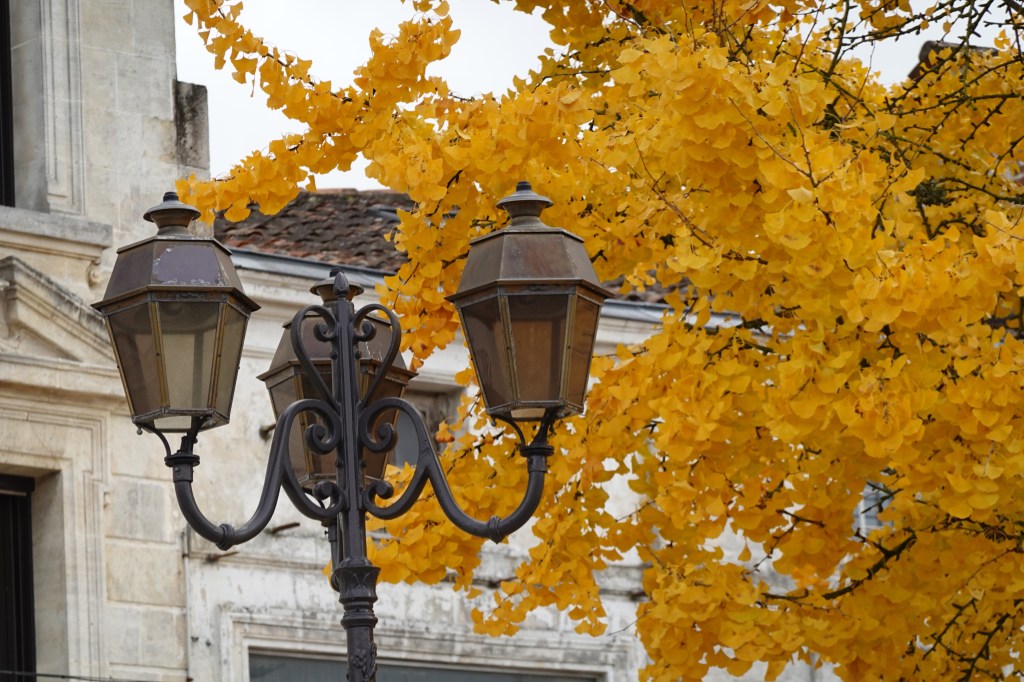
When I went to the cafe on Saturday morning my attention was caught by the colours of the autumn leaves around the Place Francois Premier.
One particular tree attracted me. It was just behind a beautiful old street lamp and I noticed that the colour of the leaves made one of the lamps appear orange, as if dimly lit, but another one, with the pale stone of the hotel behind it remained grey.
I love to notice an interplay like that…..where it takes both the foreground and the background to create the image. It reminds me of the importance of context and the way everything in this world is interconnected.
Once I’d approached the tree and the lamp to get the composition I was after I noticed the stencil on the concrete base of the post. That gave me a different interplay – the juxtaposition of human creativity and natural beauty.
Did the world leaders cop out at COP26? Did they make progress? Too little, too late? A step in the right direction?
I have very mixed feelings this morning as I read about the end of COP26. Frustration, anger, despair, optimism and hope.
Hey, that’s quite a list. And those feelings don’t seem at all compatible, do they?
What do you think? I should pick one and stick with it? Settle into despair, or embrace hope? Hold tight to the anger, or allow my optimism to grow?
Our emotional lives are complex. So is Life. So is this planet. We might like to simplify things and paint everything black and white but that reductionism isn’t real.
So, it seems the world leaders are still not doing enough. It seems they are pretty stuck at the blah blah blah stage, in thrall to, or held hostage by, those who get rich by plundering the Earth, ripping out coal, oil and gas, burning it and polluting the planet, those who destroy rainforests, rivers and oceans.
So that’s real. And it’s the source of my anger, frustration and despair.
But there’s a rising awareness too. There are other voices. Young voices, the voices of indigenous peoples, the voices of those already struggling with devastating climate change. There are different, more just, more caring and kinder visions.
That’s where my optimism and hope come from. More people are beginning to see the consequences of the way our species is living on Earth, and more are speaking up, working on new solutions, choosing different lives.
We need to change because we live in a complex interconnected web of relationships and consequences. What I do today has effects that ripple beyond the limits of my imagination. What you do today matters.
Maybe that’s where I, where we, have to start. Raising awareness and making choices based on care, based on love and based on kindness. And, yes, acting on those values and decisions.
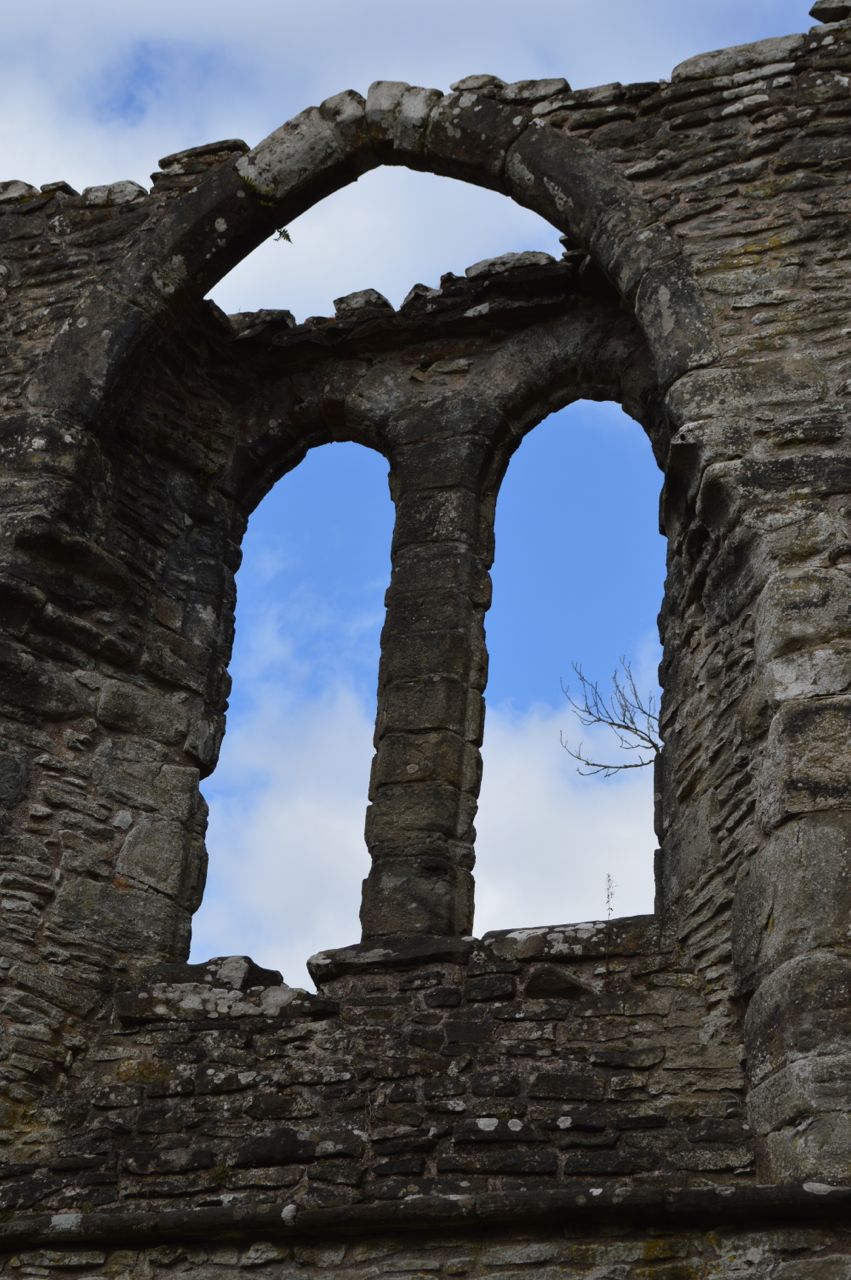
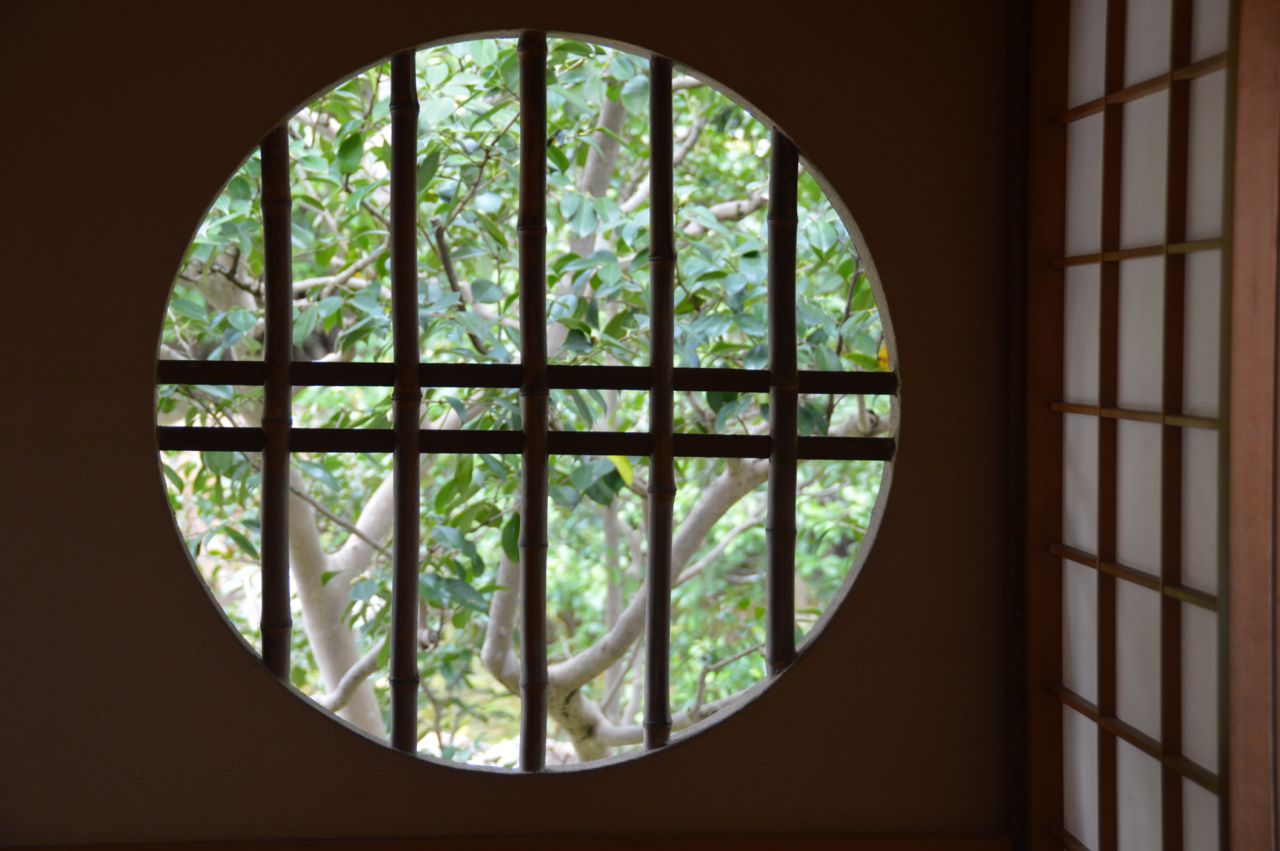
I came across these two photos sitting next to each other in my collection. The one on the left is taken in Scotland, and the one on the right in Japan.
Could they be more different?
Yet they say the same to me, each in their unique cultural context.
The Scottish one is in a ruined church. The Japanese one, in a temple. Both are spiritual windows. Both stir the soul and turn my thoughts towards the invisible.
The old church window is so typical and so familiar to me. It’s massively tall, arched shape is like a giant arrow turning my gaze upwards then pointing me towards the heavens. This is my history, my tradition, the shape of places of worship.
The temple window is utterly strange and different to me. It’s why I loved so much my many visits to Japan. The culture, traditions and shapes are from such a different history and geography to mine that I’d have my attention grabbed a thousand times a day there. My ability to notice what was around me was turned up to max. This window, too, connects me to my soul. It turns my gaze to the garden, to Nature, to Mother Earth, and the circle shape stirs my deep intuitive knowledge that all is One and Whole.
I feel blessed to have had the opportunities to experience windows like these. I feel blessed by their beauty, by their difference and by where they both lead me.
We all use the phrase “simply beautiful”, or “the beauty of simplicity”, and I think it captures the delight we feel when something makes sense. When we understand, when we see clearly, it feels good. And when that happens easily and effortlessly then I think we find the beauty in simplicity.
We don’t say “complexly beautiful” or talk about “the beauty of complexity” but, why not?
When I looked at this Nigella flower and took this photo I was entranced by both the beauty and the complexity of this plant.
Look at it. Look at those spiky stems reaching out in every direction like whiskers or feelers or even roots. Look at the varied intensities of colour in the leaves. Would it really capture the colours and shades to say “it’s purple”? Applying such a simple, single label can stop us from really seeing. Look at the colours and shapes of the pistils in the middle.
Honestly, I find this little flower astonishing. I can’t begin to imagine how it evolved to have each of these characteristics. I find myself in awe of its beauty and I feel the delights of both wonder and admiration.
All living organisms, humans, other animals, plants and so on are “complex adaptive systems”. They aren’t simple but they are beautiful, astonishing and wondrous.
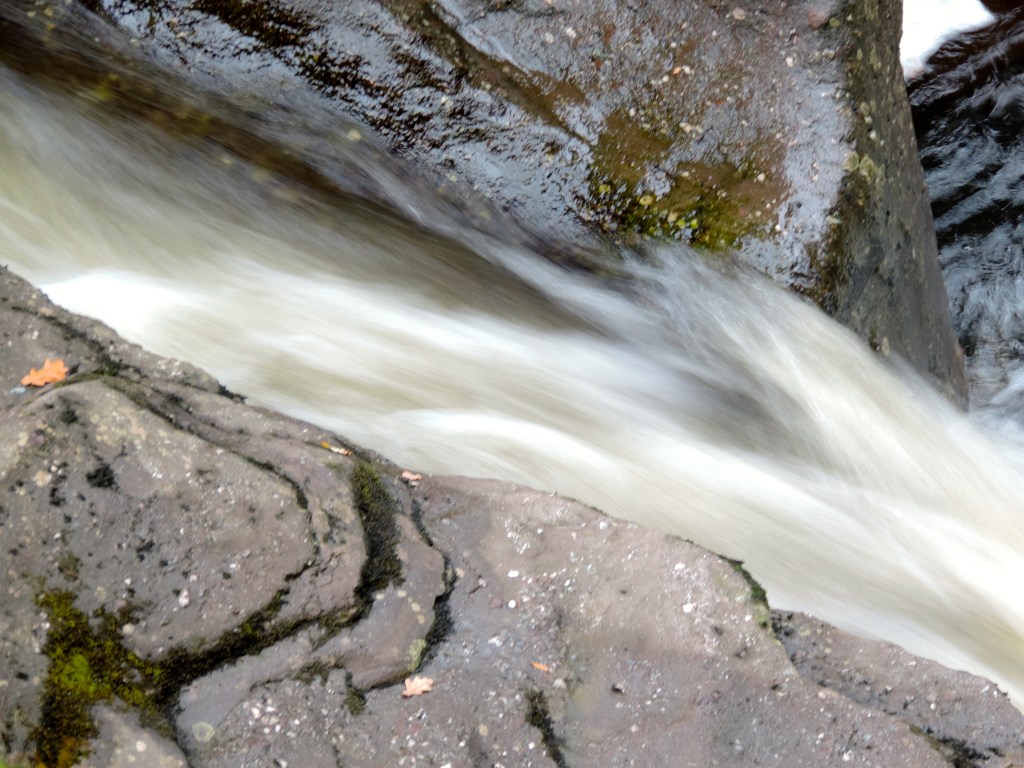
I would love to live like a river flows, carried by the surprise of its own unfolding.
Unfinished poem. John O’Donohue
When someone makes a decision he is really diving into a strong current that will carry him to places he had never dreamed of when he first made the decision.
The Alchemist. Paulo Coelho
Flow – one of the most powerful concepts I know.
Life is flow. A flow of energy and substances. We humans, like all living creatures, are the manifestation of the constant flows of atoms, energies and information.
When we pay attention to the reality of flow, we realise that we are all connected and all constantly changing. It’s harder to put people into separate boxes when you are aware of flow. It’s harder to separate out this present moment from the past and the future once you consider flow.
Machines and mechanisms don’t flow. That’s why they are predictable. Living beings do flow. That’s why they are all unique at every moment you observe them. That’s why they are not predictable.
There’s no place for industrialised, standardised methods in health care because every person is unique, every relationship is unique, every life story is unique and all are constantly flowing, continuously emerging, always in the process of becoming.
That’s why I have “becoming not being” at the top of my blog. To remind us that we are neither fixed nor separate. We are the manifestation of flow.
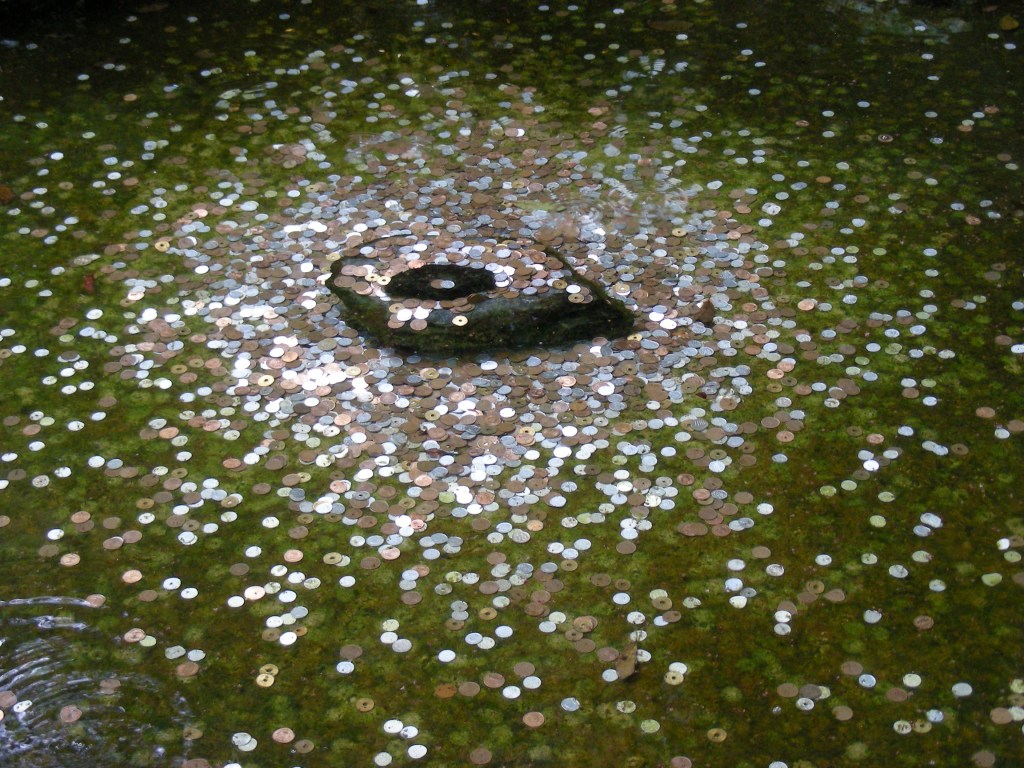
When we think of money we tend to think of coins, like these ones in this fountain. Or notes. But coins and notes are just cash and most people don’t receive their income as cash, nor do they pay most of their bills with cash.
Instead, nowadays, most money is electronic. It’s a number on a spreadsheet or a computer ledger. Isn’t that strange? Now that most money is just information on a computer it’s easier to see that money is simply a human invention – a social agreement. It doesn’t exist. Apart from cash, which is a tiny proportion of the money in bank accounts and funds around the world.
Weird, huh?
I got thinking about this the other day when Mark Carney announced at the COP26 that there was “130 trillion dollars of capital committed to net zero”. Well I mean what on Earth does 130 trillion dollars look like and where is it exactly?
And, more, if there is 130 trillion dollars sitting somewhere then why are children dying of hunger? Why isn’t there decent health care and education for everyone? Why doesn’t everyone have a home?
Well I’m no economist and I’ve read criticism of this 130 trillion dollar claim but that still leaves me thinking about money. And maybe you’re wondering about it too.
I read Stephanie Kelton’s The Deficit Myth last year and started listening to the MMT Podcast (MMT is Modern Monetary Theory). I don’t think about money the same way as I used to do any more!
I’m not going to try and tell you all about MMT or even attempt to discuss economics but when I looked at this photo again today the question posed by the MMT folk popped into my head again…..
Where does money come from?
When I think about this, the first thing I think about is cash. Coins are minted and notes are printed by the government. They don’t come from anywhere else. Anyone else creating money would be guilty of fraud. And as most money is now just numbers on computers, where does that come from? The government too.
Wait, if the government wants to spend money it just has to decide to do it? It just tells the Central Bank to put a certain number into a certain computer? Seems that’s pretty much true – at least for “fiat currencies” – ones created by governments eg US dollars, U.K. Sterling, Japanese Yen etc.
So the government doesn’t need to get money from anyone else? Not borrow it, or rake it in through taxation?
Can that be right? Well, only the government can create money so it seems they just do that every time they decide to spend something….
But there must be a limit? There is. In fact there are several. That’s what Stephanie Kenton’s book is about. There are limits. Inflation is one of them. If there is too much money in the country you get inflation. If that happens the government can take some away through taxation.
Whoa! That’s where I suddenly stopped seeing the world the same way! I thought the government needed to get money through taxes to tackle poverty, inadequate health and social care, poor housing etc. But no, they don’t get money from tax. Tax takes money OUT of the system. Spending puts it in.
Ok, enough for today. But, seriously, check this stuff out. Read The Deficit Myth or listen to a couple of introductory episodes of the MMT podcast, or check out MMT somewhere else.
I swear you won’t answer the question “where does money come from?” the same way ever again.
Now, how about we get on with deciding what problems we want to address? Turns out money is not the problem,
In the winter time I’d walk to the railway station in the dark in the early morning and by the time I finished work I’d be retracing my steps along the same dark road.
Central and West Scotland is cold in winter. It’s often windy and very often wet. I’d wear a heavy waterproof coat with a hood and walk along with the hood half covering my eyes. All I could see was the road a few metres in front of me.
It would be easy to be uncomfortable and a bit miserable on a day like that but I noticed the colours of the lights reflecting on the wet road and so I stopped to take a photo.
I really like it, even now, years later. It’s like a painting and it takes me back to that moment instantly. I remember how common it was to walk like that in the cold wet winter weather and I remember the route I followed to work every day and suddenly once more it looks beautiful and brings me joy.
You know the old saying about there being no such thing as bad weather, just inappropriate clothing? Well, there’s something in that, but there was always another way to keep my spirits up….notice the world at my feet. It’s often more beautiful than you think.
I’ve developed a habit of watching the lunchtime news on French TV. Mainly because it helps me to “get my ear in” as I try to understand all that’s being said. I’ve gone from understanding very little to understanding most of it now but I must admit it’s a rather disappointingly slow rate of progress.
Anyway, this post isn’t about my journey to become fluent in a second language. It’s been triggered by a piece on yesterday’s news about Scotland. A regular part of the weekend news is a short film about a trip somewhere. It might be somewhere in France, or, more often I think, it’s somewhere abroad. Yesterday it was “The Highlands d’Ecosse”.
They set off from Loch Ness, travelled up the east coast to Dunrobin Castle, right up to John O’Groats then along the north coast to Durness, ending the piece a bit further south in Ullapool.
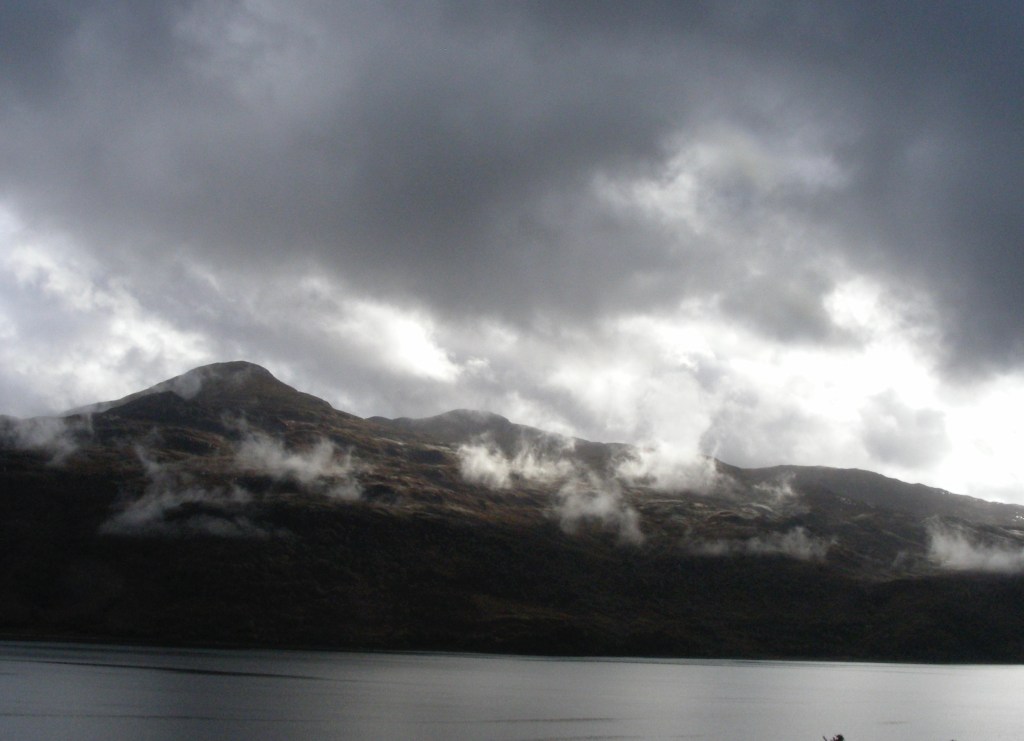
The landscape sent me to my photo collection and I picked this one to share with you today.
French TV presented Scotland as a “land of mists and mystery” and that’s pretty much what all French TV programmes do. I find that if you mention to a French person that you are Scottish they soon talk about the beauty of the mountains, about mystery, castles and ghosts.
I don’t know if this impression is specific to France or if that’s how people in other countries also think of Scotland. But there’s something in that portrayal which resonates with me, a native Scot.
Some of the most beautiful photos I have in my collection are taken amongst lochs and mountains and this one with the brightly lit wispy low clouds/mists running over the side of the hills creates a feeling of mystery I think….maybe even of ghosts or spirits.
Scotland is an ancient land with many stone circles, cairns, burial chambers and standing stones presenting a continuing presence of lives lived tens of thousands of years ago.
I grew up in Stirling, one of several places in Scotland dominated by a castle. One summer night I camped out in our back garden with a friend and we were woken at dawn (about 3am at that time of year) by the sound of footsteps. Someone was walking round outside the tent. We held our breaths and listened carefully. The footsteps stopped and didn’t start again. We unzipped the tent and carefully looked outside. The grass was covered with a heavy dew and there wasn’t a single footprint.
Yep, we were spooked! But also intrigued. So later that day we set off to the Public Library (this is well before the days of the internet!) and began reading about the ghosts of Stirling, one of whom, “The Green Lady” was said to frequent the very area where we lived.
Maybe all teenagers go through a ghosts and spooks phase, but that experience of mine just seemed to fit right in with the sense that we had that we lived in a world of mystery.
I don’t think we either believed or didn’t believe in ghosts actually. I think this was just one of many early experiences which sparked both curiosity and a deep sense of mystery.
Others have written about the disenchantment of life which seems so common now and I’m absolutely sure that the world, that life, that each of us as individuals, could benefit from a bit of re-enchantment.
For me, that happens best in places like the one is this photo. In Nature. In the wild. In beauty, wonder and awe.
It’s not about ghosts after all. It’s about this one small blue planet shared by us all and the sheer gobsmacking wonder of the everyday.
After I enjoyed another sunset and had finished taking some photos I turned around to walk back to the house.
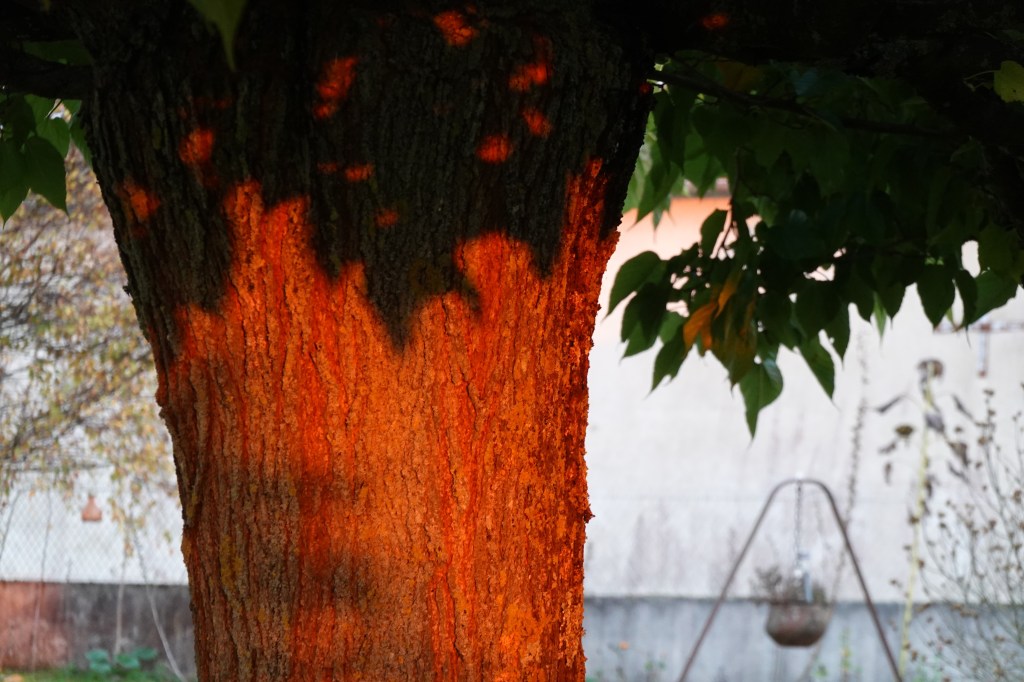
With my back to the setting sun I faced east and right in front of my eyes I saw the mulberry tree bathed in golden light, the shadows of the lowest leaves painted onto the trunk of the tree.
Isn’t this beautiful?
And all because I turned from the main attraction and looked the other way.
The sunset drew me outside into the garden again last night, as it often does. As I framed a couple of shots with my camera I spotted some large seed heads in the far corner. I got closer, changed my position and took this photo.
Oh my, isn’t it beautiful?
I’d be happy to share this with you because I think it will bring you joy and delight.
However, as always, these images set off trains of thought and this morning, as I post this, I find it puts me in touch yet again with the cycles and rhythms of Nature and Life.
Here we have thousands of seeds, each one a potential plant, all waiting for the wind to pick them up and carry them to new lands. A symbol of potential and new beginnings. Those seeds are backlit by the golden light of a setting sun. A symbol of endings, of the close of another day.
Beginnings and endings…..always so deeply intertwined.
I welcome constructive criticism and suggestions. I will not, however, tolerate abuse, rudeness or negativity, whether it is directed at me or other people. It has no place here. ANYONE making nasty comments will be banned.