Feeds:
Posts
Comments

sunset over the vines

moon

The Sun and the Moon.

The red rose and the white……

Bejewelled

bejewelled

I can’t resist it.

These sparkling jewels of dew in the morning, shining in the morning sun…..

This is the month of light, and seeing light making the world sparkle is such a treat.

Seen any sparkles near you recently?

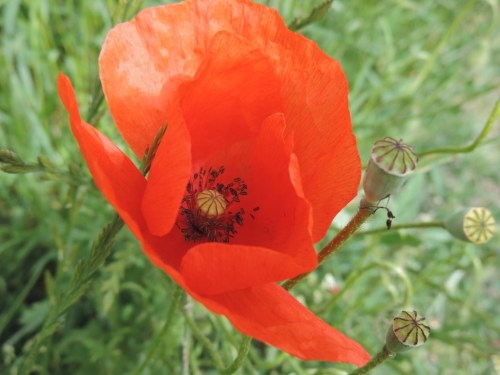
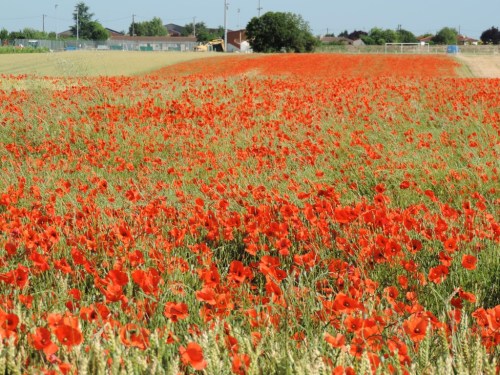
poppies south of cognac

poppy


According to Iain McGilchrist, who has explained the way we use the two different cerebral hemispheres, first of all the signals and sensations which we pick up are passed to the right hemisphere which we use to get an overall, holistic, “analogue” understanding of the world. Then we pass some of the information to the left hemisphere which is terrific at homing in on just some aspects of what we’ve picked up. We use the left hemisphere to “abstract”, analyse and categorise what we have received. If the right hemisphere view is analogue and holistic, then the left is digital and reductionist.

What should happen next is that the left passes back to the right what it has processed so the right can deepen its understanding – now understanding both the overall and the particular.

The overview, the “view from on high”, and the extracted, abstracted, reduced view, seem like opposites, and in many ways they are, but we have this incredible brain which lets us process in both of these opposite ways at one and the same time. We are capable of holding the general and the particular in our minds at the same time.

Iain says we have developed a tendency to think that the view from the left is the “correct” view, and “enough” and is so doing we failing to use our whole brains….we are failing to see the whole picture.

Interesting, huh?

Behind the light

l'amphitheatre

My previous post was about light and I shared a photo I took in a tunnel….well, here’s what that tunnel was leading to!

It’s the Roman amphitheatre in Saintes, France.

This must have been a terrifying place to be in its heyday – in the tunnel I mean. I expect the crowds of spectators (around 15,000 of them at a time) would have been excitedly waiting to see what, or who, was going to emerge from the tunnel into the arena. I suspect not many who walked or ran out of this tunnel towards this light returned alive. A shocking thought.

At the entrance to the amphitheatre there is a plaque which gives a little of the history of the place and it mentions how the Roman elite used “bread and circuses” to keep the populace in their control. Have you ever wondered how the present food and entertainment industries might do the same thing nowadays?

light at the end of the tunnel

Some years ago I realised that the names of the days of the week relate to the same planets in many languages and that got me wondering about the names of the months – which aren’t!

It struck me that relating the name of a day to a planet opened up a whole rich level of symbolism and meaning and I thought it was a shame we couldn’t do the same for months. So, I decided to come up with a keyword/theme/symbol for each month that made sense to me. I’ve been following that since, and in that scheme, June is the month of light. I chose that because, in the northern hemisphere, where I live, its the month with the most light (including the longest day). I know for some of you it’s the month with the least light, so I encourage you to come up with your own themes, which make most sense to you, or that you stick with June being the month of light and see what you can discover about winter light.

It’s hard to actually see light, but the way light plays with us, and with the rest of the world, is beautiful to explore.

I’m aware that, in choosing this particular image, which I only took yesterday, it immediately speaks to me of “light at the end of the tunnel” – so if you’re looking for some light at the end of a tunnel, here’s an image just for you!

Unwinding

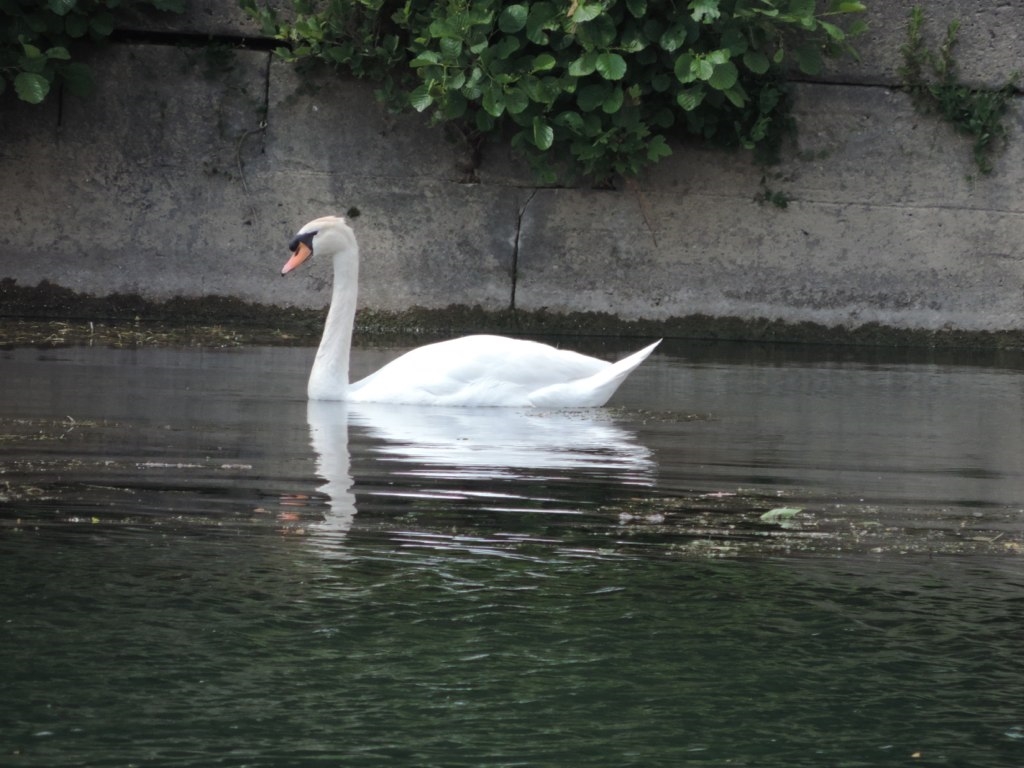
swan

I’ve reached “u” again in my “A to Z of becoming“, and “u” can stand for “unwind“.

Sunday is a good day to practice unwinding. If Sunday isn’t a good day for you then it’s still good to have at least one day a week when you set aside the demands, responsibilities and tasks for a short while and unwind. So, try to find a day in the next week even if it’s not a Sunday.

Once you find your day, how are you going to unwind?

Well, I was inspired by this swan – after all, what better way to unwind than to “swan around” for a bit? (I mean swan around in the wandering about aimlessly way, not in the dramatic or showing off way!)

The French have a great word for this – “flâner” – which means to stroll around, or (a nice English word – to “amble” around).

You see I don’t think unwinding means you need do nothing. It doesn’t mean you need to sit still, or to try to empty your mind, or anything like that. I think rather it involves taking it easy, just living, not having a particular purpose or goal for a wee while. I’m sure we need goals and purpose and everything like that, but we also need to be able to enjoy times which are free of such things.

A person who strolls around is known as a “flâneur” – and I rather like to assume the role of the “flâneur” from time to time.

I think the Italians focus more on the not doing when they unwind – have you come across “dolce fa niente“? (doing sweet nothing)

So, what about your language? What are the good words for enjoying living in an unwinding, relaxing, ambling around kind of a way?

Moi? Je flâne aujourd’hui

turning japanese

I look at this photo, and I wonder what country I was in when I took it.

Well, I don’t have to wonder for long because I only took it a day ago and I remember well that when I did I was only about an hour from where I live (in France) – but, seriously, couldn’t this have been taken in Japan?

What gives an image a strong sense of place or of culture? Is it the colour? Is it the juxtaposition of flowers and something particular a human being has made?

I don’t find it hard to see beauty in Nature, and now that I live surrounded by vineyards I feel more connected to that beauty than ever, but what takes the whole experience to a different level for me, is to see, in the same moment, so much creation – the creation of Nature, and what a person created.

You see, there is a spiral of creativity here.

There’s the creativity of the Universe which has produced this flower and the person who constructed and painted the shed behind it.

Then there’s the creativity of the person themselves, and where their imagination took them, and then their choices, their decisions and their actions to make this shed, pick this paint, paint that wood, choose that flower, plant it, nurture it and train it.

And there’s me.

To stand there and look up and see this, and to focus in on part of what I could see as I compose this image, and to capture it, and now, to post it for you to see.

And there’s you.

What might this image stimulate for you?

What might this post provoke your imagination to create now?

paint

This old wall revealing layers of paint reminded me of something important about memory.

The past isn’t something with disappears behind us, like the last station we just passed on the train. Rather, it’s what the present emerges from.

And because the present emerges from the past, the past is always a part of the present.

I am who I am, and my body is what it is, not brand new, isolated from the rest of the world and reality, but, as a living, developing, growing phenomenon.

I am emerging from not only the past in my life time, but from the life times of all who lived before me.

I think that’s partly why many people are fascinated by genealogy. It’s not just interesting stories about ancestors, its an uncovering of patterns, streams and influences which continue to create the here and the now.

Here’s some more beautiful photos of paint from the old fisherman’s shed on the Ile d’Oleron

green and blue
old greens
multicolour

I hope you enjoy them.

As well as stimulating my thoughts about the past and the present, they also demonstrate (I think) a very beautiful Japanese aesthetic concept – wabi sabi – which I love, not just because of the beauty but how it honours the beauty of reality as opposed to the delusional ideas we have about “perfection” (which doesn’t exist!!)

the geometry of flowers

Isn’t this beautiful?

How could you fail to be seduced by the astonishing geometry of this flower?

We see this everywhere in the world – how patterns seem to display an remarkable mathematical order.

Interestingly, the same day I took this photograph (which I immediately titled “the geometry of flowers”) I read a fascinating article about mathematics teaching, entitled “The limits of a rational mind in an irrational world – the language of mathematics as a potentially destructive discourse in sustainable ecology.” by Steve Arnold of Auckland University of Technology. Here are a couple of paragraphs which caught my eye –

Galileo famously said, “The laws of Nature are written in the language of mathematics.” However we realise that this profound statement was while very true, it is not strictly true. There are times when the mathematical understanding of the world breaks down. Now in a time of ecological distress, we need technologies and tools that can match more perfectly our world. In reality, Mathematics is a highly nuanced poetry that describes the human condition, it mirrors the workings of the human brain (as mathematics is exclusively a product of human thought). Mathematics tells us our own story, it tells us how the human brain works, and as we strive to make meaning of the world, we do so using the tools available to us; number is one of the ways that we language our experience.

Within mathematics there continues to this day an expectation that the simple relationships described in mathematics should be able to neatly describe our complex world. However the real world is not simple, tidy and neat. The real world is full of messiness, unpredictability, human emotion and error. Mathematics describes a predictable world, where error can be eliminated, and it is desirable to simplify and exterminate unwanted complications. Where the two differ, surprisingly it is the human experience in the real world that defers to the all-powerful notions of mathematics.

And, in conclusion, he makes the excellent point that mathematics is just one way to make sense of the world, and it’s a way that we ourselves have made up.

We put so much faith in numbers, that sometimes we place the power of the digit over the judgement of our experience. This idea of positivism has found a secure home in the teaching of mathematics in schools. We are controlled by numbers, from the early stages of test results, to class position and IQ, to more recently BMI scores, glasses prescriptions, salaries and postcodes. We sometimes forget that numbers are a way to tell the human story. We forget we make them up, not the other way round.

So, yes, this is a beautiful geometric flower and how often can we use mathematics to model the beauty of the natural world? But, surely, we need to always remember that the mathematical story of the world is not a perfect explanation. And that we should not allow anyone to reduce Life to numbers.

pink and blue

In the pink….

Into the blue….

Have you ever stopped to wonder about the colours we use in the phrases we think and say?

As I looked up towards evening, the setting sun caught the jet stream and coloured it pink as this plane streaked across the blue sky, and immediately, in my head, I heard “in the pink” and “into the blue”.

What nice phrases, aren’t they? How healthy to be “in the pink” and how free to be flying “into the blue”!

What colours cropped up in your thoughts today?