Feeds:
Posts
Comments

Where did 2013 go?
Where does the past go?
Does it go anywhere?
Is time like this long road?

DSC_0167.JPG

Was 2013 like a car, making its way along time’s highway? And disappearing into the far distance as we look?

That’s one way to look at it, but then look at this tree….

DSC_0062

The very shape of the tree tells a story, contains a history, reveals its past. Doesn’t it?

So what if time isn’t like a straight line, with the future speeding towards us, and the past soon behind us and out of sight?

What if time is cumulative? What if the past doesn’t go away anywhere, but instead continues to exist underneath the present?

Doesn’t the present emerge from an ongoing interaction between what’s possible, what’s happened already, and what else is happening now?

Think of 2013 as still here, underneath today, and out of which 2014 will grow. After all, if 2013 wasn’t still here, then what would 2014 emerge from? Nothingness?

Japanese Garden

January is named after Janus – who looks both forwards and backwards. Janus is often represented over a gateway or doorway, and it strikes me that January is a kind of doorway. We say goodbye to the previous year, looking back, reflecting, remembering, and using that recall to inform our hopes, ideas, and even plans for the coming year.
I don’t think this is something to do just on the 1st, or even in the first few days (by the way, I read a study today which said 26% of men give up diets after ONE DAY!), but that we could take a theme for this month – make this the theme of gateways, of doorways, a moment to pause, reflect and dream – both of those entwined, letting reflections stimulate dreams, and dreams stimulate reflections.
This is different from making resolutions (even sustainable ones!).
Why not get yourself a notebook, or create a new document on your computer or tablet, and allow yourself to record your daily reflections and dreams for the month? See what emerges…..

through the round window

I don’t know if you’ll be making any resolutions in the next few days, but I know a lot of people do.

One of my problems with resolutions is that they are often either so vague that they quickly dissipate, or so reduced (eg to lose x pounds), that once they are achieved, the old patterns and habits and quickly re-emerge (eg regains x pounds!)

What I’ve been thinking about these last few days is “sustainable resolutions”.

I started with thinking that a sustainable resolution is one you keep – and what that really means is creating new habits or patterns of living – but whilst that might be a useful thing to consider, I’ve gone on to thinking about “sustainable resolutions” as ones which contribute to sustainability more broadly.

What I mean is that is seems clear we (the human race) are not on a sustainable path. It’s just not possible to continuously increase the number of people in the world consuming more and more of the finite resources of the planet. It’s just not possible to continuously increase the number of people in the world consuming more and more drugs every year. It’s just not possible to continuously increase the “growth” of the economies of every country in the world every year if “growth” is shorthand for growing consumption or growing material wealth.

Marc Halévy’s writings have made that ever so clear to me over the course of last year. In one of his books, “Prospective 2015 – 2025” he asks us to think about the work we do, or the activities we carry out, and to ask ourselves three questions. I’ve adapted them slightly to produce “sustainable resolutions”

Will this activity/work/habit

  1. be excellent for my personal health – physically, mentally and spiritually?
  2. add to the wellbeing and quality of life of other human beings?
  3. be excellent for Nature, Life and the Earth?

Only if the answer to ALL three of those questions is positive, is the resolution likely to be a “sustainable resolution” – one which contributes to a better quality of daily life for the individual, whilst also contributing to a better daily life now and into the future for Life on Earth.

Fushimi Inari Shrine Torii Gates


Every New Year near Kyoto, there is a tradition to climb the hill to the shrine at Fushimi Inari. It’s a spectacular trip at any time of year, but the main reason people go there at the start of the year is for luck and prosperity.

This is the time of year when you meet people and say “Happy New Year”…….what are you wishing for them? Is it happiness? Luck? Prosperity?

Look at the path in the photo above. See how it winds around the corner……we can’t quite see where it is leading, can we?

That’s where we are, unable to see what lies ahead, but we can certainly choose which direction we want to go, and how we want to walk today……and isn’t that how we find happiness, luck and prosperity?

By choosing the direction we want to go, and by living today the way we really want to live.

Happy New Year. I hope its a year of growing, of flourishing, of becoming more fully you.

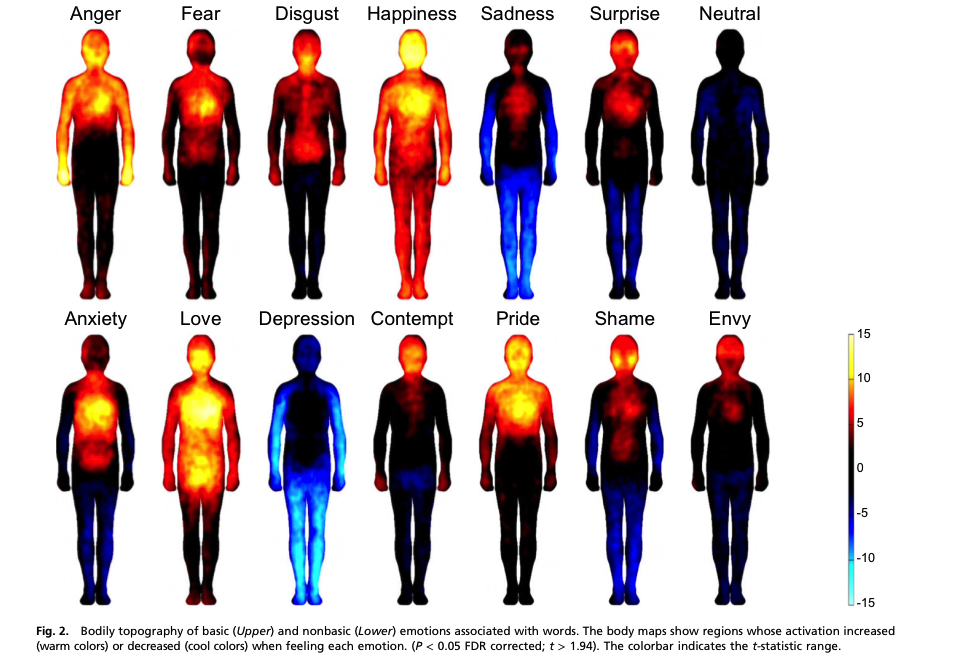
Here’s a fascinating study of 700 people asked to record what happened in different parts of their bodies when they experienced different emotions.

You’ve probably come across the idea of embodied cognition and embodied metaphors (briefly, we now know there are neural networks around the hollow organs of the body, especially the heart and the intestines, revealing that we don’t do all our cognitive work inside our skulls! and that metaphors like “heart broken”, “heart to heart”, “gut feeling” and so on, demonstrate how we experience the whole world through our whole being – body and mind)

This particular study is a self-reported one – it does not show physiological body changes, rather a representation of what people say they experience subjectively. Look at the beautiful summary image they produced –

embodied


How well does this show the shutdown experience of depression, the fist clenching of anger, the whole body experience of happiness, the links between anxiety and fear, or between shame and disgust, or between envy and contempt?

Another thing that strikes me about this is the degree to which the shutting down in depression is focused in the limbs – which makes me wonder about the links we are discovering about the healing power of exercise.

Interesting, huh?

Rays of light

In the fields of holistic and integrative medicine people often talk about taking a body/mind/spirit approach. The body and the mind aspects are pretty uncontentious. But what about “spirit”?

For many people the word spirit conjures up either organised religion, or non-denominational ideas like spirit beings, beliefs about life after death, or reincarnation, and so on. But is there a spirituality which isn’t supernatural?

Think of the idea of the “thin spaces” for example, where you feel connected to something greater than yourself.

In fact, I do think this is a key to the concept of spirituality – connection – connection to something greater than yourself. There’s a great pdf about integrative medicine (download here) across on the humanmedia.org site which includes a page on spirituality. They say it is

a means of connection and/or self-reflection through which one finds comfort, purpose and inner peace.

Not a bad definition, and it highlights both the key ideas of connection and of purpose. We are meaning seeking, meaning creating, beings. We do that through stories, through seeking patterns, by joining things up……and that gives us our myths, our beliefs and a sense of purpose. It’s pretty hard to live a life with no sense of purpose.

The Humankind document goes on to say that spirituality includes the qualities of

compassion, humility, generosity and simplicity

I wonder if thinking about qualities such as these helps us to see spirituality as something essentially integrative – in the sense of it being that which connects and pulls the body and the mind together……

Back to the idea of spirituality including a sense of being connected to that which is greater than yourself – remember this little RSA Animate video of Jeremy Rifkin’s fabulous talk on “empathic civilisation”? No? Click through and watch it now.

What does spirituality mean to you? What part does it play in your life?

what’s next?

James Hollis, in “The Middle Passage”, says

The invitation is to shift gears for the next part of the journey, to move from outer acquisition to inner development

and

…it is this emphasis on inner, rather than outer truth, that distinguishes the second adulthood from the first.

Whilst I think these developmental shifts are a perpetual presence in our lives, there is no doubt that we are more aware of the transition phases at some times than we are at others, and this is where I am now, at the end of 2013, in one of those transitions. So, I’m enjoying shifting gears, and throwing myself more fully into the process of becoming.

Are you ready to accept the invitation to change gears? I wonder what inner truths we’ll discover?


Light on Earth

light on earth


What I love about this photo is the way the light appears – it’s almost as if there must be multiple sources of the light, shining with different intensities on different parts of the landscape.

fractal cloud


Ursula Le Guin, in the introduction to her selected short stories, “Where on Earth”, says

I had been writing realistic stories (bourgeois-USA-1948) because realism was what a serious writer was supposed to write under the rule of modernism, which had decreed that non-realistic fiction, if not mere kiddilit, was trash. I was a very serious young writer. I never had anything against realistic novels, and loved many of them. I am not theory-minded, and did not yet try to question or argue with this arbitrary impoverishment of literature. But I was soon aware that the ground it offered my particular talent was small and stony. I had to find my own way elsewhere. Orsinia was the way, lying between actuality, which was supposed to be the sole subject of fiction, and the limitless realms of the imagination.

How liberating! How inspiring! Of course, all fiction is a work of the imagination, whether you call it “realism” or not, and, actually, isn’t Life, which can only be lived from the perspective of the subject, also a work of imagination? Or at least, it’s a work of finding that path between “actuality” (the objective Real), and the “limitless realms of the imagination” (how we subjectively interpret and experience that Real)?

I also love her phrase “arbitrary impoverishment of literature”. Why indeed should we limit ourselves to “realism”, especially if that same realism ignores, or worse, denies, the inclusion of the imagination?

Finally, I like that phrase “the ground if offered my particular talent was small and stony”. Isn’t it true that for each of us, our particular talents flourish in quite different environments, or on quite different paths?

thin to the divine

Atlantic

Kenneth Steven, in his poem of imagined fragments, “A Song Among The Stones”, describes what the journey might have been like for the Celtic Christian monks who are believed to have travelled from Iona to Iceland.
On the first page, these two lines grabbed me

yet this is the place they came to find
an island thin to the divine

That’s a wonderful phrase, “thin to the divine”. I can think of many places where it feels as if the land is thin to the divine, those special places which move and stir your spirit. Off the West coast of Scotland is definitely one of those places for me.

Where are yours?